Search

Sep 30, 2011

Offshore Windpower: A Royal approach to conserving seabirds & migrant birds

The Biodiversity Research Institute is bringing Rowena Langston of the Royal Society of the Protection  of Birds (RSPB) to discuss  the European approach to conserving birds when designing offshore windfarms. Langston was principal author of a February 2010 report " Offshore wind farms and birds. Round 3 zones, extensions to Round 1 & Round 2 sites & Scottish Territorial Waters."  Here are the recommendations of that study, (also known as RSPB Research Report No. 39) (pdf)

"Recommendations. Offshore wind farms and birds

1. Collation of existing information on distribution and abundance of birds in UK continental shelf
waters in a GIS compatible form; ideally bringing together data from aerial and boat-based surveys
and providing a unified assessment by species of priority areas in breeding, wintering and passage
periods, as well as identifying gaps in survey coverage. This would facilitate assessment of risk, but
needs rapid delivery to do so.

2. Comprehensive baseline data collection, using a combination of aerial and ship-based surveys, as
appropriate, using recommended methods (Camphuysen et al. 2004; Maclean et al. 2009, Thaxter &
Burton 2009). Minimum of 2 years pre-construction data collection.

3. Co-ordinated survey programme to plug gaps in coverage and provide updated contextual
information for UKCS waters. To include sample re-surveys of areas covered by ESAS, to determine
whether broad patterns of distribution and abundance remain relatively unchanged or whether
there have been changes that cast doubt on the value of using just historical ESAS data for
identifying marine SPAs or areas of potential greater sensitivity for wind farm development.
4. Further research into foraging ranges and areas used by priority species relevant to each
development area, making use of developing technology such as data loggers and habitat suitability
modelling (also relevant to identification of marine SPAs).

5. Review sensitivity indices for birds in the UK continental shelf waters – either a workshop or email
exchange, with a convener, involving several experienced ornithologists.

6. Collate and, where necessary seek to improve, information on population size, survival and
productivity, age structure and frequency of non-breeding to facilitate population modelling for
priority species.

7. Encourage and facilitate further research into migration and other flight movements at sea, notably
to elucidate routes and variation in these by bird species of conservation priority. Further
deployment of satellite tracking with enhanced frequency of positional information shows most
promise, but currently is technically restricted to larger seabirds and waterbirds. This is an
extension of 3.

8. Deployment of radar offshore, on fixed platforms post-construction, to improve our understanding
of avoidance responses by e.g. migratory waterbirds or seabirds commuting to foraging areas
(Desholm et al. 2005, 2006). Resolve how best to obtain complementary visual observations or use of
thermal imaging cameras. OceanPod (Natural Power), and other similar prototype offshore research
platforms, may be a useful development to facilitate offshore research.
Offshore wind farms and birds

9. Deployment of land-based radar and complementary visual observations at several key locations,
pre-construction, to observe departure and arrival bearings and flight elevation of migratory birds.
Offshore deployment of radar to augment baseline data collection also potentially valuable for
specific cases (Walls et al. 2009).

10. Encourage and facilitate the development of study techniques and, where applicable, mitigation
measure
s for application in the marine environment and at offshore wind farms."

End of recommendations

Sep 29, 2011

Mack Pt gasser wannabees suddenly cancel stakeholder meeting

At the request apparently of the Conoco corporados*, the Coast Guard has cancelled  tomorrow's big  stakeholder meeting about plan to create New England's biggest gas tank on the last big natural piece of  wild Mack Point!   
In a late afternoon email today, a spokesman for the Coasties  "...apologizes for this last minute notice advising of the postponement of the stakeholder meeting slated for September 30, 2011 at the Penobscot Marine Museum due to unforeseen logistical and operational circumstances." 
 Delay is GOOD! Gassers' target the forest in this image: green forest triangle and over to the bay.  It would be totally industrialized, terrorizing the clams and driving away the moose that like to hang out there.
*DCP midstream is a subsidiary of Conoco-Phillips Energy Company

Sep 22, 2011

Stop the Stank! Don't let the upper estuary take on a permanent sulfur stench

Maine DEP will decide by  Friday  whether to approve the Conoco Oil  Super Tank project for liquified Petroleum Gas - biggest tank in New England.

Not only would this petrol "Supertank" (already being called "the Stank") bequeath a permanent sulfur stench to the upper bay airshed, it will cost Penobscot Bay lobstermen millions in lost revenues from their need to honor the rolling closed areas stretching around each supertanker as it convoys up and down Penobscot Bay with its gunboats.


Yet Maine DEP proposes to blithely rubberstamp the plan  despite the fact that the agency's  review of alternatives was non-existent, the review of economic impacts to lobstermen was non-existent, the economic impacts to the resort businesses of the area was non existent.

Now we will see if Governor LePage will stand by his statement that he will review every Maine DEP permit and  decision that affects jobs.

For the DCP plant which more intelligently should be in Portland, will savage the lobsteremn witll impoverish the resort owners. DCP will fill the air of hte upper Penobscot Bay with the stink of sulfur and claim that it is the smell of money.  But it is blood money. A weregild, for slaying local prosperity on a cross of gas.

Sep 14, 2011

DCP-Midstream plan to foul upper Penobscot Bay skyline runs into opposition

Mack Point Tank Farm, viewed from Searport Shores Campground, Searsport
Two Tanks, or 
No Thanks!

DCP Midstream Partners needs to respect the irreplaceable economic scenic asset that the unbroken skyline of the upper Penobscot Bay region constitutes, and not install New England's tallest gas tank in the heart of the upper Penobscot Bay scenic zone.

In the upper photo, the existing petroleum tank farms of Sprague and Irving Oil merge harmoniously into the landscape, below the skyline  from most locations.

In the lower mockup, the DCP Liquified Petroleum Gas Tank as proposed is far out of scale. It intrudes into the scenic visual space as far as away as Camden Hills State Park and Acadia National Park.

Put bluntly: the existing proposal outright violates the scenic resource protection standards of Maine law and regulations. These,  the Natural Resources Protection Act and the Site Location of Development Act, keep the immensely sellable scenic natural character of the Maine coast intact against the depredations of

When enforced well, these laws keep the bar very high for proposals like DCP's that would irretrievably  and permanently degrade a scenic area important for the employment of thousands of Mainers in coastal tourism dependent businesses living in dozens of communities.

Yet MDEP's draft order would approve the plan anyway, without truly evaluating the scenic assets at stake. But that's okay. It's only a draft. 
 DCP can meet the standards set forth in these laws, and their federal correlates, while still turning a hefty profit. It is a non-essential opportunistic addition to the energy infrastructure. Revising DCP's plan to fit in harmoniously with the existing neighborhoods is good business. 

DCP Midstream needs to either (1) build a smaller tank, (2) build two tanks of lower height, or (3) go away. In any of those options their process will, like Mack Point's existing oil tanks, remain below the scenic horizon for virtually all locations.  Or it spends spend lots of money responding to appeals and lawsuits by outraged Bay area scenic dependent businesses and other public interests

Maine DEP is onboard with the oilies. Here's MDEP's draft order.  But that's okay. It's only a draft.  We've got truth and beauty on our side.  Click image below to get the DEP coding and general facts

Sears Island. Sierra Club's sellout bears its poisonous harvest.

The US Army Corps of Engineers  has just announced that it has given final approval to Maine Dept of Transportation's Sears Island Umbrella Mitigation Bank (1page pdf, with links to all related info )

The Sears Island Umbrella Mitigation bank is housed at Maine Dept of Transportation- Environmental Office State House Station 16 Augusta, ME 04333-0016.   Contacts below the image. Click image for  bigger size
Sears Island Mitigation Bank Contacts
Judy Gates  judy.gates@maine.gov Phone: (207)624-3100 Fax: (207)624-3101
& Deane C van Dusen  deane.vandusen@maine.gov Cell Phone: (207)592-3198


Now let's carefully watch the Maine Legislature, which has a bill before it to create a 200 million dollar bond to build a container port on Sears Island.  A bill they might act on at any time!


Sep 12, 2011

Island Institute: Blurring the Facts.

In his essay "The Blur of Summer", Island Institute chief  Phil Conkling muses on the passing of that season, and bashes a bit at critics of ocean wind farms, who'd managed to disrupt the harmony of the  Institute's recent gathering of ocean wind enthusiasts with a small protest outside on Main Street featuring a drum and coffin labeled RIP Maine Lobster.

In "The Blur" Phil steams restlessly up and down the Maine coast, marking locations where his institute - standing on the not inconsiderable shoulders of credit card magnate Charles Cawley - distributed bits of Cawley's fortune to the handful of year round occupied islands, most in the form of large libraries and schools, in the mode of "build it, they will come".

He also marked other philanthropic ventures, then sounded a note of injured pride as he comes to Vinalhaven, where a trio of hastily raised windfarms - quite unlawful from US F&WS' point of view - has raised the ire of many of the island citizenry for again erecting  monumental architecture in a low key natural environment.

From this annoying blemish of seeming ingratitude, Phil finally turns to what has really been eating him all month: Our little display in front of Island Institute headquarters on Main Street during their ocean windpower gathering where two enviros and three fishermen used fliers, posters, a coffin, and a muffled drum to get out the word that improperly sited ocean wind farms could wreak havoc of lobster larvae transport.

We enviros and fishermen ended our event then joined the windmill enthusiasts in the the Strand Theater where after a pair of short films, the institute had organized a panel discussion. We each asked a polite question during the Q & A, as did the few other fishermen at the event. None of them were supportive of ocean windpower without severest of safeguards

In his essay "The Blur of Summer", however, Philip uses artistic license to somehow transpose us to being outside the panel discussion beating a drum, while we were  inside recording it and asking questions.

"But it turned out," Conkling wrote, "there were more lobstermen inside the Strand Theater participating in the panel discussion that followed the films than outside beating the dream."

True because  nobody was beating the drum at that point - we'd all joined the panel discussion so we could quiz the panelists.

What was truly telling though was Conkling's fascinating Freudian slip, where he accuses us, not of beating the drum, but rather of "beating the dream".  For Philip's Dream - a Downeast variant of  Polynesia's Cargo Cult, would mechanize and industrialize Maine's coast into what Phil imagines as the good old days of President  Arthur, when Rosco Conkling's New York political machine helped spawn a new steel navy.

Philip's Navy is more patrician, however, and discharges money instead of  artillery shells.


Sep 1, 2011

9/1/11 Fishermen's Voice publishes two articles questioning ocean windmills impacts

On September 1, 2011  Fishermen's Voice a newspaper that covers Maine and  Gulf of Maine fishing news and issues,  published two articles questioning ocean windmills' effect on Gulf of Maine fisheries, especially lobsters and lobstering: 
 
* Offshore Lobstermen Concerned About Lack of Research on Impacts of Wind Plan  
and
"Can Wind Turbines and Lobstering Mix?"


Aug 19, 2011

Maine offshore windpower - Salazar says: No windmills in areas with "fishing sensitivities"

ORONO.  Maine. US Interior Secretary Ken Salazar has announced  that his department will not allow ocean windfarms to be leased in areas of  the Gulf of Maine with "fishing sensitivities". The secretary spoke at the University of Maine's offshore windpower laboratory at its Orono campus August 18, 2011

The August 18th announcement came in response to continuing protests taking place at recent ocean windpower boosting events in Maine (see coverage  Here & Here and Here) and in response to concerns raised by the Atlantic Offshore Lobstermen's Association - an offshore fishery organization - that offshore windfarms will bar their industry nfrom vast areas of the Gulf and drive them to fishing grounds shoreward  where conflict with inshore fishers is inevitable. See AOLA's summary it its concerns, below. 

The goal of the protestors is to apply pressure on the Interior Department officials to move its minimum distances  for Gulf of Maine windfarms from the present plan -as near as ten miles from shore -  to accepting the University of Maine DeepCwind consortium's recommendations that they be site at least 20 miles offshore and preferably 40 to 70 miles offshore farther. Reasons - away from currents important for migration of lobster larvae,  and beyond the coastal seamounts  used by offshore lobstermen, groundfishermen and others.

Speaking at the University of Maine on August 18, 2011  Interior Secretary Salazar responded to  questioning by WCSH-TV reporter Mike Desumma and others by stating "If there are commercial fishery sensitivities...then we say 'Those are not the areas where we are going to build',"
- Salazar quoted in  WCSH TV's coverage: "Supporters, critics of offshore wind on hand for Ken Salazar's visit"  Click here forWCSH story.

The Atlantic Offshore Lobstermen's Association's leader Bonnie Spinnazola said  in an email to offshore windpower critics last week that vessel insurers had notified her organization that they will not insure boats fishing within Gulf of Maine windfarm areas which can cover huge areas. The AOLA said that fishermen who are thus displaced by offshore windfarms will be forced to fish inshore, reigniting old gear conflicts and renewing formerly resolved struggles over fishing territory.

"Downsizing of the fleets is a real possibility;" Spinnazola predicted. "As a result, fishermen leaving the fishery have no where to turn to sell their vessels or gear, thus their "retirement" is literally being scrapped before their eyes. This is a very grim outlook, yet this is the reality many will likely face."

Conservation group Penobscot Bay Watch has been sounding the alarm for more than two years that  according to ocean wind power researchers in Norway, the giant wind energy-extracting ocean turbines being considered for the Gulf of Maine can, by interrupting the Ekman Transport process whereby nature "forces"wind energy into the sea,  create beneath each ocean windfarm a vast slow upwelling eddy that pulls seafloor water to the surface from beneath it.  See simulation  These miles-wide columns of cold seawater can act as barriers that slow, or even divert existing water currents transiting through the area occupied by the windfarm.  When those currents are carrying lobster larvae from the Bay of Fundy to Midcoast Maine, slowdown or diversion could bring  dramatic declines in local lobster stocks, as larvae bound for the Maine coast find themselves shunted past and sent to Massachusetts Bay or to uncertain fates offshore.


Instead the DeepCwind consortium leader Habib Dagher has repeatedly called for distant water offshore  locations on the edges of  Jordan Basin or Wilkinson Basin, where the seawinds blow strongest and most predictably.

Bonnie Spinnazola, president  of AOLA supplied a friend the following "synopsis of our concerns" on August 9, 2011:


Atlantic Offshore Lobstermen's Association
"A brief synopsis of our concerns:

"The lobster industry is not against wind farms; our concerns stem from
issues related to exclusive area rights that will be granted.  There are
no wind farms, that I am aware of, that has been open to fishing.

"Further, should a company offer access, marine insurance companies have
already weighed-in saying they would not insure vessels fishing among the
turbines. Furthermore, considering the web of underwater lines fishing will,
undoubtedly, be nearly impossible.

"Therefore, when access to huge areas in the ocean in which the fishing industry
has historically fished, is limited or denied, naturally, this allows them less space
 in which to fish. 

"It is important to realize, the former statement is far more consequential than
it may seem.  Less space in the ocean crowds together gear sectors which have
for years, worked diligently to avoid one another; especially the mobile andfixed gear fleets.

Sometimes avoidance strategies have been successful, sometimes not; when
the latter occurs, it takes many fishing hours lost to untangle the gear (if they are lucky),
in many cases, it means many thousands of dollars in both time and gear lost.

"Hence, the loss of space in the ocean is a significant matter; downsizing
of the fleets is a real possibility; as a result, fishermen leaving the
fishery have no where to turn to sell their vessels or gear, thus their
"retirement" is literally being scrapped before their eyes.

"This is a very grim outlook, yet this is the reality many will likely face."


-Bonnie Spinnazola

End of synopsis


Aug 13, 2011

Offshore wind meeting 08/11/11 Rockland Maine. Listen to speakers & questioners

On August 11, 2011, the Island Institute hosted a panel discussion of ocean windpower extraction plans for the Gulf of Maine, at the Strand Theater in Rockland, Maine. Moderator: Heather Deese. Panelists: Philip Conkling Island Institute, Bob Steneck UMaine marine ecologist, Habib Dagher UMaine composites engineer, head DeepCwind Consortium. The recording begins with  Philip Conkling's opening remarks, which were underway as the recording begins

* Philip Conkling (in progress) 4min

* Robert Steneck UMaine benthic ecologist 4 min 
* Dave Cousens, ME Lobstermen Association 4min
* Habib Dagher University of Maine composites and DeepCwind 5min 15sec
* Ted Koffman, Maine Audubon 5min 10 sec

QA 1.  Ron Huber & Habib Dagher 10 miles? or 20 miles offshore? 2 min
QA2.  John Stevens Boothbay Harbor What about mobile offshore windmills floating with currents? 3min
QA3.  Habib Dagher Responds to Stevens on positioning of turbine 1min
QA4.  Bob Steneck replies to Stevens cable question 48 sec
QA5.  Habib Dagher  re size of windfarms 2min
QA6. George Orton (sp?) Newcastle, to Dagher on landfall locations for offshore cables 2min
QA 7. Unidentified questioner to Philip Conkling: how to control the dialog, the framing? 3min
QA 8. Heather Deese  replies to unid'd questioner 1min 40 sec
QA9  Unknown questioner to Dagher on economics 2min 20 sec
QA9 Vivian Newman to Heather Deese: Where are the federal agencies? 2min\
QA 10. Rockland questioner to Dagher question on opportunities for students 3min
QA 11.  Jake Ward answers Rocklander's question on opportunities for students 2min
QA 12. Unk Q-er re  subsonic impact of 200 ocean windmills_Steneck, Koffman, Dagher respond. 3min
QA 13 Heather Deese Closing Remarks 75 seconds

(Peter Taber photograph)

Jul 18, 2011

Saving the Gulf of Maine by simply Standing


In Huber v. BPL, I challenged the state decision to let the University site its offshore wind test center off Monhegan's Lobster Cove. Against the strenuous opposition of the State and University of Maine, Judge Jeffrey Hjelm ruled that   Ron Huber indeed posessed the lawful standing and right as party to bring his case against the DeepCwind siting decision.

From:  Knox Superior Court
CIVIL ACTION Docket No. AP-10-2   ORDER ON APPEAL.       Link to the complete decision
Decision filed June 27, 2011


Ronald C. Huber,
Plaintiff.
v.
Maine Department of Conservation
Bureau of Parks and Lands,
Defendant

Pursuant to 5 M.R.S. §§ 11001—11008 and M.R.Civ.P. 80C, plaintiff Ronald C. Huber appeals from a decision issued by the Bureau of Parks and Lands, Department of Conservation  (Department), acting under the authority of 12 M.R.S. § 1868 (2010), identifying a site approximately two miles south and seaward of Monhegan Island as one of three offshore wind energy test areas and as the Maine Offshore Wind Energy Research Center. Huber’s appeal is opposed by the Department and by The University of Maine System, which appears here as an intervenor based upon its role as the lead member of DeepCwind Consortium. The Consortium, a public-private partnership that has already secured federal funding for the project, intends to apply for a permit in order to develop the Monhegan site.
 
For the reasons that follow, the court concludes that Huber has standing to appeal the Department’s decision, because the statutory characterization of the agency action must be seen to allow him to pursue a challenge even at this early stage of the prospective development. The court concludes, however, that the Department’s decision is supported by the evidence and is not otherwise unlawful.

------snip------

Standing and Party Status
The court will address Huber’s standing first because the existence of standing is a threshold issue and a predicate to the consideration of the merits of his appeal.
A. Standing
As applied to state court proceedings in Maine, the notion of standing is prudential and rests on the expectation that the parties who are "best suited to raise a particular claim" are those who should be entitled to promote or oppose that claim in court. R00p v. BeUast, 2007 ME 32, jl 7, 915 A.2d 966, 968 (citation and internal punctuation omitted). Therefore, "Maine courts are only open to those who meet this basic requirement." Lindemann v. C0mm’n on Governmental Ethics and Election Practices, 2008 ME 187, jl 8, 961 A.2d 538, 541 (citation and internal punctuation omitted).

7 The petitioner objects to the assignment of a "‘Low Quality’ viewshed rating" for the Monhegan site. The court construes this as a reference to the Department’s assessment of a "low" level of concern about the effect of the test area on the Monhegan viewshed. R. 80.

Page 8

As a general matter, the determination of standing is not subject to a specific formula. Roop, 2007 ME 32, p7, 915 A.2d at 968. However, in appeals from agency action, the right to seek review is governed by statute. Lindemann, 2008 ME 187, p 9, 961 A.2d at 542. The Legislature has characterized an administrative identification of an "offshore wind energy test area" as "final agency action." See 12 M.R.S. § 1686(4). The course of Huber’s appeal is therefore governed by the provisions of 5 M.R.S. § 11001 et seq. which provides the exclusive method for judicial review of "final agency action." Lingley v. Maine Workman's Compensation Bd 2003, A.2d 327, 330. Huber’s standing to obtain judicial review of the Department’s decision therefore depends on whether he has standing under these procedural statutes.

As described in his brief on appeal, Huber’s involvement with the Penobscot Bay area, including Monhegan Island, is long—standing. He notes that he has workedsince 1993 to protect the environment and the wild inhabitants of Penobscot Bay, motivated by a sense of spiritual obligation. He refers to his involvement in litigation from 1994 through 1996 as head of a non-governmental organization and related to construction on coastal Ducktrap Mountain in Northport. He asserts that in the mid-1990’s, he participated in the DEP’s oil tanker and oil port rules task force, which was involved in the development of rules to protect marine life from oil spills. Huber states that he was involved in additional DEP proceedings in 1998 and 2006 because of a proposed development’s potential harm to aquatic environment, ecology and scenic resources. In 2005 and 2006, he headed a citizens’ group that worked with the DEP on matters relating to the environmental effects of cement dust piles.

In addition to his history of environmental advocacy, Huber writes that he has a specific connection to Monhegan Island, which he visits and enjoys while pursuing his faith—based stewardship of the entire Penobscot Bay region. While on Monhegan Island, Huber uses the pedestrian trail to get to Lobster Cove, where he appreciates the "complex and unspoiled vista" of the gulf of Maine. He is one of many ornithologists who travel from all over the world to observe the birds and other wildlife on Monhegan Island. See also R. 65.

Pursuant to section 11001(1), "any person who is aggrieved by final agency action shall be entitled to judicial review thereof in the Superior Court in the manner provided by this subchapter? The record must therefore establish that Huber has been "aggrieved" in a way that is sufficient to give him standing to pursue this appeal. Further, Huber also must show that he was a party during the underlying administrative proceeding. See, e. g., Friends 0f Lincoln Lakes

Page 9

v. Town of Lincoln, 2010 ME 78,1111, 2 A.3d 284, 288; Lindemann, 2008 ME 187,j] 17 n. 9, 961 A.2d at 543-44; Hammond Lumber C0. v. Fin. Auth. ofMe., 521 A.2d 283, 286 n.5 (Me. 1987). Here, the court first considers whether the record shows that Huber has party status from the agency level, and it next addresses the sufficiency of his alleged injury as an element of standing.

(1) Party status
The Law Court has "interpreted the term party broadly so as to mean any participant in the proceedings who is aggrieved by the action or inaction of the zoning board of appeals." Norris Family Assocs., LLC v. Town ofPhippsburg, 2005 ME 102, il 16, 879 A.2d 1007, 1012 (emphasis in original; citation and internal punctuation omitted).8 See also In re Lappie, 377 A.2d 441, 443 (Me. 1977) (". . .the legislative rationale is that one who is adversely affected by the entry of an administrative order, whether a formal party to the administrative proceeding or A not, is more likely to be aware of the details of the administrative proceeding than are members of the public generally. Such persons are more likely to seek judicial review to assure that the administrative body acts consistently with the standards prescribed by the statute."). The Court has recognized that administrative proceedings are conducted less formally than judicial proceedings, and so “an appellant need not have formally appeared as a party as long as it participated throughout the process." Lincoln Lakes, 2010 ME 78, {1 12, 2 A.3d at 288. Thus, to qualify as a party, the person’s participation in the administrative process may be "formal or informa1." Norris Family Assocs., 2005 ME 102, 11 16, 879 A.2d at 1013 (citation and internal punctuation omitted).

Here, the Department suggests that Huber attended one of its public meetings.9 (Br. of Resp. at 13.) This is a sufficient acknowledgement to support this element of Huber’s standing claim.

8 Cases such as Norris Family Associates that address appeals from municipal boards include discussions of the concept of “party status." That principle has the same purpose as it carries in the context of appeals pursued under the Administrative Procedure Act, and so the court considers the former cases in analyzing this part of the standing issue in this action.

9 The University argues that the record does not reveal any participation by Huber in the  administrative proceeding. Because the Department takes a contrary position, the court decides the issue favorably to Huber.

Page 10

Beyond this suggestion that Huber was a participant in the agency’s process, the record also reveals that concerns generally echoing those that Huber advances here were raised at the Rockport public meeting held in September 2009. R. 132-37.10   Several written comments, which are not attributed to named persons, mirror Huber’s arguments about the effect of the test area on Monhegan’s unique scenic assets. R. 272-73. One letter in particular focuses on the visual impact of wind energy development on the southern end of Monhegan Island, which is the location of Lobster Cove — a prime focus of Huber’s claims here. R. 288.

This demonstrates that Huber apparently attended a public meeting and that during the course of the administrative process, the concerns he raises here were brought to the agency’s attention. The court finds that this combination of circumstances is a sufficient basis on which toview Huber as a party participant.

(2) Particularized injury
To complete a demonstration that he has standing, Huber must also show that the agency’s action has caused him particularized injury —- "that is, if the agency action operated prejudicially and directly upon the party’s property, pecuniary or personal r ghts." Nelson v.Bayroot, LLC, 2008 ME 91,j]10, 953 A.2d 378, 382. See also 5 M.R.S. § 8002(4) ("‘Final agency action’ means a decision by an agency which affects the legal rights, duties or privileges of specific persons, which is dispositive of all issues, legal and factual, and for which no further recourse, appeal or review is provided within the agency ."‘). This requires consideration of whether Huber has suffered a legally recognized injury and whether any such injury is a particularized one.

First, Huber contends that he has sustained damage because of the prospects of development to a site that holds particular aesthetic and religious meaning to him.“ The University argues that Huber has not been injured by the mere designation of a location as an  offshore wind energy test area and as the Maine Offshore Wind Energy Research Center. No  actual development has occurred yet in the designated offshore wind energy test area and 10. The record does not reveal who was present at that hearing, R. 130, or at the October 2009 meeting held on Monhegan Island itself, R. 162-64. Huber was not among those who received public notice by mail of the Monhegan Island meeting. R. 266-71.

11. Huber also claims that his injury encompasses changes to ocean currents and resulting damage to an animal population over which he claims to exercise a faith—based stewardship. The record, however, does not demonstrate a factual basis for this type of alleged injury.

Page 11

research center, and none will occur absent a permit issued under 38 M.R.S. § 480-HH. Until the Department issues a permit, the locations at issue will not change, and Huber’s interests in those  locations are unaffected in fact.

But for the provisions of section 1868(4), the University’s analysis might well carry the day. An injury sufficient to confer standing on a claimant must be more than abstract. Nelson, 2008 ME 91, 11 10, 953 A.2d at 382. And the harm claimed by Huber is presently little more than that. However, in section l868(4), the Legislature has deemed that “[t]he identification of an offshore wind energy test area or areas under subsection 1 or subsection 3 constitutes final agency action." This statute has significance in two ways. First, because the Legislature has established that the type of administrative determination at issue here is "final agency action," it has also established that this type of action "affects the legal rights, duties or privileges of specific persons. . ." because that is the very definition of "final agency action." This syllogism therefore demonstrates that despite the absence of any actual physical development - and even though the state has not even issued a permit that would authorize such development, the Legislature has deemed that the very designation of an offshore wind energy test area results in an injury sufficient to meet the standard that is part of the criterion of "final agency action."12

The second consequence of section 1868(4) is that because the type of action taken thus far by Department is deemed to be “final agency action ," if Huber or others similarly situated to him were precluded from seeking judicial review, he (and they) would be permanently barred from doing so. Huber is now deemed to have been injured by the mere identification of a location as a test area, because the Legislature has declared that such an identification is "final agency action," meaning that by definition it has affected ‘his rights. lf, as the University argues, Huber has no appellate recourse based on that agency action, he would be left without a remedy notwithstanding that legally acknowledged injury

----------------------------------------------------------
12.  One of the University’s arguments challenging Huber’s standing is that he has not demonstrated that his religious interests would be affected by the Department’s actions. The court need not and does not reach this issue for two reasons. First, as is discussed in the text, the statutory characterization of the Department’s action as "fina1 agency action" supports the notion that that action causes harm to a claimant. Second, harm to aesthetic interests, if particularized, is a sufficient foundation to establish standing. Fitzgerald, 385 A.2d, 189, 196-97 (Me. 1978).

Therefore, even without regard to Huber’s contention that the state action affects his religious interests, the action’s impact on his aesthetic interests is a proper basis to grant him standing.

Page 12

Thus, because of the effect of section 1868(4), the court concludes that Huber has
sustained a legally cognizable injury. The next question is whether that injury is a particularized
one.

An injury is "particularized" if it is "distinct from any experienced by the public at large and must be more than an abstract injury." Id. This standard applies to claims based on an alleged injury to public rights, including rights associated with public places. See Friends of  Lincoln Lakes, 2010 ME 78, jj 14, 2 A.3d at 289; Fitzgerald v. Baxter State Park Auth., 385 A.2dat 196-97.

In the context of this case, the court draws guidance from the Law Court’s analysis of the nature of a "particularized injury" as discussed in Nergaard v. Town of Westport Island, 2009 ME 56, 973 A.2d 735. There, the Court rejected a claim of standing by two people who were among more than 1,600 residents who would drive past a challenged development. The Court held that their injury would not be particularized because of the large number of people who would be similarly affected. ld., jj 20, 973 A.2d at 741. The Nergaard Court distinguished that universe of affected people from the one examined in Fitzgerald. In the latter case, standing was conferred on a group of five people who used Baxter State Park and who sought to challenge agency action affecting their aesthetic interests in the park. Because of the small size of that affected group of “actual users," the Court held that they were not members of the "general public" and that the harm they alleged in fact was "particularized." 385 A.2d at 196-97, discussed in Nergaard, 2009 ME 56 p 21, 973 A.2d at 741.

Like the Fitzgerald plaintiffs, Huber’s injury is distinct from that suffered by the public at large because he is an actual user of Monhegan Island, particularly Lobster Cove, which is the area from which the wind energy research test site will be visible and which holds particular aesthetic and spiritual significance for him. The record therefore demonstrates that the agency action at issue here has injured Huber and that his injury is particularized. When those conclusions are combined with his status as a party to the administrative proceedings, his demonstration of standing is complete. The court now addresses the merits of his appeal from that final agency action.


B. Merits of the Huber’s claims on appeal

Page 13
--------------------------------------------------------------------------------------------------

End of Excerpt from
CIVIL ACTION Docket No. AP-10-2   ORDER ON APPEAL.

Jul 15, 2011

Island Institute Offshore Wind Exploitation webinar 7/7/11 AUDIO recordings.

The meeting was organized by Island Institute. Speakers included Heather Deese, Ph.D., II Director of Marine Programs, Amanda LaBelle, II Marine Programs Associate, Suzanne Pude II Community Energy Director, & Birgitta Polson, II Community Energy Fellow. Matt Nixon from Maine State Planning office also spoke..  See Power Point Slides from the Webinar. 
 
AUDIO
* Welcome to meeting. 4 minutes 10 seconds

* Heather Dietz, Intro part 1. 3 minutes Describes Island Institute Concern over threat of energy costs for islands drives them. Research tech Outreach. Stance of offshore wind energy supportive. apprriately siteds and where local benefits aligned with local costs.

* Heather Dietz, Part 2. 2 minutes Describes offshore wind energy Maine motivations is that water is quite deep. Strength of wind and proximity to major load centers. High level interest and support funding from feds. Concern is high dependence on fossil fuel Vulnerable. And have strong wind.

* Heather Dietz, Part 3. 2 minutes Maine has 5 gigawatt goal by 2030 = 3% of national energy development. Also other uses of electricity. Very early stages One full scale one existing StatOil has the Hywind floating wind turbine10 miles off Norway. And U Maine has its plan.

* Heather Dietz Part 4. 2min 4 seconds Current status of state. Governor's ocean energy task Force. LD 1810 ocean wind legislation and 25 mw pilot project green ocean energy

* Heather Dietz reads UMaine official Jake Ward's 2 memos. 5 minutes Maine's 5 GW by 2030 plan. DeepCwind tech update UMaine offshore wind lab.

* Matt Nixon, GIS expert, State Planning Office. 5 minutes

*Question and Answer period 1. 5 minutes. Maine compared to other states? More action south of Cape Cod. Because pole tech is old tech. 800 ocean windmills are seafloor mounted off Europe. Siting within ten miles of Monhegan - become precedent?  

Answer. Two siting locations within state waters: 1. a process that would allow for permit application in state waters, and (2) the experimental prototypes. (3) Commercial sized incentivizing development offshore would be ten miles out. Subsidized longterm rate at which electricity would be purchased is being considered by PUC power [FIGURE 22A]. Outside that the pilot 25 megawatt project would be considered by PUC whether off Monhegan, off Matinicus or off Portland would be up to the specific interest of developers putting in proposals.

* Q&A on undersea cables and corridors. 5 min 
Will they be sent directly to Boston by undersea cable.Or Maine?

* Heather Dietz on outreach to fishers and NGOs

* Amanda LaBelle & Suzanne Pude on coming events. 11 min. August 11th film and discussion, "On the Horizon" at The Strand Theatre in Rockland. September 15: Island Institute hosts "Sites and Sounds of Offshore Wind Energy" In Oct November "Wind Turbines on Land and Sea"

* Alan Round of Gulf of ME Research Institute on Spatial Data. 4 minutes

* Role of Maine SeaGrant. 2 min 40 sec Discussion of Seagrant's role in offshore wind energy development: outreach re DeepCwind in an ongoing series of "grange hall" style informal conversations with coastal communities. [Note poll on how well the webinar went.]

* BOEMRE and offshore sites update. 2min13sec
 
* Local Benefits

* Entire Webinar audio Click here. 77minutes

Jul 13, 2011

Coastal Mountains Land Trust outrage: NGO agrees to join in gutting five acre Goose River headwaters forest for skate skiers

Outrage is indeed coming from every quarter at news that Maine's Coastal Mountains Land Trust proposes to go along with a forest fragmenting plan hatched by the town of Camden, to install a competition two mile  "skate ski" track in a thickly wooded pocket valley, where today moose and bears prowl unhindered by man..  Here's  an update, followed by what you can do.


The project would gut a five acre thickly forested headwaters valley on Ragged Mountain's northeast slope, to cram a 16 foot wide two mile long "skate-skiing" track  with numerous hairpin turnings along witt support facilities on lush wild forest land that is part owned by Coastal Mountains Land Trust and partly by the Town of Camden.  

The state of Maine considers this location to be an Area of Statewide Ecological Significance  due to its unusually rich concentrations of at-risk species and habitats co-occuring on the landscape. .See state report on ecological significance of Ragged & Bald Mountain. The Goose River connects Ragged Mountain (via Hosmer Pond) with Rockport Harbor. With Penobscot Bay  and the Gulf of Maine. For more photographs and maps of the threatened area, click here  

Coastal Mountains Land Trust will make the whole mess possible by letting the "multi use trail" be cleared bulldozed and culverted in part through their "protected" land on Ragged Mountain. See MAP 1.


Why? Because just after passing through the land trust property, the trail would reach its high point, back again on town of Camden property and rejoined to the Camden Snowbowl Resort. There, the town proposes a major septic field and what appears to be half a dozen potential structures   See rectangles in upper part of  MAP 2.   In return, CMLT get to connect their own separate hiking trail directly to the Camden Snow Bowl's planned hi speed ski track.  In summer, the trail, like other Snowbowl trails, would be opened to hikers and unleashed dogs, which will inevitably drive away the bears, moose, foxes deer and other wildlife from a now-fragmented forest.


 WHAT YOU CAN DO.   Read this summary of issues (pdf). then do two things:

1. Ask Coastal Mountains Land Trust to pull out of the deal, or else make public their reason for supporting this destructive project. CMLT should also make public  its dealings with the anonymous donor and others surrounding this plan. Contact Scot Dickerson or Kristen Lindquist at CMLT by email:  info AT coastalmountains.org. Or by phone 207-236-7091.

2. Ask the Camden Planning Board to reject the plan. On July 20, 2011, the Camden Planning Board is going to consider this plan at its evening meeting,  then vote on whether to approve it, disapprove it, or table it pending more information.  Let them know what you think.  Is fragmenting such a large and irreplaceable coastal mountain forest worth it? Who or what is the anonymous funding interest promoting this skate-ski development in such a fragile place?   Turning the headwaters of the Goose River into a septic field is an insult to Rockport.  Rockport citizens should be outraged that their headwaters of their river be defiled so casually by the town of Camden.
  
Postal mailing address is Chair, Planning Board, Camden Town Office,PO Box 1207, Camden, Maine 04843  Or Email your information to Chris MacLean, chair of the Camden Planning Board.   

Either way, ask Chris to send copies around to the planning board members. Be brief and to the  point - an irreplaceable steeply sloping natural forested wetlands-rich valley full of interior dwelling bird habitat in the Camden Hills should not be fragmented and disturbed for a speculative recreational activity. Especially one being promoted by an outside apparently anonymous interest. Camden should conserve its irreplaceable natural resources. 
That's it. Send this to a friend and ask them too to leave the town of Camden's natural forested headwaters of the Goose River alone.

Jul 9, 2011

Camden Snow Bowl plan to log & bulldoze Goose River headwaters draws fire. WHAT YOU CAN DO.

The US Army Corps of Engineer and other federal agencies are now investigating the plan being hatched between Coastal Mountains Land Trust and the Town of Camden to jointly fell,  bulldoze and if necessary blast two  miles of "multiple use trails" back and forth through five acres of  often steeply sloping old closed canopy forests on Ragged Mountain. Riddled with streamlets and wetlands, this little valley makes up on of the most undisturbed headwaters of the Goose River.
 The state of Maine considers the area to be an Area of Statewide Ecological Significance  due to its unusually rich concentrations of at-risk species and habitats co-occur on the landscape. .See state report on ecological significance of Ragged & Bald Mountain. The Goose River connects Ragged Mountain (via Hosmer Pond) with Rockport Harbor. With Penobscot Bay  and the Gulf of Maine. For more photographs and maps of the threatened area, click here  
 WHAT YOU CAN DO. 
1. Contact Coastal Mountains Land Trust and demand they drop participation in the project. CMLT obtained the land from the town of Camden for purposes of conserving it. Allowing  logging, bulldozing and deepforest canopy opening to take place on any  property held in trust by CMLT, let alone an Area of Statewide Ecological Significance like this Ragged Mountain valley, is counter to Coastal Mountain Land Trust's conservation mission. Phone, email, postal mail or visit CMLT and urge them for the good of the mountain to drop out of this project.
2. Contact the town of Camden. On the evening of July 20, 2011, the Camden Planning Board is going to consider this plan, and  then vote on whether to approve it, disapprove it, or table it pending more information.Details below the picture (looking southeast from above Ragged Mountain summit.


 Postal mailing address is Chair, Planning Board, Camden Town Office, 29 Elm Street, PO Box 1207, Camden, Maine 04843  Or email your information to Chris MacLean, chair of the Camden Planning Board. Ask Chris to make copies for the planning board members. 
Be brief and to the point: The Camden Snowbowl can reformulate an existing ski trail to suit the skate-skiers.  This steeply sloping bird and wildlife-rich natural closed canopy forest with  its numerous wetlands is not replaceable. It is an Area of Statewide Ecological Significance and must not be fragmented and disturbed for a speculative recreational activity.   Camden must conserve its irreplaceable natural resources.  
Speak out for natural Maine!

Jul 4, 2011

Monhegan Deathwatch: Centennarian to be slain by researchers with court order

Bellowing "move your easels!" University of Maine's DeepCwind engineering teams are moving to take down America's oldest art colony, the famed painters' isle Monhegan, a dozen miles off Maine's Midcoast. The Island's artifice-free natural scenic assets off its southern rim at Lobster Cove were ordered destroyed to make way for an experimental deepwater wind power test center, following a Superior Court denial of all appeals.

In protest of the imminent desecration, dozens of pieces of artwork donated by visiting artists who have had "Monhegan periods" over the decades will be sacrificed at a fiery Lobster Cove funeral in early August. 

Jun 28, 2011

DeepCwind Consortium: a Pyrrhic victory?

DeepCwind ruling by Maine Superior Court a  “Pyrrhic Victory” for University of Maine-led industrial consortium - critic.
 
ROCKLAND  In a historic precedent for defense of Maine’s natural  marine resources, the Knox Superior Court has ruled that Maine citizens have the lawful right to sue on behalf of wildlife in the Gulf of Maine.  Read the decision here

“Until now, the courts have rejected efforts by individuals to obtain legal standing to represent non human entities. “ Huber said.  “ Justice Hjelm’s decision, while it allows development of the DeepCwind offshore wind energy test center, also levels the playing field for citizens trying to protect Natural Maine in the face of powerful industrial consortium like DeepCwind. Both in Superior Court and other venues."

Huber was philosophic about the outcome. “We’ve lost one fight here, but the cost to DeepCwind  and other would-be Gulf of Maine ocean energy developers is an end to the ban on citizen representation of wild nature in Maine and the Gulf of Maine,"   Huber said he is exploring his options.

Huber said it reminded him of the tale of King Pyrrhus of Epirus
"One more such victory" fretted the King, following a costly battle with the Romans "would utterly undo him.” ….
“Likewise for the Maine Bureau of Parks and Lands,”  Huber said. “They and the DeepCwind Consortium collectively defied their own natural scientists and oceanographers in order to rush through the permitting of an offshore windpower test center two miles off Monhegan Island.  And while Judge Hjelm had little choice but to defer to the agency for making an ”informed decision,” Huber said, “the justice also signaled his suspicion of the agency’s methods by ensuring that citizens can lawfully challenge efforts by both the DeepCwind Consortium and other big industrial concerns to go around the laws and regulations protecting our irreplaceable natural Gulf of Maine.”

For  a copy of the court’s  decision, Click Here   For more information about the case Click Here


END

Jun 22, 2011

Island Institute sells out (again) to big industry

In his latest drizzle of class warfare  "Listening to the Scenery"  Island Institute's ever-industry-toadying Phil Conkling once again obeys his corporate masters and sneers at the "voice of the people"  for demanding a say in whether windfarms shall industrialize their landscapes.

Phil bemoans the fact that "anyone who can spare a half hour to assemble expert opinions from the internet can mount a campaign to stop something". Merely, he complains,  to benefit "some ill defined majority".   In other words to Phil, the problem is simply that the rabble is being allowed "too much public input". 

Phil was once part of the rabble, until Charlie Cawley's thankfully now extinct debt peddling empire MBNA  took Conkling's little Island Institute from its harborside shack and into its corporate embrace for what he describes lovingly as "commercial intercourse".  He's never looked back, content to frisk at the feet of his industrial masters,  always ready to bristle and howl  at the commoners when  instructed to do so. 


But his thunderbolts are McLightning - all flash and no wattage. 

Jun 15, 2011

Gulf of Maine - will offshore wind extraction change GOM currents?

The challenge is getting the public to understand that sustained extraction of a gigawatt of kinetic wind energy from the small proposed area east of Matinicus will affect the speed and direction of the existing seasonal coastal current that transits that site,  along with, of course, the  seasonal flows of lobster larvae, scallop larvae and all good things for marine life that travel on it.

From surface to seafloor the Gulf of Maine is in motion, through the water column to the air above.

UMaine's crew knows their full size floating turbines will create this sort of artificial stratification or upwelling effect in the waters where they are set up - its the nature of the ocean windmill beast - but are trying to convince Superior Court Judge Jeffrey Hjelm that it doesn't matter. That Maine can to worry about that AFTER it happens.

One hopes the judge sees otherwise. Probably he does, for fresh and strident last minute filings by DeepCwind's atty against the suit have appeared, beseeching him to dismiss the case..

Jun 10, 2011

Penobscot Bay Watch to US DOE on DeepCwind - It's the Maine Coastal Current & the Lobster larvae

This was set in slightly modified form to Laura Margason, US Dept of Energy on June 9, 2011.

RE: DOE/EA 1792 University of Maine’s Deepwater Offshore Floating Wind Turbine Testing and Demonstration Project,  Gulf of Maine  (108  page PDF)

Dear Ms. Margason,


We are writing in response to the draft Environmental Assessment  for Project DOE/EA 1792, released by the Department of Energy.

Penobscot Bay Watch sent scoping comments to the DOE in October 2010, noting concerns over the limited scope of review proposed, which excluded the reasonably foreseeable offsite indirect and secondary impacts that would flow out from the University's proposed activity, if the impacts to larger oceanic processes of the Gulf of Maine did occur as a result of development and deployment of the planned sequence of full scale floating wind turbines - the entire raison d'etre for the University's project.


The University seems content to  hold that there is no necessity to consider any impacts  beyond such immediate and short term impacts to resources they have identified as being within the footprint and viewshed of the proposed  marine windpower research center.


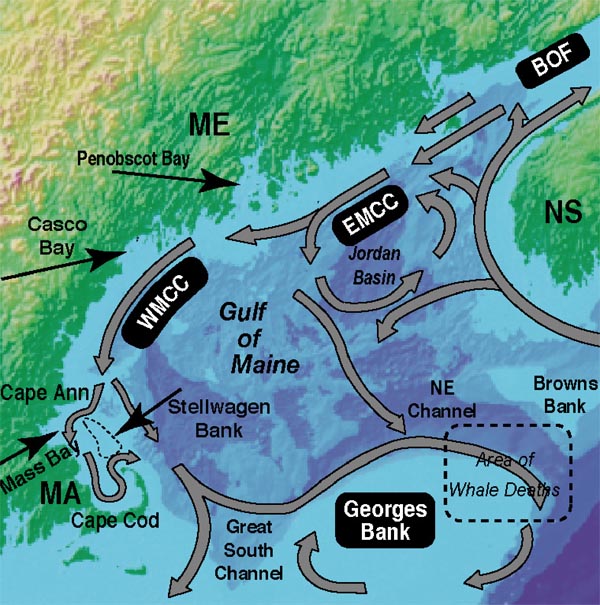
However this causes the Environmental assessment to be inadequate because it fails to address the most important , most fundamental questions raised by the proposal: what are the likely climate changing effects of interfering with the Eastern Maine Coastal Current's flow and flow rate by positioning windmills, as planned, within its pathway in the Gulf of Maine?


The state has identified as appropriate several locations in the Gulf of Maine for utility scale wind development. The preferred alternative lies within the EMCC just prior to where bathymetric conditions stimulate a segment of it to break off  (and deliver lobster larvae to Penobscot Bay).


It does not pass the straight face test for the University of Maine to pretend that the completely predictable impacts of  the utility scale ocean windfarms it proposes to build following and based on preparation of these prototypes need not be considered at this stage. It is to feign that there is no possible connection between the prototype and the full scale device that is the reason for building the prototype.


This is untenable. The Department of Energy need to work with the University of Maine to develop either a supplemental Environmental Assessment or an Environmental Impact Statement to deal with the predictable and connected offsite and indirect and cumulative impacts stemming from the proposed DeepCwind project that is requesting funding from the Department of Energy. Anything else is a mockery of the NEPA process and serves only  political haste, not scientific certainty


In conclusion we continue to find the scope of review of a number of critical issues to be seriously inadequate. Therefore we believe that  the University of Maine should be required to  prepare a supplemental Environmental Assessment to address those issues, as cited below.  Please note that these issues and the University of Maine's state permit to operate its wind testing area off Monhegan  are presently subject of litigation in Maine Superior Court.
 
Sincerely
Ron Huber, for
Penobscot Bay Watch

Jun 2, 2011

Sears Island: Cargo cultists continue pressing $200 million bond bill.

That Sears Island $200 million bond bill? IT IS STILL IN PLAY. Yes, LD 420 would float this bond issue on the next election ballot "for building a privately operated container port on Sears Island"
 In the closing days  of the Maine legislative session, this monstrous bill , and others like it  still under review by the legislature. Sears Island is still on the chopping block. Beware!

LD 420 is bottled up in the Appropriations Committee which could excrete it at any time for a vote. Sunshine is the only sensible medicine. Please let people know to contact their legislators or friends. 


In fact LET EVERYONE KNOW, and have them tell  the legislators of Maine's Committee on Appropriations and Financial Affairs  that this bill is a terrible idea.  How?  Just  email your opposition to Carol Tompkins, clerk of that  committee and ask her to send your email around to the committee members. She will.  


How kind to global industry, this subsidized Port of Dreams would be. Let us build it! they cry. The Cargo Will Come Again! For that is what it is: a Downeast outbreak of the Cargo Cult, its victims pining for the 19th century.