Search

Showing posts with label deepwater wind. Show all posts

May 8, 2014

Dagher gets knife in back from US Dept of Energy - Maine's not an ocean windpower grant finalist!


Appears that the feds figured out the good doctor Dagher just isn't ready for prime time.

Maine didn't get the $46 million dollar grant to build two fullsize floating windturbines off Monhegan.

The UMaine-led floating ocean winturbines project has suffered terribly from the near paranoid insularity of the project under  Principle Investigator Dagher, who spurned suggestions from anyone outside his charmed circle. (Charmed by the allure of all those tens of millions and what a grand time they would've had expending it

DeepCwind is getting three million federal bucks in the nationwide competitino. but according to a University source this 3 million isn't even enough to make a single full size prototype. One that can actually be tested, unlike the ridiculous toy windmill that the Maine the windies rushed out and wouldn't take out to the test area - They knew it would sink! 


So the feds took a look at this  furtive public-be-damned-operation  that UMaine engineering professor Habib Dagher, Principal Investigator  for the DeepCwind Consortium and its spin off progeny has been running.

They gazed upon the tiny toy windturbine bobbing off Castine. Too shabbily built to be safely tested at the test site off Monhegan, the design inspired no confidence  among the grantors. Where did the money  given DeepCwind to buld a fullscale prototype go? they must have wondered!

This is an important stay.  The University and its hangers-on in the DeepCwind Consortium presumably figured that if they could get away with  soiling Monhegan's viewshed with its  heavy public use and high scenic values, then all marine viewsheds of the Maine coast are vulnerable. Maine has spent too many years stewarding        

Floating off shore windpower extraction is worth trying out, but not when  it is needlessly view-polluting; or within the Gulf's  ecologically (hence economically) vital coastal currents. Nor are great sweeping blades the only way to extract energy from the seawind.   Dr. Dagher should follow his own advice and commit to siting his floaters beyond the curvature of the earth from any inhabited part of Maine.

The scent of imminent Big Money  may have pushed that civic responsibility from his mind. Now that DeepCwind Consortium and its spinoff children are no longer suffering that temptation, perhaps they will step outside of their echo chamber and listen - really LISTEN -to the existing Gulf of Maine communities of interest about how to avoid wrecking  or damaging their existing economic and cultural sectors and the manylayered heavily webbed ecosystem that fills these waters.

May 25, 2012

DeepCwind won't deploy floating test turbine this year

 Bad news for devotees of Habib Dagher's plan to install floating deepwater windpower extractors in the Gulf of Maine.  But good news for wild & scenic Gulf of Maine.

The Spring 2012 deployment of the DeepCwind Consortium's  prototype floating wind turbine off Monhegan has been delayed until  2013. This according to a May 24, 2012 story  in the weekly Free Press of Midcoast Maine : "Deep Water Wind Test Turbine Postponed Until 2013"

Writer Christine Parris noted  that the DeepCwind Consortium is having problems gaining several  government permits and has been forced to push back launch of its prototype windmill until next spring.  
She wrote: 
"Dagher said that some permits were still pending for the Monhegan site, but that he expected them to be approved in the next two to three months, which will push the launch date to next summer. "

"still pending?"  It seemed  like the permits were settled more than a year ago.  I wonder which ones they're having trouble with?  Or is that a mask for investment woes?

Or could this be proxy war between Statoil with their Maine Hywind project  and the University of Maine led DeepCwind Consortium? Statoil with their Maine Hywind project, and DeepCwind Consortium with their Monhegan Test site?  If so, Statoil's deep pockets & its deepwater experience will pose a major challenge for Maine's home team DeepCwind to overcome, if they are to compete.


Dr Dagher has declined to respond to an inquiry on exactly which permits remained to be acquired.

The mind boggles


Jan 12, 2012

Ocean windmills, turbulence avoidance and zooplankton.

A recent paper by  University of New Hampshire professor James Pringle What is the windage of zooplankton? Turbulence avoidance and the wind-driven transport of plankton reveals how strategies used by migrating zooplankton to get where they're going can have unexpected consequences when the wind blows or stops blowing.  Something that would-be deepwater windpower extractors need to keep in mind

As Bay Blog readers know,  Maine's East and West Coastal Currents are migratory thruways for the zoooplankton phase larvae of lobsters, sea scallops and many other marine animals These currents rise in the Bay of Fundy, passing Maine, New Hampshire and Massachusetts and interfacing with other currents deeper in the Gulf of Maine. See currents here (flash video)

 Dr Pringle has discovered that migrating zooplankton avoid turbulent waters while travelling. When they encounter it, they  descend and try going under the turbulence, even if their phytoplankton prey is  more abundant in the turbulent water.

But these peace-seeking plankton can run into a problem. When they leave the surface currents they have been migrating on, and are no longer near the surface, they leave the migratory thruway they were in.   If they go too deep while trying to go under the turbulence, they may come into contact with and settle upon the seafloor ecosystem at that location. Or they may be washed outward to settle on the archipelagoes of seamounts of the Gulf of Maine - while their siblings continue down the Maine Coastal Current.

It is not  unreasonable to hypothesize that the sea surface turbulence and water column turbulence and destratification stimulated by operating deepwater ocean windmills  will be just what zooplankton avoid. and finding it impossible to go under the

What is the windage of zooplankton? Turbulence avoidance and the wind-driven transport of planktonBy James M. Pringle, UNH
ABSTRACT
Observations of turbulence avoidance in zooplankton are compared to estimates of the wind-driven turbulence in the upper ocean. Turbulence avoidance is found to prevent the transport of zooplankton in the surface Ekman layer at realistic wind speeds.Plankton that avoid turbulence by moving deeper are no longer transported by the wind-driven Ekman currents near the surface because they are no longer near the surface. Turbulence avoidance is shown to lead to near-shore retention in wind-driven upwelling systems, and to a reduction of the delivery of zooplankton to Georges Bank from the deeper waters of the Gulf of Maine."
End of abstract


Dec 19, 2011

Protest reaches out to King Harald V re Norwegian plan to site ocean windpark off Maine.


South Portland, Maine. A long time Maine coastal conservation group has sent a letter to King Harold V. (Also attached as a pdf file.) The letter was sent December 10, 2011 following the December 8, 2011 meeting held by the US Bureau of Ocean Energy Management in South Portland, Maine,where a plan by Statoil to build and install a floating ocean windpark 12 miles off the Maine coast was introduced.  (Meeting agenda here)   (Media coverage here )

The December 10, 2011 letter, signed by Penobscot Bay Watch executive director Ronald Huber, asks His Majesty to call for a moratorium on deepwater ocean windparks  "until after an international committee of oceanographers considers the implications of the findings of Norwegian researcher Göran Broström and others, and develops standards to ensure ichthyoplankton-safe placement of deepwater ocean wind parks."

"Our world is on the verge of intensive shallow and deepwater ocean wind development

off nearly every coastal nation," the coastal conservation group's leader wrote. "While deepwater wind energy extraction will help our species’ struggle to escape the carbon era, it must be introduced precautionarily, lest expensive mistakes be made in the first flurry of exploitation."

Huber cites a research study by 
Dr. Brostrom  of the Norwegian Meteorological Institute,  entitled  "On the influence of large wind farms on the upper ocean circulation." the report shows that energy extraction by ocean windmills can generate large localized upwellings of seawater beneath the ocean windmills, "sufficiently enough that the local ecosystem will most likely be strongly influenced by the presence of a wind farm."   (Göran Broström, Norwegian Meteorological  Institute, 2008) See also Brostrom 2009 powerpoint: Can Ocean Windmills affect the Climate?

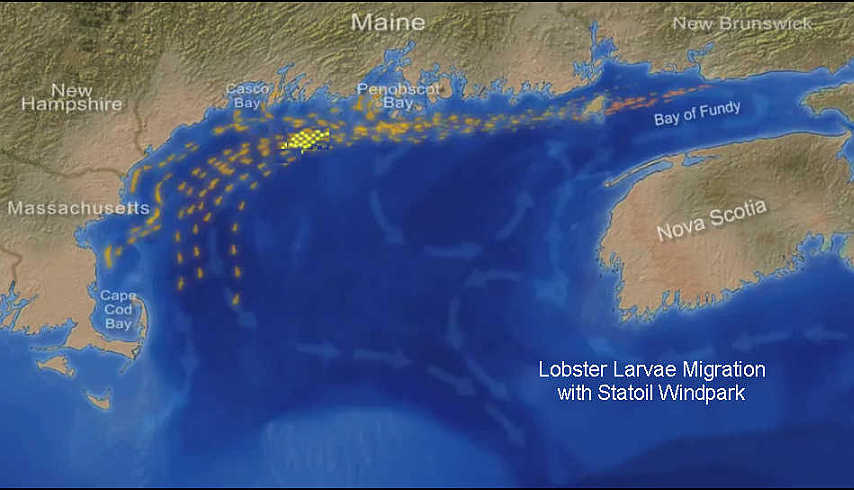
Huber and others are concerned that the kilometers-wide water upwellings produced year round by deepwater wind parks could slow or divert the movement of fish and shellfish larvae using the  Gulf of Maine's natural coastal currents to migrate during their early lifestage as plankton.  See a short
simulation of lobster larvae being diverted away from the coast by the пропсоед Statoil windpark (Youtube) Huber said this could reduce the number of these young animals reaching their normal settling habitats off shore of Maine, New Hampshire and Massachusetts, where they grow to commercial maturity.

These can be long migrations. "Many of Maine’s lobsters, for example, originate in Canada’s Bay of Fundy," Huber wrote to the King, "while many of Maine’s atlantic bluefin tuna arise in the Gulf of Mexico."


Mr. Huber met with a prominent New England researcher at the December 8, 2011 meeting.   "I spoke with Professor Peter Jumars, head of the University of Maine's School of Marine Sciences." Huber said. "He said that it is possible that the four deepwater turbines that Statoil proposes installing off Maine could together extract enough wind energy  to trigger the upwelling effect that Dr Brostrom describes." 

Huber notes that the university's 2011 Maine Offshore Wind Report cites Goran Brostrom's study  five times as it considered its own DeepCwind deepwater wind park plan.

Unfortunately the University of Maine's oceanographers have been denied repeatedly when seeking funding to study potential water circulation effects of siting deepwater windfarms in the existing Gulf of Maine  water currents, according to Dr. Jumars. 

This is why a greater global effort needs to take place now Huber said. 
"Norway could start by   funding such water circulation research for this project off Maine." he said. "Nearly every coastal nation is interested in deepwater wind power; however, many of them also lack sufficient oceanographic institutions to make informed decisions. 

If Statoil wishes to lead the world's deepwater wind exploitation,
then it needs to think on the large scale, and underwrite the expenses of a global colloquium on this topic, Huber said. 

The Penobscot Bay Watch letter to King Harald notes His Majesty's familiarity with and support for deepwater windpower extraction, and asks him to be "the one who convenes this international colloquium". 

It
takes someone of the stature of King Harold as an energy leader to pull such a meeting together, Huber believes.

"We ask you as leader of your county, and as a world leader in ocean windpower development, to call for suspension of deepwater windpark licensing until such time as siting standards are developed that evaluate the impact of these proposals on existing water currents and ichthyoplankton."


The letter closes by stating  "Many who otherwise support ocean windparks will be grateful to you for your caution and foresightedness in ensuring that both seafood and electricity comes in abundance from the world’s oceans."


--


Sep 30, 2011

Offshore Windpower: A Royal approach to conserving seabirds & migrant birds

The Biodiversity Research Institute is bringing Rowena Langston of the Royal Society of the Protection  of Birds (RSPB) to discuss  the European approach to conserving birds when designing offshore windfarms. Langston was principal author of a February 2010 report " Offshore wind farms and birds. Round 3 zones, extensions to Round 1 & Round 2 sites & Scottish Territorial Waters."  Here are the recommendations of that study, (also known as RSPB Research Report No. 39) (pdf)

"Recommendations. Offshore wind farms and birds

1. Collation of existing information on distribution and abundance of birds in UK continental shelf
waters in a GIS compatible form; ideally bringing together data from aerial and boat-based surveys
and providing a unified assessment by species of priority areas in breeding, wintering and passage
periods, as well as identifying gaps in survey coverage. This would facilitate assessment of risk, but
needs rapid delivery to do so.

2. Comprehensive baseline data collection, using a combination of aerial and ship-based surveys, as
appropriate, using recommended methods (Camphuysen et al. 2004; Maclean et al. 2009, Thaxter &
Burton 2009). Minimum of 2 years pre-construction data collection.

3. Co-ordinated survey programme to plug gaps in coverage and provide updated contextual
information for UKCS waters. To include sample re-surveys of areas covered by ESAS, to determine
whether broad patterns of distribution and abundance remain relatively unchanged or whether
there have been changes that cast doubt on the value of using just historical ESAS data for
identifying marine SPAs or areas of potential greater sensitivity for wind farm development.
4. Further research into foraging ranges and areas used by priority species relevant to each
development area, making use of developing technology such as data loggers and habitat suitability
modelling (also relevant to identification of marine SPAs).

5. Review sensitivity indices for birds in the UK continental shelf waters – either a workshop or email
exchange, with a convener, involving several experienced ornithologists.

6. Collate and, where necessary seek to improve, information on population size, survival and
productivity, age structure and frequency of non-breeding to facilitate population modelling for
priority species.

7. Encourage and facilitate further research into migration and other flight movements at sea, notably
to elucidate routes and variation in these by bird species of conservation priority. Further
deployment of satellite tracking with enhanced frequency of positional information shows most
promise, but currently is technically restricted to larger seabirds and waterbirds. This is an
extension of 3.

8. Deployment of radar offshore, on fixed platforms post-construction, to improve our understanding
of avoidance responses by e.g. migratory waterbirds or seabirds commuting to foraging areas
(Desholm et al. 2005, 2006). Resolve how best to obtain complementary visual observations or use of
thermal imaging cameras. OceanPod (Natural Power), and other similar prototype offshore research
platforms, may be a useful development to facilitate offshore research.
Offshore wind farms and birds

9. Deployment of land-based radar and complementary visual observations at several key locations,
pre-construction, to observe departure and arrival bearings and flight elevation of migratory birds.
Offshore deployment of radar to augment baseline data collection also potentially valuable for
specific cases (Walls et al. 2009).

10. Encourage and facilitate the development of study techniques and, where applicable, mitigation
measure
s for application in the marine environment and at offshore wind farms."

End of recommendations

Aug 19, 2011

Maine offshore windpower - Salazar says: No windmills in areas with "fishing sensitivities"

ORONO.  Maine. US Interior Secretary Ken Salazar has announced  that his department will not allow ocean windfarms to be leased in areas of  the Gulf of Maine with "fishing sensitivities". The secretary spoke at the University of Maine's offshore windpower laboratory at its Orono campus August 18, 2011

The August 18th announcement came in response to continuing protests taking place at recent ocean windpower boosting events in Maine (see coverage  Here & Here and Here) and in response to concerns raised by the Atlantic Offshore Lobstermen's Association - an offshore fishery organization - that offshore windfarms will bar their industry nfrom vast areas of the Gulf and drive them to fishing grounds shoreward  where conflict with inshore fishers is inevitable. See AOLA's summary it its concerns, below. 

The goal of the protestors is to apply pressure on the Interior Department officials to move its minimum distances  for Gulf of Maine windfarms from the present plan -as near as ten miles from shore -  to accepting the University of Maine DeepCwind consortium's recommendations that they be site at least 20 miles offshore and preferably 40 to 70 miles offshore farther. Reasons - away from currents important for migration of lobster larvae,  and beyond the coastal seamounts  used by offshore lobstermen, groundfishermen and others.

Speaking at the University of Maine on August 18, 2011  Interior Secretary Salazar responded to  questioning by WCSH-TV reporter Mike Desumma and others by stating "If there are commercial fishery sensitivities...then we say 'Those are not the areas where we are going to build',"
- Salazar quoted in  WCSH TV's coverage: "Supporters, critics of offshore wind on hand for Ken Salazar's visitClick here forWCSH story.

The Atlantic Offshore Lobstermen's Association's leader Bonnie Spinnazola said  in an email to offshore windpower critics last week that vessel insurers had notified her organization that they will not insure boats fishing within Gulf of Maine windfarm areas which can cover huge areas. The AOLA said that fishermen who are thus displaced by offshore windfarms will be forced to fish inshore, reigniting old gear conflicts and renewing formerly resolved struggles over fishing territory.

"Downsizing of the fleets is a real possibility;" Spinnazola predicted. "As a result, fishermen leaving the fishery have no where to turn to sell their vessels or gear, thus their "retirement" is literally being scrapped before their eyes. This is a very grim outlook, yet this is the reality many will likely face."

Conservation group Penobscot Bay Watch has been sounding the alarm for more than two years that  according to ocean wind power researchers in Norway, the giant wind energy-extracting ocean turbines being considered for the Gulf of Maine can, by interrupting the Ekman Transport process whereby nature "forces"wind energy into the sea,  create beneath each ocean windfarm a vast slow upwelling eddy that pulls seafloor water to the surface from beneath it.  See simulation  These miles-wide columns of cold seawater can act as barriers that slow, or even divert existing water currents transiting through the area occupied by the windfarm.  When those currents are carrying lobster larvae from the Bay of Fundy to Midcoast Maine, slowdown or diversion could bring  dramatic declines in local lobster stocks, as larvae bound for the Maine coast find themselves shunted past and sent to Massachusetts Bay or to uncertain fates offshore.


Instead the DeepCwind consortium leader Habib Dagher has repeatedly called for distant water offshore  locations on the edges of  Jordan Basin or Wilkinson Basin, where the seawinds blow strongest and most predictably.

Bonnie Spinnazola, president  of AOLA supplied a friend the following "synopsis of our concerns" on August 9, 2011:


Atlantic Offshore Lobstermen's Association
"A brief synopsis of our concerns:

"The lobster industry is not against wind farms; our concerns stem from
issues related to exclusive area rights that will be granted.  There are
no wind farms, that I am aware of, that has been open to fishing.

"Further, should a company offer access, marine insurance companies have
already weighed-in saying they would not insure vessels fishing among the
turbines. Furthermore, considering the web of underwater lines fishing will,
undoubtedly, be nearly impossible.

"Therefore, when access to huge areas in the ocean in which the fishing industry
has historically fished, is limited or denied, naturally, this allows them less space
 in which to fish. 

"It is important to realize, the former statement is far more consequential than
it may seem.  Less space in the ocean crowds together gear sectors which have
for years, worked diligently to avoid one another; especially the mobile andfixed gear fleets.

Sometimes avoidance strategies have been successful, sometimes not; when
the latter occurs, it takes many fishing hours lost to untangle the gear (if they are lucky),
in many cases, it means many thousands of dollars in both time and gear lost.

"Hence, the loss of space in the ocean is a significant matter; downsizing
of the fleets is a real possibility; as a result, fishermen leaving the
fishery have no where to turn to sell their vessels or gear, thus their
"retirement" is literally being scrapped before their eyes.

"This is a very grim outlook, yet this is the reality many will likely face."


-Bonnie Spinnazola

End of synopsis


Aug 13, 2011

Offshore wind meeting 08/11/11 Rockland Maine. Listen to speakers & questioners

On August 11, 2011, the Island Institute hosted a panel discussion of ocean windpower extraction plans for the Gulf of Maine, at the Strand Theater in Rockland, Maine. Moderator: Heather Deese. Panelists: Philip Conkling Island Institute, Bob Steneck UMaine marine ecologist, Habib Dagher UMaine composites engineer, head DeepCwind Consortium. The recording begins with  Philip Conkling's opening remarks, which were underway as the recording begins

* Philip Conkling (in progress) 4min

* Robert Steneck UMaine benthic ecologist 4 min 
* Dave Cousens, ME Lobstermen Association 4min
* Habib Dagher University of Maine composites and DeepCwind 5min 15sec
* Ted Koffman, Maine Audubon 5min 10 sec

QA 1.  Ron Huber & Habib Dagher 10 miles? or 20 miles offshore? 2 min
QA2.  John Stevens Boothbay Harbor What about mobile offshore windmills floating with currents? 3min
QA3.  Habib Dagher Responds to Stevens on positioning of turbine 1min
QA4.  Bob Steneck replies to Stevens cable question 48 sec
QA5.  Habib Dagher  re size of windfarms 2min
QA6. George Orton (sp?) Newcastle, to Dagher on landfall locations for offshore cables 2min
QA 7. Unidentified questioner to Philip Conkling: how to control the dialog, the framing? 3min
QA 8. Heather Deese  replies to unid'd questioner 1min 40 sec
QA9  Unknown questioner to Dagher on economics 2min 20 sec
QA9 Vivian Newman to Heather Deese: Where are the federal agencies? 2min\
QA 10. Rockland questioner to Dagher question on opportunities for students 3min
QA 11.  Jake Ward answers Rocklander's question on opportunities for students 2min
QA 12. Unk Q-er re  subsonic impact of 200 ocean windmills_Steneck, Koffman, Dagher respond. 3min
QA 13 Heather Deese Closing Remarks 75 seconds

(Peter Taber photograph)

Jul 18, 2011

Saving the Gulf of Maine by simply Standing


In Huber v. BPL, I challenged the state decision to let the University site its offshore wind test center off Monhegan's Lobster Cove. Against the strenuous opposition of the State and University of Maine, Judge Jeffrey Hjelm ruled that   Ron Huber indeed posessed the lawful standing and right as party to bring his case against the DeepCwind siting decision.

From:  Knox Superior Court
CIVIL ACTION Docket No. AP-10-2   ORDER ON APPEAL.       Link to the complete decision
Decision filed June 27, 2011


Ronald C. Huber,
Plaintiff.
v.
Maine Department of Conservation
Bureau of Parks and Lands,
Defendant

Pursuant to 5 M.R.S. §§ 11001—11008 and M.R.Civ.P. 80C, plaintiff Ronald C. Huber appeals from a decision issued by the Bureau of Parks and Lands, Department of Conservation  (Department), acting under the authority of 12 M.R.S. § 1868 (2010), identifying a site approximately two miles south and seaward of Monhegan Island as one of three offshore wind energy test areas and as the Maine Offshore Wind Energy Research Center. Huber’s appeal is opposed by the Department and by The University of Maine System, which appears here as an intervenor based upon its role as the lead member of DeepCwind Consortium. The Consortium, a public-private partnership that has already secured federal funding for the project, intends to apply for a permit in order to develop the Monhegan site.
 
For the reasons that follow, the court concludes that Huber has standing to appeal the Department’s decision, because the statutory characterization of the agency action must be seen to allow him to pursue a challenge even at this early stage of the prospective development. The court concludes, however, that the Department’s decision is supported by the evidence and is not otherwise unlawful.

------snip------

Standing and Party Status
The court will address Huber’s standing first because the existence of standing is a threshold issue and a predicate to the consideration of the merits of his appeal.
A. Standing
As applied to state court proceedings in Maine, the notion of standing is prudential and rests on the expectation that the parties who are "best suited to raise a particular claim" are those who should be entitled to promote or oppose that claim in court. R00p v. BeUast, 2007 ME 32, jl 7, 915 A.2d 966, 968 (citation and internal punctuation omitted). Therefore, "Maine courts are only open to those who meet this basic requirement." Lindemann v. C0mm’n on Governmental Ethics and Election Practices, 2008 ME 187, jl 8, 961 A.2d 538, 541 (citation and internal punctuation omitted).

7 The petitioner objects to the assignment of a "‘Low Quality’ viewshed rating" for the Monhegan site. The court construes this as a reference to the Department’s assessment of a "low" level of concern about the effect of the test area on the Monhegan viewshed. R. 80.

Page 8

As a general matter, the determination of standing is not subject to a specific formula. Roop, 2007 ME 32, p7, 915 A.2d at 968. However, in appeals from agency action, the right to seek review is governed by statute. Lindemann, 2008 ME 187, p 9, 961 A.2d at 542. The Legislature has characterized an administrative identification of an "offshore wind energy test area" as "final agency action." See 12 M.R.S. § 1686(4). The course of Huber’s appeal is therefore governed by the provisions of 5 M.R.S. § 11001 et seq. which provides the exclusive method for judicial review of "final agency action." Lingley v. Maine Workman's Compensation Bd 2003, A.2d 327, 330. Huber’s standing to obtain judicial review of the Department’s decision therefore depends on whether he has standing under these procedural statutes.

As described in his brief on appeal, Huber’s involvement with the Penobscot Bay area, including Monhegan Island, is long—standing. He notes that he has workedsince 1993 to protect the environment and the wild inhabitants of Penobscot Bay, motivated by a sense of spiritual obligation. He refers to his involvement in litigation from 1994 through 1996 as head of a non-governmental organization and related to construction on coastal Ducktrap Mountain in Northport. He asserts that in the mid-1990’s, he participated in the DEP’s oil tanker and oil port rules task force, which was involved in the development of rules to protect marine life from oil spills. Huber states that he was involved in additional DEP proceedings in 1998 and 2006 because of a proposed development’s potential harm to aquatic environment, ecology and scenic resources. In 2005 and 2006, he headed a citizens’ group that worked with the DEP on matters relating to the environmental effects of cement dust piles.

In addition to his history of environmental advocacy, Huber writes that he has a specific connection to Monhegan Island, which he visits and enjoys while pursuing his faith—based stewardship of the entire Penobscot Bay region. While on Monhegan Island, Huber uses the pedestrian trail to get to Lobster Cove, where he appreciates the "complex and unspoiled vista" of the gulf of Maine. He is one of many ornithologists who travel from all over the world to observe the birds and other wildlife on Monhegan Island. See also R. 65.

Pursuant to section 11001(1), "any person who is aggrieved by final agency action shall be entitled to judicial review thereof in the Superior Court in the manner provided by this subchapter? The record must therefore establish that Huber has been "aggrieved" in a way that is sufficient to give him standing to pursue this appeal. Further, Huber also must show that he was a party during the underlying administrative proceeding. See, e. g., Friends 0f Lincoln Lakes

Page 9

v. Town of Lincoln, 2010 ME 78,1111, 2 A.3d 284, 288; Lindemann, 2008 ME 187,j] 17 n. 9, 961 A.2d at 543-44; Hammond Lumber C0. v. Fin. Auth. ofMe., 521 A.2d 283, 286 n.5 (Me. 1987). Here, the court first considers whether the record shows that Huber has party status from the agency level, and it next addresses the sufficiency of his alleged injury as an element of standing.

(1) Party status
The Law Court has "interpreted the term party broadly so as to mean any participant in the proceedings who is aggrieved by the action or inaction of the zoning board of appeals." Norris Family Assocs., LLC v. Town ofPhippsburg, 2005 ME 102, il 16, 879 A.2d 1007, 1012 (emphasis in original; citation and internal punctuation omitted).8 See also In re Lappie, 377 A.2d 441, 443 (Me. 1977) (". . .the legislative rationale is that one who is adversely affected by the entry of an administrative order, whether a formal party to the administrative proceeding or A not, is more likely to be aware of the details of the administrative proceeding than are members of the public generally. Such persons are more likely to seek judicial review to assure that the administrative body acts consistently with the standards prescribed by the statute."). The Court has recognized that administrative proceedings are conducted less formally than judicial proceedings, and so “an appellant need not have formally appeared as a party as long as it participated throughout the process." Lincoln Lakes, 2010 ME 78, {1 12, 2 A.3d at 288. Thus, to qualify as a party, the person’s participation in the administrative process may be "formal or informa1." Norris Family Assocs., 2005 ME 102, 11 16, 879 A.2d at 1013 (citation and internal punctuation omitted).

Here, the Department suggests that Huber attended one of its public meetings.9 (Br. of Resp. at 13.) This is a sufficient acknowledgement to support this element of Huber’s standing claim.

8 Cases such as Norris Family Associates that address appeals from municipal boards include discussions of the concept of “party status." That principle has the same purpose as it carries in the context of appeals pursued under the Administrative Procedure Act, and so the court considers the former cases in analyzing this part of the standing issue in this action.

9 The University argues that the record does not reveal any participation by Huber in the  administrative proceeding. Because the Department takes a contrary position, the court decides the issue favorably to Huber.

Page 10

Beyond this suggestion that Huber was a participant in the agency’s process, the record also reveals that concerns generally echoing those that Huber advances here were raised at the Rockport public meeting held in September 2009. R. 132-37.10   Several written comments, which are not attributed to named persons, mirror Huber’s arguments about the effect of the test area on Monhegan’s unique scenic assets. R. 272-73. One letter in particular focuses on the visual impact of wind energy development on the southern end of Monhegan Island, which is the location of Lobster Cove — a prime focus of Huber’s claims here. R. 288.

This demonstrates that Huber apparently attended a public meeting and that during the course of the administrative process, the concerns he raises here were brought to the agency’s attention. The court finds that this combination of circumstances is a sufficient basis on which toview Huber as a party participant.

(2) Particularized injury
To complete a demonstration that he has standing, Huber must also show that the agency’s action has caused him particularized injury —- "that is, if the agency action operated prejudicially and directly upon the party’s property, pecuniary or personal r ghts." Nelson v.Bayroot, LLC, 2008 ME 91,j]10, 953 A.2d 378, 382. See also 5 M.R.S. § 8002(4) ("‘Final agency action’ means a decision by an agency which affects the legal rights, duties or privileges of specific persons, which is dispositive of all issues, legal and factual, and for which no further recourse, appeal or review is provided within the agency ."‘). This requires consideration of whether Huber has suffered a legally recognized injury and whether any such injury is a particularized one.

First, Huber contends that he has sustained damage because of the prospects of development to a site that holds particular aesthetic and religious meaning to him.“ The University argues that Huber has not been injured by the mere designation of a location as an  offshore wind energy test area and as the Maine Offshore Wind Energy Research Center. No  actual development has occurred yet in the designated offshore wind energy test area and 10. The record does not reveal who was present at that hearing, R. 130, or at the October 2009 meeting held on Monhegan Island itself, R. 162-64. Huber was not among those who received public notice by mail of the Monhegan Island meeting. R. 266-71.

11. Huber also claims that his injury encompasses changes to ocean currents and resulting damage to an animal population over which he claims to exercise a faith—based stewardship. The record, however, does not demonstrate a factual basis for this type of alleged injury.

Page 11

research center, and none will occur absent a permit issued under 38 M.R.S. § 480-HH. Until the Department issues a permit, the locations at issue will not change, and Huber’s interests in those  locations are unaffected in fact.

But for the provisions of section 1868(4), the University’s analysis might well carry the day. An injury sufficient to confer standing on a claimant must be more than abstract. Nelson, 2008 ME 91, 11 10, 953 A.2d at 382. And the harm claimed by Huber is presently little more than that. However, in section l868(4), the Legislature has deemed that “[t]he identification of an offshore wind energy test area or areas under subsection 1 or subsection 3 constitutes final agency action." This statute has significance in two ways. First, because the Legislature has established that the type of administrative determination at issue here is "final agency action," it has also established that this type of action "affects the legal rights, duties or privileges of specific persons. . ." because that is the very definition of "final agency action." This syllogism therefore demonstrates that despite the absence of any actual physical development - and even though the state has not even issued a permit that would authorize such development, the Legislature has deemed that the very designation of an offshore wind energy test area results in an injury sufficient to meet the standard that is part of the criterion of "final agency action."12

The second consequence of section 1868(4) is that because the type of action taken thus far by Department is deemed to be “final agency action ," if Huber or others similarly situated to him were precluded from seeking judicial review, he (and they) would be permanently barred from doing so. Huber is now deemed to have been injured by the mere identification of a location as a test area, because the Legislature has declared that such an identification is "final agency action," meaning that by definition it has affected ‘his rights. lf, as the University argues, Huber has no appellate recourse based on that agency action, he would be left without a remedy notwithstanding that legally acknowledged injury

----------------------------------------------------------
12.  One of the University’s arguments challenging Huber’s standing is that he has not demonstrated that his religious interests would be affected by the Department’s actions. The court need not and does not reach this issue for two reasons. First, as is discussed in the text, the statutory characterization of the Department’s action as "fina1 agency action" supports the notion that that action causes harm to a claimant. Second, harm to aesthetic interests, if particularized, is a sufficient foundation to establish standing. Fitzgerald, 385 A.2d, 189, 196-97 (Me. 1978).

Therefore, even without regard to Huber’s contention that the state action affects his religious interests, the action’s impact on his aesthetic interests is a proper basis to grant him standing.

Page 12

Thus, because of the effect of section 1868(4), the court concludes that Huber has
sustained a legally cognizable injury. The next question is whether that injury is a particularized
one.

An injury is "particularized" if it is "distinct from any experienced by the public at large and must be more than an abstract injury." Id. This standard applies to claims based on an alleged injury to public rights, including rights associated with public places. See Friends of  Lincoln Lakes, 2010 ME 78, jj 14, 2 A.3d at 289; Fitzgerald v. Baxter State Park Auth., 385 A.2dat 196-97.

In the context of this case, the court draws guidance from the Law Court’s analysis of the nature of a "particularized injury" as discussed in Nergaard v. Town of Westport Island, 2009 ME 56, 973 A.2d 735. There, the Court rejected a claim of standing by two people who were among more than 1,600 residents who would drive past a challenged development. The Court held that their injury would not be particularized because of the large number of people who would be similarly affected. ld., jj 20, 973 A.2d at 741. The Nergaard Court distinguished that universe of affected people from the one examined in Fitzgerald. In the latter case, standing was conferred on a group of five people who used Baxter State Park and who sought to challenge agency action affecting their aesthetic interests in the park. Because of the small size of that affected group of “actual users," the Court held that they were not members of the "general public" and that the harm they alleged in fact was "particularized." 385 A.2d at 196-97, discussed in Nergaard, 2009 ME 56 p 21, 973 A.2d at 741.

Like the Fitzgerald plaintiffs, Huber’s injury is distinct from that suffered by the public at large because he is an actual user of Monhegan Island, particularly Lobster Cove, which is the area from which the wind energy research test site will be visible and which holds particular aesthetic and spiritual significance for him. The record therefore demonstrates that the agency action at issue here has injured Huber and that his injury is particularized. When those conclusions are combined with his status as a party to the administrative proceedings, his demonstration of standing is complete. The court now addresses the merits of his appeal from that final agency action.


B. Merits of the Huber’s claims on appeal

Page 13
--------------------------------------------------------------------------------------------------

End of Excerpt from
CIVIL ACTION Docket No. AP-10-2   ORDER ON APPEAL.

Jul 15, 2011

Island Institute Offshore Wind Exploitation webinar 7/7/11 AUDIO recordings.

The meeting was organized by Island Institute. Speakers included Heather Deese, Ph.D., II Director of Marine Programs, Amanda LaBelle, II Marine Programs Associate, Suzanne Pude II Community Energy Director, & Birgitta Polson, II Community Energy Fellow. Matt Nixon from Maine State Planning office also spoke..  See Power Point Slides from the Webinar. 
 
AUDIO
* Welcome to meeting. 4 minutes 10 seconds

* Heather Dietz, Intro part 1. 3 minutes Describes Island Institute Concern over threat of energy costs for islands drives them. Research tech Outreach. Stance of offshore wind energy supportive. apprriately siteds and where local benefits aligned with local costs.

* Heather Dietz, Part 2. 2 minutes Describes offshore wind energy Maine motivations is that water is quite deep. Strength of wind and proximity to major load centers. High level interest and support funding from feds. Concern is high dependence on fossil fuel Vulnerable. And have strong wind.

* Heather Dietz, Part 3. 2 minutes Maine has 5 gigawatt goal by 2030 = 3% of national energy development. Also other uses of electricity. Very early stages One full scale one existing StatOil has the Hywind floating wind turbine10 miles off Norway. And U Maine has its plan.

* Heather Dietz Part 4. 2min 4 seconds Current status of state. Governor's ocean energy task Force. LD 1810 ocean wind legislation and 25 mw pilot project green ocean energy

* Heather Dietz reads UMaine official Jake Ward's 2 memos. 5 minutes Maine's 5 GW by 2030 plan. DeepCwind tech update UMaine offshore wind lab.

* Matt Nixon, GIS expert, State Planning Office. 5 minutes

*Question and Answer period 1. 5 minutes. Maine compared to other states? More action south of Cape Cod. Because pole tech is old tech. 800 ocean windmills are seafloor mounted off Europe. Siting within ten miles of Monhegan - become precedent?  

Answer. Two siting locations within state waters: 1. a process that would allow for permit application in state waters, and (2) the experimental prototypes. (3) Commercial sized incentivizing development offshore would be ten miles out. Subsidized longterm rate at which electricity would be purchased is being considered by PUC power [FIGURE 22A]. Outside that the pilot 25 megawatt project would be considered by PUC whether off Monhegan, off Matinicus or off Portland would be up to the specific interest of developers putting in proposals.

* Q&A on undersea cables and corridors. 5 min 
Will they be sent directly to Boston by undersea cable.Or Maine?

* Heather Dietz on outreach to fishers and NGOs

* Amanda LaBelle & Suzanne Pude on coming events. 11 min. August 11th film and discussion, "On the Horizon" at The Strand Theatre in Rockland. September 15: Island Institute hosts "Sites and Sounds of Offshore Wind Energy" In Oct November "Wind Turbines on Land and Sea"

* Alan Round of Gulf of ME Research Institute on Spatial Data. 4 minutes

* Role of Maine SeaGrant. 2 min 40 sec Discussion of Seagrant's role in offshore wind energy development: outreach re DeepCwind in an ongoing series of "grange hall" style informal conversations with coastal communities. [Note poll on how well the webinar went.]

* BOEMRE and offshore sites update. 2min13sec
 
* Local Benefits

* Entire Webinar audio Click here. 77minutes

Jul 4, 2011

Monhegan Deathwatch: Centennarian to be slain by researchers with court order

Bellowing "move your easels!" University of Maine's DeepCwind engineering teams are moving to take down America's oldest art colony, the famed painters' isle Monhegan, a dozen miles off Maine's Midcoast. The Island's artifice-free natural scenic assets off its southern rim at Lobster Cove were ordered destroyed to make way for an experimental deepwater wind power test center, following a Superior Court denial of all appeals.

In protest of the imminent desecration, dozens of pieces of artwork donated by visiting artists who have had "Monhegan periods" over the decades will be sacrificed at a fiery Lobster Cove funeral in early August. 

Nov 17, 2010

2018: Gulf of Maine Ocean wind wannabes eyeing sites off Jeffreys Ledge, Cashes Ledge, Platts Bank & the Bounties. NEFMC bails.

Learn what places the state has picked so far  and listen to the speakers at the federal/state ocean energy task force meeting held at the statehouse in Augusta on Tuesday, November 16, 2010.  CLICK HERE or scroll down this page.

Four important facts to come out of the meeting:   
  1. The map below is the state's first rough cut of suitable areas, s supplied to the meeting by Matt Nixon, GIS specialist for State Planning office. It shows four potential deepwater ocean wind areas off Midcoast and Southern Maine. His preliminary review of Gulf of Maine  trawl and dredge fishery VMS tracking data and commercial shipping use data.  Achieving the status of potential locations for ocean windfarming are:   a location east of the northern half of Jeffrey's Ledge;  one between Fippennies Bank and Cashes Ledge; one between Platts Bank and  the Harris Ground, and one between  the Bounties and the Clay Bank offshore of Penobscot Bay.
the Baldacci Administration's nervousness about picking offshore windmill locations, by being stamped in red multiple times with such qualifiers as "DRAFT: Not Agency or Administration Policy" and  "Significant Additional Stakeholder and Biological Input needed",  "Draft: For discussion purposes only", and SUBJECT TO CHANGE."   Nothing is final yet, Nixon insists:  "Extensive additional user input needed". OK, Matt, we get it!  

2. At least  three companies have written the Bureau of Parks and Lands expressing interest in building and operating ocean windmills in federal waters off Maine. That according to Dan Prichard of the Bureau of Parks and Lands, who  would not identify the companies or their desired  locations, stating confidentiality of ongoing  negotiations

3. NEFMC tucks tail. The New England Fishery Management Council,  has opted out of participating in oversight of this fishing ground takeover. This from Paul J. Howard, Council's  executive director. Howard says that while he's has been receiving calls from officials of the three New England states where BOEMRE is running  interagency  task forces (Massachusetts, Rhode Island and Maine) asking the NEFMC to get involved, "the Council does not have the resources to do so."

Howard wrote that is was good enough that NMFS's Northeast regional office participates in the BOEMRE task forces, noting however, that  NMFS regional administrator Pat Kurkul "suggested we are better off getting involved with NROC  (Northeast Regional Ocean Council than individual task forces."   But Howard notes that  "NROC is not coordinating these activities following the newly signed Presidential Executive Order about ocean planning".  NROC is  a state/federal partnership created in 2005  to "engage in regional protection and balanced use of ocean and coastal resources" by the six New England states.  So nobody appears to be guarding the Gulf of Maine fisheries chicken coop from the energy foxes? !

4th  the state may sign a revised "Letter of Intent to Coordinate Review and Approval Processes"(pdf) with the federal Bureau of Ocean Energy.  This is much more of a legal document than the now renamed "charter" of the last meeting, Listen below to Audio  Parts 14 and 15 for details on the changes the state requested be made in the letter.

New Lepage Administration Tilberg, a special advisor to outgoing governor John Baldacci, will be departing her post as state lead in the BOEMRE process at the end of the year. Kathleen Leyden, head of Maine coastal program will replace her pro-tem, but look to the Lepage Administration making its own picks for marine resource, coastal program, and ocean energy leadership slots

Offshore wind IS a marine resource. We've seen the results when other newly exploited marine resources get piled on by everyone who can afford to be out there.  While the agencies stress that nothing is settled, the process is similar to the one used to select waters off Monhegan, Boon and Damariscove Islands for ocean windpower test sites. Things are moving quickly, and with few exceptions, the public has not been watching its public servants working on this planned  major change in ocean management. And they've gotten to be "uppity servants", secure in their tenure,

The greatest environmental  protection brought to the Gulf of Maine by Maine's Coastal Program &Seagrant/Cooperative extension, are their almost perfect inertia  No matter what committees or task forces the Maine legislature spawns, no matter how many  powerpoint sessions Maine's dedicated circus troupe of ocean and coastal planning  bureaucrats host up and down our coast, the results will be the same:
A glossy coffeetable book-sized report, calls for more funding to allow the Coastal Program/Cooperative Extension/Seagrant community and their private consultant allies  to trek from catered meeting to catered meeting. For more study. And then....Nothing.
For when it comes to such potentially threatening energy extractive industries  to our  Gulf of Maine as industrial class wind and tidal power extraction, (or on such matters  as aquaculture, marine protected areas & "bay management") Coastal Program & Co seem to have adapted and revised the Hippocratic: "first do nothing harmful!" philosophy to  "First do nothing!". It is a strategy that has been phenomenally successful in thwarting efforts to manage human impacts on the se waters and their wild inhabitants.

MEETING RECORDINGS (mp3s)
1 Introduction 7 minutes
2 General introductions. 5 Minutes
3 Introduction by Karin Tilberg 5 minutes
4. Introduction by Maureen Bornholdt 3 minutes
5. Aditi Mirani, Boemre 4 minutes
6. Matt Nixon Me State Planning Office on "Maps & Gaps" 24 minutes
7 Deirdre Gilbert with Island Institute slides 7 minutes
8. DMR Commissioner George LaPointe 1 minute
9. Matt Nixon on Recreational Fisheries 1 minute.
10. Matt Nixon on commercial vessel traffic maps 5 minutes
11. Nixon on "Non-Consumptive" resources, incl viewshed 6 minutes
12. Nixon summarizes data gaps and needs 9 minutes
13.* Karin Tilberg summarizes GIS data value. 3 minutes
14. Karin Tilbert on Federal Letter of Intent to Coordinate Review and Approval Processes. 10 minutes
15. Karin Tilberg takes questions on Federal Letter changes and does wrap up. 21 minutes.
16. Professor Rebecca Holberton, University of Maine ornithologist. 8 minutes
17 Ron Huber, Penobscot Bay Watch, on RFI respondents and water current issues. 8 minutes

Nov 6, 2010

Federal Ocean Energy Task Force-Maine meets November 16th, Augusta.

Bureau of Ocean Energy Management, Regulation & Enforcement's Maine Task Force will hold a meeting on November 16, 2010 at 10am in Room 228 of the Statehouse (the Appropriations Committee room)

No agenda details are available yet.  This is a followup to  BUMMER's September 14th meeting in Belfast. (info and audio)

At the Sept 14th meeting, the state and local federal officials assembled were told to bring maps to the November meeting. Maps with locations that could be leased to monopile windfarms - windmills blasted and pounded into the seafloor. These are the type that Angus King and his cronies would like to profit by building close to the coast.

However, Maine's government and state university have chosen not to pursue that type of ocean windfarming.  Instead they have opted to develop floating deepwater windmills far offshore -out of sight of coastal residents and their scenic economic resources, and away from nearshore fishing grounds and sailing areas.   The University of maine and its Deepwind Consortium have received at least 40 millions in federal funding to (1) carry out their R&D, (2) produce a first prototype and (3) build and deploy a full sized deepwater floating windmill, connecting by cable with the mainland somewhere in New England.

So there are tensions going into the November 16th meeting.  Maine's agency representatives may end up surprising officials of BOEMRE's offshore wind power division by declining to map out hundreds of square miles of seamounts and ledge-filled submerged wildlands. Doing otherwise would only facilitate a windrush of speculators like Mr. King. 

Maine should follow the lead of its scientific community and focus on ocean energy solutoins that do not harm the very economies they purport to be helping.

If you are unable to attend and wish to listen to the meeting online, you may do so at: http://www.maine.gov/legis/ofpr/appropriations_committee/audio/  A webinar will be used during part of the meeting. For additional information, including details on how to view the webinar, contact Matt Nixon: (207) 624-6226 or by email  matthew.e.nixon AT maine.gov

Aug 19, 2010

DeepCwind Consortium: who, what, where, why? Updated 8/19/10

The DeepCwind Consortium is one of those glittering spheres of furious intellectual activity, held together inside a once speculative, now (August 2010) appropriated  funding bubble,  using that money and the earnest politicking of its leader and  supporters to work its way into the  renewable ocean energy game. See 2010 membership list, below. (and 2009 list)

To do this, DCW now needs to warm the cockles of the fishing, sailing and birding public, in hopes that these citizens will allow industrial level energy extraction into their shared environment: the offshore public air and viewsheds, the state's waters and its submerged public  lands. 

This presumes it can get past the lawsuit pending before  Maine Superior Court Judge Jeffrey Hjelm The case challenges the submerged lands lease granted by Bureau of Parks and Lands. The BPL awarded the scenic vistas off  Monhegan - beloved worldwide by generations of  artists, photographers and scenic area goers -  a "low quality" viewshed rating.  The suit by Ron Huber of Rockland asks the judge to require that the scenic evaluation be redone and if warranted, the deepwater  wind R&D operation be set up off  one of the other six final candidate sites that were considered by BPL.


Membership of the DeepCwind Consortium as of August 2010. Arranged by type of organization

AEWC Advanced Structures and Composites Center
University of Maine College of Engineering
University of Maine Department of Civil and Environmental Engineering
University of Maine Department of Industrial Cooperation/
University of Maine School of Marine Sciences 
University of Maine School of Biology and Ecology 
University of Maine Physical Oceanography Group
Maine Maritime Academy
Northern Maine Community College 
University of Western Australia

Ocean Energy Institute
Island Institute
Gulf of Maine Research Institute
New Jersey Audubon Society


Centre for Offshore Foundation Research


Bernstein Shur Counselors at Law
James W. Sewall Company
Kleinschmidt Associates
Technip USA 

Pacific Northwest National Laboratory
National Renewable Energy Laboratory 
Sandia National Labs 

Santos Wind Energy Technologies
Ashland, Inc.
Kenway Corporation 
Harbor Technologies 
PPG Industries
Owens Corning 
Zoltek / Polystrand, Inc.

American Composites Manufacturers Association  
Maine Composites Alliance
Maine Wind Industry Initiative

Cianbro Corporation 
General Dynamics
Bath Iron Works

Bangor Hydro Electric Company 
Central Maine Power Company
Technip USA/
Reed and Reed


=============================================

2009 Membership of the University of Maine DeepCwindConsortium  (source: BDN):

Universities, government and nonprofit agencies
University of Maine — AEWC Advanced Structures & Composites Center (Lead)
University of New Hampshire
Maine Maritime Academy
Northern Maine Community College
University of Western Australia
U.S. Department of Energy
Governor’s Office of Energy Independence & Security
Maine Department of Economic and Community Development
Maine Department of Environmental Protection
Ocean Energy Institute
New Jersey Audubon Society
Island Institute
Gulf of Maine Research Institute

Siting, design and fabrication operations
Cianbro Corp.
Bath Iron Works
Bernstein Shur Counselors at Law
James W. Sewall Co.
Kleinschmidt Associates
Technip USA
McNiff Light Industry
Santos Wind Energy Technology (SWEeT)
Principle Power Inc.
Bangor-Hydro Electric Co.
American Superconductor
Northern Power Systems
Clean Energy Design
Composites Materials Industry
Ashland Inc.
Kenway Corp.
Harbor Technologies
PPG Industries
Owens Corning
Zoltek
Polystrand Inc.
Industry partners, organizations and manufacturing automation
MAG International
Maine Composites Alliance
Simmons & Company International
American Composites Manufacturers Association
Maine Wind Energy Initiative