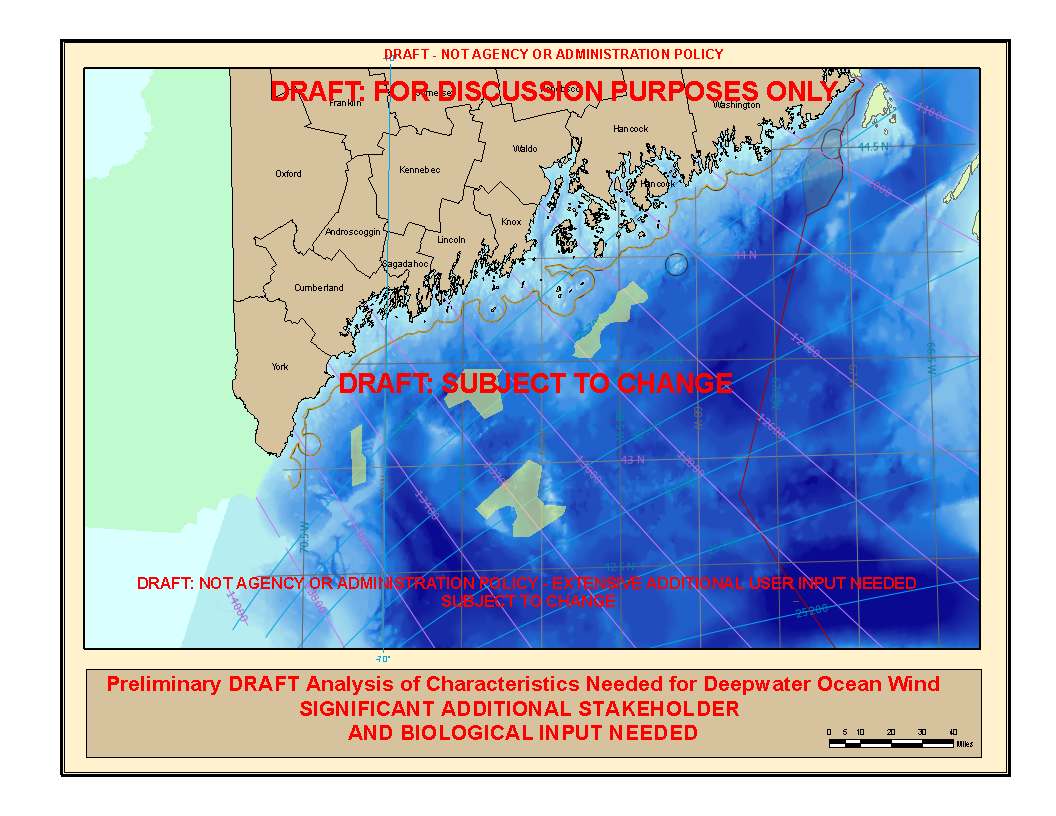
The Biodiversity Research Institute is bringing Rowena Langston of the Royal Society of the Protection of Birds (RSPB) to discuss the European approach to conserving birds when designing offshore windfarms. Langston was principal author of a February 2010 report " Offshore wind farms and birds. Round 3 zones, extensions to Round 1 & Round 2 sites & Scottish Territorial Waters." Here are the recommendations of that study, (also known as RSPB Research Report No. 39) (pdf)
"Recommendations. Offshore wind farms and birds
1. Collation of existing information on distribution and abundance of birds in UK continental shelf
waters in a GIS compatible form; ideally bringing together data from aerial and boat-based surveys
and providing a unified assessment by species of priority areas in breeding, wintering and passage
periods, as well as identifying gaps in survey coverage. This would facilitate assessment of risk, but
needs rapid delivery to do so.
2. Comprehensive baseline data collection, using a combination of aerial and ship-based surveys, as
appropriate, using recommended methods (Camphuysen et al. 2004; Maclean et al. 2009, Thaxter &
Burton 2009). Minimum of 2 years pre-construction data collection.
3. Co-ordinated survey programme to plug gaps in coverage and provide updated contextual
information for UKCS waters. To include sample re-surveys of areas covered by ESAS, to determine
whether broad patterns of distribution and abundance remain relatively unchanged or whether
there have been changes that cast doubt on the value of using just historical ESAS data for
identifying marine SPAs or areas of potential greater sensitivity for wind farm development.
4. Further research into foraging ranges and areas used by priority species relevant to each
development area, making use of developing technology such as data loggers and habitat suitability
modelling (also relevant to identification of marine SPAs).
5. Review sensitivity indices for birds in the UK continental shelf waters – either a workshop or email
exchange, with a convener, involving several experienced ornithologists.
6. Collate and, where necessary seek to improve, information on population size, survival and
productivity, age structure and frequency of non-breeding to facilitate population modelling for
priority species.
7. Encourage and facilitate further research into migration and other flight movements at sea, notably
to elucidate routes and variation in these by bird species of conservation priority. Further
deployment of satellite tracking with enhanced frequency of positional information shows most
promise, but currently is technically restricted to larger seabirds and waterbirds. This is an
extension of 3.
8. Deployment of radar offshore, on fixed platforms post-construction, to improve our understanding
of avoidance responses by e.g. migratory waterbirds or seabirds commuting to foraging areas
(Desholm et al. 2005, 2006). Resolve how best to obtain complementary visual observations or use of
thermal imaging cameras. OceanPod (Natural Power), and other similar prototype offshore research
platforms, may be a useful development to facilitate offshore research.
Offshore wind farms and birds
9. Deployment of land-based radar and complementary visual observations at several key locations,
pre-construction, to observe departure and arrival bearings and flight elevation of migratory birds.
Offshore deployment of radar to augment baseline data collection also potentially valuable for
specific cases (Walls et al. 2009).
10. Encourage and facilitate the development of study techniques and, where applicable, mitigation
measures for application in the marine environment and at offshore wind farms."
End of recommendations
"Recommendations. Offshore wind farms and birds
1. Collation of existing information on distribution and abundance of birds in UK continental shelf
waters in a GIS compatible form; ideally bringing together data from aerial and boat-based surveys
and providing a unified assessment by species of priority areas in breeding, wintering and passage
periods, as well as identifying gaps in survey coverage. This would facilitate assessment of risk, but
needs rapid delivery to do so.
2. Comprehensive baseline data collection, using a combination of aerial and ship-based surveys, as
appropriate, using recommended methods (Camphuysen et al. 2004; Maclean et al. 2009, Thaxter &
Burton 2009). Minimum of 2 years pre-construction data collection.
3. Co-ordinated survey programme to plug gaps in coverage and provide updated contextual
information for UKCS waters. To include sample re-surveys of areas covered by ESAS, to determine
whether broad patterns of distribution and abundance remain relatively unchanged or whether
there have been changes that cast doubt on the value of using just historical ESAS data for
identifying marine SPAs or areas of potential greater sensitivity for wind farm development.
4. Further research into foraging ranges and areas used by priority species relevant to each
development area, making use of developing technology such as data loggers and habitat suitability
modelling (also relevant to identification of marine SPAs).
5. Review sensitivity indices for birds in the UK continental shelf waters – either a workshop or email
exchange, with a convener, involving several experienced ornithologists.
6. Collate and, where necessary seek to improve, information on population size, survival and
productivity, age structure and frequency of non-breeding to facilitate population modelling for
priority species.
7. Encourage and facilitate further research into migration and other flight movements at sea, notably
to elucidate routes and variation in these by bird species of conservation priority. Further
deployment of satellite tracking with enhanced frequency of positional information shows most
promise, but currently is technically restricted to larger seabirds and waterbirds. This is an
extension of 3.
8. Deployment of radar offshore, on fixed platforms post-construction, to improve our understanding
of avoidance responses by e.g. migratory waterbirds or seabirds commuting to foraging areas
(Desholm et al. 2005, 2006). Resolve how best to obtain complementary visual observations or use of
thermal imaging cameras. OceanPod (Natural Power), and other similar prototype offshore research
platforms, may be a useful development to facilitate offshore research.
Offshore wind farms and birds
9. Deployment of land-based radar and complementary visual observations at several key locations,
pre-construction, to observe departure and arrival bearings and flight elevation of migratory birds.
Offshore deployment of radar to augment baseline data collection also potentially valuable for
specific cases (Walls et al. 2009).
10. Encourage and facilitate the development of study techniques and, where applicable, mitigation
measures for application in the marine environment and at offshore wind farms."
End of recommendations