Search

Showing posts with label University of Maine. Show all posts

Jul 30, 2024

DeepCwind Consortium Website 2010 to 2015


DeepCwind Consortium   Its evolution 2010 - 2015 

Scroll down to  enjoy the evolution of the consortium's website www.deepcwind.org/   
from its first  known version June 11, 2010 to its final version May 2, 2015.   
Courtesy of the Internet Archive

Reading through around thirty versions lets one learn a great deal about  how the Consortium grew and evolved  under the leadership of  the University of Maine's  Jake Ward & Habib Dagher, 
From their June 2010 version  below comes this summation: 
"In 2009, the Department of Energy granted the University of Maine $7.1 million over the course of two years to launch the DeepCwind Consortium National Research Program. The primary objectives are to:

Validate floating platform models for deepwater offshore wind turbines.
* Optimize floating platform designs by integrating more durable, lighter, hybrid composite materials.
* Estimate the cost of energy for deepwater offshore wind technologies.
* Compare the benefits and costs of composite materials to conventional materials in deepwater offshore wind manufacturing, design, and construction
.

The Final archived version May 2, 2015    Celebrates the anchoring of their  1/8 sized prototype  of their floating windturbine adjacent to Castine in upper Penobscot Bay.                  

============================================ 
 2010 websites

 June 11, 2010

July 28, 2010

Sept 1, 2010

Dec 27, 2010

Dec 30, 2010

2011 websites

Feb 3, 2011

Feb 26, 2011

July 25. 2011

Aug 8, 2011

Aug 11, 2011

Aug 14, 2011

Aug 28, 2011

Sept 2 2011

Sept 6 2011  (pdf)

Oct 6, 2011

Nov 6, 2011

Dec 7, 2011

2012 websites

  Jan 6. 2012

Mar 10, 2012

Mar 15, 2012

May 29, 2012

2013 websites

May 31. 2013

June 29, 2013

July 28, 2013

Sept 15, 2013

Oct 23, 2013

Nov 26, 2013


2014 websites

2015  websites
May 2, 2015       FINAL ARCHIVED ENTRY 


Mar 7, 2023

Me Legislature's EUT Committee hears 5G foes and friends re LD 697

Complete audio of the 3/7/23  EUT committee 73 minute public hearing on LD 697 a bill requiring UME to undertake study  of 5G health issues 

From bill  introduction by its sponsor Representative Tracy Quint to close of the hearing. 73min 

Copy of LD 697 

Jul 26, 2016

Monhegan and the Ivory Windtower

Monhegan and the Ivory Windtower
http://www.workingwaterfront.com/online-exclusives/Site-off-Monhegan-picked-for-UMaine-offshore-wind-testing/13590/

Working Water Front, the Rockland-based tabloid of coastal Maine science, fish and sociology has just published an article on the state's at-last pick of waters off Monhegan Island  to host a UMaine-led offshore wind test project.

University officials say they seek to install one 100-kilowatt turbine and one 10-killowatt turbine at this site,  the WW reports.   The site is located less than two miles south of Monhegan's Lobster Cove. Click here to see map of Monhegan test site.

Haibib Dagher of U Maine Advanced Structures and Composites Cente, is is longtime advocate for Maine to be the site of future R&D of deepwater offshore wind facilities. He has equated the Gulf of Maine’s wind capacity to that of Saudi Arabia for oil production. (as have the boosters of wind in nearly every other state of the union, though this may be the first Saudi Arabia-comparison of an American territorial waters to a desert land.

Dagher gave testimony last summer about wind energy in front of Congress stating that Maine has the potential to produce about 130 gigawatts of power in deep water — 60 to 900 meters deep — within 50 nautical miles of the coast.

May 7, 2016

UMaine grad students report on cusk barometric trauma, shrimp, lobsters, ocean warming and scallops. 4/27/16

On April 27, 2016,  three grad and post doctoral students working at the Chen Lab of the University of Maine's marine science department  described the results of their present researches on cusk release mortality, shrimp abundance,  groundfish survey data, and scallops, lobster migrations and ocean warming trends. This at the annual gathering of the Midcoast Regional Planning Commission in Union Maine

Jocelyn Runnebaum  Introduction 2 min 29sec

Jocelyn Runnebaum  Cusk, Shrimp 10min 4 sec    Cusk study webpage

Mattie Rodrique Groundfish trends from non-fisheries-dependent data 6min 46 sec

Kisei Tanaka on lobsters and scallops

Questions from audience 6min 18sec


Jan 29, 2016

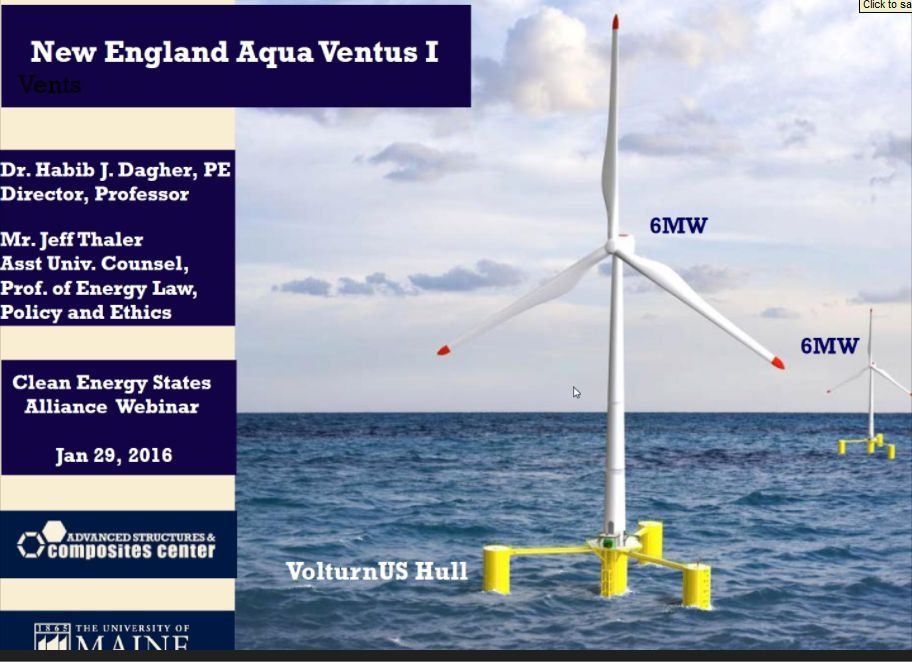
2016 Offshore Maine floating windpower 1/29/16 webinar. Audio & slides

Audio and slides from the 1/29/16 webinar presentation "Maine's Floating Offshore Wind Project: Moving Forward".

Speakers were Habib Dagher, Director, University of Maine's Advanced Structures and Composite Center, and  Jeff Thaler, Asst University Counsel and Maine AquaVentus Legal Counsel,

 The two cover the past, present and future of floating ocean wind turbines in the Gulf of Maine. Speakers refer to this slideshow

Habib Dagher
Introduction 3min37sec       

Habib Dagher  part 1  15 minutes

Habib Dagher part 2  14min55sec

Jeff Thaler 4 minutes

Habib Dagher Part 3 5 minutes

Q &A Part 1  6 minutes
Jeff Thaler

Q&A Part 2 to end of webinar 6 min 
UME's mini prototype in  Castine harbor storm


Jan 12, 2014

Maine's floating windpower project. The backstory & unfilled gaps in knowledge 2005 - 2014

Below find details about the Maine offshore windpower initiative from 2005 to the present:  government documents,  simulations, audio recordings of Maine's legislature, offshore wind industry fishermen and public; scientific/technical reports, birder concerns and more, relating to the proposal to set up floating windmills off Monhegan, Maine.

Agency and NGO Background Documents
Letters, memos, reports that the Maine Bureau of Parks and Lands produced & received in 2009 & 2010 while selecting & approving the Monhegan offshore windpower site. 359 pages

Audio recordings. MP3s.

July 11, 2013 Webinar "Making History with Volturnus" (wmv) 
(Including Jake Ward of DeepCwind)
November 29, 2009 Maine Offshore Energy '09 
June 15-18, 2009 Energy Ocean 2009

SITING, SCENIC IMPACTS & SIMULATIONS  
Dr. Habib Dagher of UMaine has repeatedly stated the importance of siting ocean windmills sufficiently offshore that they are over the horizon from the mainland. Listen to two excerpted quotes and then the full recordings. 
* Two excerpts from audio statements by UME's Habib Dagher (May 20, 2010 & August  11, 2011)  
* August 11, 2011   Listen to Dr Dagher answer a question about siting the windmills 20 or more miles offshore. Island Institute presentation at Strand Theater, Rockland.
* May 20, 2010  Listen to Dr. Dagher's 45 minute talk at the Rockport Opera House calling for them to be 20 to 50 miles offshore.   45 minutes.   

SIMULATIONS
Simulation of Volturnus floating windturbines' likely impact on Maine lobster larvae (1 min long)  Aqua Ventus floating windturbines location off off Monhegan will create a large windshadow and ocean current-slowing zone, where  induced upwelling and downwelling waters in the energy footprint of the turbines may divert downeast lobster larvae-bearing coastal current away from the midcoast.  See Jumars 2010 report, below, for details

SCIENCE. 
University of Maine's "research cluster" of faculty scientists reviewing or taking part in the offshore wind process.

April 20, 2012  New ocean windfarm fishery impact study: drop in local species; increases in exotics.   The effect of floating wind on the plankton and other sealife that relies on  surface water currents.


* 2010 Report. Dr. Peter Jumars, Director of the UMaine School of Marine Sciences.  Read Page 13 of his report "Anticipated Environmental Effects of Offshore Windpower Development in the Gulf of Maine". Dr. Jumars cites Norwegian govt scientist Göran Broström's report "On the influence of large wind farms on the upper ocean circulation." (Norwegian Meteorological Institute, 2008) .Göran Broström wrote that the ocean windfarms  reduce wind energy striking the waters  surrounding the turbine  "sufficiently enough that the local ecosystem will most likely be strongly influenced by the presence of a wind farm". Dr Jumars wrote: "This effect could be important offshore because deep waters of the Gulf of Maine stratify in summer. Would it be bad or good?" 

* May 1, 2012 Study of the nature of the "Gigawatt wakes" that windturbines create behind them. Viewed from an efficiency point of view but useful to ecological point of view also.


Dec 17, 2013

Green Crabs Summit - have the crabs won?

Listen to two speakers then a discussion on the monumental invasion and occupation of Maine state coastal waters by Carcinus Maenas, the Green Crab, and find out who won "this round".

Dr Cynthia McKenzie of the Canadian Dept of Fisheries and Oceans, Newfoundland,  and Chad Coffin, head of Maine Clammers Association, spoke in the afternoon session of the December 16, 2013 Maine Green Crab Summit at the University of Maine in Orono. The event was also streamed live on the internet.

Cynthia McKenzie 30 min 
Chad Coffin, 36 minutes
Panel Discussion 17 minutes
Pat Keliher  13 minutes


Recordings also include a discussion - occasionally very heated - among the panel and the audience,  including those on the internet, followed by closing remarks by Maine DMR Commissioner Pat Keliher.  The most important consensus of the summit was to kill as many green crabs as possible. Efforts are also underway by the Maine Clammers Association to establish gated-off crab-free coves.

 Coffin of the Clammers' Association heaped scorn on "coastal cleanups" as wastes of money and volunteer energy for cosmetic improvements, and suggested  the money and effort be better spent on  habitat and or species restoration.

Coffin also urged that towns with under 20 licensed commercial clammers lose their municipal shellfish commission, saving DMR money to concentrate on those places with viable shellfisheries and saving those towns the expense of an armed shellfish warden. "There's no clams for them to protect? Doffin said.

Little more than a century after introduction into the Gulf of Maine, the swarming green crab has succeeded in wiping out softshelled clams and mussels.

It is outcompeting lobsters for shallow water lobster trap bait and other foods. Is gnawing eelgrass flat and is boring holes in saltmarsh sediments.

Have the green crabs won?


May 25, 2012

DeepCwind won't deploy floating test turbine this year

 Bad news for devotees of Habib Dagher's plan to install floating deepwater windpower extractors in the Gulf of Maine.  But good news for wild & scenic Gulf of Maine.

The Spring 2012 deployment of the DeepCwind Consortium's  prototype floating wind turbine off Monhegan has been delayed until  2013. This according to a May 24, 2012 story  in the weekly Free Press of Midcoast Maine : "Deep Water Wind Test Turbine Postponed Until 2013"

Writer Christine Parris noted  that the DeepCwind Consortium is having problems gaining several  government permits and has been forced to push back launch of its prototype windmill until next spring.  
She wrote: 
"Dagher said that some permits were still pending for the Monhegan site, but that he expected them to be approved in the next two to three months, which will push the launch date to next summer. "

"still pending?"  It seemed  like the permits were settled more than a year ago.  I wonder which ones they're having trouble with?  Or is that a mask for investment woes?

Or could this be proxy war between Statoil with their Maine Hywind project  and the University of Maine led DeepCwind Consortium? Statoil with their Maine Hywind project, and DeepCwind Consortium with their Monhegan Test site?  If so, Statoil's deep pockets & its deepwater experience will pose a major challenge for Maine's home team DeepCwind to overcome, if they are to compete.


Dr Dagher has declined to respond to an inquiry on exactly which permits remained to be acquired.

The mind boggles


Oct 2, 2011

DeepCwind: Feds declare "no significant impacts" to Monhegan or GOM. Okay funding

Monhegan's viewshed and soundshed will change for the first time in some time, as the University of Maine and its DeepCwind Consortium finally get their multimillion dollar check cut by the US Dept of Energy to build the various components of America's first offshore wind turbine and tow them out to a site 2 miles south of the island.  

Happily UMaine has chosen to build a prototype for floating deepwater floating windpower extracting structures (see image), rather than the stick-in-the-mud steel & concrete thickets that other states have envisioned off their coasts.   

Key dimensions
* Blade length 13m (42.7ft)
* Rotor Diameter 27 m (88ft)
* Tower height: 13.7 m (44.9)
* Upper hull hgt: 23.4m ( 77ft)

Key Materials 
Blades: fiber reinforced polyester resin
Tower: Steel
Hull: Steel
Mooring Lines: HMPE Polyethylene
Anchors: Steel boxes filled w/ copper slag


It is the belief of the developers of the DeepCwind prototype, that they will learn sufficiently from this test bed over a two to three year period, to build and safely and cost-effectively deploy a great armada of floating deepwater turbines 25 and more miles off Maine.  Time will tell if they are right.


Below are links to all the documents used in the Department of Energy's decisionmaking process that has finally approved University of Maine’s "Deepwater Offshore Floating Wind Turbine Testing and Demonstration Project, Gulf of Maine" aka DOE/EA 1792 (pdf)

Jul 18, 2011

Saving the Gulf of Maine by simply Standing


In Huber v. BPL, I challenged the state decision to let the University site its offshore wind test center off Monhegan's Lobster Cove. Against the strenuous opposition of the State and University of Maine, Judge Jeffrey Hjelm ruled that   Ron Huber indeed posessed the lawful standing and right as party to bring his case against the DeepCwind siting decision.

From:  Knox Superior Court
CIVIL ACTION Docket No. AP-10-2   ORDER ON APPEAL.       Link to the complete decision
Decision filed June 27, 2011


Ronald C. Huber,
Plaintiff.
v.
Maine Department of Conservation
Bureau of Parks and Lands,
Defendant

Pursuant to 5 M.R.S. §§ 11001—11008 and M.R.Civ.P. 80C, plaintiff Ronald C. Huber appeals from a decision issued by the Bureau of Parks and Lands, Department of Conservation  (Department), acting under the authority of 12 M.R.S. § 1868 (2010), identifying a site approximately two miles south and seaward of Monhegan Island as one of three offshore wind energy test areas and as the Maine Offshore Wind Energy Research Center. Huber’s appeal is opposed by the Department and by The University of Maine System, which appears here as an intervenor based upon its role as the lead member of DeepCwind Consortium. The Consortium, a public-private partnership that has already secured federal funding for the project, intends to apply for a permit in order to develop the Monhegan site.
 
For the reasons that follow, the court concludes that Huber has standing to appeal the Department’s decision, because the statutory characterization of the agency action must be seen to allow him to pursue a challenge even at this early stage of the prospective development. The court concludes, however, that the Department’s decision is supported by the evidence and is not otherwise unlawful.

------snip------

Standing and Party Status
The court will address Huber’s standing first because the existence of standing is a threshold issue and a predicate to the consideration of the merits of his appeal.
A. Standing
As applied to state court proceedings in Maine, the notion of standing is prudential and rests on the expectation that the parties who are "best suited to raise a particular claim" are those who should be entitled to promote or oppose that claim in court. R00p v. BeUast, 2007 ME 32, jl 7, 915 A.2d 966, 968 (citation and internal punctuation omitted). Therefore, "Maine courts are only open to those who meet this basic requirement." Lindemann v. C0mm’n on Governmental Ethics and Election Practices, 2008 ME 187, jl 8, 961 A.2d 538, 541 (citation and internal punctuation omitted).

7 The petitioner objects to the assignment of a "‘Low Quality’ viewshed rating" for the Monhegan site. The court construes this as a reference to the Department’s assessment of a "low" level of concern about the effect of the test area on the Monhegan viewshed. R. 80.

Page 8

As a general matter, the determination of standing is not subject to a specific formula. Roop, 2007 ME 32, p7, 915 A.2d at 968. However, in appeals from agency action, the right to seek review is governed by statute. Lindemann, 2008 ME 187, p 9, 961 A.2d at 542. The Legislature has characterized an administrative identification of an "offshore wind energy test area" as "final agency action." See 12 M.R.S. § 1686(4). The course of Huber’s appeal is therefore governed by the provisions of 5 M.R.S. § 11001 et seq. which provides the exclusive method for judicial review of "final agency action." Lingley v. Maine Workman's Compensation Bd 2003, A.2d 327, 330. Huber’s standing to obtain judicial review of the Department’s decision therefore depends on whether he has standing under these procedural statutes.

As described in his brief on appeal, Huber’s involvement with the Penobscot Bay area, including Monhegan Island, is long—standing. He notes that he has workedsince 1993 to protect the environment and the wild inhabitants of Penobscot Bay, motivated by a sense of spiritual obligation. He refers to his involvement in litigation from 1994 through 1996 as head of a non-governmental organization and related to construction on coastal Ducktrap Mountain in Northport. He asserts that in the mid-1990’s, he participated in the DEP’s oil tanker and oil port rules task force, which was involved in the development of rules to protect marine life from oil spills. Huber states that he was involved in additional DEP proceedings in 1998 and 2006 because of a proposed development’s potential harm to aquatic environment, ecology and scenic resources. In 2005 and 2006, he headed a citizens’ group that worked with the DEP on matters relating to the environmental effects of cement dust piles.

In addition to his history of environmental advocacy, Huber writes that he has a specific connection to Monhegan Island, which he visits and enjoys while pursuing his faith—based stewardship of the entire Penobscot Bay region. While on Monhegan Island, Huber uses the pedestrian trail to get to Lobster Cove, where he appreciates the "complex and unspoiled vista" of the gulf of Maine. He is one of many ornithologists who travel from all over the world to observe the birds and other wildlife on Monhegan Island. See also R. 65.

Pursuant to section 11001(1), "any person who is aggrieved by final agency action shall be entitled to judicial review thereof in the Superior Court in the manner provided by this subchapter? The record must therefore establish that Huber has been "aggrieved" in a way that is sufficient to give him standing to pursue this appeal. Further, Huber also must show that he was a party during the underlying administrative proceeding. See, e. g., Friends 0f Lincoln Lakes

Page 9

v. Town of Lincoln, 2010 ME 78,1111, 2 A.3d 284, 288; Lindemann, 2008 ME 187,j] 17 n. 9, 961 A.2d at 543-44; Hammond Lumber C0. v. Fin. Auth. ofMe., 521 A.2d 283, 286 n.5 (Me. 1987). Here, the court first considers whether the record shows that Huber has party status from the agency level, and it next addresses the sufficiency of his alleged injury as an element of standing.

(1) Party status
The Law Court has "interpreted the term party broadly so as to mean any participant in the proceedings who is aggrieved by the action or inaction of the zoning board of appeals." Norris Family Assocs., LLC v. Town ofPhippsburg, 2005 ME 102, il 16, 879 A.2d 1007, 1012 (emphasis in original; citation and internal punctuation omitted).8 See also In re Lappie, 377 A.2d 441, 443 (Me. 1977) (". . .the legislative rationale is that one who is adversely affected by the entry of an administrative order, whether a formal party to the administrative proceeding or A not, is more likely to be aware of the details of the administrative proceeding than are members of the public generally. Such persons are more likely to seek judicial review to assure that the administrative body acts consistently with the standards prescribed by the statute."). The Court has recognized that administrative proceedings are conducted less formally than judicial proceedings, and so “an appellant need not have formally appeared as a party as long as it participated throughout the process." Lincoln Lakes, 2010 ME 78, {1 12, 2 A.3d at 288. Thus, to qualify as a party, the person’s participation in the administrative process may be "formal or informa1." Norris Family Assocs., 2005 ME 102, 11 16, 879 A.2d at 1013 (citation and internal punctuation omitted).

Here, the Department suggests that Huber attended one of its public meetings.9 (Br. of Resp. at 13.) This is a sufficient acknowledgement to support this element of Huber’s standing claim.

8 Cases such as Norris Family Associates that address appeals from municipal boards include discussions of the concept of “party status." That principle has the same purpose as it carries in the context of appeals pursued under the Administrative Procedure Act, and so the court considers the former cases in analyzing this part of the standing issue in this action.

9 The University argues that the record does not reveal any participation by Huber in the  administrative proceeding. Because the Department takes a contrary position, the court decides the issue favorably to Huber.

Page 10

Beyond this suggestion that Huber was a participant in the agency’s process, the record also reveals that concerns generally echoing those that Huber advances here were raised at the Rockport public meeting held in September 2009. R. 132-37.10   Several written comments, which are not attributed to named persons, mirror Huber’s arguments about the effect of the test area on Monhegan’s unique scenic assets. R. 272-73. One letter in particular focuses on the visual impact of wind energy development on the southern end of Monhegan Island, which is the location of Lobster Cove — a prime focus of Huber’s claims here. R. 288.

This demonstrates that Huber apparently attended a public meeting and that during the course of the administrative process, the concerns he raises here were brought to the agency’s attention. The court finds that this combination of circumstances is a sufficient basis on which toview Huber as a party participant.

(2) Particularized injury
To complete a demonstration that he has standing, Huber must also show that the agency’s action has caused him particularized injury —- "that is, if the agency action operated prejudicially and directly upon the party’s property, pecuniary or personal r ghts." Nelson v.Bayroot, LLC, 2008 ME 91,j]10, 953 A.2d 378, 382. See also 5 M.R.S. § 8002(4) ("‘Final agency action’ means a decision by an agency which affects the legal rights, duties or privileges of specific persons, which is dispositive of all issues, legal and factual, and for which no further recourse, appeal or review is provided within the agency ."‘). This requires consideration of whether Huber has suffered a legally recognized injury and whether any such injury is a particularized one.

First, Huber contends that he has sustained damage because of the prospects of development to a site that holds particular aesthetic and religious meaning to him.“ The University argues that Huber has not been injured by the mere designation of a location as an  offshore wind energy test area and as the Maine Offshore Wind Energy Research Center. No  actual development has occurred yet in the designated offshore wind energy test area and 10. The record does not reveal who was present at that hearing, R. 130, or at the October 2009 meeting held on Monhegan Island itself, R. 162-64. Huber was not among those who received public notice by mail of the Monhegan Island meeting. R. 266-71.

11. Huber also claims that his injury encompasses changes to ocean currents and resulting damage to an animal population over which he claims to exercise a faith—based stewardship. The record, however, does not demonstrate a factual basis for this type of alleged injury.

Page 11

research center, and none will occur absent a permit issued under 38 M.R.S. § 480-HH. Until the Department issues a permit, the locations at issue will not change, and Huber’s interests in those  locations are unaffected in fact.

But for the provisions of section 1868(4), the University’s analysis might well carry the day. An injury sufficient to confer standing on a claimant must be more than abstract. Nelson, 2008 ME 91, 11 10, 953 A.2d at 382. And the harm claimed by Huber is presently little more than that. However, in section l868(4), the Legislature has deemed that “[t]he identification of an offshore wind energy test area or areas under subsection 1 or subsection 3 constitutes final agency action." This statute has significance in two ways. First, because the Legislature has established that the type of administrative determination at issue here is "final agency action," it has also established that this type of action "affects the legal rights, duties or privileges of specific persons. . ." because that is the very definition of "final agency action." This syllogism therefore demonstrates that despite the absence of any actual physical development - and even though the state has not even issued a permit that would authorize such development, the Legislature has deemed that the very designation of an offshore wind energy test area results in an injury sufficient to meet the standard that is part of the criterion of "final agency action."12

The second consequence of section 1868(4) is that because the type of action taken thus far by Department is deemed to be “final agency action ," if Huber or others similarly situated to him were precluded from seeking judicial review, he (and they) would be permanently barred from doing so. Huber is now deemed to have been injured by the mere identification of a location as a test area, because the Legislature has declared that such an identification is "final agency action," meaning that by definition it has affected ‘his rights. lf, as the University argues, Huber has no appellate recourse based on that agency action, he would be left without a remedy notwithstanding that legally acknowledged injury

----------------------------------------------------------
12.  One of the University’s arguments challenging Huber’s standing is that he has not demonstrated that his religious interests would be affected by the Department’s actions. The court need not and does not reach this issue for two reasons. First, as is discussed in the text, the statutory characterization of the Department’s action as "fina1 agency action" supports the notion that that action causes harm to a claimant. Second, harm to aesthetic interests, if particularized, is a sufficient foundation to establish standing. Fitzgerald, 385 A.2d, 189, 196-97 (Me. 1978).

Therefore, even without regard to Huber’s contention that the state action affects his religious interests, the action’s impact on his aesthetic interests is a proper basis to grant him standing.

Page 12

Thus, because of the effect of section 1868(4), the court concludes that Huber has
sustained a legally cognizable injury. The next question is whether that injury is a particularized
one.

An injury is "particularized" if it is "distinct from any experienced by the public at large and must be more than an abstract injury." Id. This standard applies to claims based on an alleged injury to public rights, including rights associated with public places. See Friends of  Lincoln Lakes, 2010 ME 78, jj 14, 2 A.3d at 289; Fitzgerald v. Baxter State Park Auth., 385 A.2dat 196-97.

In the context of this case, the court draws guidance from the Law Court’s analysis of the nature of a "particularized injury" as discussed in Nergaard v. Town of Westport Island, 2009 ME 56, 973 A.2d 735. There, the Court rejected a claim of standing by two people who were among more than 1,600 residents who would drive past a challenged development. The Court held that their injury would not be particularized because of the large number of people who would be similarly affected. ld., jj 20, 973 A.2d at 741. The Nergaard Court distinguished that universe of affected people from the one examined in Fitzgerald. In the latter case, standing was conferred on a group of five people who used Baxter State Park and who sought to challenge agency action affecting their aesthetic interests in the park. Because of the small size of that affected group of “actual users," the Court held that they were not members of the "general public" and that the harm they alleged in fact was "particularized." 385 A.2d at 196-97, discussed in Nergaard, 2009 ME 56 p 21, 973 A.2d at 741.

Like the Fitzgerald plaintiffs, Huber’s injury is distinct from that suffered by the public at large because he is an actual user of Monhegan Island, particularly Lobster Cove, which is the area from which the wind energy research test site will be visible and which holds particular aesthetic and spiritual significance for him. The record therefore demonstrates that the agency action at issue here has injured Huber and that his injury is particularized. When those conclusions are combined with his status as a party to the administrative proceedings, his demonstration of standing is complete. The court now addresses the merits of his appeal from that final agency action.


B. Merits of the Huber’s claims on appeal

Page 13
--------------------------------------------------------------------------------------------------

End of Excerpt from
CIVIL ACTION Docket No. AP-10-2   ORDER ON APPEAL.

May 19, 2011

Maine offshore wind extraction plan decision in motion. Public Input deadline June 9th.

Whatever you call it, whether you support it or not, the University of Maine and a host of Maine companies and companies from away are banded together and plan to start assembling (onshore) the first two prototype 2/3 size deep water floating ocean windmills, for anchoring at a site two miles south of Monhegan Island.

Like all windmills, these two  floaters will affect the natural ecosystem and environment, around them, and a host of human resource values as well. They will be chosen from among the three alternatives in the picture.
 
They will also be the precursors to deploying an armada of  full sized utility scale deepwater floating ocean windmills further offshore in the Gulf of Maine.

The DeepCwind strategy for this environmentas assessment appears to be to pretend these prototypes are not a step in the path to deploying a fullsized ocean windfarm in the Gulf of Maine. Thus no  need to consider  indirect or culmulative or secondary impacts.

So it is also important for this environmental assessment to acknowledge and examine the effects that THOSE big ones could have on the Gulf of Maine's  ecology and environment. Not only the effects within the footprint of the prototypes. But where they lead. 

DEADLINE Before the US Dept of Energy releases the millions to DeepCwind to proceed,  the public is given until June 9, 2011, to submit comments offering their point of view or facts that the agency needs to take into consideration . Email comments to  laura.margason@go.doe.gov.  Snail-mail your comments to the US Dept of Energy, c/o Laura Margason, 1617 Cole Boulevard, Golden, CO 80401. Be  sure to refer to DOE/EA 1792. 

These would be comments on the plan, the possible adverse impacts both in the footprint of the prototype windmills and beyond that would be affected. The following linked documents should be be enough to enable you to send them comments that will make a difference.

BACKGROUND MATERIALS

Department of Energy's Deepcwind  EA Documents. (pdfs)

DOE Public Notice of Draft Environmental Assessment 1page

Draft Environmental Assessment 108 pages

Scoping materials 40 pages.   Agencies, lobstermens Association etc

Letters and Consultation 34 pages   Agency letters on endangered species


DeepCwind's 2011 report on their project
www.penbay.org/wind/ocean/deepcwind/deepcwind2011report.html

DeepCwind website http://www.deepwind.org

Audio recordings of DeepCwind official Habib Dagher


* October 19, 2010  Habib Dagher speaks at 1st annual Maine Deepwater Offshore Wind Conference (one hour)
* May 20, 2010  Habib Dagher speaks at public meeting at Rockport opera House - one hour
* Habib Dagher at two work sessions of the Utility and Energy Committee on LD 1810 An Act To Implement the recommendations of the Governor's Ocean Energy Task Force
 March 18, 2010  Work session    Dr Habib Dagher 12 minutes
 March 23, 2010 Work Session  Dr Habib Dagher,  10 minutesDr. Habib Dagher, Q&A  8 minutes

MORE INFO http://penbay.org/wind/mainewind.html

Please take action to protect our wild seawinds!

May 16, 2011

DeepCwind: Feds release draft Environmental Assessment,

The US Department of Energy wants to know what YOU think about their proposal to award tens of millions of dollars to the University of Maine for its Deepwater Offshore Floating Wind Turbine Testing and Demonstration Project,  in waters  2 to 3 miles south of Monhegan Island.(the lower left corner of aerial photo)

Here are the documents that the federal agency will use to make its decision via an Environmental Assessment - PLUS whatever information you bring to them between now and June 9, 2011.   

Please read, think, mail comments to the DOE Golden Field Office, c/o Laura Margason, 1617 Cole Boulevard, Golden, CO 80401, or by email to laura.margason@go.doe.gov.


* Notice of Availability Public Notice from Dept of Energy about  the below 3 things                                                           
* Draft Environmental Assessment  A review of the environmental impacts that will arise from funding  the DeepCwind Plan. Written after reviewing the agency and organizations letters and other scoping materials. 115 page pdf

* Draft EA Scoping Materials  Letters from agencies, Maine Lobstermen's Association and Penobscot Bay Watch), about the issues that the Environmental Assessment should look into. 40 page pdf

* Consultation Letters Letters from agencies about protected living historic and archaeological resources in the waters proposed for the floating test windmills.

Related Information:
* Huber v Bureau of Parks & Lands  Read about what is at risk at Monhegan and about the active lawsuit presently before Knox Superior Court contesting the state's granting a permit to the University off  off Monhegan without considering the impact on irreplacement world class scenic vistas.used by generations of artists on Monhegan.


* Maine Deepwater Offshore Wind Report 2/23/11 University of Maine's recent study reviewing the DeepCwind plan and its possible impacts. (Split into chapters for easier reading)

Feb 3, 2011

While Judge Hjelm considers Huber v BPL, a Federal agency's release of a draft EA on financing DeepCWind's start-up project off Monhegan could be a game changer.

All sides in the question of what standards ocean windmills will have to meet off Maine await two big decisions:

1. Knox County Superior Court Judge Jeffrey Hjelm's upcoming decision in Huber v Bureau of Parks & Lands over the sufficiency of the state agency's review of the probable scenic impacts and impacts to migrating seabirds, if the University of Maine's planned  deepwater wind test center two miles off the southern tip of  Monhegan Island goes forward.

2.  This month's release by the US Department of Energy of  a draft environmental assessment of the environmental impact of its proposal to give twenty million dollars to the University of Maine for a pair of  deepwater wind projects. See earlier DOE notice. The plans include::

(A) One or more prototype 1/3 sized  floating windmills (plus  undersea test structures), off Monhegan, &  
(B) A single full scale operational 5 megawatt deepwater floating windmill, to be towed to an as-yet only dimly defined location, either off Monhegan or "20 to 50 miles" offshore, according to the University

The agency's assessment must be carried out according the National Environmental Policy Act and the agency's own strict NEPA guidelines (11pg pdf file; ignore the "SUN" references). According to the guidelines, the two DOE officials involved:  Kurt Rautenstrauch and Laura Margason must:

*"Identify any adverse environmental effects that cannot be avoided should this proposed  action be implemented."
* "Evaluate viable alternatives to the proposed action, including a no action alternative."
* "Describe the relationship between local short-term uses of the environment and the maintenance and enhancement of long-term productivity."
* "Characterize any irreversible and irretrievable commitments of resources that would be involved should this proposed action be implemented."


Link to the information and issues supplied by Penobscot Bay Watch to the DOE. 

If Judge Hjelm  takes an approach similar to the one he took in Huber v MDOT, he will wait to see  the Department of Energy's draft  EA: Will the agency agree with Penobscot Bay Watch that more needs to be considered bird-wise, beauty-wise, lobster larvae-wise, currents-impact-wise? If so, then he may rule in in Huber's favor. If not, not.   

Stay tuned. 


May 17, 2010

Monhegan offshore windmill test area lawsuit record. PARTS 1 & 2 , 4 & 5

Huber v Bureau of Parks and Lands. Below are links to 4 of the ten sections of the Record that contains all the information that the Bureau used to decide that waters off Monhegan  were suitable Monhegan Deepwater Wind R&D site lawsuit.


Index to the Record Table of contents and introductory letters.

Part 1 of the Record 27 pages. The Bureau's decision, maps, and enabling state legislation

Part 2 of the Record 40 pages  Site selection methods, notes of mtgs with federal agencies, outreach committee notes, USFWS letter and comments.
Part 3 of the Record. Charts (to be added)
Part 4 of the Record  39 pages Outreach schedule; state website on ecean energy; public information meeting announcements 8/27/09 and 9/1/09. List meeting attendees; slideshow; Ellsworth 9/9/09 meeting agenda and notes.


Part 5 of the Record. Meetings notes and agendas at Planning Area C (Monhegan) meetings: 8/26/09, 10/8/09; 15 page powerpoint presentation; 10/8/09 meeting notes (edited); site location ranking documents

Parts 6 through 10 still to come. See index.
Stay tuned. Your comments welcome!