Search

Showing posts with label Eastern Maine Coastal Current. Show all posts

Jan 18, 2012

DCP gasser-wannabees respond to January 4, 2012 USACE Request for Additional Information

DCP sent the following responses to a January 4, 2012 USACE Request for Additional Information.  DCP's reply  is a very long pdf file. Here it is broken into its various parts.

Part 1.  DCP letter to Jay Clement with responses to request for additional information.  47 pages
Part 2.  Attachment A  Applicable design codes and Standards. 5 pages
Part 3.  Attachment B Visual Simulations. 6 pages
Part 4.  Attachment C  Additional Examples of Public Outreach Effort.6 pages
Part 5.  Attachment D Maine DOT Correspondence.  5 pages
Part 6.  Attachment E  Letters from local emergency responders. 4 pages
Part 7.  Attachment F Other community support letters.  46 pages
Part 8.  Attachment G  Maine Geologic survey press release.  3pages
Part 9.  Attachment H. Penobscot River & Bay Pilots Assn & security zone map. 3 pages

Jan 12, 2012

Ocean windmills, turbulence avoidance and zooplankton.

A recent paper by  University of New Hampshire professor James Pringle What is the windage of zooplankton? Turbulence avoidance and the wind-driven transport of plankton reveals how strategies used by migrating zooplankton to get where they're going can have unexpected consequences when the wind blows or stops blowing.  Something that would-be deepwater windpower extractors need to keep in mind

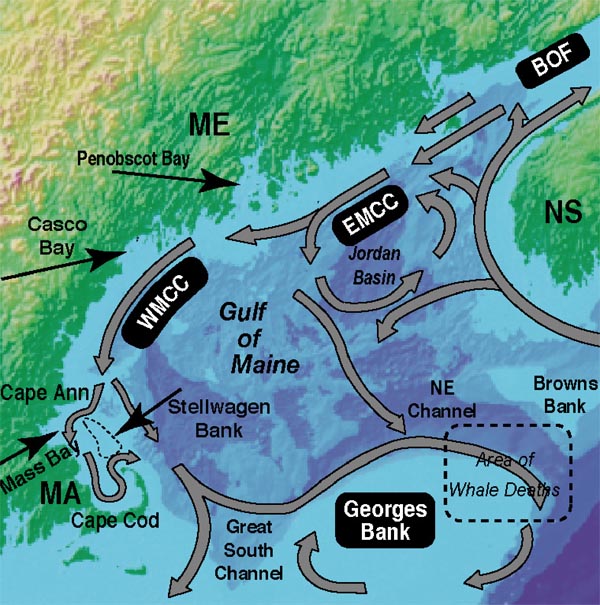
As Bay Blog readers know,  Maine's East and West Coastal Currents are migratory thruways for the zoooplankton phase larvae of lobsters, sea scallops and many other marine animals These currents rise in the Bay of Fundy, passing Maine, New Hampshire and Massachusetts and interfacing with other currents deeper in the Gulf of Maine. See currents here (flash video)

 Dr Pringle has discovered that migrating zooplankton avoid turbulent waters while travelling. When they encounter it, they  descend and try going under the turbulence, even if their phytoplankton prey is  more abundant in the turbulent water.

But these peace-seeking plankton can run into a problem. When they leave the surface currents they have been migrating on, and are no longer near the surface, they leave the migratory thruway they were in.   If they go too deep while trying to go under the turbulence, they may come into contact with and settle upon the seafloor ecosystem at that location. Or they may be washed outward to settle on the archipelagoes of seamounts of the Gulf of Maine - while their siblings continue down the Maine Coastal Current.

It is not  unreasonable to hypothesize that the sea surface turbulence and water column turbulence and destratification stimulated by operating deepwater ocean windmills  will be just what zooplankton avoid. and finding it impossible to go under the

What is the windage of zooplankton? Turbulence avoidance and the wind-driven transport of planktonBy James M. Pringle, UNH
ABSTRACT
Observations of turbulence avoidance in zooplankton are compared to estimates of the wind-driven turbulence in the upper ocean. Turbulence avoidance is found to prevent the transport of zooplankton in the surface Ekman layer at realistic wind speeds.Plankton that avoid turbulence by moving deeper are no longer transported by the wind-driven Ekman currents near the surface because they are no longer near the surface. Turbulence avoidance is shown to lead to near-shore retention in wind-driven upwelling systems, and to a reduction of the delivery of zooplankton to Georges Bank from the deeper waters of the Gulf of Maine."
End of abstract


Dec 9, 2011

Norwegian Wind: federal/state task force discusses Statoil plan for floating windfarm 12+ miles off Boothbay Hbr.

Media Coverage of the December 8, 2011,  Bureau of Ocean Management meeting on the Norwegian proposal to emplace a windfarm in waters 12 miles off Midcoast Maine. 

While most of the coverage was supportive, a precautionary note was struck by the Bay Watch, as the stories  extracted from Google News show.  In addition, the  absence of any officials or even representatives of energy giant Statoil at this meeting on their proposal was felt to be an insult to the assembled officials of the towns and fishing industries that would be affected by their plan present..

WCSH-TV, Channel 6. Portland."While environmental groups believe harnessing the ocean's winds for power could provide a tremendous source of renewable energy, some are concerned about the potential impacts on a variety of sea creatures:

"We have a lot of concerns that they have not looked into all the ecological implications of what transpires when you set up ocean windmills," stated Ron Huber, executive director of Penobscot Bay Watch.  He hopes more research is done before major investments are made into off-shore wind power projects.
  
Norwegian Company Pitches Floating Wind Farm off Maine Coast   MPBN News: "Environmental activist Ron Huber heads a group called Penobscot Bay Watch.  " Earlier this year Interior Secretary Ken Salazar said they would make every effort to make sure that these proposals were not in areas that were fisheries sensitive."
"And the area they're looking at is an extremely important fishery zone for both scallop fisheries, ground fisheries and lobster fisheries,"  Huber says.  "So we think they're not really going quite in good faith with that." End of excerpt
Nevertheless the meeting shouldered on. The State representative representing Boothbay Harbor - where the extracted power would come ashore - had many questions, including from his own fishermen who are concerned that a prime area for atlantic bluefin tuna would be in the midst of this.  But strangely absent from media coverage of the meeting was the fact that not a single representative of the Norwegian company or its government was present to offer any details on the project.  
The BOEM officials produced a bland  four page document from Statoil. It was quite free of any details ,then  a string of functionaries from American agencies  used powerpoints and posters to explain their bits of the puzzle. 
But without the Norwegian company's officials present, the meeting was strangely unfulfilling, like 
Stay tuned, audio recordings of the meeting will be uploaded on the Bay Blog shortly.


Sep 1, 2011

9/1/11 Fishermen's Voice publishes two articles questioning ocean windmills impacts

On September 1, 2011  Fishermen's Voice a newspaper that covers Maine and  Gulf of Maine fishing news and issues,  published two articles questioning ocean windmills' effect on Gulf of Maine fisheries, especially lobsters and lobstering: 
 
* Offshore Lobstermen Concerned About Lack of Research on Impacts of Wind Plan  
and
"Can Wind Turbines and Lobstering Mix?"


Jun 15, 2011

Gulf of Maine - will offshore wind extraction change GOM currents?

The challenge is getting the public to understand that sustained extraction of a gigawatt of kinetic wind energy from the small proposed area east of Matinicus will affect the speed and direction of the existing seasonal coastal current that transits that site,  along with, of course, the  seasonal flows of lobster larvae, scallop larvae and all good things for marine life that travel on it.

From surface to seafloor the Gulf of Maine is in motion, through the water column to the air above.

UMaine's crew knows their full size floating turbines will create this sort of artificial stratification or upwelling effect in the waters where they are set up - its the nature of the ocean windmill beast - but are trying to convince Superior Court Judge Jeffrey Hjelm that it doesn't matter. That Maine can to worry about that AFTER it happens.

One hopes the judge sees otherwise. Probably he does, for fresh and strident last minute filings by DeepCwind's atty against the suit have appeared, beseeching him to dismiss the case..

Jun 10, 2011

Penobscot Bay Watch to US DOE on DeepCwind - It's the Maine Coastal Current & the Lobster larvae

This was set in slightly modified form to Laura Margason, US Dept of Energy on June 9, 2011.

RE: DOE/EA 1792 University of Maine’s Deepwater Offshore Floating Wind Turbine Testing and Demonstration Project,  Gulf of Maine  (108  page PDF)

Dear Ms. Margason,


We are writing in response to the draft Environmental Assessment  for Project DOE/EA 1792, released by the Department of Energy.

Penobscot Bay Watch sent scoping comments to the DOE in October 2010, noting concerns over the limited scope of review proposed, which excluded the reasonably foreseeable offsite indirect and secondary impacts that would flow out from the University's proposed activity, if the impacts to larger oceanic processes of the Gulf of Maine did occur as a result of development and deployment of the planned sequence of full scale floating wind turbines - the entire raison d'etre for the University's project.


The University seems content to  hold that there is no necessity to consider any impacts  beyond such immediate and short term impacts to resources they have identified as being within the footprint and viewshed of the proposed  marine windpower research center.


However this causes the Environmental assessment to be inadequate because it fails to address the most important , most fundamental questions raised by the proposal: what are the likely climate changing effects of interfering with the Eastern Maine Coastal Current's flow and flow rate by positioning windmills, as planned, within its pathway in the Gulf of Maine?


The state has identified as appropriate several locations in the Gulf of Maine for utility scale wind development. The preferred alternative lies within the EMCC just prior to where bathymetric conditions stimulate a segment of it to break off  (and deliver lobster larvae to Penobscot Bay).


It does not pass the straight face test for the University of Maine to pretend that the completely predictable impacts of  the utility scale ocean windfarms it proposes to build following and based on preparation of these prototypes need not be considered at this stage. It is to feign that there is no possible connection between the prototype and the full scale device that is the reason for building the prototype.


This is untenable. The Department of Energy need to work with the University of Maine to develop either a supplemental Environmental Assessment or an Environmental Impact Statement to deal with the predictable and connected offsite and indirect and cumulative impacts stemming from the proposed DeepCwind project that is requesting funding from the Department of Energy. Anything else is a mockery of the NEPA process and serves only  political haste, not scientific certainty


In conclusion we continue to find the scope of review of a number of critical issues to be seriously inadequate. Therefore we believe that  the University of Maine should be required to  prepare a supplemental Environmental Assessment to address those issues, as cited below.  Please note that these issues and the University of Maine's state permit to operate its wind testing area off Monhegan  are presently subject of litigation in Maine Superior Court.
 
Sincerely
Ron Huber, for
Penobscot Bay Watch