Search

Jun 28, 2011

DeepCwind Consortium: a Pyrrhic victory?

DeepCwind ruling by Maine Superior Court a  “Pyrrhic Victory” for University of Maine-led industrial consortium - critic.
 
ROCKLAND  In a historic precedent for defense of Maine’s natural  marine resources, the Knox Superior Court has ruled that Maine citizens have the lawful right to sue on behalf of wildlife in the Gulf of Maine.  Read the decision here

“Until now, the courts have rejected efforts by individuals to obtain legal standing to represent non human entities. “ Huber said.  “ Justice Hjelm’s decision, while it allows development of the DeepCwind offshore wind energy test center, also levels the playing field for citizens trying to protect Natural Maine in the face of powerful industrial consortium like DeepCwind. Both in Superior Court and other venues."

Huber was philosophic about the outcome. “We’ve lost one fight here, but the cost to DeepCwind  and other would-be Gulf of Maine ocean energy developers is an end to the ban on citizen representation of wild nature in Maine and the Gulf of Maine,"   Huber said he is exploring his options.

Huber said it reminded him of the tale of King Pyrrhus of Epirus
"One more such victory" fretted the King, following a costly battle with the Romans "would utterly undo him.” ….
“Likewise for the Maine Bureau of Parks and Lands,”  Huber said. “They and the DeepCwind Consortium collectively defied their own natural scientists and oceanographers in order to rush through the permitting of an offshore windpower test center two miles off Monhegan Island.  And while Judge Hjelm had little choice but to defer to the agency for making an ”informed decision,” Huber said, “the justice also signaled his suspicion of the agency’s methods by ensuring that citizens can lawfully challenge efforts by both the DeepCwind Consortium and other big industrial concerns to go around the laws and regulations protecting our irreplaceable natural Gulf of Maine.”

For  a copy of the court’s  decision, Click Here   For more information about the case Click Here


END

Jun 22, 2011

Island Institute sells out (again) to big industry

In his latest drizzle of class warfare  "Listening to the Scenery"  Island Institute's ever-industry-toadying Phil Conkling once again obeys his corporate masters and sneers at the "voice of the people"  for demanding a say in whether windfarms shall industrialize their landscapes.

Phil bemoans the fact that "anyone who can spare a half hour to assemble expert opinions from the internet can mount a campaign to stop something". Merely, he complains,  to benefit "some ill defined majority".   In other words to Phil, the problem is simply that the rabble is being allowed "too much public input". 

Phil was once part of the rabble, until Charlie Cawley's thankfully now extinct debt peddling empire MBNA  took Conkling's little Island Institute from its harborside shack and into its corporate embrace for what he describes lovingly as "commercial intercourse".  He's never looked back, content to frisk at the feet of his industrial masters,  always ready to bristle and howl  at the commoners when  instructed to do so. 


But his thunderbolts are McLightning - all flash and no wattage. 

Jun 15, 2011

Gulf of Maine - will offshore wind extraction change GOM currents?

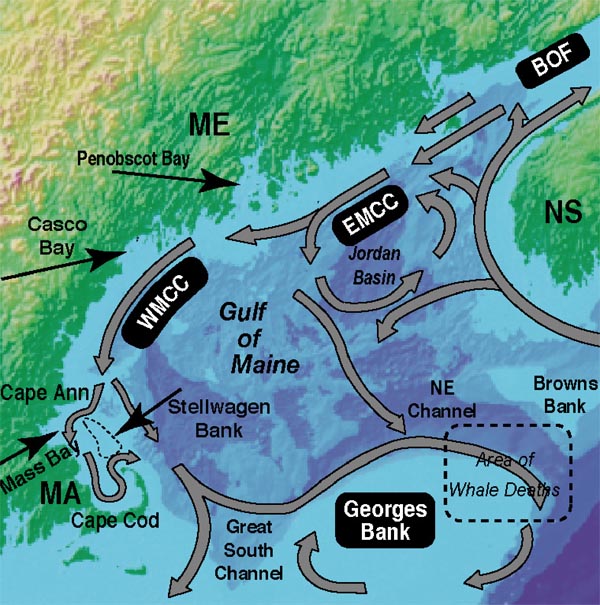
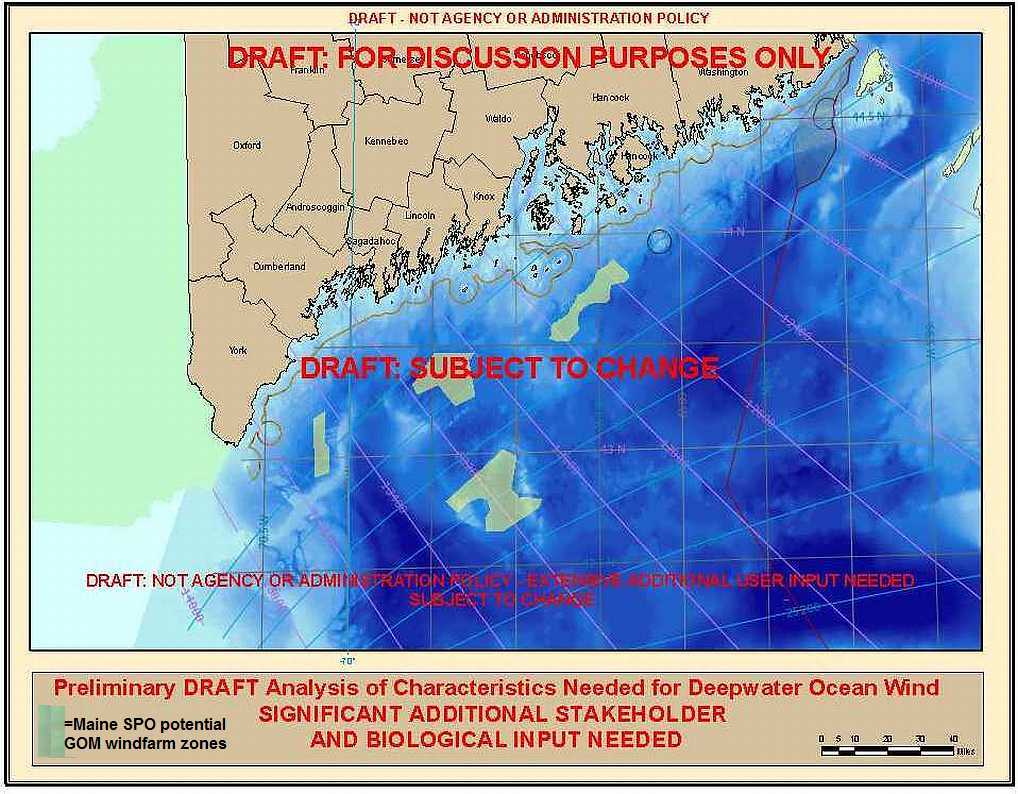
The challenge is getting the public to understand that sustained extraction of a gigawatt of kinetic wind energy from the small proposed area east of Matinicus will affect the speed and direction of the existing seasonal coastal current that transits that site,  along with, of course, the  seasonal flows of lobster larvae, scallop larvae and all good things for marine life that travel on it.

From surface to seafloor the Gulf of Maine is in motion, through the water column to the air above.

UMaine's crew knows their full size floating turbines will create this sort of artificial stratification or upwelling effect in the waters where they are set up - its the nature of the ocean windmill beast - but are trying to convince Superior Court Judge Jeffrey Hjelm that it doesn't matter. That Maine can to worry about that AFTER it happens.

One hopes the judge sees otherwise. Probably he does, for fresh and strident last minute filings by DeepCwind's atty against the suit have appeared, beseeching him to dismiss the case..

Jun 10, 2011

Penobscot Bay Watch to US DOE on DeepCwind - It's the Maine Coastal Current & the Lobster larvae

This was set in slightly modified form to Laura Margason, US Dept of Energy on June 9, 2011.

RE: DOE/EA 1792 University of Maine’s Deepwater Offshore Floating Wind Turbine Testing and Demonstration Project,  Gulf of Maine  (108  page PDF)

Dear Ms. Margason,


We are writing in response to the draft Environmental Assessment  for Project DOE/EA 1792, released by the Department of Energy.

Penobscot Bay Watch sent scoping comments to the DOE in October 2010, noting concerns over the limited scope of review proposed, which excluded the reasonably foreseeable offsite indirect and secondary impacts that would flow out from the University's proposed activity, if the impacts to larger oceanic processes of the Gulf of Maine did occur as a result of development and deployment of the planned sequence of full scale floating wind turbines - the entire raison d'etre for the University's project.


The University seems content to  hold that there is no necessity to consider any impacts  beyond such immediate and short term impacts to resources they have identified as being within the footprint and viewshed of the proposed  marine windpower research center.


However this causes the Environmental assessment to be inadequate because it fails to address the most important , most fundamental questions raised by the proposal: what are the likely climate changing effects of interfering with the Eastern Maine Coastal Current's flow and flow rate by positioning windmills, as planned, within its pathway in the Gulf of Maine?


The state has identified as appropriate several locations in the Gulf of Maine for utility scale wind development. The preferred alternative lies within the EMCC just prior to where bathymetric conditions stimulate a segment of it to break off  (and deliver lobster larvae to Penobscot Bay).


It does not pass the straight face test for the University of Maine to pretend that the completely predictable impacts of  the utility scale ocean windfarms it proposes to build following and based on preparation of these prototypes need not be considered at this stage. It is to feign that there is no possible connection between the prototype and the full scale device that is the reason for building the prototype.


This is untenable. The Department of Energy need to work with the University of Maine to develop either a supplemental Environmental Assessment or an Environmental Impact Statement to deal with the predictable and connected offsite and indirect and cumulative impacts stemming from the proposed DeepCwind project that is requesting funding from the Department of Energy. Anything else is a mockery of the NEPA process and serves only  political haste, not scientific certainty


In conclusion we continue to find the scope of review of a number of critical issues to be seriously inadequate. Therefore we believe that  the University of Maine should be required to  prepare a supplemental Environmental Assessment to address those issues, as cited below.  Please note that these issues and the University of Maine's state permit to operate its wind testing area off Monhegan  are presently subject of litigation in Maine Superior Court.
 
Sincerely
Ron Huber, for
Penobscot Bay Watch

Jun 2, 2011

Sears Island: Cargo cultists continue pressing $200 million bond bill.

That Sears Island $200 million bond bill? IT IS STILL IN PLAY. Yes, LD 420 would float this bond issue on the next election ballot "for building a privately operated container port on Sears Island"
 In the closing days  of the Maine legislative session, this monstrous bill , and others like it  still under review by the legislature. Sears Island is still on the chopping block. Beware!

LD 420 is bottled up in the Appropriations Committee which could excrete it at any time for a vote. Sunshine is the only sensible medicine. Please let people know to contact their legislators or friends. 


In fact LET EVERYONE KNOW, and have them tell  the legislators of Maine's Committee on Appropriations and Financial Affairs  that this bill is a terrible idea.  How?  Just  email your opposition to Carol Tompkins, clerk of that  committee and ask her to send your email around to the committee members. She will.  


How kind to global industry, this subsidized Port of Dreams would be. Let us build it! they cry. The Cargo Will Come Again! For that is what it is: a Downeast outbreak of the Cargo Cult, its victims pining for the 19th century. 

May 28, 2011

Maine legislature 5/26/11 Listen to lobstermen fend off bill to open Maine lobster marketing to Wall Street.

Legislators in Augusta held a public hearing 5/26/11 on LD 1579 An Act To Amend the Lobster Promotion Council  The bill, introduced by the Governor with less than 24 hours warning, on the last day the Marine Resources Committee meets for the year, met with confusion from the legislators and wrath from the fishermen whose associations' leaders had been up all night frantically studying the hefty new bill. Big industry had tried to sneak this bill in quietly. They failed.

The lobstermen convinced the committee to hold the bill over to 2012 before any more hearings, to give the people time to organize.

LISTEN TO MP3s OF  HEARING  & WS       
SUPPORTERS
1. First twenty minutes - testimony by DMR Commissioner Norman Olsen - was not recorded
2. Patrice Farrell, Maine Lobstermens Association  9 minutes Supports with major amendments

OPPONENTS

May 26, 2011

Maine lobster industry in peril if bill to privatize ..VICTORY! YOU HELD THEM OFF

VICTORY!  YOU HELD THEM OFF !!!!!! NO CORPORATE TAKEOVER OF MAINE'S LOBSTER INDUSTRY  
LD 1579 the Wall Street rush attempt to take control of lobstering in the Dawn State has been stopped in its tracks. It will come up like a bad penny  late this summer, but by that time the people of the Maine coast will have rewritten it in their own image.
Hooray!!!!!!!!!!!!!!!!!!!!!!!
 SOS SOS SOS SOS SOS SOS SOS SOS SOS SOS SOS SOS Maine lobstering's future at risk in Augusta  3 pm TODAY !!!
Tell the legislature's Marine Resources Committee to keep Wall Street out of Maine Lobstering ASK THEM TO HOLD LD 1579 OVER, OR GIVE IT AN ONTP                           Contact Info below Listen to committee live on internet here  (Starting 3pm)
DO THIS  Please email or phone these legislators and ask them politely but in the strongest terms possible,to hold back on a final  committee vote on LD 1579 An Act To Amend the Lobster Promotion Council until next year    

CLICK HERE for cut & paste email addresses of the Marine Resources Committee members.
 

Reasons:
1. The bill needlessly, dangerously, allows Wall Street to plug directly into the economic heart of coastal Maine's most important industry, with virtually no controls in the bill strong enough to keep this  fishery out of the claws of powerful financial speculators waiting in the wings.

2. Maine lobstering is a sustainable profitable, diverse, robust network of  community-based businesses.  As such it has had to time and again battle for its freedom. For its very life, against financial giants from Away, which have ceaselessly sought for ways to seize control of the industry, and reduce lobstermen to sharecroppers and minions.

3. LD 1579 allows big industry a way in once more. It  breaks the communities' grip on the marketing of their lobsters. It diluting the coastal community representation on the Lobster Promotion Council, instead  putting more non-lobster related interests on board, whose sole interest is in diverting as much of the cashflow from lobstering to absentee investor interests outside of our fishing communities. Outside our state and perhaps our nation.

4. LD 1579 requires frequent elections to the Lobster Promotional Council. This will break up the Council's community-based institutional memory on effective promotion of their target species and make for membership more open to the speculative wheeler dealing of the financial and investment communities. Their immediate short term goal will be: boost the catch to boost the cashflow

5. Boosting the reveneu cannot be done without opening up either younger or older lobsters to exploitation in Maine waters.
  A fool's errand: the younger will be much more valuable when fully grown; the elder lobsters lay magnitudes more eggs than those of lesser ages.   Yet LD 1579 if passed will let absentee speculators force open up one or both of those  ends of  Maine's natural lobster spectrum. With disastrous results ot the natural wild cornucopia that pours forth this critical resource.

6. While inland communities deserve to have their opinion heard on statewide seafood topics. But they have no more business being represented on the lobster promotion council, than lobstermen do advising the Katahdin Region Chamber of Commerce. 

IN SUMMARY   Maine legislators love our state's wonderful, well-managed community-supporting lobster industry. Please urge the legislators on the Marine Resources Committee RIGHT NOW to hold this bill LD 1579 over till next session, and have OPEGA or another independent analyst clarify the pluses and minuses of making these changes to the lobster promotional council.  A grateful coast will bless an honor you for your foresight and prudent caution.


Please contact these legislators (below) right now and let them know they should hold back this bill and not risk Maine's most profitable most sustainble seafood industry, for the moentary gratification of Wall Streeters. You can cut and past the list into your email  "To" or "CC" address list to reach the whole committee
CLICK HERE FOR LIST OF COMMITTEE MEMBERS EMAILS. 
CUT AND PASTE TO YOUR  MESSAGE'S ADDRESS BOX . WRITE TO THEM NOW! 

The lobster you save may be your own.

May 23, 2011

Feds to public: Should we give DeepCwind $20 million? Or not?

Feds call for public input by June 9th on their draft environmental assessment of the likely impacts of the  proposed DeepCwind project off Monhegan. Feds'll then decide to give 20 millions to the University. Or not.  What does that fed draft assessment tell us? Read it and related info!
Department of Energy's Deepcwind Draft Environmental Assessment Documents. (pdfs)

DOE Public Notice of Draft Environmental Assessment 1page (Includes who to email to.)


Draft Environmental Assessment 108 pages

Scoping materials  40 pages.   What the agencies, Lobstermens Association, Pen Bay Watch etc told the feds

Letters and Consultation 34 pages   Agency letters on endangered species


DeepCwind's 2011 report on their project

Audio recordings of DeepCwind official Habib Dagher

* October 19, 2010  Habib Dagher speaks at 1st annual Maine Deepwater Offshore Wind Conference (one hour)
* May 20, 2010  Habib Dagher speaks at public meeting at Rockport opera House - one hour
* Habib Dagher at two work sessions of the Maine Legislature's Utility & Energy Committee on LD 1810 An Act To Implement the recommendations of the Governor's Ocean Energy Task Force
 March 18,  2010  Work session   Dr Habib Dagher 12 minutes
 March 23, 2010 Work Session  Dr Habib Dagher,  10 minutesQ&A Dr. Habib Dagher,  8 minutes

MORE INFO http://penbay.org/wind/mainewind.html

May 19, 2011

Maine offshore wind extraction plan decision in motion. Public Input deadline June 9th.

Whatever you call it, whether you support it or not, the University of Maine and a host of Maine companies and companies from away are banded together and plan to start assembling (onshore) the first two prototype 2/3 size deep water floating ocean windmills, for anchoring at a site two miles south of Monhegan Island.

Like all windmills, these two  floaters will affect the natural ecosystem and environment, around them, and a host of human resource values as well. They will be chosen from among the three alternatives in the picture.
 
They will also be the precursors to deploying an armada of  full sized utility scale deepwater floating ocean windmills further offshore in the Gulf of Maine.

The DeepCwind strategy for this environmentas assessment appears to be to pretend these prototypes are not a step in the path to deploying a fullsized ocean windfarm in the Gulf of Maine. Thus no  need to consider  indirect or culmulative or secondary impacts.

So it is also important for this environmental assessment to acknowledge and examine the effects that THOSE big ones could have on the Gulf of Maine's  ecology and environment. Not only the effects within the footprint of the prototypes. But where they lead. 

DEADLINE Before the US Dept of Energy releases the millions to DeepCwind to proceed,  the public is given until June 9, 2011, to submit comments offering their point of view or facts that the agency needs to take into consideration . Email comments to  laura.margason@go.doe.gov.  Snail-mail your comments to the US Dept of Energy, c/o Laura Margason, 1617 Cole Boulevard, Golden, CO 80401. Be  sure to refer to DOE/EA 1792. 

These would be comments on the plan, the possible adverse impacts both in the footprint of the prototype windmills and beyond that would be affected. The following linked documents should be be enough to enable you to send them comments that will make a difference.

BACKGROUND MATERIALS

Department of Energy's Deepcwind  EA Documents. (pdfs)

DOE Public Notice of Draft Environmental Assessment 1page

Draft Environmental Assessment 108 pages

Scoping materials 40 pages.   Agencies, lobstermens Association etc

Letters and Consultation 34 pages   Agency letters on endangered species


DeepCwind's 2011 report on their project
www.penbay.org/wind/ocean/deepcwind/deepcwind2011report.html

DeepCwind website http://www.deepwind.org

Audio recordings of DeepCwind official Habib Dagher


* October 19, 2010  Habib Dagher speaks at 1st annual Maine Deepwater Offshore Wind Conference (one hour)
* May 20, 2010  Habib Dagher speaks at public meeting at Rockport opera House - one hour
* Habib Dagher at two work sessions of the Utility and Energy Committee on LD 1810 An Act To Implement the recommendations of the Governor's Ocean Energy Task Force
 March 18, 2010  Work session    Dr Habib Dagher 12 minutes
 March 23, 2010 Work Session  Dr Habib Dagher,  10 minutesDr. Habib Dagher, Q&A  8 minutes

MORE INFO http://penbay.org/wind/mainewind.html

Please take action to protect our wild seawinds!

May 16, 2011

DeepCwind: Feds release draft Environmental Assessment,

The US Department of Energy wants to know what YOU think about their proposal to award tens of millions of dollars to the University of Maine for its Deepwater Offshore Floating Wind Turbine Testing and Demonstration Project,  in waters  2 to 3 miles south of Monhegan Island.(the lower left corner of aerial photo)

Here are the documents that the federal agency will use to make its decision via an Environmental Assessment - PLUS whatever information you bring to them between now and June 9, 2011.   

Please read, think, mail comments to the DOE Golden Field Office, c/o Laura Margason, 1617 Cole Boulevard, Golden, CO 80401, or by email to laura.margason@go.doe.gov.


* Notice of Availability Public Notice from Dept of Energy about  the below 3 things                                                           
* Draft Environmental Assessment  A review of the environmental impacts that will arise from funding  the DeepCwind Plan. Written after reviewing the agency and organizations letters and other scoping materials. 115 page pdf

* Draft EA Scoping Materials  Letters from agencies, Maine Lobstermen's Association and Penobscot Bay Watch), about the issues that the Environmental Assessment should look into. 40 page pdf

* Consultation Letters Letters from agencies about protected living historic and archaeological resources in the waters proposed for the floating test windmills.

Related Information:
* Huber v Bureau of Parks & Lands  Read about what is at risk at Monhegan and about the active lawsuit presently before Knox Superior Court contesting the state's granting a permit to the University off  off Monhegan without considering the impact on irreplacement world class scenic vistas.used by generations of artists on Monhegan.


* Maine Deepwater Offshore Wind Report 2/23/11 University of Maine's recent study reviewing the DeepCwind plan and its possible impacts. (Split into chapters for easier reading)

May 6, 2011

Sears Island - Maine Supreme Judicial Court rules on Huber v MDOT.

 The Maine Supreme Judicial Court has sent Sears Island activists back to the starting gate, ruling May 3rd to uphold a 2010 Superior Court decision that litigation is premature until Maine DOT actually accepts an application to build a container port on Sears Island.  

The state has sought to build a variety of facilities on the island since the mid 20th century, but opposition in the 1980s from Sierra Club and other conservationists in the 1990s and early 2000s has kept the island port-free and almost completely undeveloped.


Plaintiff Ron Huber of Penobscot Bay Watch, was disappointed but not surprised by the court's verdict. 

"I knew that the state's failure to attract a port wannabee would influence their decision," Huber said, "but had hoped the Law Court would examine the constitutionality of  Public Law Chapter 277 "An Act Regarding the Management and Use of Sears Island,"  This is the law that gives the Legislature's Transportation Committee veto power over all Sears Island management decisions.  I still strongly  believe it violates the Maine Constitution's Article 3: "Distribution of powers".
"Over the  years" said Huber, who filed his lawsuit as a private citizen, "the state has unsuccessfully sought applicants for one after another ecologically short-sighted schemes.  This latest plan for a container port on Sears Island would convert one of midcoast Maine's top inshore fish nursery shoals (map) for atlantic cod and a wide variety of fishes and shellfishes that inhabit these irreplaceable sunlit shallows, full of eelgrass-rich shoals and intertidal kelp beds west of Sears Island,  into a dredged-out, ecologically  low quality container port harbor," he said.
  Sierra Club's otherwise exemplary history of defending Sears Island has been tarnished by the present day Maine Sierra Club chapter. The chapter leadership, without polling its members, joined with the Baldacci administration in a Joint Use committee  and in , the face of much criticism  in 2009 joined with Maine Coastal Heritage Trust in  accepting a compromise that  surrenders part of Sears Island to port development, provided the rest of the island is kept free of development.  That compromise triggered Huber's lawsuit.

"I've got news for  Sierra Club and for Maine DOT: you can't replace nursery  shoals at the mouth of Penobscot River with anything but more shoals at the mouth of Penobscot River." Huber said. "An industrial port on-island  would be as bad for Penobscot Bay's cod and other saltwater fishes as building a new dam below Bangor would be for salmon, sturgeon and other diadromous fishes that rely on nursery habitats upriver. "

Maine's Supreme Judicial Court  found it could no more get a grip on the ecologically and constitutionally sticky issues raised by  the case than the Knox County Superior Court could, he said.

Huber, who was part of the successful fight to thwart Angus King's port plan for the island  said that the ruling leaves the door open for he or other plaintiffs to file a fresh case if Maine DOT does get an applicant to build a port on Sears Island. 

"I have a message for Maine DOT" he said:  "Go ahead....Make My Day."

Offshore Gulf of Maine Birds - Are new studies good news or bad for DeepCwind?

A symposium of bird researchers came together recently to compare and share the results and data mined from ongoing field studies documenting migratory bird movements in the Gulf of Maine.  It was was described in a March 2011  news article The significance of this flocking together of avian eggheads is that it has become clear that many more birds of many more species than suspected  are using Maine's offshore islands like Monhegan to migrate north and south each year. Like this redbellied woodpecker on Monhegan.


Certainly not what the DeepCwind folks wanted to hear. Now we'll see who much they respect the work of these university researchers.
 

UMaine ornithologist Rebecca Holbertson is quoted in the article “We found the islands had more brush and scrub habitat and a greater number and diversity of birds that we didn’t expect.....We easily, conservatively estimated over half a million birds were coming through the Penobscot Bay area alone. We had no idea of the magnitude of this."

.Image:Black scoters off Monhegan.

 Remember this USFWS Cape Wind bird study excerpt? (the aerial and boat surveys mentioned in it were done by windpower environemental consultants:
"[T]he Cape Wind project aerial and boat surveys resulted in the observation of approximately 210 birds flying at turbine height while the [US Fish and Wildlife Service's] radar surveys conducted for the same project resulted in the tabulation of over 127,697 targets within the proposed rotor swept zone...."

That's what they're discovering up here now.
Will Ocean Windpower developers  find sections of the Gulf of Maine never visited by birds? I can't think what else would be a happy discovery for Dagher and company. One can't help but worry that there aren't many places like that out there.
Stay tuned

Mar 16, 2011

MIT fishery researchers finally turn to wild plankton management.


After all, if your freshly hatched cod, flounder, haddock , scallops, lobsters etc don't have the right food available - and in the right quantity - they starve to death before they're as big as a grain of rice.  See this report from Wood Hole Oceanographic Institute.  So:  


MIT SeaGrant Performance Measure 2010-2014:
 * Tools and training for accurate evaluation of planktonic food sources as they relate to climate change and other factors delivered to NMFS, MA DMF, and other state and local agencies.

MIT SeaGrant Target 2010-2014:
* Five top-level fisheries managers will be trained and their agencies able to evaluate planktonic food resources, changes in blooms and overall productivity.

Go for it, MIT!

Recent stories about ocean wind from U Maine's online newspaper.

Recent articles about ocean wind power plans from U Maine's online newspaper.

Mar 6, 2011

Maine Fishermen's Forum 2011 seminar "Bringing Back the Fish" Listen to recordings

Maine Fishermen's Forum 2011.   
Recording  of "Bringing Back the Fish" seminar.
 
Why are some fishing grounds empty when others  show increases in several important New England groundfish stocks? Why aren’t the fish found on inshore grounds along much of New England’s coast? Listen to 5 fishermen, a government scientist and a conservationist discuss how the Gulf of Maine fishes have changed over their fishing careers and lifetimes, and what's to be done.
Audio of "Bringing Back the Fish"
1. Billy Chaprales, F/V Reuby. 2 minutes
2. Glenn Libby, F/V Skipper. 5 minutes
3. Jake Kritzer NEFMC. 2 minutes
4. Jason Joyce, F/V Andanamra. 6 minutes
5. Jim Odlin, Atlantic Trawlers. 6 minutes
6. Q&A 1. 12 minutes
7. Q&A 2. 5 minutes
8. Q&A 3. 16 minutes
9. Q&A 4. 17 minutes
10. Q&A 5. 4minutes

Feb 24, 2011

DeepCwind Report misses the boat

Today's announcement by the public affairs staff of the University of Maine's DeepCwind Consortium  of the release of its report is raising a few eyebrows.


"Not so fast!" I cautioned, being  a critic of DeepCwind's controversial proposal to site its windpower research site in the middle of  one of the world's most painted, most beloved, most fecund ocean places 

I was speaking with a TV producer, whose only crew was, alas, nearing Augusta whilst he himself was enroute to Orono, to cover Dr Dagher's latest Dog & Pony show, DeepCwind's report the   "The Offshore Wind Report just issued by DeepCwind raises as many questions as it answers."

"Not only is Judge Jeffrey Hjelm of Knox Superior Court yet to rule on a lawsuit challenging the state's decision to allow the DeepCwind project to be sited off Monhegan," I said,  "the Department of Energy is dragging its feet on deciding whether to fund the DeepCwind project with the tens of millions of bucks the Consortium expects and needs to get moving."

I read to him (and later emailed him) an email I'd gotten from the Department of Energy on why they were already a month late issuing their draft environmental Assessment. Showing how confused things are in fed land, the Dept of Energy's NEPA coordinator wrote that the "DeepCWind project is still going through internal DOE reviews and revisions. I would not be able to give you an exact date but we anticipate posting it for public review and comment in the next 3-8 weeks." 
 
Three to eight weeks away from releasing even the first draft of the necessary Environmental Assessment that must be reviewed and commented on the promised multi-millions of dollars in federal funding become available. And it was supposed to come out in early February. DeepCwind's cash burn rate is one that has eaten up the last million dollars; the next millions may not come quite as quickly as they'd hoped.

I don't see why Dr Dagher and friends are celebrating: the Fat Lady hasn't even cleared her throat yet, let alone sung.

"While the Consortium's  report is hefty, it does not address some of the most critical issues that now the Federal energy regulators are being faced with," I told the newsguy.  "Is one of the other 2 sites along the Maine coast a better location, after all?"

Topping that list of concerns is a need to discover to what extent ocean windmills placed in the path of migrating lobster larvae will divert some of those young lobsters away from Penobscot Bay and out into the deep Gulf of Maine where survival is less likely.

University of Maine Marine scientist Pete Jumars  acknowledges quite candidly in the report that the "upwelling" effects that extracting  wind energy with an ocean windmill are now known to cause will make changes in the Gulf of Maine's water column. in the area beneath the windfarm and 'downstream in the passing currents. 


Where are those locations?   The state has picked four sites right smack in the  midst of the critical Maine Coastal Current, including one the most easterly site, athwart a junction point where a large piece of the Eastern Maine Coastal Current diverts in to Penobscot Bay.
 
But inexplicably, beyond that acknowledgement, is action suggested? Poor Pete Jumars! Caught between the Scylla of scientific rigor and the Charybdis of Cianbro and the rest of the impatiently waiting companies and University of Maine's administrators . In a section of the report apparently written by him,  Jumars accepts Brostrom's 2008 predictions of forced upwellings beneath operating ocean windmills - at 1 meter per day over large area (pg 5-47);  notes that the effects would be noticeable "several kilometers" away (page 5-70); and recommends using upstream and downstream buoys, along with gliders to measure how powerful the upwelling force is, to help them address "potential concerns about increased phytodetrital fluxes to the seabed." (page 5-74 of the report.).  

Bravo Dr! I mean it!

So is it time  to prepare an EIS?  While such a possibility probably leads to sleepless nights for Jumars, Dr. Dagher and the rest of the  deepwater offshore windpower extraction crew, it may be necesssary, unless DeepCwind agrees to a few small but important additional improvements to their research plan. Calling Bob Steneck!

Because while an artificial upwelling is a good thing at the right season, if and when a floating  wind farm is anchored within  in the Eastern Maine Coastal Current, (as  State Planning Office proposes), the oasis of nutrients may confuse and divert passing lobster larvae into perceiving they've reached a good home. A lethal error: given the lack of possibilities for burrowing on a submerged windmill shaft, the lobsters cannot hide, to the great joy of predaceous fishes and seals attracted to the floating poles.

Worse, the natural predators of freeswimming lobster larvae could soon be exploiting the floating windmills' submerged habitats, using them as  bases from which to prey on the passing baby lobsters, which travel  in great numbers every year to Penobscot Bay and points south from Canadian waters of the northern Gulf of Maine.

Finally, the endless plume of water  brought up from the seafloor beneath the anchored  ocean windfarm is dense and cold.  It may form a kind of blockage to the passing  warmer surface current  water and could divert some of the Eastern Maine Coastal Current away from the coast, baby lobsters and all, to an uncertain fate.

But DeepCwind Consortium  doesn’t want to deal with the upwelling issues beyond hoping for the best and hoping on dealing with whatever problems crop up after the fact.

I think the US Department of Energy will have to take on that question, if the court doesn't first. 

Stay tuned!"

BACKGROUND

1. EMAIL from Dept of Energy on delaying decision

From: Margason, Laura <laura.margason@go.doe.gov>
Date: Wed, Feb 16, 2011 at 9:48 AM
Subject: RE: DOE/EA-1792 draft env assessment UMaine DeepCwind - update?
To: Ron Huber <coastwatch@gmail.com>

Mr. Huber,

At this time, the draft Environmental Assessment for the University of
Maine's DeepCWind project is still going through internal DOE reviews
and revisions. I would not be able to give you an exact date but we
anticipate posting it for public review and comment in the next 3-8
weeks. I do have you and your organization on our mailing list for this
project and you will receive a postcard Notice of Availability when it
is out for public review. All our documents are put onto the Golden
Field Office Public Reading Room web site for the public to access.
The web site is http://www.eere.energy.gov/golden/NEPA_DEA.aspx

Thank you,
Laura Margason,  NEPA Specialist, 720.356.1322

2. BROSTROM CITED BY UMAINE RESEARCHER IN RECENT PRESENTATION
Go to page 13 of Pete Jumar's pdf file of his recent presentation; it is the Brostrom paper, with Dr. Jumar's side notes on it

Feb 3, 2011

While Judge Hjelm considers Huber v BPL, a Federal agency's release of a draft EA on financing DeepCWind's start-up project off Monhegan could be a game changer.

All sides in the question of what standards ocean windmills will have to meet off Maine await two big decisions:

1. Knox County Superior Court Judge Jeffrey Hjelm's upcoming decision in Huber v Bureau of Parks & Lands over the sufficiency of the state agency's review of the probable scenic impacts and impacts to migrating seabirds, if the University of Maine's planned  deepwater wind test center two miles off the southern tip of  Monhegan Island goes forward.

2.  This month's release by the US Department of Energy of  a draft environmental assessment of the environmental impact of its proposal to give twenty million dollars to the University of Maine for a pair of  deepwater wind projects. See earlier DOE notice. The plans include::

(A) One or more prototype 1/3 sized  floating windmills (plus  undersea test structures), off Monhegan, &  
(B) A single full scale operational 5 megawatt deepwater floating windmill, to be towed to an as-yet only dimly defined location, either off Monhegan or "20 to 50 miles" offshore, according to the University

The agency's assessment must be carried out according the National Environmental Policy Act and the agency's own strict NEPA guidelines (11pg pdf file; ignore the "SUN" references). According to the guidelines, the two DOE officials involved:  Kurt Rautenstrauch and Laura Margason must:

*"Identify any adverse environmental effects that cannot be avoided should this proposed  action be implemented."
* "Evaluate viable alternatives to the proposed action, including a no action alternative."
* "Describe the relationship between local short-term uses of the environment and the maintenance and enhancement of long-term productivity."
* "Characterize any irreversible and irretrievable commitments of resources that would be involved should this proposed action be implemented."


Link to the information and issues supplied by Penobscot Bay Watch to the DOE. 

If Judge Hjelm  takes an approach similar to the one he took in Huber v MDOT, he will wait to see  the Department of Energy's draft  EA: Will the agency agree with Penobscot Bay Watch that more needs to be considered bird-wise, beauty-wise, lobster larvae-wise, currents-impact-wise? If so, then he may rule in in Huber's favor. If not, not.   

Stay tuned. 


Penobscot Bay Watch needs help burning the past.

Though it is in the end a dishonorable and unhealthy burning of our distant ancestors, operating a petrol-powered  personal vehicle is one of those things that one must do to travel regionally in the absence of a regional public transit system, such as is largely the regrettable case of the towns around Penobscot Bay.


Your BayBlogger is looking for a recently-stickered beater for of $2,000 US or less that would ferry the Watch to meetings, hearings, expeditions and investigations around Penobscot Bay and  along with the occasional jaunt to state agency offices in Augusta and Bangor.  Or donate it outright and take a state tax deduction for that value.

Contact the Penobscot Bay Blog at coastwatch@gmail.com or tel 207-593-2744, if you have or know of such a machine.

Jan 30, 2011

When it comes to offshore windpower, the Shadow knows....

The ocean windpower extraction industry is now nervous about how more serious than earlier believed is the problem of "wind shadow" when positioning the mega windcomplexes envisioned off the Atlantic coast far enough apart to not reduce the wind too much between them.  The data from the Norwegian and other european ocean windmill operations is in and it is not pretty.

Read the January 10, 2011 letter from Blue Water Wind to federal wind agency BOEMRE: "...mitigation of potential shadowing effects on the Mid‐Atlantic Wind Park off Delaware must be considered"..."In this case, NRG Bluewater’s analysis indicates that turbines in the northern reaches of the Maryland RFI area will shadow some of the southernmost turbines of the proposed Mid‐Atlantic Wind Park." 

QUESTION: If impact of shadowing is enough to affect the performance of ocean windmills miles away, what affect must  wind energy extraction be having on the energetics of the oceanic ecosystem in the air and water currents flowing though these windparks? The significance of this on coastal currents is only beginning to be understood . Could Penobscot Bay lose its lobsters?  Could the Chesapeake lose its blue crabs? 

The Shadow knows....or those who plan to make those shadows.

Theoretically, yes, if larvae-bearing surface currents are slightly diverted from their landward wind drift by the giant wind armadas proposed to be stationed off the atlantic coast, from Maine to North Carolina, they could very well end of missing their home bays.

Jan 9, 2011

Last month's offshore Maine Wind Conference - links to all speakers' written remarks

Courtesy of the Island Institute, here are pdf files of  speakers’ presentations at the December 14, 2010 offshore windpower conference in Belfast, Maine, Link to Panel 3 audio included.

Panel I – Ocean Energy Goals in Maine

Panel II – Understanding the “Critical Factors”
Panel III - Lessons Learned From Siting Renewable Energy Projects AUDIO of panel

Jan 5, 2011

Maine legislation calls for cutting aerial pesticide notification zone by 90%.


LD 16. An Act To Revise Notification Requirements for Pesticides Applications Using Aircraft or Air-carrier Equipment. Sponsor: Representative Jeffrey Timberlake of Turner, Maine. (9 cosponsors)
summary
This bill changes the notification criteria regarding the application of pesticides by aircraft or air-carrier equipment to a person on a notification registry from 1,320 feet to 100 feet. It also changes the distance requiring notification when pesticides are sprayed into the crowns of fruit trees or Christmas trees using air-carrier equipment from 500 feet to 50 feet.

SPONSOR: Representative Jeffrey Timberlake of Turner.
COSPONSORS:  Representative BLACK of Wilton; Representative CRAFTS of Lisbon, Representative DAVIS of Sangerville, , Representative DUNPHY of Embden, Representative LIBBY of Waterboro, Representative LONG of Sherman, Senator MASON of Androscoggin, Representative VALENTINO of Saco, Representative WOOD of Sabattus
TEXT OF BILL
Be it enacted by the People of the State of Maine as follows:
Sec. 1. 22 MRSA §1471-Z, sub-§3,  as enacted by PL 2009, c. 584, §2, is amended to read:
3. Criteria requiring notification.  A land manager is required to notify a person whose property is on the registry if:
A. Pesticides are being applied using aircraft and the registered property lies within 1,320 100 feet of the intended spray area;
B. Pesticides are being applied using air-carrier equipment and the registered property lies within 1,320 100 feet of the intended spray area; or
C. Notwithstanding paragraph B, pesticides are being applied using air-carrier equipment into the crowns of fruit trees or Christmas trees and the registered property lies within 500 50 feet of the intended spray area. This paragraph is repealed January 1, 2012.