Search

Showing posts with label Statoil. Show all posts

Jun 10, 2016

Maine offshore wind funding 2016 : French naval contractor getting a big piece of the pie?


Perched at the mouth of Penobscot Bay, Monhegan Island could soon find itself hosting a French company with no experience with offshore windpower. DCNS has become a partner in Maine Aqua Ventus, the University of Maine-led consortium working to develop and deploy two fullsize prototype floating wind turbines off in state waters off Monhegan.

With contractors like DCNS, $40 million won't be going very far. What's DCNS' bite of the Maine Aqua Ventus funding pie? Why them and not BIW or another Maine company?

DCNS cites "Our knowledge of complex systems and maritime technologies, as well as our expertise in managing complex programs..." as reason for hiring out-of-country.

Those skills are not to be found here in the Dawn State? DCNS is simply a big naval contractor that, having snapped up some tidal power businesses, now proposes to expand into ocean windpower, of which they, by their own admission have zero experience.
Milking the cash cow. How much do the various individuals within the ivory tower & the consultancies feeding off this grant expect to earn? Not to mention expense accounts and junketing around our windy world, as consumed much of DOE's seed grant that ended up with Dagher's Folly, a dwarf prototype too small and frail to be tested at Maine's ocean wind test center! Don't think it can't happen again. Leadership of the consortium whose prototype failed the DOE competition hasn't changed. Maine is back in only because of the inability of the winner states to follow through. Do we really expect different results from the same crew that mismanaged its federal seed money? Isn't that the definition of.......naive? Worse: Statoil's shortlived wind effort here was a model of transparency compared to the DeepCwind team's consistent opacity. It took litigation to free up information about their offshore wind test center selection process. Top windie Habib Dagher absolutely refuses to debate with critics of "his" project or even appear on a wind energy panel if an "unbeliever" is allowed too.
In short Maine's ocean wind power consortium, under whichever name: DeepCwind or Maine Aquaventus has always been more like a private Game of Thrones: a great wasteful scramble for personal advantage, with the smallfolk not welcome.

Maine can do better than that

Dec 2, 2015

George Bank area oil drilling - a look back at how CLF fought them in the 1970s & 1980s

While the proposed oil drilling may be off Canada, It is helpful to helpful to look at  three of Conservation Law Foundation's court battles with the feds  & oil industry over Georges Bank  from the 1970s and 1980s when the US was trying to drill on Georges.  Yes they were American companies but Canada got involved back then because spills from these could harm the sealife  of their waters and shores too.

1979 
Com. of Mass & CLF . v. Andrus481 F.Supp. 685 (D. Mass., 1979), a notice of sale was issued by the Secretary of Interior on October 5, 1979 scheduling the opening of bids for Tuesday, November 6, 1979 in the State of Rhode Island.  The State of Massachusetts and the Conservation Law Foundation brought suit to stop the sale and the matter came on for hearing before the Federal District Court for the District of Massachusetts on a motion for preliminary injunction and cross-motions for summary judgment.   Andrus won

1983
March 28, 1983 Federal District Judge David A. Mazzone issued a temporary restraining order  stopping the sale of oil drilling lease rights on 2.8 million acres of the Georges Bank The offering, the largest of its kind ever proposed by the Federal Government, was to go up for bids in New York City  on the 29th. The ruling was the latest development in a five-year effort by the New England states and various environmental groups to restrict the Government's plan to lease almost all of the continental shelf for oil and gas exploration by 1987.

1986
End of Judge's decision: On November 21, 1984, the Secretary filed a notice of appeal. On December 21, over two months after a decision of the International Court of Justice (ICJ) determined that the tracts in question belonged to Canada, he cancelled Lease Sale 82, Part II. On March 5, 1985, after the Secretary represented by affidavit that no new sales would take place until February 1987 at the earliest and that the administrative record for Lease Sale 82 would be abandoned, the court dismissed the case. 

Oct 29, 2013

A Hywind Maine Restrospective

Statoil's Hywind Maine venture rose and fell between 2011 and 2013.  The proposal to set floating windmills offshore of Boothbay Harbor

Here are highlights of that process, including recordings of public events media coverage

July 5, 2013 Statoil puts Hywind Maine project on hold. Boothbay Register 

July 5, 2013 Statoil Freezes Hywind Maine ProjectOffshore Wind Biz


*January 24, 2013. Maine's Public Utilities Commission approves Statoil's modified proposal Media coverage of PUC  decision   **** Statoil's comments to PUC, 8/156/12

2012
December 31, 2012 deadline to comment on Statoil plan; Federal Register notice

10/23/12 BOEM held Public Info meeting on Statoil in Boothbay. Meeting Coverage in Pen Bay Blog ( Listen to audio links here

6/26/12 BOEM and Statoil hold public info meeting in Rockland Pictures, interviews here ..... Pre-meeting review of planned meetings on June 25, 26 and 27,in Boothbay, Portland & Rockland.


May 23, 2012. Feds/Maine ocean energy task force e-meeting considered next 2 steps in process reviewing Statoil's 4-turbine floating windpark plan.  


April 4, 2012. Norwegian energy giant Statoil says it has not received enough subsidies from the state of Maine and the US Government to carry out its deepwater floating windfarm project off Boothbay Harbor, Maine. floating windmills.

3/12/12 Fishermen give chilly reception to Statoil offshore wind plan at 2012 Maine Fishermen's Forum. Media Coverage of 2012 Forum

2011
12/08/11 Bureau of Ocean Energy Management (BOEM) Public Information meeting about Statoil plan off Maine


Oct 26, 2012

Feds vague at public meeting on Statoil's Hywind Maine application

What is it about federal & state agency ocean windpower people & public information meetings?

On October 23rd, the Bureau of Ocean Energy Management held a  public information meeting in Boothbay Harbor on how Uncle Sam is handling Statoil's Hywind Maine offshore windpower application.

A very important public information meeting. A historic plan to bring floating ocean windmills to deep waters off Maine. A lively resistance by offshore fishermen looking at their commons closing. This meeting was to be a followup on the very well attended  public information meeting that BOEM held in Boothbay back in June.

But alas, though the  October 25th meeting was supposed to inform people about  what has happened in the Statoil review process since June, and explain the coming environmental impact study, very little of that happened
 Boothbay Register reporter Sue Mello noted in her coverage of the BOEM meeting, there were few useful answers to any of the attendees' questions. Instead the agency crew reiterated its last meeting, and kept its presentation couched in  acronym speak, and mostly shrugging helplessly when questioned on anything substantial

There were several telling incidents that characterized  BOEM's polite unhelpfulness.

* Asked why there weren't any pictures or simulations of what the wind turbines would look like in BOEM's slide presentation, nor among on the agency's maps on the walls, the agency demurred that  Statoil had not supplied them one.

This from a federal agency with a vast graphics department at its disposal, and with all the details of the turbine at hand. Right there, on their projector's slides: distance from land, height & width of tower above and below sea surface, size of blades, types of anchors, types of cables.

Clearly the agency could have produced simulations and design drawings for this meeting - had it wanted to.  (See simulations of the Cape Wind proposal at various distances from land).  

Instead, BOEM has purposely chosen not to supply the public with this important basic visual information.

* When questions were asked of the three feds at the head table,  either they had not that information, or, as in questions about the cables that would knife through federal and state waters, they'd say the question was premature and would be discussed at a future information meeting. 


Yet many of the state and federal officials that DID have much of that information were there. Representatives of Statoil were there.  But  instead of being up front with BOEM's trio, where they could do some good, they were scattered through the audience.

It was as if the officials were there as  spectators of the project, not the active participants  that they actually are.  They answered no questions, offered no information - with the exception of a Coast Guard attendee who offered her expertise. But the BOEMers ignored her - and the other officials who were there. The answers to the public's questions were there - but but not given.  
 .
* A fisherman noted that there had been a great deal of informed comments given to BOEM at the June 2012 BOEM/Statoil meeting in Boothbay Harbor.  Had Bornholt or her coworkers at the meeting Aditi Mirani read those comments. Could they comment on them?? Answer: No & No. 

The breathtaking  audacity of officialdom: seeking public input, receiving it, then ignoring it.  What did that mean for the comments being made at this meeting, one wonders? 

The BOEM's Maine staff tasked with this project as earnest as they may appear, are not interested in the input from their "public information meetings."  Evidently the reason the meeting was held was so that BOEM could check off the "meet with locals" box on their to-do list. 
 WHAT YOU CAN DO:
If you care about the Gulf of Maine, the most important thing to do is by November 8th send written comments to BOEM about what it needs to look at in its Environmental Impact Study. Use one of two methods:

1. Federal eRulemaking Portal: http://www.regulations.gov. In the entry titled "Enter Keyword or ID,'' enter BOEM-2012-0049, and then click "search." Follow the instructions to submit public comments and view related materials.
2. By Postal Service send your comments and info to: Bureau of Ocean Energy Management, Office of Renewable Energy, 381 Elden Street, HM 1328, Herndon, Virginia 20170-4817. Note that your letter is about BOEM-2012-0049.

May 25, 2012

DeepCwind won't deploy floating test turbine this year

 Bad news for devotees of Habib Dagher's plan to install floating deepwater windpower extractors in the Gulf of Maine.  But good news for wild & scenic Gulf of Maine.

The Spring 2012 deployment of the DeepCwind Consortium's  prototype floating wind turbine off Monhegan has been delayed until  2013. This according to a May 24, 2012 story  in the weekly Free Press of Midcoast Maine : "Deep Water Wind Test Turbine Postponed Until 2013"

Writer Christine Parris noted  that the DeepCwind Consortium is having problems gaining several  government permits and has been forced to push back launch of its prototype windmill until next spring.  
She wrote: 
"Dagher said that some permits were still pending for the Monhegan site, but that he expected them to be approved in the next two to three months, which will push the launch date to next summer. "

"still pending?"  It seemed  like the permits were settled more than a year ago.  I wonder which ones they're having trouble with?  Or is that a mask for investment woes?

Or could this be proxy war between Statoil with their Maine Hywind project  and the University of Maine led DeepCwind Consortium? Statoil with their Maine Hywind project, and DeepCwind Consortium with their Monhegan Test site?  If so, Statoil's deep pockets & its deepwater experience will pose a major challenge for Maine's home team DeepCwind to overcome, if they are to compete.


Dr Dagher has declined to respond to an inquiry on exactly which permits remained to be acquired.

The mind boggles


May 24, 2012

Feds/Maine ocean energy task force e-meets on next 2 steps reviewing Statoil's 4-turbine floating windpark plan, then holds public teleconference. AUDIO and TRANSCRIPT of public teleconference

On  May 23, 2012, the Federal Bureau of Ocean Energy Management (BOEM) held a virtual interagency meeting of the Maine Ocean Energy Task Force  on the next steps reviewing energy giant Statoil's  "unsolicited" application to deploy four deepwater wind turbines12+ miles off Brunswick, Maine. 


The e-meeting was closed to the public, but was followed by a public teleconference, recounting that meeting.  Listen to  conference call (20 min mp3) See public tele-meeting transcript click here and below  Short description of BOEM process with "unsolicited"  offshore windpower applicants like Statoil.

Key topics reviewed by the Maine Ocean Energy Task Force included.
(1) The wording of a Request for Competitive Interest (RFCI), to be published to learn if any other energy companies are interested in the proposed location before moving forward with Statoil's application;
(2) A July issuance of a  Notice of Intent to Prepare an Environmental Analysis. Whether to do a Environmental Impact Study or only an Environmental Assessment and 
(3) Upcoming meetings and events. Statoil will hold multiple public meetings in late June 2012. Then in July  BOEM will release its Request for Competitive Interest and its Notice of Intent to prepare an Environmental Analysis,   To get notification about the Statoil public meetings, contact:   (Statoil: Kari Hege Mork :email  Kahm at statoil dot com . To be notified of BOEM's  Notice of Intent to Prepare an Environmental Analysis, and RFCI, contact  Aditi Mirani. Email:  Aditi.Mirani at boem dot gov.                                                              

PUBLIC CONFERENCE CALL After the close of the virtual Task Force meeting, Aditi Mirani of BOEM hosted  an 18 minute public conference call about the meeting.  Conference call attendees included:
Aditi Mirani & Randy Jones of BOEM
Michelle ___?__ from Coast Guard
Heather Parent,  Maine DEP Policy Director
Michael Ernst and Kathleen Miller of Tetra Tech
Suzanne McDonald Island Institute
Ron Huber, Penobscot Bay Watch
Kristen Amodt, Kari Hege Mork & Megan Kaiser of Statoil 

TRANSCRIPT START (edited for clarity)
Aditi Mirani BOEM Introduction  Let's go over a brief debrief of the intergovernmental task force meeting: We discussed the three main goals for issuing the Request for Competitive Interest:

1. Description of  proposal. Who is the applicant? What are they proposing? What type of technology: the who, what , where and how of it.

2. Public Input Get public input regarding proposal, including its potential environmental consequences and competitive interests for a commercial lease off Maine.

3. Last, the mechanism. When published in the federal register (estimated date mid to late July) it will be for 60 days. You can send in comments electronically via www.regulations.gov or via mail to BOEM's address

Mirani (continued)Then the Task Force discussed the requirements for those interested in submitting a nomination for a lease: a statement of their wish to acquire a commercial lease for the area; what the schedule is; any available pertinent resources, and documentation of proof of being financially qualified. We do a qualification scheck of the applicant.

Then the task force meeting discussed what kind of info we are looking for frominterested or affected  parties. For example geological info. Geophysical info.Physical conditions, historic or geological studies. Looking for any kind of alternative uses : navigation vessel traffic and commercial and recreational fisheries -we know thatis an important area, especially in Maine. Another example: archeological info; any other environmental economic information you think is relevant.   The last part of the Maine Task Force meeting was about the confidentiality of information supplied to its members.

I should mention that along with RFCI, we plan to at the same time issue a notice of intent to prepare an environmental analysis which will be a separate federal register notice but will be going out at the same time as the RFCI That was the nature of the discussion

That's really it. Questions?   (End of Mirani's summary)

QUESTIONS

Q. Ron Huber, Penobscot Bay Watch :Would that be an assessment of whether an EA or Environmental impact study would be done?
A. BOEM That'll be determined in the publication in the notice of intent It will tell  exactly what we intend to prepare. There will be a public comment opportunity between
30 to 120 days, that will be determined by the type of document we choose. In addition there will be public information sessions that we will conduct as part of our
scoping process. Statoil is planning to have their own public information session meeting during the week of June 25th. There are going to be held maybe in three or four
locations. so if anyone is interested in attending you can certainly do so I do not have the date information but Statoil's Kari Hege Mork will. There will be public notices published in the newspaper for the open house details.

Q . Ernst For the Statoil meeting?
A.  Yes.

Q. Ron Huber TheMaine  DEP person on this call was on the conference; Does that person have any insights to share?
A. Heather Parent, Maine DEP. At this point we don't have an application submitted for review. Once an application has been submitted to DEP we' ll be going forward with our environmental review. We'll be having independent public comment opportunities at that time.

Q. Suzanne McDonald, Island Institute. The RFCI once released will be published in the federal register. Will it be publicized through any other way, like one of the emails that will come out from you like the one announcing this meeting today?
A. BOEM. I think there will be a press release. Keep a look out in the federal register. I can probably also send a notice to the interested parties.

Q. Michael Ernst, Tetratech. Can you tell us the focus of the environmental analysis that you are beginning at the same time as the issuance of the request for competitive interest?

A. Randy Jones (sp?) - BOEM Environment Branch Here's a little about NEPA. The NEPA analysis will be focused on the proposed action but it will be scoped, and therefore, the answer to your question will be the results of the scoping meetings and the comments we receive as a result of the Notice of Intent .

You'll have much more information about our NEPA process when you get the Notice of Intent But the result of that scoping really will inform the full view of what we're looking at. So we'll be more prepared to answer that question fully when we get through with our scoping process.

Q. Michael Ernst , Tetratech. You mentioned that it is targeted to the specific action. Are you referring to the decision on Competitive interest Is that the specific action?
A. No I'm referring to the unsolicited proposal that BOEM received from Statoil

Aditi Mirani . Any other questions?

Q Ron Huber; A question to Statoil: How does this process stack up with the process for your Hywind project off Norway?
A. Megan Kaiser, Statoil. The only other Hywind demo we have right now is just a single demonstration project off the coast of Norway, It did not go through a similar process so it is difficult to compare. We feel confident we’ve been having a good dialog and with the task force and feel its progressing well.

Q. Ron Huber The fishermen do not think they been getting connected very well with Statoil.
A Mirani : that should be a subject for Statoil's meeting, not this one.

Q. Ron Huber Was there anyone from the municipalities at the task force meeting?
A. Mirani Yes. Bruce McDonald was there, Chris Rector was not there. The County Commissioner Jean Cloutier was there. Representative Michaud's staffer Rosemary Winslow and a representative of Senator Collins: Carol Woodcock. The town manager of Boothbay was there..

Q. Michael Ernst, Tetratech: Re the NEPA review announcement. I understand the agency whenever it takes a particular action or issues a significant decision, that appropriate NEPA review is required. If BOEM issues a determination of no competition interest, then Statoil will proceed to the next step in the BOEM process? That will proceed with them filing a COP  (Construction &Operation Plan) ?
A. BOEM: Then there will be an appropriate environmental review under NEPA for that process.

Q. Michael Ernst, Tetratech: My question is, by announcing this NEPA analysis in
conjunction with the request for competitive interest, are you focusing on a decision that will be made related to the determination of competitive interest? Or are you announcing your proposed environmental review for the entire process, including the COP
A. BOEM: What we received in the unsolicited proposal includes the information that would be necessary for us to conduct the review through decommissioning of that proposed project. This assumes that we are able to determine non competitive interest and proceed down that path. If it is determine there's no competitive interest we’ll complete the environmental analysis based on the entirety of the proposed project - from lease issuance all the way through  decommissioning.

The other possibility. although not going to make any indications that it may or may not be, is that there IS some competitive interest. In that case we would have to reconsider and revise our notice of Intent and reform our environmental analysis around a structure that looks like our "Smart From The Start" program for the midatlantic states. But the short answer is we are trying to issue the RFCI and the Notice of Intent at the same time to build efficiencies into the time scheduled for this project.

We aren't predetermining the outcome of either the RFCI or the NEPA analysis but we are initiating them concurrently so that we can gather this information from you and other interested parties very early in the process. And so that we can complete it more efficiently. Does that answer your questions?

A Ernst Yes.

Q Aditi Mirani: Are there any more questions before we wrap up? 
(15 second silence)

A (multiple persons:) Thank you.

END OF EDITED TRANSCRIPT

May 21, 2012

Statoil's Maine deepwater floating windmills plan - open webinar May 23rd, 1-3pm

The closing by Big Energy of America's great public and wild commons we call the Gulf of Maine  is underway. Big Renewable Energy, that is.  A virtual meeting of government officials  today will move that process a bit further.


On May 23, 2012, from 1-3pm, a virtual meeting of state and federal bureaucrats (public not invited) will continue consideration of a plan by global energy giant Statoil to set up the world's first deepwater floating windfarm, 12+ miles off Brunswick, Maine. The meeting will be followed at 3pm by a 30 minute public webinar that all are urged to take part in.)  


To take part in the 3 - 3:30pm  webinar:  Use the following dial-in number to participate in this public question and answer session: 1 (877) 972-8773Code: 9556297. To see BOEM description of meeting click here, then scroll to bottom of that page)

Statoil IS being precautionary, in its own vigorous way. Having  launched a full sized  prototype floating wind turbine in 2009 - which shows a respectable 50% capacity factor, the company has decided to apply for permits to  deploy four floating windturbines off Midcoast Maine.  If those are approved and built, what comes after, if those achieve Statoil's expectations,  is of great interest and concern to existing Gulf of Maine natural resource users  and conservationists.

HOW MANY TURBINES? At the 2012 Maine Fishermen's Forum's  offshore windpower seminar,  fishermen asked: how  many turbines  the company might deploy to reach its ultimate goal of 300 to 500 megawatts?  
Note this chart is from DeepCwind Consortium not from Statoil


Mork replied that the number could be up to 90 turbines.  She cautioned however, that as deepwater floating wind technology develops, larger turbines could reduce that number substantially. 

Read a  recent short presentation  (pdf) by Statoil's stakeholder manager about  the company's approach to British fishermen and other stakeholders, concerning a proposed ocean windfarm off the UK.  The presentation suggests the company gives little heed to environmentalists  and conservationists & some heed to fishermen's organizations. But the bulk of its strategic attention by far is, not surprisingly, on negotiating with the agencies who will grant or deny Statoil the necessary permits and licenses.  


While Statoil has experience negotiating with fishermen and other ocean windfarm stakeholders,  Maine fishermen  aren't so pleased by Statoil's approach.  At the 2012 Maine Fishermen's Forum's  offshore windpower seminar, Portland tuna fishermen Chris Weiner  spoke of  his concern that Statoil was not engaging with his industry( 6 minute mp3) 

WHAT'S AT ISSUE?  Even though windmills do not extract hydrocarbons, they are still extractive industries. Ask the wind industry itself, spending millions to finance studies figuring out how far apart to spread ocean turbines to minimize the "wind shadow" impact of each windturbine's energy extraction activity on the turbines downwind of it.  On the larger scale, too: figuring out  the windshadow impact of each ocean windfarm on neighboring ocean windfarms is critical. 

It is fine to maximize  extraction of wind energy, but what effects do these offshore windshadows  have or the inhabitants of the aqueous environment underneath the ocean turbines?  Research on both sides of the Atlantic suggests  that the impact could be substantial

TWO STUDIES SUGGEST  STATOIL TAKE A PRECAUTIONARY APPROACH
First,  read  On the Influence of Large Wind farms on the upper ocean circulation.  by Göran Broström, Norwegian Meteorological Institute in Oslo, Norway.  Broström describes how these artificially generated wind shadows translate into changes in  vertical water column movement, potentially disrupting local currents - an issue of major import for the Gulf of Maine, as most commercially important species spend part of their lives migrating along Maine's coastal currents.
Next,  learn why unhindered ocean currents are  important in the Gulf of Maine.  Consider University of New Hampshire professor James Pringle's 2007 paper  What is the windage of zooplankton? Turbulence avoidance and the wind-driven transport of plankton.

Pringle shows that migrating zooplankton avoid surface turbulence by dropping below it.   But dropping below a certain depth will take the plankton out of those surface currents and result in it settling in that location instead of proceeding on to the normal end of its migration.

A question for Statoil: Given that Dr Brostrom showed that ocean windfarms can cause turbulence and water column destratification extending over a fairly large area, will the Statoil's own project induce premature settlement of zooplanktonic lobster and scallop larvae, or their prey species in their windpark's vicinity?

Will that reduce commercial fisheries downcurrent of ocean windparks off the coast of Maine? While Statoil's planned 4 turbines likely will not, it is believed that they will demonstrate the effect on a small scale. It will be critical to use those results, if any, to extrapolate the potential impacts to zooplankton-carrying currents when planning the utility scale windparks that Statoil ultimately proposes to set up , in the Gulf of Maine or elsewhere

WHERE THINGS STAND Happily, Statoil's  Kari Hege Mork has agreed with a request from Penobscot Bay Watch to have her company look into this ocean currents/floating deepwater turbines question.   At least, Statoil will consult with state and federal agencies and others on whether to review this issue in depth.  Let us hope that Statoil relies more on the academics than on the permitting agencies when doing this evaluation, as permit reviewers are under political pressure to bring ocean windpower extraction to the Gulf of Maine, and will be loath to examine additional issues such as the one that Brostrom revealed..


Statoil's  Hywind Maine's project manager Kristin Asmodt recently reminded us that, "one of the benefits of floating offshore wind is that there is more flexibility on placement of the turbines (e.g. can be placed further from shore in less conflicting areas)"


Let us hope that one of the things Statoil is willing to be flexible about is looking after the best interests of the Gulf of Maine's larval fishes and shellfishes. These are utterly dependent on reliable Gulf of Maine currents.


 If Statoil commits to studying the potential impacts of their new technology on zooplankton-sensitive currents during this 4 turbine  prototype phase - and  if it discovers that the water column destratification does occur as Brostrom predicts, the company could set a standard of ecological review of full deepwater wind projects that other deepwater windpower  applicants around the world will be pressured to follow. 

Time will tell.

Mar 4, 2012

Windpower seminar at 2012 Maine Fishermen's Forum. Listen to groundfishers, lobstermen, tuna men, grill Statoil rep, academics, and govt officials


2012 Fishermen's Forum: offshore wind gets chilly reception.
Listen below to two panels and a room full of fishermen and others discussing both the Statoil proposal and the greater impacts of the additional offshore Gulf of Maine windfarms that would follow in Statoil's wake, (more than a thousand turbines projected).
 Note 1: static from nearby I Pads often jammed the digital audio recorder with overwhelming static, forcing editing out of  parts of several speakers including Glenn Libby and Pete Jumars. Note 2: If anyone is misidentified, please leave a comment to that effect and it will be corrected

OPENING STATEMENT
*  Darryl Francois BOEM opening statement 11min.mp3

INTRODUCTIONS
* Ken Fletcher Governor's office of energy independence_51sec

Kari Hege Mork Statoil 26sec

 * Rick Bellance Rhode Island fisherman 10sec

Pete Jumars UMaine 41sec

John Weber, NROC 1min 48sec

* Paul Willliamson Me Wind Industry Initiative 75 sec

* Kari Hege Mork Statoi introduces video 2min 42sec

 *John Weber NROC 20sec.mp3

QUESTIONS FROM AUDIENCE

* Q: Richard Melton  Friendship Lobster Bait  1min44sec

QA2 Geo Lapointe and Kari Hege Mork 3min 28sec

'* QA 3 audience 5min_45sec

*QA 4 Kari Hege Mork Windpark size 1 minute

* QA 5 Pete Jumars Edited due to noise

QA6 Paul Anderson edited 7min

QA 7. 4min_30sec

QA 8 Glenn Libby edited 1min 30sec

QA 9 1min_55sec

QA 10 Kari Hege Mork 1min26sec

QA 11 4min_30sec

QA 12 Ron Huber 3min 43sec

QA 13 Ken Fletcher others on showstoppers 4min 55sec

QA 14 Small biz admin 1 min

QA 15_final words

PART 3 BREAK OUT GROUPS AND CLOSING

Keliher comments 2min

*  Bruce MacDonald intro fishpanel_2min_45sec

Breakout Groups Introduction 47sec

* Chris Weiner, Portland tuna fisherman. 6min 9sec

* Breakout Group 2. Patrice MLA 3min 50sec

Breakout Group 3 Bruce MacDonald 55sec

Breakout group 4 Mary Beth Tooley, 1min_32sec

Breakout Group 5 Cushman 1min 11sec.mp3

 PART 3 COMPLETE 57 MINUTES (above is only 1/3 of Part 3)

Dec 19, 2011

Protest reaches out to King Harald V re Norwegian plan to site ocean windpark off Maine.


South Portland, Maine. A long time Maine coastal conservation group has sent a letter to King Harold V. (Also attached as a pdf file.) The letter was sent December 10, 2011 following the December 8, 2011 meeting held by the US Bureau of Ocean Energy Management in South Portland, Maine,where a plan by Statoil to build and install a floating ocean windpark 12 miles off the Maine coast was introduced.  (Meeting agenda here)   (Media coverage here )

The December 10, 2011 letter, signed by Penobscot Bay Watch executive director Ronald Huber, asks His Majesty to call for a moratorium on deepwater ocean windparks  "until after an international committee of oceanographers considers the implications of the findings of Norwegian researcher Göran Broström and others, and develops standards to ensure ichthyoplankton-safe placement of deepwater ocean wind parks."

"Our world is on the verge of intensive shallow and deepwater ocean wind development

off nearly every coastal nation," the coastal conservation group's leader wrote. "While deepwater wind energy extraction will help our species’ struggle to escape the carbon era, it must be introduced precautionarily, lest expensive mistakes be made in the first flurry of exploitation."

Huber cites a research study by 
Dr. Brostrom  of the Norwegian Meteorological Institute,  entitled  "On the influence of large wind farms on the upper ocean circulation." the report shows that energy extraction by ocean windmills can generate large localized upwellings of seawater beneath the ocean windmills, "sufficiently enough that the local ecosystem will most likely be strongly influenced by the presence of a wind farm."   (Göran Broström, Norwegian Meteorological  Institute, 2008) See also Brostrom 2009 powerpoint: Can Ocean Windmills affect the Climate?

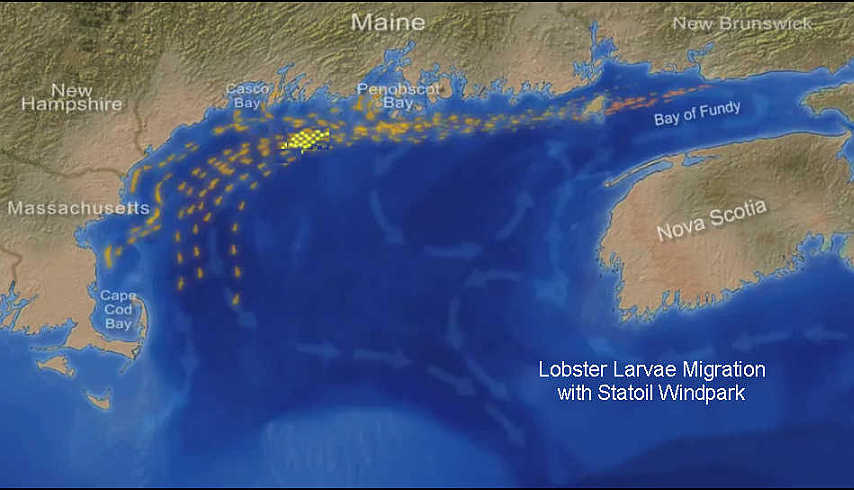
Huber and others are concerned that the kilometers-wide water upwellings produced year round by deepwater wind parks could slow or divert the movement of fish and shellfish larvae using the  Gulf of Maine's natural coastal currents to migrate during their early lifestage as plankton.  See a short
simulation of lobster larvae being diverted away from the coast by the пропсоед Statoil windpark (Youtube) Huber said this could reduce the number of these young animals reaching their normal settling habitats off shore of Maine, New Hampshire and Massachusetts, where they grow to commercial maturity.

These can be long migrations. "Many of Maine’s lobsters, for example, originate in Canada’s Bay of Fundy," Huber wrote to the King, "while many of Maine’s atlantic bluefin tuna arise in the Gulf of Mexico."


Mr. Huber met with a prominent New England researcher at the December 8, 2011 meeting.   "I spoke with Professor Peter Jumars, head of the University of Maine's School of Marine Sciences." Huber said. "He said that it is possible that the four deepwater turbines that Statoil proposes installing off Maine could together extract enough wind energy  to trigger the upwelling effect that Dr Brostrom describes." 

Huber notes that the university's 2011 Maine Offshore Wind Report cites Goran Brostrom's study  five times as it considered its own DeepCwind deepwater wind park plan.

Unfortunately the University of Maine's oceanographers have been denied repeatedly when seeking funding to study potential water circulation effects of siting deepwater windfarms in the existing Gulf of Maine  water currents, according to Dr. Jumars. 

This is why a greater global effort needs to take place now Huber said. 
"Norway could start by   funding such water circulation research for this project off Maine." he said. "Nearly every coastal nation is interested in deepwater wind power; however, many of them also lack sufficient oceanographic institutions to make informed decisions. 

If Statoil wishes to lead the world's deepwater wind exploitation,
then it needs to think on the large scale, and underwrite the expenses of a global colloquium on this topic, Huber said. 

The Penobscot Bay Watch letter to King Harald notes His Majesty's familiarity with and support for deepwater windpower extraction, and asks him to be "the one who convenes this international colloquium". 

It
takes someone of the stature of King Harold as an energy leader to pull such a meeting together, Huber believes.

"We ask you as leader of your county, and as a world leader in ocean windpower development, to call for suspension of deepwater windpark licensing until such time as siting standards are developed that evaluate the impact of these proposals on existing water currents and ichthyoplankton."


The letter closes by stating  "Many who otherwise support ocean windparks will be grateful to you for your caution and foresightedness in ensuring that both seafood and electricity comes in abundance from the world’s oceans."


--