Search

Showing posts with label Norway. Show all posts

Oct 19, 2018

Nordic submits its DEP discharge permit application. Read in 19 sections

On October 19, 2018, Nordic AquaFarms (NAF) submitted its application to discharge wastewater into Penobscot Bay to Gregg Wood of Maine DEP.  Below, read the application broken into its sections for ease of reading . Pg #s 1 - 222 are pagination on  pdf file of the full application

1. Pg 1 General Application (4pgs)

2. Pg 5 Options and Purchase agreement 15 pages

3. Pg 20 Real Property & Lease Property. 26 pages

4. Pg 60. Submerged lands application (pipeline). 9 pages

5. Page 69 Wastewater Treatment 9 pages

7. Pg 78. Overall Project Development and Discharge Summary 11pgs

8 Pg 89 Far-field Dilution of Proposed discharge.  9pgs

9 pg 98  Ramboll Belfast Bay Surface Water Discharge Assessment 5pgs

10. Page 103 . Water Quality Summary Belfast Bay. 23pgs

11.  Pg 126 Abutters 7 pgs

12. Pg 133. Public Information meetings.  9pgs

13. Pg 142 Transcript of Public meetings 52 pages 

14. Pg 194  Waiver of presubmission meeting 2pgs

15. Pg 196  Food Processing Facilities 8pgs

16. Pg 204  New Sources and New Dischargers Application for Permit to Discharge Process Wastewater. 6pgs

17. Pg 216  Chemicals used in fish farm 4pgs 

18. Pg 220 Outfall Information

19 Pg 222  to End. Questions and answers  from October 4, 2018 Public Information Meeting. 17pgs


Dec 19, 2011

Protest reaches out to King Harald V re Norwegian plan to site ocean windpark off Maine.


South Portland, Maine. A long time Maine coastal conservation group has sent a letter to King Harold V. (Also attached as a pdf file.) The letter was sent December 10, 2011 following the December 8, 2011 meeting held by the US Bureau of Ocean Energy Management in South Portland, Maine,where a plan by Statoil to build and install a floating ocean windpark 12 miles off the Maine coast was introduced.  (Meeting agenda here)   (Media coverage here )

The December 10, 2011 letter, signed by Penobscot Bay Watch executive director Ronald Huber, asks His Majesty to call for a moratorium on deepwater ocean windparks  "until after an international committee of oceanographers considers the implications of the findings of Norwegian researcher Göran Broström and others, and develops standards to ensure ichthyoplankton-safe placement of deepwater ocean wind parks."

"Our world is on the verge of intensive shallow and deepwater ocean wind development

off nearly every coastal nation," the coastal conservation group's leader wrote. "While deepwater wind energy extraction will help our species’ struggle to escape the carbon era, it must be introduced precautionarily, lest expensive mistakes be made in the first flurry of exploitation."

Huber cites a research study by 
Dr. Brostrom  of the Norwegian Meteorological Institute,  entitled  "On the influence of large wind farms on the upper ocean circulation." the report shows that energy extraction by ocean windmills can generate large localized upwellings of seawater beneath the ocean windmills, "sufficiently enough that the local ecosystem will most likely be strongly influenced by the presence of a wind farm."   (Göran Broström, Norwegian Meteorological  Institute, 2008) See also Brostrom 2009 powerpoint: Can Ocean Windmills affect the Climate?

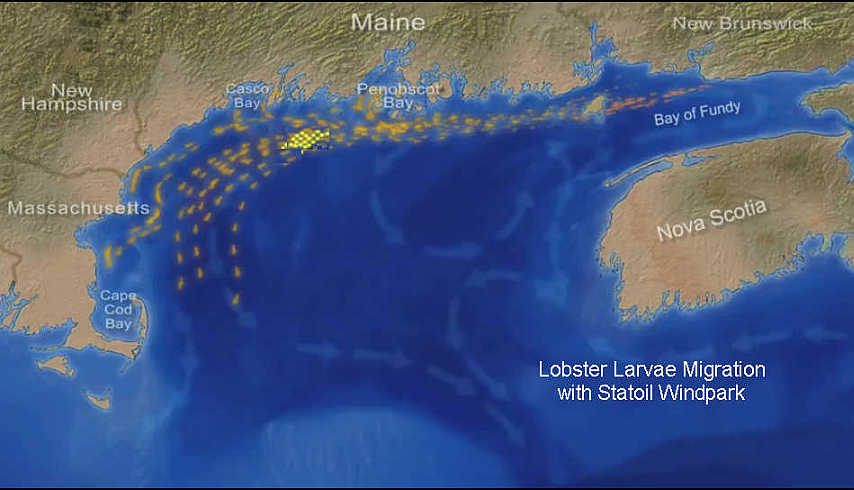
Huber and others are concerned that the kilometers-wide water upwellings produced year round by deepwater wind parks could slow or divert the movement of fish and shellfish larvae using the  Gulf of Maine's natural coastal currents to migrate during their early lifestage as plankton.  See a short
simulation of lobster larvae being diverted away from the coast by the пропсоед Statoil windpark (Youtube) Huber said this could reduce the number of these young animals reaching their normal settling habitats off shore of Maine, New Hampshire and Massachusetts, where they grow to commercial maturity.

These can be long migrations. "Many of Maine’s lobsters, for example, originate in Canada’s Bay of Fundy," Huber wrote to the King, "while many of Maine’s atlantic bluefin tuna arise in the Gulf of Mexico."


Mr. Huber met with a prominent New England researcher at the December 8, 2011 meeting.   "I spoke with Professor Peter Jumars, head of the University of Maine's School of Marine Sciences." Huber said. "He said that it is possible that the four deepwater turbines that Statoil proposes installing off Maine could together extract enough wind energy  to trigger the upwelling effect that Dr Brostrom describes." 

Huber notes that the university's 2011 Maine Offshore Wind Report cites Goran Brostrom's study  five times as it considered its own DeepCwind deepwater wind park plan.

Unfortunately the University of Maine's oceanographers have been denied repeatedly when seeking funding to study potential water circulation effects of siting deepwater windfarms in the existing Gulf of Maine  water currents, according to Dr. Jumars. 

This is why a greater global effort needs to take place now Huber said. 
"Norway could start by   funding such water circulation research for this project off Maine." he said. "Nearly every coastal nation is interested in deepwater wind power; however, many of them also lack sufficient oceanographic institutions to make informed decisions. 

If Statoil wishes to lead the world's deepwater wind exploitation,
then it needs to think on the large scale, and underwrite the expenses of a global colloquium on this topic, Huber said. 

The Penobscot Bay Watch letter to King Harald notes His Majesty's familiarity with and support for deepwater windpower extraction, and asks him to be "the one who convenes this international colloquium". 

It
takes someone of the stature of King Harold as an energy leader to pull such a meeting together, Huber believes.

"We ask you as leader of your county, and as a world leader in ocean windpower development, to call for suspension of deepwater windpark licensing until such time as siting standards are developed that evaluate the impact of these proposals on existing water currents and ichthyoplankton."


The letter closes by stating  "Many who otherwise support ocean windparks will be grateful to you for your caution and foresightedness in ensuring that both seafood and electricity comes in abundance from the world’s oceans."


--


Dec 9, 2011

Norwegian Wind: federal/state task force discusses Statoil plan for floating windfarm 12+ miles off Boothbay Hbr.

Media Coverage of the December 8, 2011,  Bureau of Ocean Management meeting on the Norwegian proposal to emplace a windfarm in waters 12 miles off Midcoast Maine. 

While most of the coverage was supportive, a precautionary note was struck by the Bay Watch, as the stories  extracted from Google News show.  In addition, the  absence of any officials or even representatives of energy giant Statoil at this meeting on their proposal was felt to be an insult to the assembled officials of the towns and fishing industries that would be affected by their plan present..

WCSH-TV, Channel 6. Portland."While environmental groups believe harnessing the ocean's winds for power could provide a tremendous source of renewable energy, some are concerned about the potential impacts on a variety of sea creatures:

"We have a lot of concerns that they have not looked into all the ecological implications of what transpires when you set up ocean windmills," stated Ron Huber, executive director of Penobscot Bay Watch.  He hopes more research is done before major investments are made into off-shore wind power projects.
  
Norwegian Company Pitches Floating Wind Farm off Maine Coast   MPBN News: "Environmental activist Ron Huber heads a group called Penobscot Bay Watch.  " Earlier this year Interior Secretary Ken Salazar said they would make every effort to make sure that these proposals were not in areas that were fisheries sensitive."
"And the area they're looking at is an extremely important fishery zone for both scallop fisheries, ground fisheries and lobster fisheries,"  Huber says.  "So we think they're not really going quite in good faith with that." End of excerpt
Nevertheless the meeting shouldered on. The State representative representing Boothbay Harbor - where the extracted power would come ashore - had many questions, including from his own fishermen who are concerned that a prime area for atlantic bluefin tuna would be in the midst of this.  But strangely absent from media coverage of the meeting was the fact that not a single representative of the Norwegian company or its government was present to offer any details on the project.  
The BOEM officials produced a bland  four page document from Statoil. It was quite free of any details ,then  a string of functionaries from American agencies  used powerpoints and posters to explain their bits of the puzzle. 
But without the Norwegian company's officials present, the meeting was strangely unfulfilling, like 
Stay tuned, audio recordings of the meeting will be uploaded on the Bay Blog shortly.


Dec 7, 2011

Protestors to picket Norwegian offshore windfarm meeting in Portland.


Protestors to picket Norwegian ocean windfarm meeting in Portland on December 8th.
STATOIL is here! Will they plunder  Maine's offshore wind ?
Cite "betrayal" by Dept of Interior, risk to fisheries, ask for King of Norway's help

South Portland, Maine
. Tomorrow's meeting of the  US Bureau of Ocean Energy Management in South Portland will have an unexpected beginning, as demonstrators concerned about Norwegian energy giant Statoil's ocean windmill plan for waters off Maine greet incoming meeting goers with a variety of signs and props, near the entrance to the event's location, the Marriott Sable Oaks Hotel.

Protestors say:

1. They feel betrayed by US Interior Secretary Kenneth Salazar. 
On August 18th, Salazar promised that there would be no windmills in "Fishery Sensitive Areas".

Yet the area chosen by  Norwegian state-owned energy giant Statoil, say protestors,  is well known by fishermen and scientists alike for its important role in transporting the larvae of lobsters, scallops and other  seafood species down the coast of southern Maine, New Hampshire and Massachusetts.
"There's nothing more sensitive than this part of their life cycles" said Ron Huber of Penobscot Bay Watch. "Disrupting them could cost millions in lost fishing income. What is Salazar thinking?"

2. Norway is risking American fisheries. Norwegian research shows that energy extraction by ocean windmills generates large localized upwellings of seawater beneath the ocean windmills, "sufficiently enough that the local ecosystem will most likely be strongly influenced by the presence of a wind farm." according to  Norwegian meteorological researcher Goran Brostrom.
When ocean wind mills operate, millions of gallons of water are pulled from the seafloor to the surface.

"It seems that Statoil is proposing ocean windfarms here because it is better to risk Maine's coastal marine ecosystem than Norway's. Why not do its experimenting off its own coast?"

3.Norway's King can help. Huber said a letter is being sent to King Harald V of Norway, asking that he convene an international colloquium or conference to get to the bottom of the upwellings issue.

"His Majesty is extremely knowledgeable about ocean windpower. He neds to understand It is vital that this important knowledge gap be filled, as nations around the seven seas are poised to start setting out thousands of  ocean windmills. Only someone of his stature, credibility and influence can make such a conference happen. This is portant to carry out to prevent any major marine ecological blunders by well meaning nations seeking renewable energy."

4. Maine citizens will not be allowed to speak or ask questions on the record during the event.  While the decisions made at the BOEM meeting will affect all Maine citizens, and will cover areas that of vital importance to fishermen and environmentalists alike, those citizens are banned from speaking during the daylong event.

"This is a disgrace and a slap in the face to all Mainers." Huber said. "The federal government and a foreign government are going to decide the future of the waters off Maine and we citizens are to keep our mouths shut?"  Huber said that he and other demonstrators will have their mouths taped shut while attending the meeting, to get the point across.

"They tried this last year," he said. We complained to Olympia Snowe and Governor Baldacci, and they changed their tune.  Hopefully, Governor Lepage has the pull that his predecessor has and can let Maine people speak at this event."

For more information on Maine and offshore wind  Click here

###