Search

Showing posts with label RAS. Show all posts

Oct 21, 2021

LBA bill of 2019

A  bill that I had introduced in 2019   by Belfast State Rep Janice Dodge.  Require cumulative impact study when more than  one  Land Based Aquaculture  operation  gets proposed in a  single waterbody. (a bay or reach of a river)

1.LD 620, HP 448,129th LegislatureAn Act Regarding Licensing of Land-based Aquaculture Facilities
 
CLICK HERE for testimony for and aagainst  LD620

Sep 4, 2021

Mercury -safe? Is the fish you are eating mercury safe? Maine DEP does NOT want you to know?

 2 MERCURY

We are requesting expansion of Maine's safe eating guidelines for fresh water and salt water species to include Recirculating Aquaculture System (RAS)  salmon tankfarms  raised in waters with known mercury restrictions based on those guidelines.

Specifically the new label would be for Atlantic Salmon and other fishes raised in Recirculating Aquaculture System facilities , when the incoming habitat water for the tank-farmed salmon is taken from rivers and/or lakes with fish or seafood consumption warnings imposed by the state for pregnant and nursing women, women who may get pregnant, and children under the age of 8.

Or where wild harvest is  prohibited due to mercury concerns as in the case of Lower Penobscot River's lobster and crab fisheries.

We think that  DEP has erred by declining to  adopt  an incremental precautionary approach to the health safety impacts from the introduction of the new Recirculating Aquaculture into Maine's top wild salmon waters: Penobscot  River and Penobscot Bay. 

Expressing an inadequate “best professional judgement” that the fish grown in a lower Penobscot river-dependent RAS operation proposed for Bucksport probably would not violate state mercury safety standards.

Importantly, even then,  DEP is only referring to the discharge wastewater, not the content of the flesh of the fishes themselves.

Suspended mercury levels in these waters will  vary  as tanker ships, cruiseships  tugboats  and the annual snow melt  stir up  and re-elevate mercury-tainted  lower river sediments .  Whatever  systems the company proposes for mercury removal from incoming river and lake water must be able to adapt as the area's water concentrations of methylmercury  rise and fall.

Our concern is that,  despite their best efforts, the mercury concentrations in the RAS salmon fish tissues will fluctuate.  This would vary based on the location and seasonality of the salt wedge in the lower Penobscot River, where sediments can resuspend as currents collide at this fresh salt interface.

For that reason, we believe that  mercury advisory guidelines be developed.specifically for fishes raised in tanks whose waters are sourced in lower Penobscot River  and Hancock County lakes and ponds. 

The state  currently suggests that fish from waters of "Penobscot River below Lincoln" be limited to  "1-2 fish meals per month" 

Penobscot River below Lincoln:

1-2 fish meals a month

   While it may never need to be imposed, it is critical for the public health agencies have an advisory's language already drafted for this new class of salmon, that, unlike landlocked salmon and open ocean net pen salmon, must spend their entire lives bathing & breathing waters known to have elevated mercury levels. The potential for significant mercury uptake in RAS tank farmed salmon is real in our estimation.

It is prudent for the State of Maine to act NOW and preemptively develop a guideline mercury standard for the flesh of RAS fish raised entirely using state waters known to be contaminated by that metal. For RAS applicants the potential for label requirements will be a powerful incentive to those and future applicants to take this issue very seriously from the start.

The new advisory and label will be timely. This new system of fish farming in Maine is drawing many investors. Maine is touted by the seafood industry press and media as one of the most desirable states in which to operate these facilities. We have little doubt that Penobscot Bay and its tidal rivers will feature greatly in such initiatives,

It is imprudent to waiting until more of these facilities dot the shores of Maine rivers, bays and coasts, and the industry gets the clout to challenge creation of such standards.

Such an advisory label, clearly visible to potential buyers,would be used by: in three venues

* Wholesale distributors' invoices of product from a RAS facility with such water quality challenges.

* Retail and online outlets where said product is sold fresh, frozen or processed, 

* Advertisements and commercials promoting said product from that facility


At Issue: Unlike landlocked salmon, RAS farmed salmon are raised in both freshwater and saltwater tanks during different stages of their lives. When the freshwater for an RAS facility is drawn from a lake sufficiently contaminated with mercury to have an advisory for its fishes, and then the saltwater for that facility's fishes' post-smolt phase of their lives is drawn from a section of a river closed to crustacean harvesting due to mercury contamination, the farmed fish will have at least double the exposure to mercury.

Our mercury advisory request presently concerns the proposed use of Penobscot River water pumped ashore in Bucksport Maine to raise Atlantic salmon in a land based recirculating aquaculture  operation that would be joined by freshwater from a Bucksport Lake that also has a mercury advisory.

According to court ordered and peer reviewed studies, the high turbulence of river waters adjacent to the town of Bucksport resuspends more mercury into the water column there than anywhere else on the river.

Source: Penobscot River Mercury Study, Chapter 7 "Field Investigations of Hydrodynamics and Particle Transport in Penobscot River and Bay", See Figure 7A.


Significantly, the level of mercury  in this reach of waters may be grossly underestimated, due to incomplete testing. After revealing very high levels of resuspended mercury, the sampling device used in the Penobscot River Mercury Study failed, preventing a fuller understanding of the mercury content of the Bucksport water column. ( (PMRS Ch7).


A  RAS facility that uses river and lake waters that are under mercury advisories may assert that certain filtering processes will remove a large percentage of  mercury from those waters before their seafood species are immersed in it. 

This is only a partial removal at best, and is yet to be proven for waters pumped continually into and through the facility at a very high rate and in such large amounts, as RAS facilities require,  with varying levels of mercury in them

At best the organisms raised in such waters their entire lives would have lower levels of mercury (but most certainly not mercury-free) 


At worst would have MEHG levels above the state's food safety advisory trigger. That they are raised in a concentrated area with little of the variability of wild fishes.

Moreover the aforenoted incomplete records of mercury contamination off Bucksport may skew the decision making on how much mercury must be removed to let the RAS facility's fish avoid labeling.


Until such time as a reliable study clarifies the amounts of mercury actually in Bucksport waters,  we request the department to be responsibly precautionary and require safe eating guidelines labeling of aquaculture products raised in waters that are under state and/or federal mercury advisories.    


In closing, we must again emphasize that as interest in siting RAS aquaculture facilities in Maine grows ,it is imperative that the state of Maine protect health of consumers of RAS aquaculture products raised with such waters, by requiring the appropriate health advisory labels to be affixed to the products  whether fresh, frozen or processed.


The advisory would warn pregnant and nursing women, women who may get pregnant, and children under age 8 not to consume  fishes from RAS facilities raising fishes using significantly mercury  contaminated waters, and for others to limit their consumption of salmon from such a facility to once per month.


SUGGESTION We would like to work with Maine CDC  and this new industry to ensure that our concerns are reviewed and that, as needed, the products of  land based recirculating aquaculture systems are listed appropriately in the state's  Safe Fish Eating Guidelines.


May 30, 2021

GE salmon and RAS aquaculture: Biotech guy says it'll improve RAS tankfish salmon farming.

    On April 27, 2021, Under Current News' Matt Craze  held a webinar with a group of RAS aquaculture experts from around the world,  on the status of efforts to "mainstream"  land based fish farms.  Titled "Dissecting the land-based aquaculture trend", It seems the New Frontier is  genetically engineering  fish to fit the technology and new feeds,  instead of improving  technology to fit the fishes' needs!   

Matt Craze's question to  GE Fish expert John Buchanon of the Center for Aquaculture Technologies:   "What's your angle on the broad challenges to Land Based Aquaculture  becoming mainstream?  

JB:  "Could argue it's  already become mainstream. Lots of discretions and investment and activity in the sector.  Big  commitments initially were around engineering - and it's still a major focus

"Feed obviously has to be a focus.  The way the diets  are formulated  is quite different. It needs to be optimized for RAS food.  

"Last step of the puzzle is the genetics of the fish. RAS is a very capital intensive investment. Elements are very well understood.  Once you get to scale, then investment in improving the fish  makes sense.

"We are approaching that point, especially for salmon, but many other species, for improvement in growth as you are moving fish through the tanks;  while you're waiting for the biomass to grow. There's inefficiency there that can be recaptured with faster growing fish. Very simply.

"Obviously better SCR or  the waste products from the fish  that allow biofilter to support a larger biomass would be fundamentally transformative  to the the industry and to profitability

"In my past I was director of R&D for Aqua Bounty. We are looking at biotech solutions to solve these problems. They can be addressed though breeding and new technologies in genome editing.  RAS is also contained.  

"There's  a lot of benefits to really taking the next step in the industry and getting the genetics to complement both the  feeds and the engineering. A good opportunity for the future."

End excerpt.


May 29, 2021

Land based salmon aquaculture trend webinar April 27, 2021

 On April  27, 2021 Undercurrents News held a webinar  Dissecting the land-based aquaculture trend.

Start with introductions. Then host Matt Craze  summarizes the state of LBA,   A discussion of the sustainble trophic LBAs .What biotech is up to.   Then listen to the the struggle between East and West:  the Asian model:  investing in  small farms that grow inexpensive species, affordable to rich and poor alike vs the West's AQ strategy of   growing and peddling its elitist 11 dollars a pound salmon fillets. Salmon will feed the world!"  Don't be ridiculous!

0.short quote

1 Introduction of speakers 5min 34sec

2 Matt Craze  the state of LBA globally 4min 25sec

3 Sustainable Trophic LBA 3min 

4 Biotech 2min 6sec

5 Low Cost Asian LBA less expensive species 4min 33sec_

PONDERABLE:  how far will Kingfish AQ's  waste output effluents  be transported by the Eastern Maine Coastal Current?

\\


from:
Undercurrents
Tuesday, Apr 27, 2021John Buchanan, Jeff Cheng, Roberto Tishler, Ohad Maiman, Stian Rognlid, Matt Craze


According to Matt Craze of Undercurrent News  Land-based aquaculture is  a currently huge interest to investors.    Atlantic Sapphire has built a major salmon farm at an inland location near Miami and several other well-financed are set to follow in the company's footsteps. 
Conventional coastal salmon farming companies have mastered the art of using recirculating aquaculture systems (RAS) to grow large smolt that can spend less time in the sea. 

But RAS could be a panacea for a host of new species that can be grown around the world. We explore this new innovation, from crayfish in China and Taiwan to yellowtail seriola farms in the Netherlan


Dec 18, 2020

Upstream Watch files appeal of Maine's okay of Nordic AQ's permits

 On December 16, 2020 environmental group Upstream Watch filed an 80-C appeal of a recent Maine Board of Environmental Protection's  approval  of water and air pollution permits  for Nordic Aquafarms.  (Read appeal below) The company has proposed  building a large land based salmon farm in Belfast, Maine that would  take in water from Penobscot Bay  and discharge treated fish wastewater back into the bay.  Below, read the  28 page Upstream Watch appeal, and separately its attachments (PDFs)

Upstream Watch 80-C Superior Court appeal 12/16/20  28 pages.

Attachment A 

Attachment B

Attachment C

Attachment D

Attachment E

Attachment Maps

DEP memo NAF May 20- 21, 2020

Attachment. Service letters


Nov 26, 2020

Two oppos to Nordic's salmon tankfarm detail BEP's flawed reasoning in letters to the editor.

Two letters to the editor that were published November 26, 2020, The first is by Amy Grant, President of Upstream Watch; the second by Belfast citizen Lawrence Reichard

1. Questions remain in Nordic permit process
Nordic Aquafarms’ permitting process with the Department of Environmental Protection is far from over. Board of Environmental Protection member Susan Lessard stated that “this isn’t a period at the end of a sentence but more like three dots.” Nordic has a very steep slope ahead of them to meet the multiple conditions the Department of Environmental Protection requested. Given the opportunity for appeals on many of the permit conditions, this process will drag on for years.

We look forward to getting this in front of a judge and will be filing our appeal in the coming days. The BEP has granted permits that were incomplete and instead is letting Nordic fill in the blanks after the fact. That approach is both illogical and illegal.

The DEP has asked for multiple conditions which would normally be required before permits get approved. Board members questioned the wisdom of applying conditions at the same time as issuing permits, but in the end all votes were unanimous without discussion, suggesting that the vote was predetermined.

At least 12 of the conditions on the site location of development application permit open the door for further appeals that require public hearings. Upstream is fortunate to have a strong science-based team in place to see this process through, however long that may take. Upstream will continue to stand with the need for much more conclusive data and clear answers before construction begins.

The law says that conditions can only be used for minor and easily fixable issues and they are not interchangeable with permit requirements. Permit conditions are allowed to assure compliance with the permit, not to qualify for a permit after the project is constructed. Nordic still has a lot of questions to answer.
By Amy Grant, President, Upstream Watch, Belfast

===========================================================

2. The BEP's fatal flaws
Last week the Maine Board of Environmental Protection approved permits for Nordic Aquafarms' industrial fish farm.

In its decision, BEP ignored and violated many of its own rules and regulations by not requiring Nordic to perform legally mandated studies. Apparently the board is happy to fly blind with the future of Belfast Bay and the woods, wetlands and wildlife habitat Nordic seeks to destroy.

The BEP decision has at least two fatal flaws. Before it can even apply for BEP permits, Nordic must by law establish title, right and interest to all lands it intends to use, but BEP chose to completely ignore very substantial problems with Nordic's TRI. It's ludicrous to rule that Nordic has sufficient TRI while Nordic's TRI is being litigated in court — especially when a Maine court recently ruled that active litigation by definition obviates TRI. The BEP chose to utterly ignore this.

The second flaw is the question of Nordic's competence — or incompetence. As an official BEP intervenor who has repeatedly documented significant Nordic incompetencies, I was barred from addressing these incompetencies in my testimony.

This, too, is ludicrous. As city of Belfast attorney Bill Kelly has urged the Belfast Planning Board to do, the BEP focused exclusively on the viability of Nordic's design, not the company's ability to actually follow that design competently. That's like buying a perfectly viable new Ford and then handing the keys to your 4-year-old child.

Perhaps the worst of all this is that no BEP member lives in Belfast or Northport. Thus none of them will have to live with the consequences of allowing Nordic to daily spew at least 7.7 million gallons of effluent into Belfast Bay, to annually devour at least 630 million gallons of our freshwater, and to destroy our woods, wetlands, wildlife habitat and hiking trails.

With its Nordic decision, the BEP has failed to protect our environment and has failed the people of Maine — all for the sake of wealthy corporate executives and stockholders, and high-end consumers. Let's hope our courts don't follow suit.
By Lawrence Reichard, Belfast

Jun 28, 2020

Taking issue with the Army Corps final Sediment Analysis Plan for Nordic Aquafarms proposed dredging for wastewater and intake water pipelines

Below, read the interleaved commentary  of two of Penobscot Bay's fiercest defenders: Conservation & Environmental Attorney Kim Ervin Tucker's and  Paul Bernaki  licenced  longtime wetlands, uplands and and intertidal and subtidal lands consultant for our area, 

Here the two dissect the  Army Corps of Engineers June 18,2020  Sediment Analysis Plan for Nordic Aquafarm's application to dredge mercury-tainted  sediment from SW Belfast Bay from the intertidal to the   gas crater field  offshore, and lay bare the various anti-bay efforts that  the Mills Administration  has made to try to get  the company's salmon tankfarm plan rubberstamped  into approval.   -RH

"Comments for the record "of the Nordic combined applications before the Maine DEP. It is also a comment for the record of the USACOE applications for the Nordic /Cianbro project . 

     As some of you know , the SAP (Sediment Analysis Plan) forwarded below produced by The USACOE was " released " by the office of Council of the USACOE  on   friday to the Parties { legal intervention parties, Towns and NGO  } of the BEP/DEP  Nordic , multiple application , Major Project review to and through Kim Tucker ESQ council for Mabee /Grace , the Maine Lobstering Union and the Friends of Harriet L Hartley Conservation Area  .

   This "release"  , released  now to everybody, is approximately eight days after Ms Ransom  received it from The Project manager handling the USACOE application for Fill , Structure , Dredging , Sidecasting { deposit into the waters } 

{ Funny I am not familiar with the section of the CWA that details the "temporary" side casting , re Deposit into the waters of dredge spoils and the time limit that qualifies or quantifies "temporary " and the exact method and RIM requirements of the review of such "temporary " activity . } ,Blasting , Removing obstacles , filling depressions ,dewatering dredge spoils, Transport / dewatering from Barges into the waters , speculative Mack point dewatering facility or the resulting point source Discharge . etc .

    It seems that according to the USACOE that the unknown persons  with suitable qualifications on  staff of  the  Maine DEP reviewed the "draft " of this SAP and then again someone signed off on this draft on Behalf of the Maine DEP . [Included in the recent MGL FOAA  Request to DEP , pending]  

   As it is clear that this SAP is as of this point a critical and repeatedly called for and then accepted part of the review by the Maine DEP/BEP process , The Maine DMR , and the USACOE process   and that the results of this SAP testing are critical  to this review and constitute  new evidence ;

    I would like you all to know that the record is now reopened on all of the prematurely "closed " records of proceedings before each of the Maine agencies that were and are required by law to review , and to receive comments from the effected towns , citizens , fisheries and NGO  on such important and potentially destructive industrial proposals  .  This is not a question of "if " but a question of How the BEP, the Attorney Generals Office , and the Administration' s of the Maine DEP and DMR will legally proceed with  The Nordic /Cianbro comeuppance resulting in the  resetting  of most if not all of the application review process/ hearings / comment periods on multiple related subject matter . 

{Perhaps the lack of Notice to the Town of Searsport  and Isleboro should be rectified at this point ?}

   The USACOE "record " is never "closed" until final action is taken on a Rivers and Harbors Act and the Clean water Act , application to dredge /fill/deposit/ structure . The Maine DEP in order to "review and accept" the SAP Draft , reopened the record {albeit unknown to the parties } .  

Likewise the formal transmission to   Mr Hiem's Agent for the various Maine DEP applications and the USACOE application , Ms Ransom , constituted the reopening of the record regarding every thing related to the Construction , the Benthic effects , the fisheries impacts, erosion and deposition  of released sediments, the effect on structures in the vicinity of the construction, the effects on the recreational and commercial users of the  Penobscot Bay in regards to all aspects of water quality, fisheries, Critical Fisheries Habitat , the Endangered Species act and  the sediment and erosion control measures , as well as all related aspects of review of the pipeline and its construction and post construction environmental impacts .   

    The subject matter of a SAP and its results are critical to many aspects of the review in regards to  NRPA , CWA , and a host of other federal and Maine agency  acceptance of  expert and lay comments and reviews thereof

{.Too bad the Maine DEP and the Maine office of the USACOE didn't require this SAP as a result of the TIER one  desktop review last year !.} 


Having a detailed analysis of the saturation , the grain size , the contained contaminants , the actual stratifications and "suitability for backfilling "   the geotechnical properties  of these sediments along the proposed pipeline installation and the specific locations and qualities to depth  of the sediments extraction  , will create a new set of reviewable data that will require the engagement of suitable experts . { replacing the unacceptable  " only an estimate of unsuitable materials and an unknown level of contaminants in that unknown amount of "unsuitable " dredge spoils ,  on the abandoned location , 

We all will {including Ms Tourangoey} be looking at the actual amounts to be dredged, side cast , re-dredged , dewatered , Blasted , " Hoe -Rammed" etc.    This process of review by the DEP/BEP ,DMR and Experts engaged by the towns and other parties must not be rushed , and especially because of the disruption to "business as usual " aspect of the national and state emergency created by the Pandemic still raging across our country , and  all  resulting considerations of actual Due Process to  be regarded . 

  As to the actual SAP , although the details of the sampling  ,the called for  methods of  extraction of samples  and the lab tests appear to be acceptable in regards to the RIM and Green Book ;  { Thanks Steve } 

     The exclusion of the "resting on the seafloor"  "suspended above  the seafloor" intake pipe, 3OOO foot extension across the Holocene Mud sediments,  out to some 55 feet of depth, directly  effecting Isloboro and Northport/Bayside , and on the very edge of the Pockmark locations and Methane deposits , { as  commented on by Steve Dickson to Maine DEP Land administration, and as shown on the Brothers Graphic , USGS Staff  } ,  from the test locations requirements , despite the comments and questionings of the parties and interested persons, is unacceptable .

   This exclusion from the SAP Sediment Analysis Plan  of this portion of the Cianbro/Nordic construction involving unspecified , un-quantified ,  and  un-located  sediment dredging and sidecasting , including heavy barge mounted equipment "grading and filling " ,

minus an actual to depth geotechnical and chemical contaminant content test and analysis , is an unacceptable risk to the environment in light of the already detailed and in the record of the various  applications to state and federal agencies , detailing the  effects of scour , sediment transport and redeposit ,on the surrounding benthic habitat and the Beaches of Bayside / Northport and Beyond , {as well as DR Petigrews commit that the current and circulations data are insufficient for review of TSS transport and mixing/deposit and contaminant mixing considerations }  

   Failing to include this portion of  large scale industrial installation activity and   the entire footprint of that activity  in  the SAP will only result in further  delay of the  resolution of the issues presented  by the applicant’s proposed activity  and does not serve any ones interest or the LAW . 

  I am disappointed in the exclusion of these issues and locations in the SAP in Spite of the expert  comments in the record supplied by myself and others to these records and directly to the US EPA and The USACOE who have responsibility along with the Maine DEP of the creation of the SAP before us . As the Drafting process was a secret and Internal agency process not FOAA or FOIA accessible , found by SCOTUS  to  be "chilling" on agency and intra  agency review  process ;

   We are left with no recourse other than continue to comment  on the record  that Cianbro heavy construction equipment should not be let loose on the Bay without suitable detailed  plans , showing exact locations and amounts of displacement of marine soils , geotechnical testing and contaminant testing of all areas  of the industrial construction process  for the entire project . 

Thank you all for your attention to these detailed and lengthy considerations of the newly “released” SAP , I look forward to the next several years of thrashing this through with you all . 

Paul Bernacki , Homeplace Team coordinator 


Jun 21, 2020

Maine BEP 5/20/20 audio mp3s deliberative session re Nordic Aquafarms application

On May 20-21 2020  Maine Board of Environmental Protection held a "deliberative session" to consider the memos and other information they had received from DEP's commissioner and bureaus, interested parties & Nordic aquafarms consultants.  Memos discussed at the meeting
Listen below to audio from the 5 hour and 46 minute BEP meeting. (more to come)


* INTRODUCTION

* AIR EMISSIONS

* WATER USE

* NATURAL RESOURCES WETLANDS AND STREAMS


Subsections
(c) BEP QA  to  Muller  &  Wood etc  58min   (overlap of last bit of Wood testimony first .and the acting chairs question Then a break (deleted) ,then chair asks again and questions follow


Feb 13, 2020

Maine BEP comes to Belfast - and listens to the people re Nordic salmon tankfarm plan. AUDIO mp3s

On February 11, 2020 Maine's Board of Environmental Protection came to UMaine's  Hutchinson Center in Belfast It conducted a formal public hearing during the day, and took sworn public comment that evening (link to audio)
 Listen to 2 hours of people from all walks of life (the vast majority in opposition to Nordic's Land based tank farm) speak to the Board members   commercial fishing & filterfarming communities.

RECORDED SPEAKERS

Sidney Block 3min 30sec

Pat Kaplan   2min30sec

Lou MacGregor  1min 15sec

Marsden Brewer 3min

Jennifer Hill, 3min 41sec

Nancy Durand Lanson_3min25sec

Robert Brewer 51sec

Chris Wright. 1min 52sec

Susan Cutting. 3min 30sec

Walden Cutting

Terry Faulkingham 1 min 48sec

Hunter Penney. 50sec

John Murphy 57sec

Christopher  Hyk, 1 min 37sec

Andy Stevenson_3min43sec

Janie Philips 2min49sec

Laurissa Flimlin 2min 30sec

Peter Del Greco (Pres/CEO Maine & Co) 3min_43sec

Linda  Sylvia O'Connor 2min39sec

Samantha Langlois 3min52sec

Conny Hatch 2min55sec

Sally Brophy 3min 42sec

Jim Merkel 7min 42sec

Aimee Moffitt-Mercer 3min34sec

Joanne Moesswilde 4min24sec

Gretchen Heilman &. Piper 4min

Hillary Emma 3min47sec


Samantha Jane Ames Matinicus. 5th generation fisherman

Eric Cohen Salal

Bethany Allgrove 1min 45sec

Geir Gaseidnes 3min

Steve Standard

Jason Raun
           
Ron Huber   

Courtney Beyers
Camille Penn
John Pincince. Maine Guide
Shanna Hanson
BEP question to Eileen Wolper
Close of meeting

Jan 18, 2020

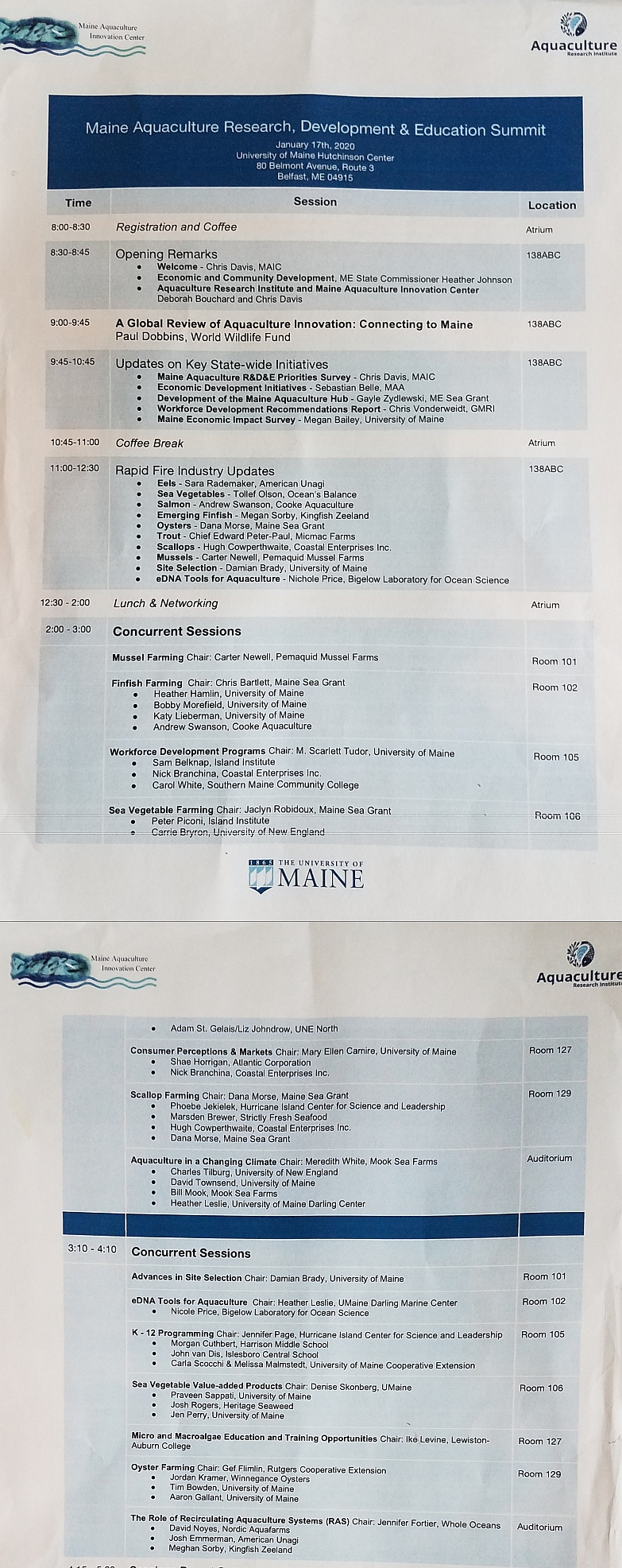
Maine Aquaculture R&D and Education Summit 1/17/2020 Audio Pt 2 .RAS.

On January 17, 2020, the Maine Aquaculture Innovation Center hosted "Maine Aquaculture Research, Development and Education Summit" at the University of Maine Hutchinson Center.  (Read event agenda)  Listen to part 2 The role of RAS systems

*1. RAS Part 1 Public Outreach 19min

*2 RAS  Public Outreach  Introductions

* David  Noyes   Nordic Aquafarms_intro_1min

*3 RAS Public Outreach. Megan Sorby Kingfish Zeeland 8min

*4. RAS  Public Outreach Jennifer Fortier Whole Oceans 2minb47sec

*5  Fish feeds updates discussion 27min 


Mar 10, 2019

News: Second Battle of Penobscot Bay. Melee of estuary and aquaculture interests over fate of estuary

For Immediate Release
PENOBSCOT ESTUARY This dynamic zone, where the dissolved tincture of 8,000 forested square miles of interior Maine  encounters the  Penobscot Bay pressing its salty tides inland, is become a war zone. (cont'd below image)
For more than a year, multinational  and local aquaculture interests, pitted against  community activists  and bay fishery and conservation groups, have  brawled their way through municipal and state hearings and  public events.

Now foes of two land based aquaculture plans, flush from bringing  the  permit review of one to a standstill, are pressing the legislature to make state regulators "think like an estuary" with a series of reform and science bills, the first of which  LD 620 An Act Regarding Licensing of Land-based Aquaculture Facilities -  faces its first committee vote Tuesday in Room  214 of the Cross Building.

LD 620 adds this clause twice  to the existing law when it is deciding whether to deny the application or revoke an existing  one. 

"alone in the use of a body of water or in combination with the aquaculture activity of any other land-based aquaculture operations using the same body of water " 

" Estuaries like ours are small enough and their flushing rate slow enough," said bay activist Ron Huber   "that  while one of these landfarms could be an  lawfully defensible burden,  multiple fish farm effluent discharges, especially of  hormones and other biochemicals released by salmon  could  have a demonstrable unacceptable effect."    He said that  the survival of smolts, elvers  and alewives  transiting the estuary in their migrations could be put at risk. (Continued below image)

The bill gives the Department of Agriculture Conservation and Forestry the authority to  require its consulting agencies, DEP, DMR and DIFW  to prepare a cumulative impacts assessment  when multiple salmon tankfarms  are proposed for a single estuary/ 

Without this,  reformers warn,  Maine is in danger of triggering a goldrush  scramble  for permits  and land leases along the lower river and upper bay.    "I've looked at dozens of Maine agency comments on big  coastal developments and small." said Huber  "Concerns about  the cumulative impact of new projects  when combined with existing ones, rarely enter the calculations. "

One 


LD 620 empowers the Dept of Agriculture to  produce a  big picture of what decisionmakers can expect  for the greater estuary if they approve going ahead with an additional salmon tankfarm. This is vital to smart bay management. 

Agency review of Nordic Aqua Farm's ambitious plan for building one of the world's largest land-based salmon aquaculture facilities  has been suspended, after a sharp-eyed activist tipped attorneys  for NGO Upstream Watch and Maine Lobstering Union, to a glaring fault in the project design,.

Attention has turned to Augusta,  where Tuesday the legislature's  Agriculture, Forestry and Conservation Committee will examine its evidence and conscience, then approve, amend or kill  LD 620 the aquaculture reform  bill.    

Filling the Gap  Critics say the state is so new to land based salmon farming that its selected overseer, the Department of Agriculture Conservation and Forestry, has yet to put together rules and regulations to interpret the one page law, 7 MRSA §1501."Land-based Aquaculture license".  

"Taking on a multinational industry with a flimsy one page statute and non existent rules is an open invitation  to repeat the disastrous start of Maine's fishpen salmon aquaculture in the early 1990s." Huber warned legislators at their earlier public hearing on the bill. "That is when  investors triggered  a gold rush for permits, that were grandfathered in under the then-new  salmon fish pen laws.  Don't worry, they said."

What happened? Too many salmon farms, licensed too close to each other in too many environmentally sketchy areas . The fouled seafloors, disease and parasites  that these immense unmoving schools of salmon  stimulated were as bad for the natural ecosystem outside the pens as for those inside.

It took years  and much bad blood between  conservation and fish pen farmers to bring salmon net penning down to more realistic levels.

"We do  NOT want to go down that same path with a flurry of land based salmon farms pumping effluent into the Penobscot Estuaruy . But we will if we don't  use LD 620 to let the agency take these first steps  slowly."


END

Feb 5, 2019

Whole Oceans as of January 2019

Since  its March 20, 2018 public presentation,   Whole Oceans LLC has rather sailed through a six month journey from application to state permit approval on November  22, 2018. 

This was followed by a  12/17/18 appeal of Whole Oceans permit by bay citizen  Holly Faubel . The  administrative appeal was dismissed January 17, 2019  by Maine Board of Environmental Protection   based on the state's questionable  challenging of her legal standing  - not on the risk identified by Faubel of boosted methylmercury production, and  its circulation into the western bay - her neighborhood -  - thanks to boosted  & concentrated salmon manure production at that critical Bucksport location. See  Faubel's  References & data pages  There, a remnant elemental mercury pool is pushed to and fro by tide and current - and reacts with nutrients such as the  RAS salmon excrete by methylizing with it into much more neurotoxic methylmercury .

There things stand for the moment. Now it is time for state legislative initiatives

Feb 1, 2019

Dec 30, 2018

Two NGOs petition for BEP review of Nordic Aquafarms, interested party status, public hearing.

Below read  petitions by two  organizations sent Maine Department of Environmental Protection in late November. The Maine Lobstering Union and Upsteam Watch asked to be recognized as interested parties regarding the Nordic Aquafarms application to build a salmon tankfarm in Belfast and discharge effluent into Belfast Bay.  They also requested that Maine Board of Environmental Protection take over review of the project and that a public hearing be held.

MLU Petition to Intervene 11/26/18

MLU Request for public hearing on Nordic application 11/26/128

Upstream Watch petition for Maine Board of Environmental Protection to assume Jurisdiction over NAF application 11/26/18

Upstream Watch Request for Public Hearing 11/26/18

Upstream Watch Petition for Interested Party Status 11/26/18

six

Maine DEP acting chief recommends against citizen board review of Nordic Aquafarms plan.

Salmon tankfarm opponents are rightfully livid over Maine DEP's acting chief Melanie Loyzim's actions on the controversial salmon tank farm plans by Nordic Aquaculture proposed to discharge into Belfast Bay
Loyzim denied out of hand petitions from Maine Lobstering Union and Upstream Watch requesting (1) a public hearing and (2) intervenor status. She also declared there was little public interest or controversy, recommending against MLU's request that BEP assume jurisdiction of the review of the project its proposed outfall's proposed contents and its baywater intake.
Read MLU's and Upstream Watch petitions here
Loyzim used indefensible assertio.ns that there was no possible significance to the effluvia of up to 20 million fish per year in the proposed CAFO tanks - largest ever in the United States - discharging out a single pipeline into the bay 24/7. What could go wrong?
Raising and slaughtering up to 20 million fish per year at Nordic and Whole Oceans - one at each end of Penobscot Bay's estuary - is nothing special, Loyzim asserted in her letter to conservation attorney Kim Tucker. Just like any little existing fishfarm, Loyzim smirked, enjoying her brief moment of ecological vandalism at the helm of the disfunctional-under-Lepage agency.
One remembers the good old days of Late McKernan Early Angus King , early baldacci,  when the Board of Environmental Protection performed its duty and routinely heard  citizen appeals - I actually won a special condition added to MBNA's Ducktrap Mtn guest cottage rush job tht was sprawling into an important deer wintering area   No more cottages, BEP announced. How MBNA's VP Shane Flynn howled! 


Oct 20, 2018

Salmon tankfarming - compare Whole Oceans' and Nordic Aqua farms' applications to discharge wastewater

Two different businesses are proposing salmon tankfarming in the Penobscot Estuary:  Whole Oceans in Bucksport and Nordic Aquafarms in Belfast.  Let's compare Whole Oceans' and Nordic Aqua farms' applications to discharge salmon farming wastewater into the estuary,

Whole Oceans discharge application  ***   Nordic Aquafarms discharge application

SECTIONS COMPARISON  Note: Applications were written slightly differently

WO   Part 1 General application 12 pages
NORDIC 1 General Application (4pgs)

WO Purchase & title 27 pg
NORDIC Options and Purchase agreement 15 pages
 Real Property & Lease Property. 26 pages

WO  Food Processing Facility permit 6pgs  
NORDIC  Food Processing Facilities 8pgs

WO *Estimated Annual Chemical Use for outfall 003. 2pgs
NORDIC Chemicals used in fish farm 4pgs 

WO  Outfall information. 3pgs
NORDIC Outfall Information 2pgs

WO  Water Effluent Flows Sterilizing discharges 4pgs
NORDIC   Wastewater Treatment 9 pages


WHOLE OCEANS  ALL SECTIONS

* Discharge application 12 pages

*  Purchase & title 27 pg

* Topographic map 2pgs  Attach c

*  Food Processing Facility permit 6pgs  Attachment D

* US EPA New  Source Dischargers 5pgs

* Water Effluent Flows Sterilizing discharges 4pgs

* Estimated Annual Chemical Use for outfall 003. 2pgs

 * Fish Rearing Application 4pgs

*  Outfall information from WO. 3pgs

*  Description of waste treatment facilities. 10pgs

* Certificate of Public Outreach

*  WO Rsponses to Significant Issues. 3pages

=======================================================

NORDIC ALL SECTIONS

1. Pg 1 General Application (4pgs)

2. Pg 5 Options and Purchase agreement 15 pages

3. Pg 20 Real Property & Lease Property. 26 pages

4. Pg 60. Submerged lands application (pipeline). 9 pages

5. Page 69 Wastewater Treatment 9 pages

7. Pg 78. Overall Project Development and Discharge Summary 11pgs

8 Pg 89 Far-field Dilution of Proposed discharge.  9pgs

9 pg 98  Ramboll Belfast Bay Surface Water Discharge Assessment 5pgs

10. Page 103 . Water Quality Summary Belfast Bay. 23pgs

11.  Pg 126 Abutters 7 pgs

12. Pg 133. Public Information meetings.  9pgs

13. Pg 142 Transcript of Public meetings 52 pages 

14. Pg 194  Waiver of presubmission meeting 2pgs

15. Pg 196  Food Processing Facilities 8pgs

16. Pg 204  New Sources and New Dischargers Application for Permit to Discharge Process Wastewater. 6pgs

17. Pg 216  Chemicals used in fish farm 4pgs 

18. Pg 220 Outfall Information

19 Pg 222  to End. Questions and answers  from October 4, 2018 Public Information Meeting. 17pgs