Search

Showing posts with label Bucksport. Show all posts

Dec 12, 2019

Bay Group calls for health advisory labeling of RAS salmon raised in mercury tainted waters

For Immediate release  12/12/19

Contact Ron Huber, 207 691-4634    Adrienne Caldwell 917 753-0563

Penobscot Bay activists call for health advisory labeling of RAS salmon raised in mercury tainted waters.

BUCKSPORT. Plans to grow market Atlantic salmon raised  from egg to harvest solely in water from mercury-contaminated waterbodies have raised concerns in Maine over potential dietary health risks for children and pregnant or nursing women.

In response, environmental group Friends of Penobscot Bay (BLOG) has written to the Maine Centers for Disease Control asking the state to develop an advisory label for salmon raised in recirculating aquaculture systems that use mercury tainted waters. Read letter here       

A recent report found Bucksport to be one of the most mercury polluted river towns in Maine.   While the state has strict mercury advisories on nearly all  Maine freshwater fishes,  and such saltwater species as striped bass, shark and swordfish, not so for RAS-farmed salmon.

FOPB noted that in the case of at least one project underway in Maine Whole Oceans LLC, salmon would  be raised  from egg to harvest in giant tanks filled with water piped continuously from  mercury tainted lower Penobscot River.  Ron Huber the group's  executive director  said that  "because of the real potential for significant mercury uptake by RAS tank farmed salmon exposed to these waters, we are asking  Maine Centers  for Disease Control  to expand its public health protections   by developing a warning label for salmon raised in any water that is considered polluted based on the court ordered of the Penobscot River Mercury Study."

 FOPB river coordinator Adrienne Caldwell, of Bucksport, said, “unlike wild salmon and open ocean net-pen salmon, RAS fishes raised solely in facilities that use water from upper Penobscot Bay or the lower Penobscot River will spend their entire lives swimming in and breathing waters known to have elevated mercury levels." 

"Let's be precautionary" she said. "Whole Ocean's claim that Recirculating Aquaculture Systems reduce mercury concentrations isn't good enough."

 Huber summarized the Whole Oceans project as  "in the wrong place at the right time. Yes," he said, " Land-Based Recirculating \Aquaculture is a growth agribiz, but no, the mercury tainted Penobscot estuary is not the place for it to grow."
" I mean, really?" he added. " Pick the most mercury-fouled river in the United States as water supply for your salmon tank farm startups?  If consumers knew, he added "they would be reluctant to buy salmon from that company,

Caldwell wondered "What were they thinking?".

The Friends of Penobscot Bay will be hosting a number of educational field events in the mercury contaminated area.

SUMMARY 
Maine currently has mercury health advisories for  nearly all fishes captured in Maine lakes and ponds, for striped bass, shark and swordfish, and an outright ban on lobstering and crabbing in the lower Penobscot River, due to significant mercury pollution of the waters and sediments.

   Currently, commercial raised atlantic salmon are considered low in mercury. due to the natural flushing activation of the  bays where net pens salmon farms are operated .   Friends of Penobscot Bay's proposal would add an  special advisory for salmon grown in tanks filled with such mercury impacted waters.  The label would recommend zero consumption of such tank-raised fishes by children under eight, or pregnant or nursing mothers - the same as for other fishes living in those waters.

The advisory labels would be required for
* Wholesale salmon distributors' invoices from a RAS facility with such challenges,
* Retail & online outlets where said fish is sold fresh, frozen or processed,
* Advertisements and commercials promoting salmon from that facility.


Friends of Penobscot Bay
People Who Care About Maine's Biggest Bay
POB 1971 Rockland ME 04841  FB: /penobscotbay

Sep 11, 2019

Bucksport's Indian Point pollution legacy - by the numbers

Among many others, two of Bucksport Maine's former top employers, Verso and Champion, left their chemical "signatures" in the land and tidal flats of Indian Point

VERSO  45 spills investigated by Maine DEP

CHAMPION  94 spills investigated by Maine DEP


Aug 30, 2019

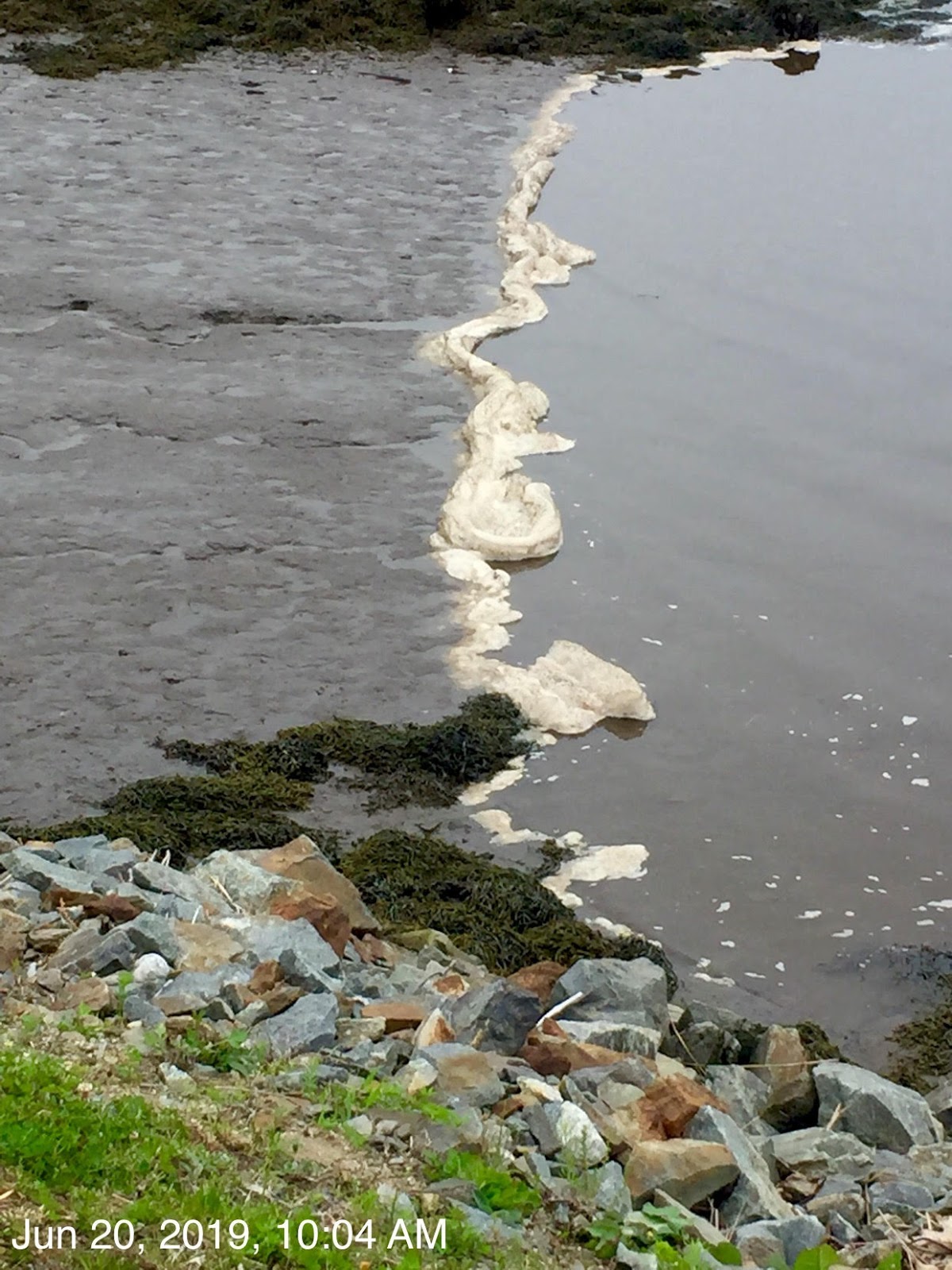
Bucksport mystery foam continues to plague Penobscot River

Sticky gelatinous foams have been appearing along the Bucksport Harbor shore this summer. 

See examples  from three different dates    060719    062019/   082219/

Yet when pressed to investigate, Maine DEP has apparently identified this as politically charged  wasteand has embraced the no-action alternative 

 The agency's behavior has been shameful.  Unacceptable.   Hopefully this a legacy of  Lepageism that will fade under a more enlightened Mills administration

Hopefully....

The  heavily polluted former industrial site is in process of demolition  Its old basements and subbasements are being dug up and cleared out.


Asked to investigate what is washing out of the site, known for its historic high levels of dioxin and mercury  DEP's responders dropped the ball.  They declined our photos or video or refrigerated samples.  Declined to meet with our person on the scene. Declined to issue a report to us. 

Turns out, that  they instead informed Bucksport's town manager of our call.  She the next day informed our River coordinator that there was no problem, nothing to worry about. 

The sort of content free assurance what makes one deeply suspicious, makes one doubt they collected a  drop of goop to confirm or deny it. 

Mar 10, 2019

News: Second Battle of Penobscot Bay. Melee of estuary and aquaculture interests over fate of estuary

For Immediate Release
PENOBSCOT ESTUARY This dynamic zone, where the dissolved tincture of 8,000 forested square miles of interior Maine  encounters the  Penobscot Bay pressing its salty tides inland, is become a war zone. (cont'd below image)
For more than a year, multinational  and local aquaculture interests, pitted against  community activists  and bay fishery and conservation groups, have  brawled their way through municipal and state hearings and  public events.

Now foes of two land based aquaculture plans, flush from bringing  the  permit review of one to a standstill, are pressing the legislature to make state regulators "think like an estuary" with a series of reform and science bills, the first of which  LD 620 An Act Regarding Licensing of Land-based Aquaculture Facilities -  faces its first committee vote Tuesday in Room  214 of the Cross Building.

LD 620 adds this clause twice  to the existing law when it is deciding whether to deny the application or revoke an existing  one. 

"alone in the use of a body of water or in combination with the aquaculture activity of any other land-based aquaculture operations using the same body of water " 

" Estuaries like ours are small enough and their flushing rate slow enough," said bay activist Ron Huber   "that  while one of these landfarms could be an  lawfully defensible burden,  multiple fish farm effluent discharges, especially of  hormones and other biochemicals released by salmon  could  have a demonstrable unacceptable effect."    He said that  the survival of smolts, elvers  and alewives  transiting the estuary in their migrations could be put at risk. (Continued below image)

The bill gives the Department of Agriculture Conservation and Forestry the authority to  require its consulting agencies, DEP, DMR and DIFW  to prepare a cumulative impacts assessment  when multiple salmon tankfarms  are proposed for a single estuary/ 

Without this,  reformers warn,  Maine is in danger of triggering a goldrush  scramble  for permits  and land leases along the lower river and upper bay.    "I've looked at dozens of Maine agency comments on big  coastal developments and small." said Huber  "Concerns about  the cumulative impact of new projects  when combined with existing ones, rarely enter the calculations. "

One 


LD 620 empowers the Dept of Agriculture to  produce a  big picture of what decisionmakers can expect  for the greater estuary if they approve going ahead with an additional salmon tankfarm. This is vital to smart bay management. 

Agency review of Nordic Aqua Farm's ambitious plan for building one of the world's largest land-based salmon aquaculture facilities  has been suspended, after a sharp-eyed activist tipped attorneys  for NGO Upstream Watch and Maine Lobstering Union, to a glaring fault in the project design,.

Attention has turned to Augusta,  where Tuesday the legislature's  Agriculture, Forestry and Conservation Committee will examine its evidence and conscience, then approve, amend or kill  LD 620 the aquaculture reform  bill.    

Filling the Gap  Critics say the state is so new to land based salmon farming that its selected overseer, the Department of Agriculture Conservation and Forestry, has yet to put together rules and regulations to interpret the one page law, 7 MRSA §1501."Land-based Aquaculture license".  

"Taking on a multinational industry with a flimsy one page statute and non existent rules is an open invitation  to repeat the disastrous start of Maine's fishpen salmon aquaculture in the early 1990s." Huber warned legislators at their earlier public hearing on the bill. "That is when  investors triggered  a gold rush for permits, that were grandfathered in under the then-new  salmon fish pen laws.  Don't worry, they said."

What happened? Too many salmon farms, licensed too close to each other in too many environmentally sketchy areas . The fouled seafloors, disease and parasites  that these immense unmoving schools of salmon  stimulated were as bad for the natural ecosystem outside the pens as for those inside.

It took years  and much bad blood between  conservation and fish pen farmers to bring salmon net penning down to more realistic levels.

"We do  NOT want to go down that same path with a flurry of land based salmon farms pumping effluent into the Penobscot Estuaruy . But we will if we don't  use LD 620 to let the agency take these first steps  slowly."


END

Oct 20, 2018

Salmon tankfarming - compare Whole Oceans' and Nordic Aqua farms' applications to discharge wastewater

Two different businesses are proposing salmon tankfarming in the Penobscot Estuary:  Whole Oceans in Bucksport and Nordic Aquafarms in Belfast.  Let's compare Whole Oceans' and Nordic Aqua farms' applications to discharge salmon farming wastewater into the estuary,

Whole Oceans discharge application  ***   Nordic Aquafarms discharge application

SECTIONS COMPARISON  Note: Applications were written slightly differently

WO   Part 1 General application 12 pages
NORDIC 1 General Application (4pgs)

WO Purchase & title 27 pg
NORDIC Options and Purchase agreement 15 pages
 Real Property & Lease Property. 26 pages

WO  Food Processing Facility permit 6pgs  
NORDIC  Food Processing Facilities 8pgs

WO *Estimated Annual Chemical Use for outfall 003. 2pgs
NORDIC Chemicals used in fish farm 4pgs 

WO  Outfall information. 3pgs
NORDIC Outfall Information 2pgs

WO  Water Effluent Flows Sterilizing discharges 4pgs
NORDIC   Wastewater Treatment 9 pages


WHOLE OCEANS  ALL SECTIONS

Discharge application 12 pages

*  Purchase & title 27 pg

Topographic map 2pgs  Attach c

*  Food Processing Facility permit 6pgs  Attachment D

* US EPA New  Source Dischargers 5pgs

Water Effluent Flows Sterilizing discharges 4pgs

* Estimated Annual Chemical Use for outfall 003. 2pgs

 * Fish Rearing Application 4pgs

*  Outfall information from WO. 3pgs

*  Description of waste treatment facilities. 10pgs

* Certificate of Public Outreach

*  WO Rsponses to Significant Issues. 3pages

=======================================================

NORDIC ALL SECTIONS

1. Pg 1 General Application (4pgs)

2. Pg 5 Options and Purchase agreement 15 pages

3. Pg 20 Real Property & Lease Property. 26 pages

4. Pg 60. Submerged lands application (pipeline). 9 pages

5. Page 69 Wastewater Treatment 9 pages

7. Pg 78. Overall Project Development and Discharge Summary 11pgs

8 Pg 89 Far-field Dilution of Proposed discharge.  9pgs

9 pg 98  Ramboll Belfast Bay Surface Water Discharge Assessment 5pgs

10. Page 103 . Water Quality Summary Belfast Bay. 23pgs

11.  Pg 126 Abutters 7 pgs

12. Pg 133. Public Information meetings.  9pgs

13. Pg 142 Transcript of Public meetings 52 pages 

14. Pg 194  Waiver of presubmission meeting 2pgs

15. Pg 196  Food Processing Facilities 8pgs

16. Pg 204  New Sources and New Dischargers Application for Permit to Discharge Process Wastewater. 6pgs

17. Pg 216  Chemicals used in fish farm 4pgs 

18. Pg 220 Outfall Information

19 Pg 222  to End. Questions and answers  from October 4, 2018 Public Information Meeting. 17pgs

Jul 7, 2018

Whole Oceans discharge application online. Shows importance of chemical biosecurity.

Maine DEP recently released an application by land based salmon farm developer Whole Oceans. READ IT,  AT LINKS BELOW.   WO proposes to uptake and discharge millions of gallons of water to and from the tidal Penobscot River as it passes Bucksport.

The uptaken river waters will be lived within and breathed for a day by millions of atlantic salmon,  replaced by  continually imported riverwater, passing it through the fishes, then discharging into Penobscot River. Maine DEP is lead state agency  on reviewing the permit water, along with a coterie of commenting state agencies: DMR DIFW, MCP,  Submerged Lands and more.

* Part 1 Discharge application 12 pages

*  Purchase & title 27 pg

* Topographic map 2pgs  Attach c

*  Food Processing Facility permit 6pgs  Attachment D

* US EPA New  Source Dischargers 5pgs

* Water Effluent Flows Sterilizing discharges 4pgs

* Estimated Annual Chemical Use for outfall 003. 2pgs

 * Fish Rearing Application 4pgs

*  Outfall information from WO. 3pgs

*  Description of waste treatment facilities. 10pgs

* Certificate of Public Outreach

*  WO Rsponses to Significant Issues. 3pages


Jun 28, 2018

Land-based salmon farming in Maine - how oversight went from DMR to DACF

On November 11, 2017, Maine PUBLIC LAW 2017 CHAPTER 94 came into effect.
Titled  An Act To Transfer Responsibility for Licensing of Landbased Aquaculture from the Department of Marine Resources to the Department of Agriculture, Conservation and Forestry"  It describes the authority for the transfer to the land agriculture agency and how it will decide how safe these are.

Says Department of Agriculture Conservation and Forestry will deny land based salmon aquaculture licenses, if  either DMR or IFW informs DACF  "that the aquaculture activity presents an unreasonable risk to indigenous marine or freshwater life or its environment.Sounds like a strongish standard (no "unreasonable risk"), but only as strong as the information that the agencies have to determine its reasonableness or unreasonableness. Given tthis is new hitherto unused technology, it won't be easy.

Text of Public Law 2017 Ch 94 Law: 
(Sentences separated for ease of reading)

"Transfers authority for the licensing of land-based aquaculture from the Department of Marine Resources and Inland Fisheries & Wildlife to the Department of Agriculture, Conservation and Forestry. 

"The Commissioner of DACF shall refuse to issue a license if the Commissioner receives information from the Commissioner of either DMR or DIFW that the aquaculture activity presents an unreasonable risk to indigenous marine or freshwater life or its environment. 

"The risk factors that DMR and DIFW shall consider include but are not limited to: risk of accidental or intentional introduction of marine or freshwater organisms, or organism products, into the waters of the State, risk of the introduction or spread of disease within the State and interference with the enforcement of possession, size or season limits for wild marine or freshwater organisms. 
"
The Commissioner of DACF shall monitor licensed facilities annually and if there are risks noted such as listed above the Commissioner shall notify DIFW and DMR"

(End )