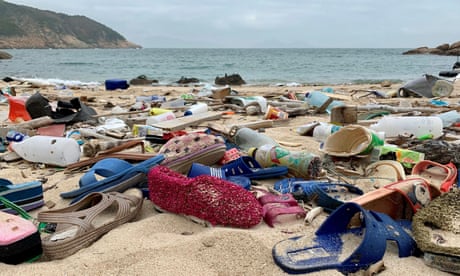
''We're getting Europe's waste?' US hit by plastic debris lost from UK ship
Environmentalists question why waste washing up on Maine coast was being imported from Northern Ireland for energy production
Shredded plastic destined to be burned in a waste-to-electricity plant in Maine has been washing up on the shores of Sears Island. Photograph: Material Research
Brightly coloured plastic debris from the UK has been washing up along the coast of Maine in the US after a shipment bound for incineration fell into the sea.
The plastic debris, part of a 10,000-tonne consignment from Re-Gen Waste, a company based in Newry, Northern Ireland, has infuriated environmentalists and locals surprised to learn that the north-eastern state of Maine is importing plastic from almost 3,000 miles away.
Volunteers struggling to clear the waste from the shoreline of Sears Island, alongside a company employed to tackle it, fear they are fighting a losing battle as more plastic washes up with every tide.
Politicians and environmentalists say the US, which is the world’s biggest producer of plastic waste, should not be importing more plastic. They are concerned about the potential effects on wildlife in Penobscot Bay, home to one of Maine’s first commercial lobster fisheries.
“This event was an unfortunate and preventable accident and speaks to a larger issue, that is, how we process trash,” Genevieve McDonald, a Democratic representative in the Maine legislature, said.
“We should not be in a position where any facility needs to import trash. This came as a surprise to me because I know how much plastic we create in the US.”
McDonald, who is a commercial lobster boat captain and sits on Maine’s marine resource committee, said she was also concerned about the effect of the waste on the area’s wildlife, as well as on the lobster fishery, “a cornerstone of our marine economy here in Maine”.
In a statement, Re-Gen Waste said it was “distressed” to learn of the “unacceptable and entirely preventable” incident. The bales of what it called “waste to energy fuel”, which is diverted from landfill, were being transferred from the MV Sider London cargo ship to Mack Port in Searsport during a storm on 2 December.
During the transfer, by Sprague Energy terminal, two bales fell into Penobscot Bay. One of the bales could not be retrieved, it said, and high winds blew the plastic on to the north-west side of Sears Island. The rest of the consignment was transferred to Penobscot Energy Recovery Company (Perc) in the town of Orrington, to be used to generate electricity.
The Re-Gen Waste statement said: “We have been active in the interim, working closely with Searsport’s town manager, Sprague Energy terminal and Penobscot Energy Recovery Co, to ensure that every measure possible is employed, to redress the situation.
“A crew from Clean Harbors in Hampden was deployed to clean up the plastic that accumulated on the north-west corner of Sears Island, and students from the Maine Ocean School were mobilised to do a further sweep of the shoreline last Friday.
Volunteers have been sweeping the area for debris. Photograph: Ethan Andrews
Re-Gen Waste said it had shipped between 80,000 and 100,000 tonnes of waste into Europe and across the world and this was the first time an “offloading incident” had been reported by a port. The Guardian contacted Sprague Energy and Perc for comment but neither has yet responded.
Ron Huber, a conservationist and executive director of Friends of Penobscot Bay, said he had already been concerned about waste from New York and other parts of New England coming to Maine. “Now we’re getting Europe’s waste as well? This is a real disincentive to reduce waste: ‘Oh we’ll just take your waste and burn it.’”
He said the area was important for wildlife, including moose and deer, and that the bay was host to fish nurseries.
“So many citizens are out there picking up the waste. But the whole thing is a comedy of errors. It shouldn’t have been a week before the agencies responded. They should have nets to make sure waste bales don’t fall into the sea.”
Jim Valette, an anti-waste campaigner who runs Material Research, a “low-profit” company, said the consignment was the biggest export to the US he had seen: “It’s usually going the other way. It’s outrageous it has come to us to clean up Europe’s mess.”
From 1 January, controls on transboundary waste will be tightened under the Basel convention, a treaty covering waste shipments between nearly 190 governments, including the UK. The US has signed but not ratified the convention, but the regulations are expected to affect how it trades in plastic waste.
PENOBSCOT ESTUARY This dynamic zone, where the dissolved tincture of 8,000 forested square miles of interior Maine encounters the Penobscot Bay pressing its salty tides inland, is become a war zone. (cont'd below image)
For more than a year, multinational and local aquaculture interests, pitted against community activists and bay fishery and conservation groups, have brawled their way through municipal and state hearings and public events.
Now foes of two land based aquaculture plans, flush from bringing the permit review of one to a standstill, are pressing the legislature to make state regulators "think like an estuary" with a series of reform and science bills, the first of which LD 620 An Act Regarding Licensing of Land-based Aquaculture Facilities - faces its first committee vote Tuesday in Room 214 of the Cross Building.
LD 620 adds this clause twice to the existing law when it is deciding whether to deny the application or revoke an existing one.
"alone in the use of a body of water or in combination with the aquaculture activity of any other land-based aquaculture operations using the same body of water "
" Estuaries like ours are small enough and their flushing rate slow enough," said bay activist Ron Huber "that while one of these landfarms could be an lawfully defensible burden, multiple fish farm effluent discharges, especially of hormones and other biochemicals released by salmon could have a demonstrable unacceptable effect." He said that the survival of smolts, elvers and alewives transiting the estuary in their migrations could be put at risk. (Continued below image)
The bill gives the Department of Agriculture Conservation and Forestry the authority to require its consulting agencies, DEP, DMR and DIFW to prepare a cumulative impacts assessment when multiple salmon tankfarms are proposed for a single estuary/
Without this, reformers warn, Maine is in danger of triggering a goldrush scramble for permits and land leases along the lower river and upper bay. "I've looked at dozens of Maine agency comments on big coastal developments and small." said Huber "Concerns about the cumulative impact of new projects when combined with existing ones, rarely enter the calculations. " One
LD 620 empowers the Dept of Agriculture to produce a big picture of what decisionmakers can expect for the greater estuary if they approve going ahead with an additional salmon tankfarm. This is vital to smart bay management.
Agency review of Nordic Aqua Farm's ambitious plan for building one of the world's largest land-based salmon aquaculture facilities has been suspended, after a sharp-eyed activist tipped attorneys for NGO Upstream Watch and Maine Lobstering Union, to a glaring fault in the project design,.
Attention has turned to Augusta, where Tuesday the legislature's Agriculture, Forestry and Conservation Committee will examine its evidence and conscience, then approve, amend or kill LD 620 the aquaculture reform bill.
Filling the GapCritics say the state is so new to land based salmon farming that its selected overseer, the Department of Agriculture Conservation and Forestry, has yet to put together rules and regulations to interpret the one page law, 7 MRSA§1501."Land-based Aquaculture license".
"Taking on a multinational industry with a flimsy one page statute and non existent rules is an open invitation to repeat the disastrous start of Maine's fishpen salmon aquaculture in the early 1990s." Huber warned legislators at their earlier public hearing on the bill. "That is when investors triggered a gold rush for permits, that were grandfathered in under the then-new salmon fish pen laws. Don't worry, they said."
What happened? Too many salmon farms, licensed too close to each other in too many environmentally sketchy areas . The fouled seafloors, disease and parasites that these immense unmoving schools of salmon stimulated were as bad for the natural ecosystem outside the pens as for those inside.
It took years and much bad blood between conservation and fish pen farmers to bring salmon net penning down to more realistic levels. "We do NOT want to go down that same path with a flurry of land based salmon farms pumping effluent into the Penobscot Estuaruy . But we will if we don't use LD 620 to let the agency take these first steps slowly."
Incident reports on acid spills oil spills and other chemical at GAC Chemical's Kidder Point property from 1983 to 2012. Click on spill number of the report you wish to read (From the HOSS online pollution spill reports )
Muncipality:SEARSPORT, Keywords: Delta Chemical, General Alum, GAC Chemical Reports are html. If the spill number is not clickable, the spill report is pending.