Check out below the just released proposed consent agreement and supporting documents responding to the December 2, 2020 spill of bales of (plastic) solid recovered fuel by Sprague personnel operating the crane on the M/V Sider London. Then let DEP know what you think
Maine DEPhas announced a 30 day public comment period beginning Friday, September 17, 2021. Details below the links.
Note: Sprague has signed this agreement. But the agency says it will only either accept it or require changes , AFTER they consider the public's information.
WHAT'S NEXT? DEP's Water Quality enforcement Chief Pamela Parker explains: (separated into sections for ease of reading)
"Once the public comment period has ended, the Department will respond to all relevant comments and include those responses in the information provided to the Board of Environmental Protection (BEP) 2 weeks prior to the meeting where this action will be heard.
"The BEP meeting provides another opportunity for public comment.
"After deliberation the Board will vote to approve the agreement or direct staff to amend the document and renegotiate with Sprague.
"You will note that this agreement does not require further remediation of the spilled plastic, after much deliberation, the Department concluded that additional cleanup actions would do more harm than good.
"You will also note that Sprague did not propose a supplemental environmental project, this is always an option for the violator but Sprague chose not to pursue that option as it may have significantly delayed settling this matter.
"If you have comments, please do not hesitate to send them to me."
On December 16, 2020 environmental group Upstream Watch filed an 80-C appeal of a recent Maine Board of Environmental Protection's approval of water and air pollution permits for Nordic Aquafarms. (Read appeal below) The company has proposed building a large land based salmon farm in Belfast, Maine that would take in water from Penobscot Bay and discharge treated fish wastewater back into the bay. Below, read the 28 page Upstream Watch appeal, and separately its attachments (PDFs)
''We're getting Europe's waste?' US hit by plastic debris lost from UK ship
Environmentalists question why waste washing up on Maine coast was being imported from Northern Ireland for energy production
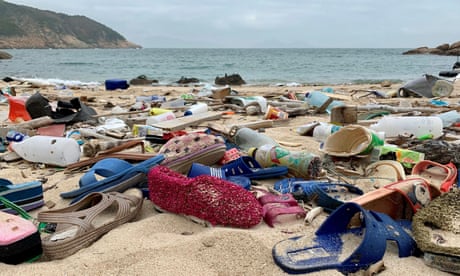
Shredded plastic destined to be burned in a waste-to-electricity plant in Maine has been washing up on the shores of Sears Island. Photograph: Material Research
Brightly coloured plastic debris from the UK has been washing up along the coast of Maine in the US after a shipment bound for incineration fell into the sea.
The plastic debris, part of a 10,000-tonne consignment from Re-Gen Waste, a company based in Newry, Northern Ireland, has infuriated environmentalists and locals surprised to learn that the north-eastern state of Maine is importing plastic from almost 3,000 miles away.
Volunteers struggling to clear the waste from the shoreline of Sears Island, alongside a company employed to tackle it, fear they are fighting a losing battle as more plastic washes up with every tide.
Politicians and environmentalists say the US, which is the world’s biggest producer of plastic waste, should not be importing more plastic. They are concerned about the potential effects on wildlife in Penobscot Bay, home to one of Maine’s first commercial lobster fisheries.
“This event was an unfortunate and preventable accident and speaks to a larger issue, that is, how we process trash,” Genevieve McDonald, a Democratic representative in the Maine legislature, said.
“We should not be in a position where any facility needs to import trash. This came as a surprise to me because I know how much plastic we create in the US.”
McDonald, who is a commercial lobster boat captain and sits on Maine’s marine resource committee, said she was also concerned about the effect of the waste on the area’s wildlife, as well as on the lobster fishery, “a cornerstone of our marine economy here in Maine”.
In a statement, Re-Gen Waste said it was “distressed” to learn of the “unacceptable and entirely preventable” incident. The bales of what it called “waste to energy fuel”, which is diverted from landfill, were being transferred from the MV Sider London cargo ship to Mack Port in Searsport during a storm on 2 December.
During the transfer, by Sprague Energy terminal, two bales fell into Penobscot Bay. One of the bales could not be retrieved, it said, and high winds blew the plastic on to the north-west side of Sears Island. The rest of the consignment was transferred to Penobscot Energy Recovery Company (Perc) in the town of Orrington, to be used to generate electricity.
The Re-Gen Waste statement said: “We have been active in the interim, working closely with Searsport’s town manager, Sprague Energy terminal and Penobscot Energy Recovery Co, to ensure that every measure possible is employed, to redress the situation.
“A crew from Clean Harbors in Hampden was deployed to clean up the plastic that accumulated on the north-west corner of Sears Island, and students from the Maine Ocean School were mobilised to do a further sweep of the shoreline last Friday.
Volunteers have been sweeping the area for debris. Photograph: Ethan Andrews
Re-Gen Waste said it had shipped between 80,000 and 100,000 tonnes of waste into Europe and across the world and this was the first time an “offloading incident” had been reported by a port. The Guardian contacted Sprague Energy and Perc for comment but neither has yet responded.
Ron Huber, a conservationist and executive director of Friends of Penobscot Bay, said he had already been concerned about waste from New York and other parts of New England coming to Maine. “Now we’re getting Europe’s waste as well? This is a real disincentive to reduce waste: ‘Oh we’ll just take your waste and burn it.’”
He said the area was important for wildlife, including moose and deer, and that the bay was host to fish nurseries.
“So many citizens are out there picking up the waste. But the whole thing is a comedy of errors. It shouldn’t have been a week before the agencies responded. They should have nets to make sure waste bales don’t fall into the sea.”
Jim Valette, an anti-waste campaigner who runs Material Research, a “low-profit” company, said the consignment was the biggest export to the US he had seen: “It’s usually going the other way. It’s outrageous it has come to us to clean up Europe’s mess.”
From 1 January, controls on transboundary waste will be tightened under the Basel convention, a treaty covering waste shipments between nearly 190 governments, including the UK. The US has signed but not ratified the convention, but the regulations are expected to affect how it trades in plastic waste.
Two letters to the editor that were published November 26, 2020, The first is by Amy Grant, President of Upstream Watch; the second by Belfast citizen Lawrence Reichard
1. Questions remain in Nordic permit process Nordic Aquafarms’ permitting process with the Department of Environmental Protection is far from over. Board of Environmental Protection member Susan Lessard stated that “this isn’t a period at the end of a sentence but more like three dots.” Nordic has a very steep slope ahead of them to meet the multiple conditions the Department of Environmental Protection requested. Given the opportunity for appeals on many of the permit conditions, this process will drag on for years.
We look forward to getting this in front of a judge and will be filing our appeal in the coming days. The BEP has granted permits that were incomplete and instead is letting Nordic fill in the blanks after the fact. That approach is both illogical and illegal.
The DEP has asked for multiple conditions which would normally be required before permits get approved. Board members questioned the wisdom of applying conditions at the same time as issuing permits, but in the end all votes were unanimous without discussion, suggesting that the vote was predetermined.
At least 12 of the conditions on the site location of development application permit open the door for further appeals that require public hearings. Upstream is fortunate to have a strong science-based team in place to see this process through, however long that may take. Upstream will continue to stand with the need for much more conclusive data and clear answers before construction begins.
The law says that conditions can only be used for minor and easily fixable issues and they are not interchangeable with permit requirements. Permit conditions are allowed to assure compliance with the permit, not to qualify for a permit after the project is constructed. Nordic still has a lot of questions to answer. By Amy Grant, President, Upstream Watch, Belfast
2. The BEP's fatal flaws Last week the Maine Board of Environmental Protection approved permits for Nordic Aquafarms' industrial fish farm.
In its decision, BEP ignored and violated many of its own rules and regulations by not requiring Nordic to perform legally mandated studies. Apparently the board is happy to fly blind with the future of Belfast Bay and the woods, wetlands and wildlife habitat Nordic seeks to destroy.
The BEP decision has at least two fatal flaws. Before it can even apply for BEP permits, Nordic must by law establish title, right and interest to all lands it intends to use, but BEP chose to completely ignore very substantial problems with Nordic's TRI. It's ludicrous to rule that Nordic has sufficient TRI while Nordic's TRI is being litigated in court — especially when a Maine court recently ruled that active litigation by definition obviates TRI. The BEP chose to utterly ignore this.
The second flaw is the question of Nordic's competence — or incompetence. As an official BEP intervenor who has repeatedly documented significant Nordic incompetencies, I was barred from addressing these incompetencies in my testimony.
This, too, is ludicrous. As city of Belfast attorney Bill Kelly has urged the Belfast Planning Board to do, the BEP focused exclusively on the viability of Nordic's design, not the company's ability to actually follow that design competently. That's like buying a perfectly viable new Ford and then handing the keys to your 4-year-old child.
Perhaps the worst of all this is that no BEP member lives in Belfast or Northport. Thus none of them will have to live with the consequences of allowing Nordic to daily spew at least 7.7 million gallons of effluent into Belfast Bay, to annually devour at least 630 million gallons of our freshwater, and to destroy our woods, wetlands, wildlife habitat and hiking trails.
With its Nordic decision, the BEP has failed to protect our environment and has failed the people of Maine — all for the sake of wealthy corporate executives and stockholders, and high-end consumers. Let's hope our courts don't follow suit.
An activist group is claiming that leachate from the state-owned landfill in Old Town is discharged — untreated — into the Penobscot River. This is absolutely false.
“Leachate” is liquid that passes through solid waste in a landfill. Liquid in waste and rainwater that passes through waste is captured within the landfill, conveyed to a secure tank and transported offsite to a treatment plant.
The state-owned landfill is highly engineered with double liners, leak detection systems and a sophisticated liquid conveyance system. It contracts with the Old Town mill for treatment and disposal of its leachate, as required by law.
The Department of Environmental Protection carefully regulates every step in this process. It limits concentrations in discharges and requires monitoring for a range of parameters. The state-owned landfill and the Old Town Mill are fully compliant with these requirements.
The DEP recently reviewed the landfill’s operations relative to future leachate disposal. It concluded that all applicable licensing criteria for proposed waste discharge were met and the discharge won’t lower the quality of the Penobscot River.
There are five licensed wastewater treatment plants north of Old Town discharging to the Penobscot River. There are 11 more discharging further downstream. The amount attributable to the state-owned landfill – all of it treated – is 1/100,000th of the total.
Wastewater and leachate are collected and treated to ensure the safety of our environment. Disposal from the state-owned landfill is compliant with state law, and a miniscule portion of the overall discharges permitted to the river.
On November 3, 2020, Maine Board of Environmental Protection released its amended final draft of its MEPDES Pollution Permit and its Waste Discharge License. Here is the 5 page draft approval decision followed by 15 Special Conditions that the company must meet.
On October 22, 2020, Undercurrent News senior reporter Jason Huffman hosted a webinar entitled Seafood and the American Election 2020 Below are three segments from the 1hr 45min webinar . More to come Full meeting video on youtube)
"New England Aqua Ventus LLC, a joint venture between Diamond Offshore Wind, a subsidiary of Mitsubishi Corp., and German RWE Renewables, the second-largest company in offshore wind globally, has replaced the previous company behind the project, Maine Aqua Ventus 1 GP LLC, according to Jake Ward, vice president for innovation and economic development at the University of Maine."
"Wissemann was joined in the Zoom call by two colleagues at Diamond Offshore Wind, David Deutsch and Duncan McEachern, as well as a consultant recently hired by the company, Genevieve McDonald."
"$100 million in funding for the project, dubbed New England Aqua Ventus I."
"New England Aqua Ventus LLC will lead construction, deployment, and operations for the single 10- to 12-megawatt wind turbine..."
"The university’s Advanced Structures and Composites Center will handle design, engineering, and research and development for the project, and will monitor it once it is operating."
"Chris Wissemann, CEO of Diamond Offshore Wind, spoke for the joint venture and said he hopes to identify a landing site where the underwater cable from the wind turbine can tie into the power grid by the end of 2020:.
"The route of the cable and where it will make land, both points of contention in mainland communities since the initiation of the project several years ago, are not yet clear."
"Wissemann said a central concern is researching the impact that the turbine will have on the ecosystem of the area, particularly on fishermen."
"We think it would be prudent to build only on research that demonstrates how people can operate around these things — how right whales can operate around these things, how fisherman can fish,” Wissemann said."
"New England Aqua Ventus LLC hopes to begin submitting permit applications early next year and start building the foundation in 2022, said Wissemann."
At dredge team meetings, navigation projects large and small that involve excavating out an area of our bay floors, GOM-floor or river floors - and moving the "spoils" to another location - come under discussion by municipal, state and federal officials with dredging part or all of their mandates. Along and with environmentalists and others joining in as the interested public, presenting as well.
The dredge team also reviews proposed or ongoing ecological restoration projects - often more of them than navigation projects. As the minutes of the March 3, 2020 meeting and the October 4, 2019 bear witness to .
At the March 13 meeting, ACOE 's Mark Habel said there were no large scale dredging projects underway in Maine. He then gave updates on the status of small-scale navigation improvement projects presently under consideration in Blue Hill Harbor, Great Chebeague Island. Surry and Brooksville
Non-navigation projects considered at the March 13, 2020 meeting included Pleasant Point (shore protection riprap), Cherryfield Dam on the Narraguagus River (modelling fish passage options), Stratton Island (Proposed shorebird habitat enhancement,) Meduxnekeag River (investigating fish passage& habitat improvement); Pleasant River (culvert replacement and marsh restoration); New Meadows River (improving water quality and enhancing inter-tidal and salt marsh) and Royal River marsh remediation project and fish passage options at the dam and falls on the lower river.
SUMMARIES & AGENDAS & AUDIO OF EARLIER MAINE DREDGE MEETINGS
On September 9, 2020 the Maine Climate Council heard reports from leaders of its subcommittees & working groups: with a focus on emission reductions. Council Reports Link to full mtg recording* *minus meeting opening statements
Attorney Kim Ervin Tucker has been a leader of the effort to keep Land based fishfarm wannabee Nordic Aquafarms building and operating i.e. discharging wastewater from their project into Befast Bay and Penobscot Bay, She is representing the Maine Lobstering Union and the Friends of the Harriet L. Hartley Conservation Area in opposing to the Nordic Aquafarms plan
"The proposed sediment testing plan, as it must for CWA Section 404 reasons, includes the intertidal land that is protected by a recorded Conservation Easement that my clients, Jeffrey Mabee and Judith Grace, own and my other clients, the Friends of the Harriet L. Hartley Conservation Area, hold. I have repeatedly filed documentation demonstrating that NAF has no legally cognizable expectation to use this intertidal land."
.......
"The SAP [Sampling and Analysis Plan] fails to require any sediment testing in the submerged lands area where NAF proposes to place pipes above ground after “grading and filling” to place brackets holding these pipes above the seafloor every 15 feet, secured by cement anchors into this methane-rich, unstable holocene mud.":
"The USACE is aware of the instability of the sediment in this area and the significant methane deposits in this area — it is part of the reason this area has been determined to be unsuitable for dredge spoils disposal since at least 1999.
I"n light of the SAP’s acknowledgement that this area has buried HoltraChem mercury in the upper 1-foot of sediment — including in the area proposed for “grading and filling” that would likely disturb and re-suspend this buried mercury — this omission from the SAP is inexplicable and needs to be corrected immediately."