Search

Feb 24, 2011

DeepCwind Report misses the boat

Today's announcement by the public affairs staff of the University of Maine's DeepCwind Consortium  of the release of its report is raising a few eyebrows.


"Not so fast!" I cautioned, being  a critic of DeepCwind's controversial proposal to site its windpower research site in the middle of  one of the world's most painted, most beloved, most fecund ocean places.   

I was speaking with a TV producer, whose only crew was, alas, nearing Augusta whilst he himself was enroute to Orono, to cover Dr Dagher's latest Dog & Pony show, DeepCwind's report the   "The Offshore Wind Report just issued by DeepCwind raises as many questions as it answers."

"Not only is Judge Jeffrey Hjelm of Knox Superior Court yet to rule on a lawsuit challenging the state's decision to allow the DeepCwind project to be sited off Monhegan," I said,  "the Department of Energy is dragging its feet on deciding whether to fund the DeepCwind project with the tens of millions of bucks the Consortium expects and needs to get moving."

I read to him (and later emailed him) an email I'd gotten from the Department of Energy on why they were already a month late issuing their draft environmental Assessment. Showing how confused things are in fed land, the Dept of Energy's NEPA coordinator wrote that the "DeepCWind project is still going through internal DOE reviews and revisions. I would not be able to give you an exact date but we anticipate posting it for public review and comment in the next 3-8 weeks." 
 
Three to eight weeks away from releasing even the first draft of the necessary Environmental Assessment that must be reviewed and commented on the promised multi-millions of dollars in federal funding become available. And it was supposed to come out in early February. DeepCwind's cash burn rate is one that has eaten up the last million dollars; the next millions may not come quite as quickly as they'd hoped.

I don't see why Dr Dagher and friends are celebrating: the Fat Lady hasn't even cleared her throat yet, let alone sung.

"While the Consortium's  report is hefty, it does not address some of the most critical issues that now the Federal energy regulators are being faced with," I told the newsguy.  "Is one of the other 2 sites along the Maine coast a better location, after all?"

Topping that list of concerns is a need to discover to what extent ocean windmills placed in the path of migrating lobster larvae will divert some of those young lobsters away from Penobscot Bay and out into the deep Gulf of Maine where survival is less likely.

University of Maine Marine scientist Pete Jumars  acknowledges quite candidly in the report that the "upwelling" effects that extracting  wind energy with an ocean windmill are now known to cause will make changes in the Gulf of Maine's water column. in the area beneath the windfarm and 'downstream in the passing currents. 


Where are those locations?   The state has picked four sites right smack in the  midst of the critical Maine Coastal Current, including one the most easterly site, athwart a junction point where a large piece of the Eastern Maine Coastal Current diverts in to Penobscot Bay.
 
But inexplicably, beyond that acknowledgement, is action suggested? Poor Pete Jumars! Caught between the Scylla of scientific rigor and the Charybdis of Cianbro and the rest of the impatiently waiting companies and University of Maine's administrators . In a section of the report apparently written by him,  Jumars accepts Brostrom's 2008 predictions of forced upwellings beneath operating ocean windmills - at 1 meter per day over large area (pg 5-47);  notes that the effects would be noticeable "several kilometers" away (page 5-70); and recommends using upstream and downstream buoys, along with gliders to measure how powerful the upwelling force is, to help them address "potential concerns about increased phytodetrital fluxes to the seabed." (page 5-74 of the report.).  

Bravo Dr! I mean it!

So is it time  to prepare an EIS?  While such a possibility probably leads to sleepless nights for Jumars, Dr. Dagher and the rest of the  deepwater offshore windpower extraction crew, it may be necesssary, unless DeepCwind agrees to a few small but important additional improvements to their research plan. Calling Bob Steneck!

Because while an artificial upwelling is a good thing at the right season, if and when a floating  wind farm is anchored within  in the Eastern Maine Coastal Current, (as  State Planning Office proposes), the oasis of nutrients may confuse and divert passing lobster larvae into perceiving they've reached a good home. A lethal error: given the lack of possibilities for burrowing on a submerged windmill shaft, the lobsters cannot hide, to the great joy of predaceous fishes and seals attracted to the floating poles.

Worse, the natural predators of freeswimming lobster larvae could soon be exploiting the floating windmills' submerged habitats, using them as  bases from which to prey on the passing baby lobsters, which travel  in great numbers every year to Penobscot Bay and points south from Canadian waters of the northern Gulf of Maine.

Finally, the endless plume of water  brought up from the seafloor beneath the anchored  ocean windfarm is dense and cold.  It may form a kind of blockage to the passing  warmer surface current  water and could divert some of the Eastern Maine Coastal Current away from the coast, baby lobsters and all, to an uncertain fate.

But DeepCwind Consortium  doesn’t want to deal with the upwelling issues beyond hoping for the best and hoping on dealing with whatever problems crop up after the fact.

I think the US Department of Energy will have to take on that question, if the court doesn't first. 

Stay tuned!"

BACKGROUND

1. EMAIL from Dept of Energy on delaying decision

From: Margason, Laura <laura.margason@go.doe.gov>
Date: Wed, Feb 16, 2011 at 9:48 AM
Subject: RE: DOE/EA-1792 draft env assessment UMaine DeepCwind - update?
To: Ron Huber <coastwatch@gmail.com>

Mr. Huber,

At this time, the draft Environmental Assessment for the University of
Maine's DeepCWind project is still going through internal DOE reviews
and revisions. I would not be able to give you an exact date but we
anticipate posting it for public review and comment in the next 3-8
weeks. I do have you and your organization on our mailing list for this
project and you will receive a postcard Notice of Availability when it
is out for public review. All our documents are put onto the Golden
Field Office Public Reading Room web site for the public to access.
The web site is http://www.eere.energy.gov/golden/NEPA_DEA.aspx

Thank you,
Laura Margason,  NEPA Specialist, 720.356.1322

2. BROSTROM CITED BY UMAINE RESEARCHER IN RECENT PRESENTATION
Go to page 13 of Pete Jumar's pdf file of his recent presentation; it is the Brostrom paper, with Dr. Jumar's side notes on it

Feb 3, 2011

While Judge Hjelm considers Huber v BPL, a Federal agency's release of a draft EA on financing DeepCWind's start-up project off Monhegan could be a game changer.

All sides in the question of what standards ocean windmills will have to meet off Maine await two big decisions:

1. Knox County Superior Court Judge Jeffrey Hjelm's upcoming decision in Huber v Bureau of Parks & Lands over the sufficiency of the state agency's review of the probable scenic impacts and impacts to migrating seabirds, if the University of Maine's planned  deepwater wind test center two miles off the southern tip of  Monhegan Island goes forward.

2.  This month's release by the US Department of Energy of  a draft environmental assessment of the environmental impact of its proposal to give twenty million dollars to the University of Maine for a pair of  deepwater wind projects. See earlier DOE notice. The plans include::

(A) One or more prototype 1/3 sized  floating windmills (plus  undersea test structures), off Monhegan, &  
(B) A single full scale operational 5 megawatt deepwater floating windmill, to be towed to an as-yet only dimly defined location, either off Monhegan or "20 to 50 miles" offshore, according to the University. 

The agency's assessment must be carried out according the National Environmental Policy Act and the agency's own strict NEPA guidelines (11pg pdf file; ignore the "SUN" references). According to the guidelines, the two DOE officials involved:  Kurt Rautenstrauch and Laura Margason must:

*"Identify any adverse environmental effects that cannot be avoided should this proposed  action be implemented."
* "Evaluate viable alternatives to the proposed action, including a no action alternative."
* "Describe the relationship between local short-term uses of the environment and the maintenance and enhancement of long-term productivity."
* "Characterize any irreversible and irretrievable commitments of resources that would be involved should this proposed action be implemented."


Link to the information and issues supplied by Penobscot Bay Watch to the DOE. 

If Judge Hjelm  takes an approach similar to the one he took in Huber v MDOT, he will wait to see  the Department of Energy's draft  EA: Will the agency agree with Penobscot Bay Watch that more needs to be considered bird-wise, beauty-wise, lobster larvae-wise, currents-impact-wise? If so, then he may rule in in Huber's favor. If not, not.   

Stay tuned. 


Penobscot Bay Watch needs help burning the past.

Though it is in the end a dishonorable and unhealthy burning of our distant ancestors, operating a petrol-powered  personal vehicle is one of those things that one must do to travel regionally in the absence of a regional public transit system, such as is largely the regrettable case of the towns around Penobscot Bay.


Your BayBlogger is looking for a recently-stickered beater for of $2,000 US or less that would ferry the Watch to meetings, hearings, expeditions and investigations around Penobscot Bay and  along with the occasional jaunt to state agency offices in Augusta and Bangor.  Or donate it outright and take a state tax deduction for that value.

Contact the Penobscot Bay Blog at coastwatch@gmail.com or tel 207-593-2744, if you have or know of such a machine.

Jan 30, 2011

When it comes to offshore windpower, the Shadow knows....

The ocean windpower extraction industry is now nervous about how more serious than earlier believed is the problem of "wind shadow" when positioning the mega windcomplexes envisioned off the Atlantic coast far enough apart to not reduce the wind too much between them.  The data from the Norwegian and other european ocean windmill operations is in and it is not pretty.

Read the January 10, 2011 letter from Blue Water Wind to federal wind agency BOEMRE: "...mitigation of potential shadowing effects on the Mid‐Atlantic Wind Park off Delaware must be considered"..."In this case, NRG Bluewater’s analysis indicates that turbines in the northern reaches of the Maryland RFI area will shadow some of the southernmost turbines of the proposed Mid‐Atlantic Wind Park." 

QUESTION: If impact of shadowing is enough to affect the performance of ocean windmills miles away, what affect must  wind energy extraction be having on the energetics of the oceanic ecosystem in the air and water currents flowing though these windparks? The significance of this on coastal currents is only beginning to be understood . Could Penobscot Bay lose its lobsters?  Could the Chesapeake lose its blue crabs? 

The Shadow knows....or those who plan to make those shadows.

Theoretically, yes, if larvae-bearing surface currents are slightly diverted from their landward wind drift by the giant wind armadas proposed to be stationed off the atlantic coast, from Maine to North Carolina, they could very well end of missing their home bays.

Jan 9, 2011

Last month's offshore Maine Wind Conference - links to all speakers' written remarks

Courtesy of the Island Institute, here are pdf files of  speakers’ presentations at the December 14, 2010 offshore windpower conference in Belfast, Maine, Link to Panel 3 audio included.

Panel I – Ocean Energy Goals in Maine

Panel II – Understanding the “Critical Factors”
Panel III - Lessons Learned From Siting Renewable Energy Projects AUDIO of panel

Jan 5, 2011

Maine legislation calls for cutting aerial pesticide notification zone by 90%.


LD 16. An Act To Revise Notification Requirements for Pesticides Applications Using Aircraft or Air-carrier Equipment. Sponsor: Representative Jeffrey Timberlake of Turner, Maine. (9 cosponsors)
summary
This bill changes the notification criteria regarding the application of pesticides by aircraft or air-carrier equipment to a person on a notification registry from 1,320 feet to 100 feet. It also changes the distance requiring notification when pesticides are sprayed into the crowns of fruit trees or Christmas trees using air-carrier equipment from 500 feet to 50 feet.

SPONSOR: Representative Jeffrey Timberlake of Turner.
COSPONSORS:  Representative BLACK of Wilton; Representative CRAFTS of Lisbon, Representative DAVIS of Sangerville, , Representative DUNPHY of Embden, Representative LIBBY of Waterboro, Representative LONG of Sherman, Senator MASON of Androscoggin, Representative VALENTINO of Saco, Representative WOOD of Sabattus
TEXT OF BILL
Be it enacted by the People of the State of Maine as follows:
Sec. 1. 22 MRSA §1471-Z, sub-§3,  as enacted by PL 2009, c. 584, §2, is amended to read:
3. Criteria requiring notification.  A land manager is required to notify a person whose property is on the registry if:
A. Pesticides are being applied using aircraft and the registered property lies within 1,320 100 feet of the intended spray area;
B. Pesticides are being applied using air-carrier equipment and the registered property lies within 1,320 100 feet of the intended spray area; or
C. Notwithstanding paragraph B, pesticides are being applied using air-carrier equipment into the crowns of fruit trees or Christmas trees and the registered property lies within 500 50 feet of the intended spray area. This paragraph is repealed January 1, 2012.

Dec 30, 2010

Mainers are farming their lobsters. Confirmed.

In his 2010 report "Use of Herring Bait to Farm Lobsters in the Gulf of Maine"  Gulf of Maine research institute researcher Jonathan H. Grabowski, says it is "human augmentation" of wild lobsters' natural diets with herring bait that keeps the population of lobsters high and steady.

Is that really "farming"?  Well, yes. Not exactly "herding" the lobsters, but establishing diffused underwater CAFO concentrated animal feedlot operations, only in the case of lobsters, DAFOs Dynamic Animal Feedlot Operations that travel with the migrating lobsters. A sort of crustacean welfare.
 
Of course these feedlots require the hunter/gatherer herring fleets that ply the Gulf of Maine, zone by seasonal zone, seeking out and tapping into the great schools that also feed other fishes, the marine mammals and seabirds.
 
Last year these boats made  60,000 metric tons of herring  (about 132 million individual fishes)  directly available to the bristly palates of  Maine's lobsters via the lobster traps. (Herring average about a pound each, and  about three pounds of bait are used per  pound of lobster captured).

There are myriad other elements to this watery agribusiness from boatbuilders to regulators and tax gatherers, but the care we take in these two fisheries are key to the success of the whole enterprise as it value-adds its way into the greater economy.
(photo courtesy Lobster Adventure)

Dec 26, 2010

Rockland Harbor, 2nd day of Christmas

No Partidges in a Pear Tree, but how about Pigeons on a Power Line? I took a quick chilly trip to my city's harbor. Below and  at the link are some photos of birds and boats of Rockland's harbor, as afternoon waned, this December 26, 2010, as Maine awaits the snowstorm heading north from the midAtlantic.
 *
  *
 *

Dec 23, 2010

Dragon shedding again?

Dragon Cement Products' clinker hill in Thomaston, Maine, which was supposed to shrinking, seems to be GROWING And ERODING.

Clinker is cement maker's waste: like dottle in a meerschaum pipe. Imperfectly burnt stuff .

In the photo the jagged horizontal line on the side of the snow-covered clinker mountain is where the artificial soil put on it to prevent erosion (in response to a lawsuit by Neighbors for a Safe Dragon) has collapsed.

This is baring the cement waste to the elements, leading to erosion and to the leaching of toxic clinker funk into a marsh leading into the Weskeag River.

Dec 22, 2010

BOEMRE & state meeting November 16, 2010, Augusta ME. AUDIO

11/16/10.Augusta. Federal & Maine state ocean wind officials meet for second time & discuss opening offshore grounds to energy leasing. Listen to them!
1 Introduction 7 minutes
2 General introductions. 5 Minutes
3 Introduction by Karin Tilberg 5 minutes
4. Introduction by Maureen Bornholdt 3 minutes
5. Aditi Mirani, Boemre 4 minutes
6. Matt Nixon Me State Planning Office on "Maps & Gaps" 24 minutes
7 Deirdre Gilbert with Island Institute slides 7 minutes
8. DMR Commissioner George LaPointe 1 minute
9. Matt Nixon on Recreational Fisheries 1 minute.
10. Matt Nixon on commercial vessel traffic maps 5 minutes
11. Nixon on "Non-Consumptive" resources, incl viewshed 6 minutes
12. Nixon summarizes data gaps and needs 9 minutes
13.* Karin Tilberg summarizes GIS data value. 3 minutes
14. Karin Tilbert on Federal Letter of Intent to Coordinate Review and Approval Processes. 10 minutes
15. Karin Tilberg takes questions on Federal Letter changes and does wrap up. 21 minutes.
16. Professor Rebecca Holberton, University of Maine ornithologist. 8 minutes
17 Ron Huber, Penobscot Bay Watch, on RFI respondents and water current issues. 8 minutes

Dec 21, 2010

My visit to the Governor's office - a final Baldacci freedom of information moment

Drove through the sleety rain from the Penobscot Bay coast to Augusta, pleasantly surprised to discover my  mp3  was full of Yes and Jon Anderson's Olias of Sunhillow. The miles melted away as the Camden Hills rose and receded, and the lakes shimmered past, their frozen edges portending icefishing in times to come.
 
Suddenly it was Augusta and then flash forward and the patient receptionist at Governor Baldacci's office  has registered my appointment and bade me wait in the seating nook under the grand staircase of the echoey empty Hall of Flags, where lobbyists awaiting the Governor cool their heels.  

The capitol is absolutely throbbing with political life forms (except in still-barely-Governor Baldacci's office, where the dutiful staff  have boxes piled up around their cubicles, but continue to answer constituent calls otherwise do the gubernatorial thing to the bitter end, when the lights go out on the Baldacci Administration.)


But in a flash Karla Black was there, leading me to the empty governor's conference room, where about two reams of paper documents await my inspection.   Ever efficient Black has provided mini-postits to stick on "keeper pages" that I want copied.


Then the door shut and I was alone with my roughly thousand pages of documents, and 2 hours to peruse them and select which to keep which not.  (For I know I have a great multitude of them already through a federal FOIA request of BOEMRE (pronounced "Bummer"). Why pay a quarter a page for 100s of pages I've already got?)

So I took the stack and split the trump into months.  Then It was time for the Great Sift:  I started speed reading these government emails (all of which were addressed to Karin Tilberg, the Governor's special assistant for renewable energy, either directly or she was cc'd,).  Key names like Maureen Bornholdt, Habib Dagher,  Aditi Mirani, Stacy Fitts.....like my own name.  

Hah! How they howled, it turns out, as I lashed them - the feds and state officials -by blog and by tweet, by facebook  and e-lists, and in the mainstream and  fishery press!  A handful of aroused coasters came down on the governor and politicians and bade them threaten not their livelihoods, forcing officials state and federal to parley to come up with rebuttals or, worse, to come up with means of ignoring the concerns.


On through the pages I plowed, in their tens and hundreds. Some months held but a mere dozen or two emails, another month  half a ream's worth.....An hour and a half passed before I sat back and surveyed the documents divided into keepers and leavers. 

Then it was time, and I stacked them into two stacks, picked up my debris, and returned to the quietly busy governor's office. (No sign of His Nibs).The receptionist pressed a button and Karla Black came out from the inner sanctum. From governor country. Public stay out.

Karla was a little surprised at how many  pages I wanted  - about 250. The last time there I'd only kept  dozen out of of  around 300 pages.

She warned me that the cost would be 25 cents/page. (I'd hoped it was a dime, like MDEP sometimes charges per page). But then she cut me a deal on postage, so we parted amicably amd I sailed back down Route 17, homeward bound.
Dec 20, 2010

DeepCwind - will it get DeepSixed by Republican Pork Hawks?

There it was in the news: A rejected federal appropriation bill left the  DeepCwind Consortium's distant water  offshore windpower project quite suddenly stripped of nearly all of its funding! 
   Said the PPH: "Funding in the [now-dead] legislation included... $10 million for deepwater, offshore wind research at the University of Maine at Orono, and myriad of other spending initiatives."
    Dr. Habib Dagher,... said the $10 million was a continuation of funding from a competitive grant won by the university......Dagher said that the program was also promised $20 million in funding from the U.S. Department of Energy budget after Secretary of Energy Steven Chu came to visit Maine. That funding also is contingent upon Congress approving a new budget."

Absent philanthropic grand gestures from the Monied Progressives; this project may have no where to go for the foreseeable future.  One hopes this doesn't open the door for pressure to be brought to induce closer-to-shore piledriven wind nightmares like those proposed as "Cape Wind"...


Dec 18, 2010

Sears Island: Maine Supreme Court told "solemn occasion" merits their intervention

I went to Portland Friday and, as required, filed my Sears Island Supreme Judicial Court case's "Appellate Brief". By law, the Supreme Juidicial Court meets as the "Law Court" to consider appeals like mine. Here is a  link to the 20 page Brief and other filings

The brief (well I guess at 20 pages it's not very brief)  lays out my arguments as to why the Law Court should agree with me and tell the lower court (Judge Jeffrey Hjelm of Waldo County Superior Court) to take a fresh look at my case and actually consider the issues.

As a  non-lawyer's effort. this appeal is of course prone to imperfections that a legal secretary etc would polish away or prevent. Yet it takes a certain naiivete to break new ground. To raise one's head out of the box and chart a different yet logical course.  That is what the case attempts.

Judge Hjelm had ruled in September that since there wasn't an actual port plan out there, there was no way I or anyone else was being harmed by the conservation easement that gives 2/3 of Sears Island to Maine Coast Heritage Trust "in perpetuity", and defines the rest of the island as a "Marine Transportation Zone".  Something shamefully agreed with by the Sierra Club, which argued ridiculously in favor of MDOT's claim that the island could support BOTH an industrial port AND wildlife and scenic & recreational resources; the so-called "Joint Use" plan.

I told the Law Court that there was another issue I had raised in my case, one Judge Hjelm didn't consider. Can the Supreme Judicial Court make him consider it?

 I hope so.  I had to  raise a few..novel constitutional arguments.

Dec 15, 2010

Offshore Wind Energy: Coastal Stakeholders event. Panel 3 audio from Dec 14th mtg

The Island Institute sponsored: Offshore Ocean energy: Tools and Information for Coastal Stakeholders on December 14, 2010. Panel three of the meeting included people and organizations in Rhode Island & Massachusetts, states which are further into the offshore wind planning & decisionmaking than Maine.The panel also includes a rep of tidal energy developer ORPC.  Moderated by Dave McGlinchey, Manomet Center for Conservation Science.

Panel 3 Lessons Learned from Siting Renewable Energy Projects
* Introduction by Dave MccGlinchey 2 minutes

* Kim Gaffett, Mayor Block Island. 15 min

* Rick Ballavance,Rhode Island Party & Charterboat Association 15 min

* John Weber, Massachusetts Coastal Zone Mgmt 20 min
* Glen Marquis, Ocean Renewable Power Company 13 min

* Question and Answer Session 19 min

Dec 7, 2010

Offshore Wind Conference: Dec 14th Belfast

On Tuesday December 14th, 2010, the Island Institute will host the "Offshore Wind: Tools and Information for Coastal Stakeholders" conference. 

Topics are the standard fare for these events:
* "Maine's new offshore wind goals
 
* Critical factors that will impact the development of offshore wind
 
 * East Coast experiences with offshore wind siting
 
* Concepts and tools for evaluating ocean renewable energy projects

* Improving the community outreach and permitting process
"

In this context, "improving the permitting process"  means weakening the environmental & conservation rules .  Island Institute, NRCM, CLF and a host of other eco-yuppy outfits have decided the War on Carbon's end justifies the means; laudably global in thinking but hideously impractical for the health of the wild Gulf of Maine.

Dec 4, 2010

Ocean WindRush boosters should look before leaping offshore.

The federal decision to fast-track the siting of  ocean windmills off  the US mid Atlantic and New England coasts ("Smart from the Start")  risks leaving many environmental issues that could affect the future of Maine fisheries environment  unexplored until irretrievable commitments are made.

To make things worse, New England Fishery Management Council, which has been spending years developing Essential Fish Habitat protection in these same waters, has washed its hands of the issue and will not represent the commercial fishermen's interests in the federal ocean wind process.

Organizations like CLF, NRCM & Environment Maine too, are doing nobody any good. Their uncritical endorsement of the Obama Adminstration's decision to weaken marine environmental laws in order to "expedite" the leasing and permitting of offshore windpower extraction, runs counter to their own mission statements of conserving Maine's and the Gulf of Maine's living marine resources.

CLF should know better; the latter two organizations have very little experience with ocean conservation issues  Both of them, however also vigorously supported weakening of Maine's  land conservation laws, in order to "expedite" the permitting and licensing of  mountaintops for windpower extraction  by large absentee energy companies. Unsurprisingly, all three organizations take money from the wind power industry

 All three ENGOs have fallen prey to an end-justifies-the-means philosophy which holds that  the  Carbon Crisis requires we literally destroy our villages locally to save them globally. A noble sentiment;  but one not necessarily shared by a majority of the villagers whose lives and livelihoods they so blithely propose to alter.  they so blithely

For a windrush is ON.  Windfarm-able ocean zones are proposed from Maine, in the path of the  Eastern Maine Coastal Current, and all the way down the Atlantic coast to Florida, where the Gulf Stream itself may be affected as it passes through vast  ocean windfarms planned off along the south Atlantic  and midAtlantic coasts.
 We know ocean windmills generate fogbanks. We also know that something happens to ocean hydrology when all that energy is diverted away from the intended Ekman Transport into the water column - the force that puts windpower into the ocean, but we aren't surewhow much.

But the stakes are large For instance, one of the areas proposed for ocean windfarming off Maine is in the route of a current that transports  lobster larvae from waters off Lubec south to Penobscot Bay.

Will diverting any of that current east into the Gulf of Maine's deep basins take a lot of larvae with it? NRCM, Environment Maine and other groups need to look before they blindly leap onboard the federal offshore windrush.

We've seen the results when other newly exploited marine resources get piled on by everyone who can afford to be out there. Unless other states follow Maine's lead of promoting floating deepwater windmills, well offshore, states will find it impossible to reposition ocean windfarms if they are found later to destabilize the Atlantic coast's currents.

Natural Resources Council of Maine,  Environment Maine and other land conservation groups groups should proceed with caution when entering ocean wind energy policy issues.

BACKGROUND
* On the influence of large wind farms on the upper ocean circulation Göran Broström, NMI


Another Brostrom piece summarizing the first one.
Merete B. Christiansen and Charlotte B. Hasager, Risoe National Laboratory,  Denmark
Excerpt: "Wake effects were observed for downstream distances of 5-20 km, depending on the ambient wind speed, the atmospheric stability and the fraction of turbines operating during SAR data acquisitions."

*Wind power could alter currents:  Discovery News story

Nov 30, 2010

Sears Island: State legislators to submit a container port bill for unprotected third of estuary island.

A Sears Island intertidal area threatened by proposed port.
According to a November 22, 2010 article "Thomas will introduce bill for Sears Island container port" by Mike Lange of the Somerset Valley Weekly,  Maine state senator-elect Douglas A. Thomas is, in his own words: "...submitting a bill in this session to build a container port on Sears Island,”. Thomas has yet to return phone or email requests for elaboration.

So it is not clear: Is he proposing renewed soliciting of potential port applicants - unlikely to prove different from the state's recent  unanswered global call for port applicants -  or if he is proposing that  a state owned port be built there using taxpayer funds?

Thomas is quoted in the SV  as saying "We've been fooling around with this for 30 years. We've already made an agreement to put 600 acres of the island into a permanent conservation easement. That leaves 340 acres to build a container port.”  (Those thirty years include  these federal lawsuits  and several citizen uprisings, including one against Angus King's woodchip port plan, and Governor Baldacci's Sears Island LNG port plan.


BACKSTORY
On January 13th and  on January 15,  2009, as state representative, Thomas and several other legislators made their opposition  clear   to the Legislature's Transportation Committee chairs about Maine DOT's Joint Use Plan for Sears Island and Governor Baldacci's  Executive Order 24/fy08 (pdf) authorizing it.


However, at those two meetings, then-Transportation Committee co-chair Senator Dennis Damon brushed aside Thomas and several other returning and new legislators on that Committee,  and on  January 18th, Damon shoved through  approval of the JUPC plan (15 minute mp3):

No reaction yet from Joint Use Plan signers Friends of Sears Island, Maine Sierra Club, Maine Coast Heritage Trust, Coastal Mountain Land Trust, Island Institute and others who supported the dividing of the public-owned island into a perpetual easement to the Maine Coast Heritage Trust of two thirds of the island , and  a western third dedicated to the  "marine transportation ".

Senator Thomas?  Tell us about your Sears Island bill, please!

Nov 21, 2010

Governor LePage's choice: Ocean Wind Energy? Or Lobsters, Scallops & Haddock?

As far as the Gulf of Maine goes, Governor Paul LePage must begin by either supporting the rough and tumble economy of  Maine's existing small ocean businesses - lobstering and other commercial & recreational fisheries offshore and onshore of Maine, and their supporting landbased economic partners.  Or else LePage must support oncoming big absentee corporations businesses - utility companies, investment banks and more - brought by the new federal ocean windpower  agency  to lease waters off Maine  critical to those fisheries.
 
What's at stake for Maine in Governor LePage's decision could be the  the very survival of Maine lobstering itself against powerful federal pressure for a quick and dirty heavily subsidized offshore industrial windrush.  

WHY? Larval lobsters are planktonic for a month or more after hatching in early summer. 

Although they can swim, their movement is largely that of the currents in which they become entrained. As demonstrated in this University of Maine animation, Maine lobster larvae hatching from Canadian and Downeast broodstock travel down the Eastern Maine Coastal Current to Penobscot Bay waters, where the world's top American Lobster fishery unsurprisingly occurs. scallops and many finfish also spend their larval life travelling by ocean current from hatching place to settlement area.

But in this illustration of summer surface currents -  based on the state's official draft location map of  proposed Gulf of Maine ocean windpower zones - one proposed windpower area is directly athwart the Eastern Maine Coastal Current  - just before it reaches Penobscot Bay. 

Depending on the size of  ocean wind project set up there, more lobster larvae could be diverted south into the outer Gulf of Maine, instead of continuing west into SW Penobscot Bay 's rich lobstergrounds.

Two others ocean windpower planning areas are within the Western Maine Coastal Current, which travels from west Penobscot Bay to Massachusetts Bay along the Northern New England coast - one off Casco Bay and one between upper Jeffreys Ledge and the mainland.  (Actual sites have more  irregular shapes than shown  see map below)


Nov 17, 2010

2018: Gulf of Maine Ocean wind wannabes eyeing sites off Jeffreys Ledge, Cashes Ledge, Platts Bank & the Bounties. NEFMC bails.

Learn what places the state has picked so far  and listen to the speakers at the federal/state ocean energy task force meeting held at the statehouse in Augusta on Tuesday, November 16, 2010.  CLICK HERE or scroll down this page.

Four important facts to come out of the meeting:   
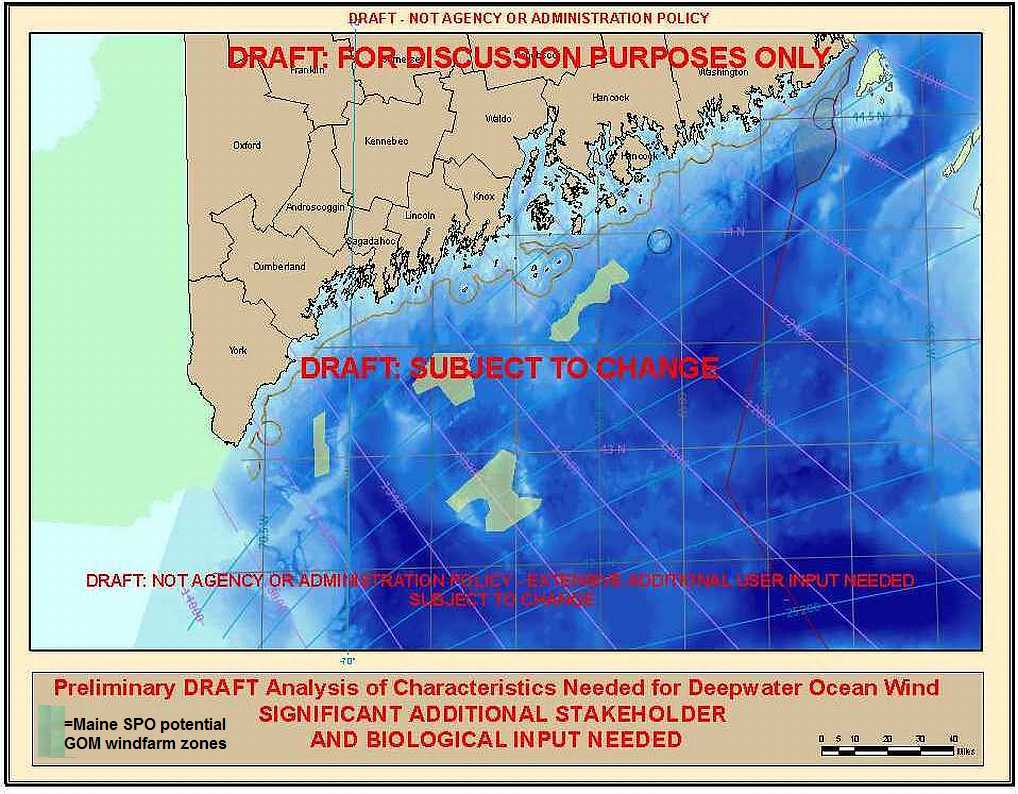
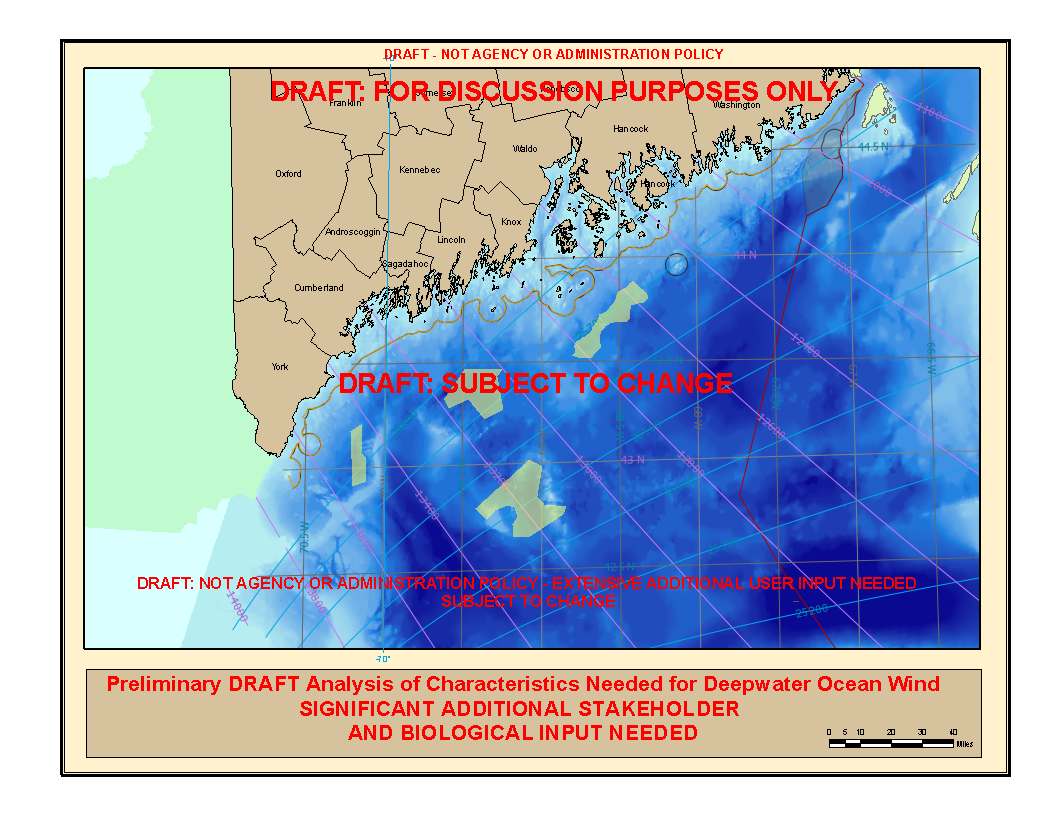
  1. The map below is the state's first rough cut of suitable areas, s supplied to the meeting by Matt Nixon, GIS specialist for State Planning office. It shows four potential deepwater ocean wind areas off Midcoast and Southern Maine. His preliminary review of Gulf of Maine  trawl and dredge fishery VMS tracking data and commercial shipping use data.  Achieving the status of potential locations for ocean windfarming are:   a location east of the northern half of Jeffrey's Ledge;  one between Fippennies Bank and Cashes Ledge; one between Platts Bank and  the Harris Ground, and one between  the Bounties and the Clay Bank offshore of Penobscot Bay.
the Baldacci Administration's nervousness about picking offshore windmill locations, by being stamped in red multiple times with such qualifiers as "DRAFT: Not Agency or Administration Policy" and  "Significant Additional Stakeholder and Biological Input needed",  "Draft: For discussion purposes only", and SUBJECT TO CHANGE."   Nothing is final yet, Nixon insists:  "Extensive additional user input needed". OK, Matt, we get it!  

2. At least  three companies have written the Bureau of Parks and Lands expressing interest in building and operating ocean windmills in federal waters off Maine. That according to Dan Prichard of the Bureau of Parks and Lands, who  would not identify the companies or their desired  locations, stating confidentiality of ongoing  negotiations

3. NEFMC tucks tail. The New England Fishery Management Council,  has opted out of participating in oversight of this fishing ground takeover. This from Paul J. Howard, Council's  executive director. Howard says that while he's has been receiving calls from officials of the three New England states where BOEMRE is running  interagency  task forces (Massachusetts, Rhode Island and Maine) asking the NEFMC to get involved, "the Council does not have the resources to do so."

Howard wrote that is was good enough that NMFS's Northeast regional office participates in the BOEMRE task forces, noting however, that  NMFS regional administrator Pat Kurkul "suggested we are better off getting involved with NROC  (Northeast Regional Ocean Council)  than individual task forces."   But Howard notes that  "NROC is not coordinating these activities following the newly signed Presidential Executive Order about ocean planning".  NROC is  a state/federal partnership created in 2005  to "engage in regional protection and balanced use of ocean and coastal resources" by the six New England states.  So nobody appears to be guarding the Gulf of Maine fisheries chicken coop from the energy foxes? !

4th  the state may sign a revised "Letter of Intent to Coordinate Review and Approval Processes"(pdf) with the federal Bureau of Ocean Energy.  This is much more of a legal document than the now renamed "charter" of the last meeting, Listen below to Audio  Parts 14 and 15 for details on the changes the state requested be made in the letter.

New Lepage Administration Tilberg, a special advisor to outgoing governor John Baldacci, will be departing her post as state lead in the BOEMRE process at the end of the year. Kathleen Leyden, head of Maine coastal program will replace her pro-tem, but look to the Lepage Administration making its own picks for marine resource, coastal program, and ocean energy leadership slots

Offshore wind IS a marine resource. We've seen the results when other newly exploited marine resources get piled on by everyone who can afford to be out there.  While the agencies stress that nothing is settled, the process is similar to the one used to select waters off Monhegan, Boon and Damariscove Islands for ocean windpower test sites. Things are moving quickly, and with few exceptions, the public has not been watching its public servants working on this planned  major change in ocean management. And they've gotten to be "uppity servants", secure in their tenure,

The greatest environmental  protection brought to the Gulf of Maine by Maine's Coastal Program &Seagrant/Cooperative extension, are their almost perfect inertia  No matter what committees or task forces the Maine legislature spawns, no matter how many  powerpoint sessions Maine's dedicated circus troupe of ocean and coastal planning  bureaucrats host up and down our coast, the results will be the same:
A glossy coffeetable book-sized report, calls for more funding to allow the Coastal Program/Cooperative Extension/Seagrant community and their private consultant allies  to trek from catered meeting to catered meeting. For more study. And then....Nothing.
For when it comes to such potentially threatening energy extractive industries  to our  Gulf of Maine as industrial class wind and tidal power extraction, (or on such matters  as aquaculture, marine protected areas & "bay management") Coastal Program & Co seem to have adapted and revised the Hippocratic: "first do nothing harmful!" philosophy to  "First do nothing!". It is a strategy that has been phenomenally successful in thwarting efforts to manage human impacts on the se waters and their wild inhabitants.

MEETING RECORDINGS (mp3s)
1 Introduction 7 minutes
2 General introductions. 5 Minutes
3 Introduction by Karin Tilberg 5 minutes
4. Introduction by Maureen Bornholdt 3 minutes
5. Aditi Mirani, Boemre 4 minutes
6. Matt Nixon Me State Planning Office on "Maps & Gaps" 24 minutes
7 Deirdre Gilbert with Island Institute slides 7 minutes
8. DMR Commissioner George LaPointe 1 minute
9. Matt Nixon on Recreational Fisheries 1 minute.
10. Matt Nixon on commercial vessel traffic maps 5 minutes
11. Nixon on "Non-Consumptive" resources, incl viewshed 6 minutes
12. Nixon summarizes data gaps and needs 9 minutes
13.* Karin Tilberg summarizes GIS data value. 3 minutes
14. Karin Tilbert on Federal Letter of Intent to Coordinate Review and Approval Processes. 10 minutes
15. Karin Tilberg takes questions on Federal Letter changes and does wrap up. 21 minutes.
16. Professor Rebecca Holberton, University of Maine ornithologist. 8 minutes
17 Ron Huber, Penobscot Bay Watch, on RFI respondents and water current issues. 8 minutes

Nov 15, 2010

Maine coast fishing grounds to be divvied up for wind energy corporations Tuesday by fed & state officials meeting in Augusta

The future for Maine sea fisheries is getting foggy.  There seems to be an aggressive attempt by the federal Bureau of Ocean Energy Management, Regulation; Enforcement, (BOEMRE) to close the marine commons off Maine in waters 3+ miles offshore.  
On the morning of November 16th,  BOEMRE hosts its second meeting of its  Maine Ocean Energy Interagency  Task Force in Augusta . The meeting starts at 10am and ends 12:30pm  in Room 228 of the Statehouse (the Appropriations Committee room)   READ AGENDA (I page pdf).     
TOPIC: Continued negotiations with state officials on closing  the ocean commons off Maine and  leasing it to the energy industry. Read the "charter" between Maine and the federal agency. Location. State House, Room 228 Augusta. Open to public.   Read details of the federal bureau of ocean energy's Maine program.

To listen to the meeting streaming online, go to this legislative committee room audio link from 10am to 12:30pm on Tuesday November 15th

If you  wish to listen to the meeting by phone/ conference call, you may do so toll free by calling 1-887-930-6875 and using Passcode: 2197783 when prompted.

A webinar will be used during part of the meeting. For additional information,  contact Matt Nixon: (207) 624-6226 or by email  matthew.e.nixon AT maine.gov

This is a followup to  BOEMRE's September 14th meeting in Belfast. (info and audio)
At the Sept 14th meeting, the state and local federal officials assembled were told to bring maps to the November meeting. Maps with locations that could be leased to monopile windfarms - windmills blasted and pounded into the seafloor. These are the type that Angus King and his cronies would like to profit by building close to the coast.

However, Maine's government and state university have chosen not to pursue that type of ocean windfarming.  Instead they have opted to develop floating deepwater windmills far offshore -out of sight of coastal residents and their scenic economic resources, and away from nearshore fishing grounds and sailing areas.   The University of Maine and its DeepCwind Consortium have received at least 40 millions in federal funding to (1) carry out their R&D, (2) produce a first prototype and (3) build and deploy a full sized deepwater floating windmill, connecting by cable with the mainland somewhere in New England.

So there are tensions going into the November 16th meeting.  Maine's agency representatives may end up surprising officials of BOEMRE's offshore wind power division by declining to map out hundreds of square miles of seamounts and ledge-filled submerged wildlands. Doing otherwise would only facilitate a windrush of speculators like Mr. King. 

Maine should follow the lead of its scientific community and focus on ocean energy solutoins that do not harm the very economies they purport to be helping.

If you are unable to attend and wish to listen to the meeting online, you may do so at: http://www.maine.gov/legis/ofpr/appropriations_committee/audio/  A webinar will be used during part of the meeting. For additional information, including details on how to view the webinar, contact Matt Nixon: (207) 624-6226 or by email  matthew.e.nixon AT maine.gov