Search

Dec 7, 2011

Protestors to picket Norwegian offshore windfarm meeting in Portland.


Protestors to picket Norwegian ocean windfarm meeting in Portland on December 8th.
STATOIL is here! Will they plunder  Maine's offshore wind ?
Cite "betrayal" by Dept of Interior, risk to fisheries, ask for King of Norway's help

South Portland, Maine
. Tomorrow's meeting of the  US Bureau of Ocean Energy Management in South Portland will have an unexpected beginning, as demonstrators concerned about Norwegian energy giant Statoil's ocean windmill plan for waters off Maine greet incoming meeting goers with a variety of signs and props, near the entrance to the event's location, the Marriott Sable Oaks Hotel.

Protestors say:

1. They feel betrayed by US Interior Secretary Kenneth Salazar. 
On August 18th, Salazar promised that there would be no windmills in "Fishery Sensitive Areas".

Yet the area chosen by  Norwegian state-owned energy giant Statoil, say protestors,  is well known by fishermen and scientists alike for its important role in transporting the larvae of lobsters, scallops and other  seafood species down the coast of southern Maine, New Hampshire and Massachusetts.
"There's nothing more sensitive than this part of their life cycles" said Ron Huber of Penobscot Bay Watch. "Disrupting them could cost millions in lost fishing income. What is Salazar thinking?"

2. Norway is risking American fisheries. Norwegian research shows that energy extraction by ocean windmills generates large localized upwellings of seawater beneath the ocean windmills, "sufficiently enough that the local ecosystem will most likely be strongly influenced by the presence of a wind farm." according to  Norwegian meteorological researcher Goran Brostrom.
When ocean wind mills operate, millions of gallons of water are pulled from the seafloor to the surface.

"It seems that Statoil is proposing ocean windfarms here because it is better to risk Maine's coastal marine ecosystem than Norway's. Why not do its experimenting off its own coast?"

3.Norway's King can help. Huber said a letter is being sent to King Harald V of Norway, asking that he convene an international colloquium or conference to get to the bottom of the upwellings issue.

"His Majesty is extremely knowledgeable about ocean windpower. He neds to understand It is vital that this important knowledge gap be filled, as nations around the seven seas are poised to start setting out thousands of  ocean windmills. Only someone of his stature, credibility and influence can make such a conference happen. This is portant to carry out to prevent any major marine ecological blunders by well meaning nations seeking renewable energy."

4. Maine citizens will not be allowed to speak or ask questions on the record during the event.  While the decisions made at the BOEM meeting will affect all Maine citizens, and will cover areas that of vital importance to fishermen and environmentalists alike, those citizens are banned from speaking during the daylong event.

"This is a disgrace and a slap in the face to all Mainers." Huber said. "The federal government and a foreign government are going to decide the future of the waters off Maine and we citizens are to keep our mouths shut?"  Huber said that he and other demonstrators will have their mouths taped shut while attending the meeting, to get the point across.

"They tried this last year," he said. We complained to Olympia Snowe and Governor Baldacci, and they changed their tune.  Hopefully, Governor Lepage has the pull that his predecessor has and can let Maine people speak at this event."

For more information on Maine and offshore wind  Click here

###

Dec 3, 2011

Stopping the DCP tank plan. Newspaper lays out details of both sides.

Safety & sightlines in Searsport,  By Ethan Andrews, Republican Journal 12/2/11  Wildly divergent views of a proposed 22.7-million-gallon liquefied petroleum gas terminal have polarized the debate on the would-be Searsport development. A portion of a satirical comic circulated by opponents at a recent rally shows the tank looming over Penobscot Bay..

 SEARSPORT As discussion heats up about a proposed 22.7-million-gallon propane tank in Searsport, a number of questions have been raised by residents ranging from the safety of the terminal to the potential effects of a large gas storage tank on tourism, whether the new taxes and jobs will be worth it and what the effect will be on local roads.

In an effort to distill some of the major ideas, VillageSoup looked at two of the more talked about concerns — safety and visual impact.

Worst-case scenario
Online videos of propane explosions are easy to find — everything from people shooting backyard barbecue tanks with high-caliber rifles to footage of major industrial accidents. The Discovery Channel's "MythBusters" show tested the veracity of a scene from a James Bond movie where Bond evades pursuers by shooting a propane tank causing it to explode. In real life, the professional debunkers found, it didn't work.

When propane does explode, the effect is dramatic enough to make it the go-to fuel for movie producers and other purveyors of theatrical shock and awe. So while the bullet in the James Bond movie might not have blown up the tank in real life, the explosion in the film was most likely made with real propane.
Closer to home, there's the controlled burn of a kitchen range or backyard grill.

But if lighting a range — essentially a leaking tank — or shooting a propane tank with a bullet doesn't cause it to explode, what does?

Hang around the propane safety water cooler long enough and the acronym BLEVE (short for boiling liquid expanding vapor explosion, and pronounced like "Chevy") invariably comes up. A BLEVE happens when liquid propane or natural gas is subjected to extreme heat, often as the result of another tank or pipeline that has ruptured and caught fire. The fuel in the undamaged tank expands as the temperature increases and releases pressure through a safety vent.

The trouble comes when a wall of the tank that has emptied and is no longer being cooled from inside is exposed to intense heat, which leads to a rupture, releasing a large amount of propane quickly and causing an explosion.

BLEVEs are the basis for the some of the more apocalyptic visions of tank opponents, including the one-mile-fireball theory and the idea of an "incineration zone." Historically, the largest LPG disasters have involved much smaller quantities of fuel than has been proposed for Searsport, so there is no direct precedent for a worst-case scenario involving a BLEVE at a facility the size of the proposed DCP Midstream LPG tank.

One of the largest historical LPG accidents in terms of fatalities involved a series of BLEVEs that destroyed the PEMEX LPG terminal in San Juan Ixhuatepec, Mexico in 1984. The accident killed between 400 and 500 people and injured between 2,000 and 7,200 by one account.

The PEMEX terminal had a collective capacity of roughly 3 million gallons of a propane and butane mixture, spread among 54 tanks. Reports from the time indicated that a substantial amount of the heavier-than-air mixture leaked before it caught fire. The first BLEVEs happened within five minutes. A large area of the town was destroyed by the explosions and fires that followed.

An exhaustive study by the Paul Scherrer Institute, a Swiss research center, of energy-related accidents between 1969 and 1996 ranked the PEMEX terminal explosion the tenth worst in terms of fatalities — burst dams and nuclear power plant accidents easily topped the fatalities list — and worst in terms of injuries.
The same report found that immediate fatality rates were typically higher in LPG accidents than in accidents involving other energy sources.

Other LPG accidents have caused major spectacles, property damage or disruptions but few fatalities.
A 1979 train derailment in Mississauga, Ontario, outside Toronto, involving a propane explosion prompted the evacuation of 200,000 people. It was reportedly the largest peacetime evacuation prior to Hurricane Katrina in 2005. The evacuation, however, was primarily due to a chlorine gas leak secondary to the propane explosion.

In 2008, the Toronto area was hit with another sensational propane accident when tanks at the Sunrise Propane terminal, having a total capacity of 4,000 gallons, exploded. Newspapers reported that the cause was an "illegal tank-to-tank transfer." Residents mistook the blast for everything from a plane crash to a nuclear bomb. Two people died; one of them a firefighter who suffered a heart attack.

At 22.7 million gallons, the proposed DCP Midstream terminal in Searsport would be among the larger propane storage facilities in the country. The company also operates a 20-million-gallon facility in Virginia.
Sea-3, a subsidiary of Transammonia (and according to the company's website, the largest importer and distributor of propane in the Northeastern United States) has a slightly larger tank — 26 million gallons — in Tampa, Fla. Searsport tank opponents have pointed out that the Sea-3 tank, which is located on a peninsula in a heavily industrial area, is further removed from the residential population than the Searsport tank would be.

While LPG is not as widely used in the United States as in other parts of the world, there is some historical precedent for large-capacity tanks here. A pair of 12-million-gallon propane storage tanks in Elk Grove, a suburb of Sacramento, Calif., were built 40 years ago, and have provided a propane distribution point for the San Joaquin Valley almost without incident. In 2000, FBI agents arrested two local militiamen who were allegedly planning to blow up the tanks in an effort to catalyze hate groups around Y2K hysteria with a goal of overthrowing the U.S. government.

The plot was foiled. But over the years residential areas of Elk Grove have inched closer to the once-industrial zone, fueling renewed concerns about the safety of the tanks.
Though large-scale propane accidents have the potential to be catastrophic, statistically, they barely register as hazards.

According to a 1981 study by the U.S. Department of Energy (“LPG Land Transportation and Storage Safety”) cited in literature from the National Propane Gas Association, an person's odds of being killed by an accident related to LPG are 1 in 37 million, about the same odds of a person on the ground being killed by an airplane crash.

Presumably these odds increase for people who live near an LPG terminal, though whether they would rise to the level of a fatal lightning strike (1 in 3.75 million), a fatal car crash (1 in 4,700) or something else is not addressed in the cited statistics.

Data collected in two major studies of energy-related accidents, the Paul Scherrer Institute study and an analysis by Benjamin Sovacool of energy-related accidents between 1907 and 2007, show some broad trends. Petroleum industry-related accidents in the Paul Scherrer Institute study, for example, increased with oil consumption, peaking in the mid-1980s, then declined over the next 10 years. But both studies suggest that individual accidents follow no predictable pattern.

As a final note, VillageSoup asked François Amar of the University of Maine's Chemistry Department to illuminate a worst-case scenario. Namely, what would happen if the whole thing blew up?
Amar professed no specialized knowledge of propane accidents, but offered what he called a "Freshman chemistry-type calculation" to determine the amount of energy in 22.7 million gallons of propane. The figure he came up with: 2,300 terajoules.

"That's a lot of energy," he said.

Amar left it to VillageSoup to put the terajoules figure into perspective. To frame it in terms of a frequent benchmark of explosive power, 2,300 terajoules is the equivalent of 549,713 tons of TNT.
"Part of the fear that people have is what happens if all that energy were liberated in an instant, which of course can't happen in a chemical reaction," Amar said. "It can burn explosively but it wouldn't be in an instant. The oxygen has to get there so it happens over time."

Big tank or little tank

The proposed LPG tank would invariably interrupt some of the views of forested areas of Searsport and obscure sightlines to the water, which are staples of the Midcoast tourism economy and a factor in local property values. Compared to other local view blockers, the inert geometry of the proposed tank is unlikely to be seen as an elegant extension of its surroundings in the way of, say, the Penobscot Narrows Bridge. Nor will it be a visible beehive of human productivity — like, say, Front Street Shipyard in Belfast.

But leaving aside the subjective nature of what constitutes an eyesore, how visible would the tank be?

In a full-page ad in the Nov. 19-20 edition of the Bangor Daily News, DCP Midstream President William Waldheim said that the tank would be recessed in the ground but didn't indicate by how much. An accompanying photo illustration, showing what the tank would look like from Penobscot Bay in comparison with the nearby Irving tanks at Mack Point, appeared to downplay the visual impact.

According to a spokesperson for Irving Oil, the nearby tanks are between 45 and 50 feet tall and have diameters ranging from 100 to 160 feet.

While performing an accurate measurement against a photograph is problematic, a rough estimate based on the Irving tanks pictured in the same photo suggests that the proposed DCP tank could rise to as much as double the height that it appeared in the ad and be twice as wide.

Asked about the visualization study, DCP Midstream Spokeswoman Roz Elliott disputed this interpretation, saying the depiction in the ad was done by an expert, based on a number of criteria, and was accurate at the time it was published. She added that the tank is currently expected to be recessed 17 feet below ground level at the lowest point, taking into account the slope of the land, and that as a result would likely appear lower than the visualization in the ad.
Local opponents have compared the height of the tank to tree heights and the height of the average building in Searsport — the latter is 34 feet, according to one account by Astrig Tanguay of the group "Thanks but no Tank" — as evidence that the DCP tank would be grossly out of scale with its surroundings.

An exaggerated version of this idea appeared in series of comic strips by Meredith Ares circulated at an anti-tank rally in Searsport on Nov. 19 showing a massive cylindrical tank looming over the bay. Another panel suggested the tank could be seen from space. Unlike the DCP rendering, which presumes to show the tank in its correct scale, the comics were exaggerated for satiric effect. The point of view, however, was clear. If it's too big, it might as well be a mile high.

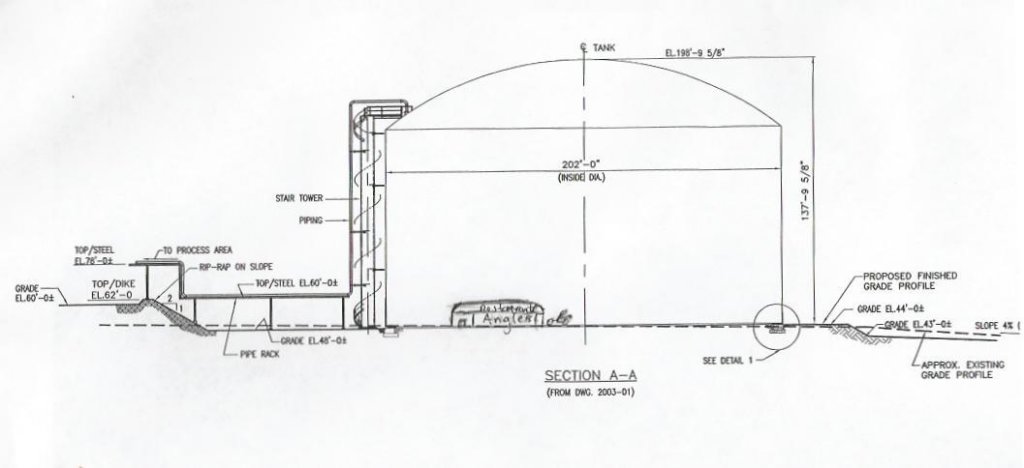
Unlike the cylinder in the cartoon, the DCP tank would be rounded at the top. The shape is structural, but the sloping shoulders would also make the tank appear slightly less imposing. According to figures from the Maine Department of Environmental Protection, the peak of the tank would be 138 feet above the ground, but the vertical walls would be approximately 102 feet high.

A viewshed analysis by MDEP, which used a U.S. Geological Survey digital elevation model, concluded that the proposed project "will not have an unreasonable adverse effect on the scenic character of the surrounding area."

Local residents and business owners have presented a different view. An image shown at a recent presentation by "Thanks but no Tank" superimposed a tiny Angler's Restaurant in front of the tank. The drawing, which was done to scale, was not intended to show the two structures as they would appear on site, but was apt given that the tank, according to restaurant owner Buddy Hall, would be located several hundred feet behind the restaurant.

Opponents have questioned the diligence of a Maine Department of Environmental Protection approval of the project with regard to visual impact.

Some of this criticism derives from a line in the report stating, "... the project would not be visible to a viewer who is standing among trees in a forested area." The seemingly self-evident truism has been used as a laugh line among opponents who have taken it out of context. Because trees typically block views in forested areas, the statement recognizes that views from these areas would not be impacted. This assumption informed one of several parameters used for calculating the sightlines.

The report cites the fact that Mack Point is already an industrial area to support its conclusion that the proposed DCP terminal would have "a minor visual impact on the landscape." While Mack Point is clearly an industrial area, the surrounding area is not, and the proposed DCP tank would be substantially larger and more visible than any existing structure there.

Original documents related to the DCP Midstream proposal, including documents on safety and viewshed issues, are available for viewing at the Searsport town office. According to Town Manager James Gillway, dozens of residents have gone through the binders of supporting materials.
END

Nov 23, 2011

Newspaper: Propane proposal pulls protesters to Searsport

Belfast Republican Journal 11/22/11
Propane proposal pulls protesters to Searsport By Steve Fuller | Nov 22, 2011

Photo by: Steve Fuller Many of the people who attended Saturday's protest carried signs showing their opposition to the proposed tank project.

Searsport — The corner of Station Avenue and Route 1 was a busy location Saturday afternoon, Nov. 19, as approximately 100 people held signs, made speeches and otherwise expressed their opposition to a proposal to build a large propane storage tank a stone's throw from where they stood.

Signs seen at Saturday's protest ranged from the straightforward — "No LPG [Liquefied Petroleum Gas] Tank at Mack Point" — to the sensational, such as the sign that asked, "Are your children in the incineration zone?", referring to the area that would be impacted if a fuel storage tank were to blow up.
Organizers estimated the size of the crowd at anywhere from 75 to 100 people, and though the attendance fluctuated throughout the two-hour protest, an informal count seemed to show those figures were accurate.

Peter Wilkinson of Belfast addressed the crowd early on and said he didn't expect so many people would turn out on a cold fall afternoon. He said he hoped the protest would prove to be the first of many in opposition to what he called a "monster tank," one he said "nobody needs and nobody wants."

DCP Midstream, a Colorado-based company, announced almost a year ago that it was interested in building a 137-foot-tall, 22.7-million-gallon tank at Mack Point. The project has been given the green light by both the Maine Department of Transportation and Maine Department of Environmental protection, while approval from other agencies (such as the Coast Guard) is pending.

The Searsport Planning Board has yet to make a decision on the proposal because DCP has yet to file an official application with the town. Although an ordinance change allowing for taller structures was approved at Searsport's annual town meeting in March of this year, some people — Searsport residents, as well as people in neighboring communities and around the Midcoast — believe the project has moved along too quickly, and are now seeking to at least delay any final approval of the project until questions about safety, economic impact and other subjects can be addressed.

In Searsport, residents have started a petition campaign seeking a town vote on whether to impose a moratorium on developments such as the one DCP is proposing. For those living in other communities — only registered voters in Searsport can sign the petition — Saturday's protest allowed them a chance to voice their opinion and express their various concerns about the project.

Some, like Diane Messer of Liberty, spoke about other fossil fuel projects, such as the proposed tar sand pipelines from Canada into the U.S. Messer said she was there in "solidarity" with the tank protesters.


Others, like Searsport resident Daniel Berg, voiced their frustration that most decisions relating to the project were being voted on by appointed officials, rather than elected representatives, or citizens themselves.  "This seems to be a travesty of democracy," said Berg, who said he had contacted the Maine Civil Liberties Union.

Astrig Tanguay, one of the organizers of the "Thanks But No Tank" group and a co-owner of Searsport Shores Campground, spoke about the economic impact the proposed tank might have on Searsport. While DCP has said the project would bring approximately a dozen full-time jobs (and more construction jobs, while the tank was being built), Tanguay and others expressed concerns that existing jobs would be lost due to a decrease in tourism.

She said increased truck traffic and associated safety concerns, in addition to the visual impact of the tank itself, would turn upper Penobscot Bay into an "industrialized zone."
Tourists, Tanguay said, would likely opt to head from Maine's southern beaches to Acadia National Park via Interstate 95, rather than across Route 3 and then along Route 1 through the Midcoast, if the tank were built.

"If we become known as the town with a tank, then people won't bother with Belfast," Tanguay said. "It is definitely an economic issue."

Ron Huber, who has actively campaigned for the preservation of nearby Sears Island and has opposed other large industrial efforts in the past (such as a proposed LNG facility), also spoke Saturday afternoon. Tanguay introduced him as "the guy who got our butts in gear," and he spoke about the importance of natural resources and nearby historic Native American sites.

"People are important," said Huber, acknowledging the concerns previous speakers had expressed about the proposed project's potential impact on humans, "but I'm always here on the side of nature, too."

Reactions to the proposed tank project from other people at Saturday's event included words such as "catastrophic," "horrified" and "disgusting."

Organizers said given the short timeframe in which the protest was planned — about two weeks, using Facebook, photocopied fliers and word-of-mouth — they were pleased with the turnout.
"I think it's a spectacular display of public outrage," said Wilkinson. "It's very significant."

Tanguay said the next step would be to present Searsport selectmen with the petition calling for the moratorium. She anticipated that happening at the next regularly scheduled selectmen's meeting, set for Tuesday, Dec. 6.

Other protests are a possibility, as well. Earlier in the event, when Tanguay cited what she described as a less-than-supportive reaction from State Senator Mike Thibodeau, the suggestion was offered that the next protest could be held in front of Thibodeau's residence in Winterport. Another protester was heard suggesting that Thibodeau be recalled from office.

Although protesters often found themselves standing in the street due to limited space on the shoulder of the road, traffic seemed to flow smoothly as people moved out of the way as needed. Searsport Police Officer Eric Bonney briefly addressed the group midway through the protest, saying his only request was that people stay out of the road.

Noting that Bonney was the only law enforcement official there, Wilkinson quipped that the lawman was outnumbered, but people in attendance generally complied with Bonney's request, and no one seemed to complain about it.
END

Mack Point Forest - Let's protect irreplaceable forested coastal wetlands

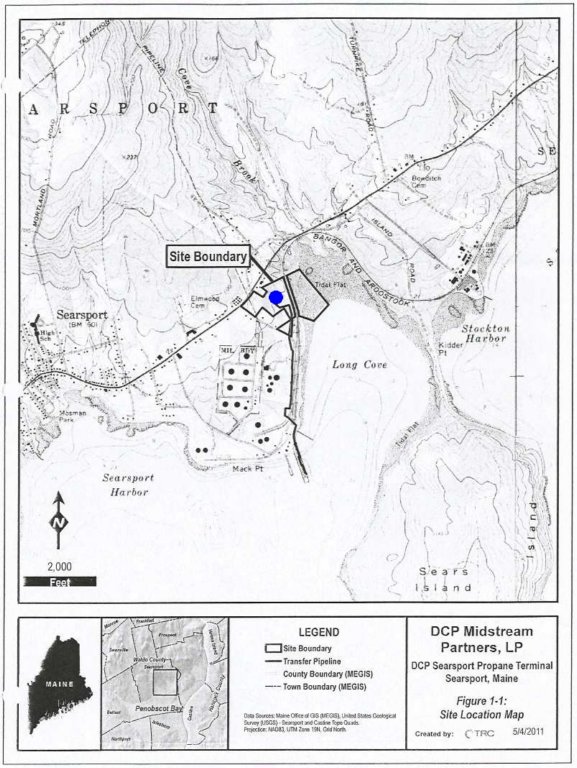
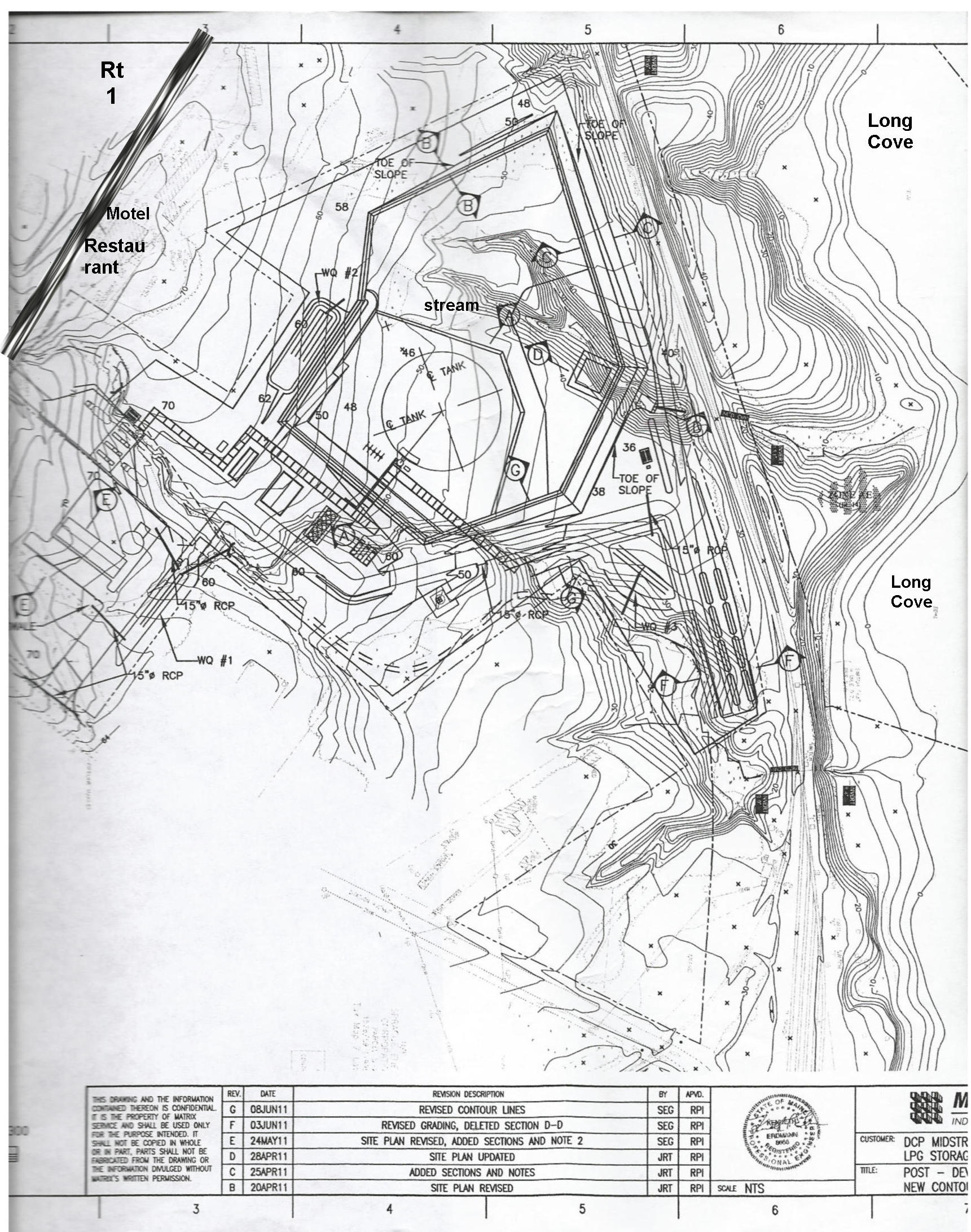
Saving the Mack Point Forest and its Coastal Wetlands Location and Site maps
* http://penbay.org/dcp/wetlands/mackptwoods_eco_map_lg.jpg
* http://penbay.org/dcp/wetlands/longcovemap.jpg
* http://penbay.org/dcp/wetlands/dcp_siteloc_map1.jpg
* http://penbay.org/dcp/wetlands/dcp_wetlands_map-3.jpg
* http://penbay.org/dcp/wetlands/dcp_footprint_capt.jpg

Maine Wetlands and their Boundaries: a Guide for Code Enforcement Officers
http://www.beginningwithhabitat.org/pdf/Maine_Wetlands_Boundaries.pdf

Identifying Hydric Soils - wetlands soils 
 * http://penbay.org/dcp/wetlands/hydricsoils1_megov.jpg 
* http://penbay.org/dcp/wetlands/hydricsoils2_megov.jpg
* http://penbay.org/dcp/wetlands/hydricsoils3_megov.jpg
*  http://penbay.org/dcp/wetlands/hydricsoils4_megov.jpg

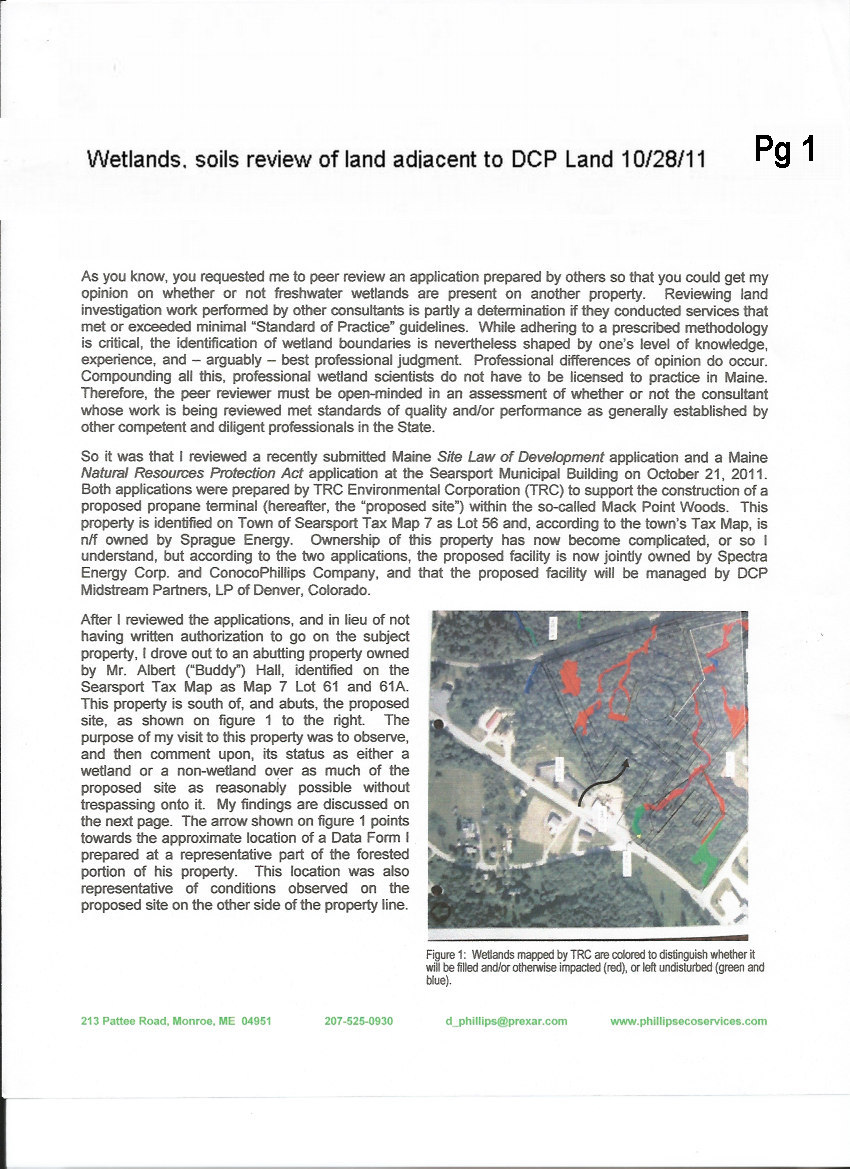
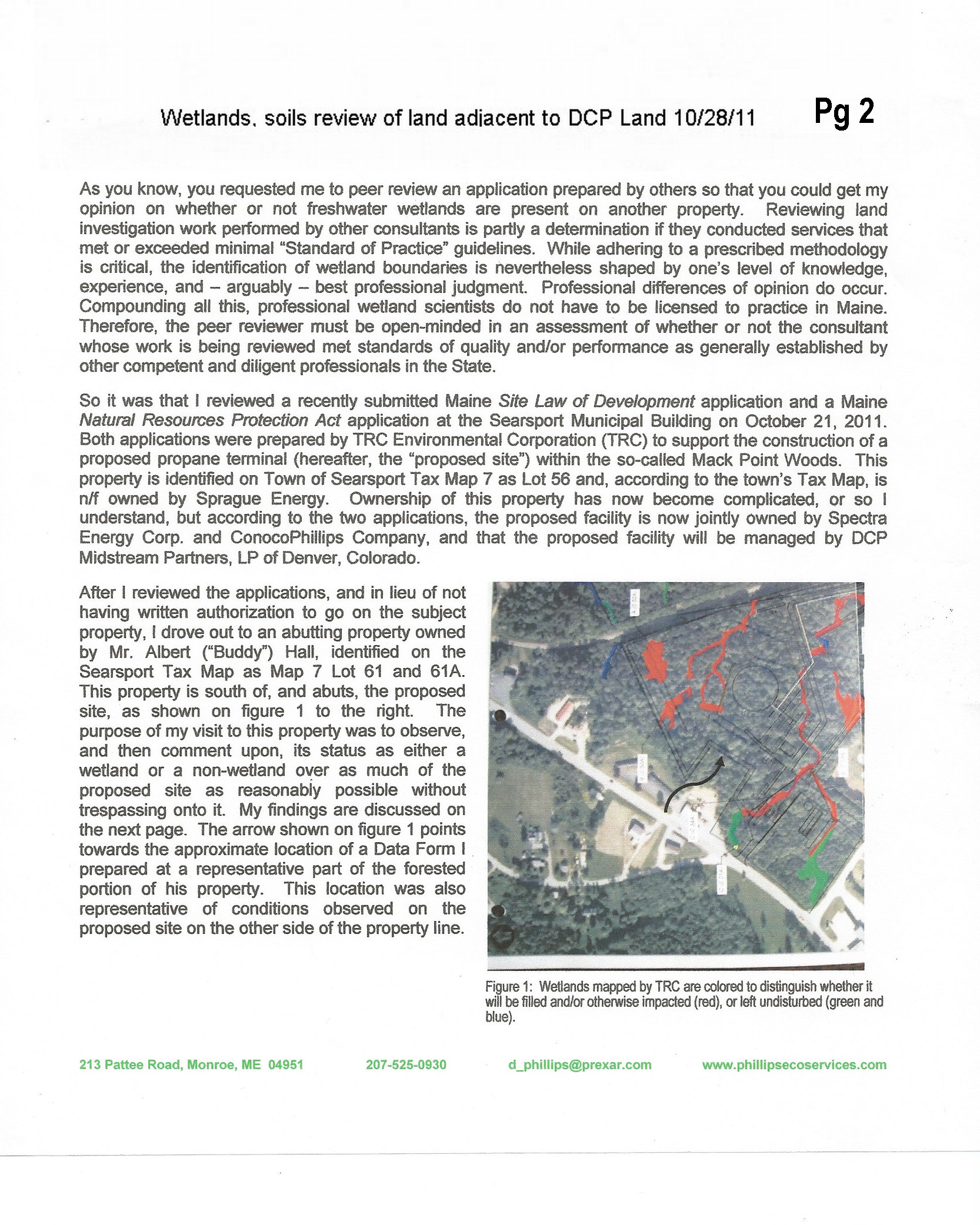
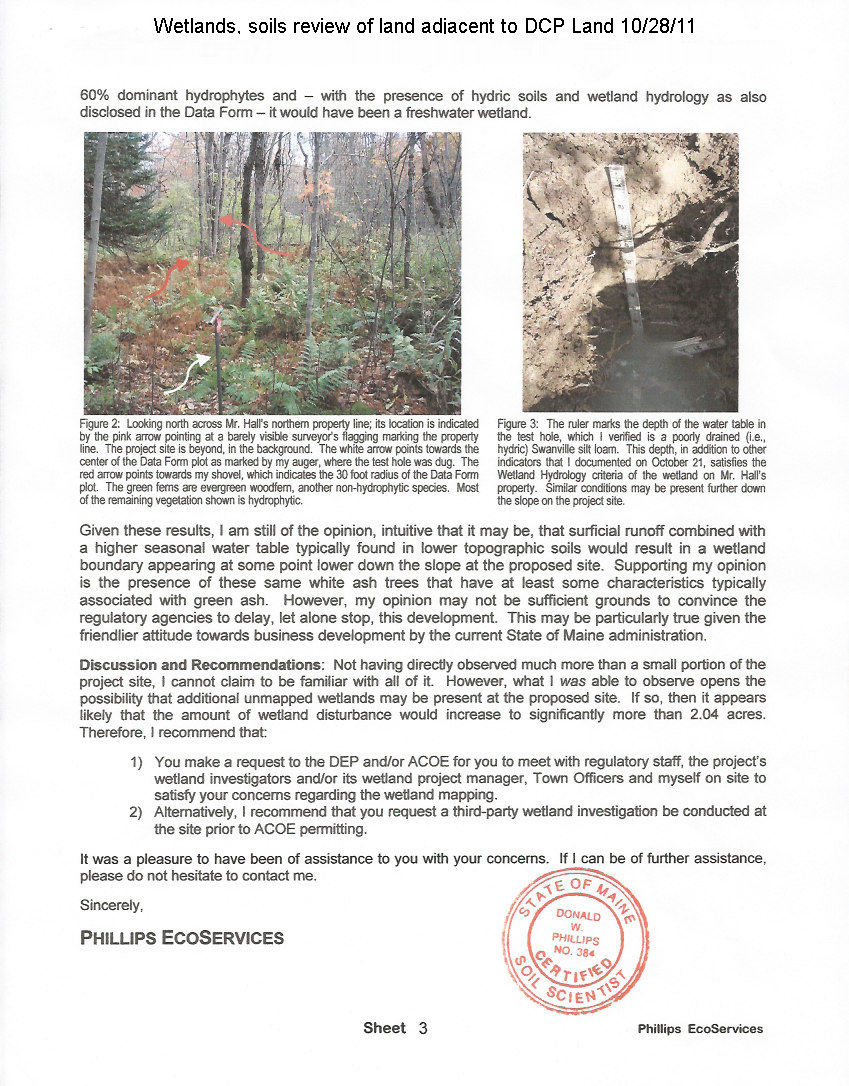
Wetlands Study for Thanks But No Tank
* http://penbay.org/dcp/wetlands/mackptwoods_eco_102811_pg1.jpg
* http://penbay.org/dcp/wetlands/mackptwoods_eco_102811_pg2.jpg
* http://penbay.org/dcp/wetlands/mackptwoods_eco_102811_pg3.jpg

Maine Wetlands Species Identifiers
* Forested swamps  http://www.maine.gov/dep/blwq/wetlands/forested.htm
* Forested floodplain wetlands http://www.maine.gov/dep/blwq/wetlands/flood.htm
* Vernal Pools http://www.maine.gov/dep/blwq/wetlands/vernal.htm
* Shrub Swamps http://www.maine.gov/dep/blwq/wetlands/shrub.htm
* Vernal pool identification guidelines (Massachusetts) http://www.vernalpool.org/ed-pr-01.htm

Nov 20, 2011

DCP Midstream tank plan protest draws more than 100 in Searsport

Judy Kaiser, 70, of Waldo, stood in the cold Saturday in Searsport to protest a plan to build a large propane storage tank in town.

Posted Nov. 19, 2011, at 4:43 p.m.
Print this   E-mail this    Facebook this   Tweet this  

Judy Kaiser, 70, of Waldo, stood in the cold Saturday in Searsport to protest a plan to build a large propane storage tank in town. 

SEARSPORT, Maine — More than 100 people stood on the side of Route 1 by an Irving gas station Saturday to protest a plan to build a $40 million, 138-foot-tall liquid propane terminal at Mack Point. Vehicles driving by — including at least one Shell fuel truck — honked with support.
One protester was 70-year-old Judy Kasier of Waldo, who waved her handmade “No Tank” sign at people who drove by. “I came here today because I am outraged at the possibility there might be such an industrial project in midcoast Maine where we rely so heavily on tourism,” Kaiser said Saturday.

There are already several fuel storage tanks in the area, but this one, if approved by the town planning board, would be much taller.

“The beauty of the harbor will be ruined,” Kaiser said. “It will be so huge and so tall you will be able to see it from Acadia National Park. It will ruin our coastline.”

Earlier this fall, the Maine Department of Environmental Protection gave approval for DCP Midstream’s plans for Mack Point.

Randall Parr, 67, of Appleton, shouted through half a milk gallon to a crowd of protesters. About 100 people gathered in Searsport on Saturday to rally against a plan to build a large propane storage tank in town.Randall Parr, 67, of Appleton, shouted through half a milk gallon to a crowd of protesters. About 100 people gathered in Searsport on Saturday to rally against a plan to build a large propane storage tank in town. Buy Photo

On Saturday afternoon, protesters signed a petition to try to stop the tank from getting town approval. According to Astrig Tanguay, 45, of Searsport, the petition will ask that the town declare a moratorium on building tanks until an impact study can be conducted.
Tanguay, a local business owner, fears the huge tank will dramatically increase truck traffic and make coastal Route 1 less desirable for tourists to drive on. If traffic gets rerouted, Searsport businesses might miss out on tourists’ shopping stops.

“A lot of people still come through here to get to Mount Desert Island. If this tank is built, they might go through Bangor,” she said.

David Berg, 66, of Searsport had a similar complaint.

“I moved here from New York because of the natural beauty. This will ruin it. This is so different from the tanks already at Mack Point,” Berg said at the protest.

Berg also worried about the safety of having a large propane tank in town.

The company proposing the tank, DCP Midstream, responded to protesters’ worries about safety, truck traffic and how large the tank would be in a full-page advertisement in the Bangor Daily on Saturday.

According to the company, the tank would add 50 truck trips a day in the town. The tank would have tree buffers and wouldn’t stand out much more than the tanks already at the site, the company president, Bill Waldheim, wrote to Searsport residents in the ad. Waldheim also said that federal and local regulations would ensure that the tank is safe and not emitting too much noise, light or odor. The company wrote that Maine is dependent on propane and needs a supply in the area.

Protesters plan to present the petition to stop the project to the town on Dec. 13.
END OF ARTICLE

--

MORE INFO:  http//www.penbay.org/dcp 

Nov 19, 2011

If you love Penobscot Bay, come to Searsport today at 1pm. Stand up against DCP's LPG Gas tank plan! (picture is crude approximatiion).
Where: 1pm Route 1 and Station Avenue - just past the Irving Oil station.
The forest next to you is the one that DCP Midstream gas company wants to flatten and replace with the biggest liquified gas tank in the northeast United States. Got drums? Good! Bring'em! Signs  guitars songs..Bring them Speak for the forest, the bay and the people

Nov 16, 2011

Belfasters speak out against DCP supertank plan. Audio.

At the November 15, 2011  Belfast City Council Meeting, three Belfast residents spoke out with their concerns about the proposed LPG super tank in nearby Searsport. And the City Councilors listened and replied. Listen to them, below.

City Council members questioned the speakers and  raised their own questions and concerns about how the project is moving along under the radar and whether or not the entire decision, with its many implications for Belfast, and other towns up and down Penobscot Bay, should rest with the small town of Searsport.
 RECORDINGS

Council meeting introduction and Jane Sanford of Belfast(2 minutes)


Phyllis Coelho of Belfast  (5 minutes)

Belfast councilors discuss issues raised by Sanford and Coelho (15 minutes)

Peter Wilkinson of Belfast describes regional scale of issues, upcoming events. Councilors Q&A (19 minutes)


Jane Sanford  and close of discussion on DCP issues (1minute)

Nov 11, 2011

Fury in Maine as Denver company proposes New England's biggest gas tank in heart of scenic tourism area.


As reported in the Denver Post, plans by Denver-based natural gas distributor DCP Midstream to set up a large LPG gas storage tank on the coast of Maine have run into a buzzsaw of opposition from businesses making up the area's very profitable coastal tourism industry.

Opponents of DCP's plan to build and operate a 22.7 million gallon liquified petroleum gas (LPG) tank and terminal in the scenic Penobscot bay town of Searsport  say the company's proposed tank - biggest ever in the Northeast - is simply too far out of scale with existing energy companies using the town port to be acceptable.  At meeting after meeting, the residents of  Searsport, Stockton Springs, Belfast and even movie-star-laden Islesboro are marshalling their resources.

"We need to be careful that industry does not drive away tourism," wrote Tom Goscze of the grassroots group Thanks But No Tank! in an op-ed piece in the Bangor Daily News.   "Let’s make sure that we are not destroying our property values and safety for a couple jobs from importing the most expensive fossil fuel on the market."

"Searsport has two oil and gasoline tank farms," said Ron Huber of Penobscot Bay Watch, a regional conservation group, "but those companies, Irving Oil and Sprague Energy, have kept their operations low profile. They do not inflict themselves on the scenic viewsheds of the Penobscot Bay region."  By contrast, Huber said, " DCP Midstream's supertank is five times taller, and would hulk over the skylines of at least a dozen bay towns. It would be a visible eyesore from as far away as Acadia National Park  and Baxter State Park, and a heck of a lot of lesser parks and resorts in the region."

The natural forested mountain viewshed of upper Penobscot Bay is a major selling point for more than a dozen towns' myriads of  tourism-dependent businesses. As far as the businesses of Searsport, Belfast and other bay towns  are concerned, Huber said, " DCP Midstream is lobbing a giant stink bomb at Midcoast Maine, and insisting it's Chanel # 5".

Just as temper-raising have been Homeland Security considerations. The giant tank would rear up literally a stone's throw from US Rte 1. "Its hard to find a less secure location on the Atlantic coast for one of these supertanks" Huber observed, noting that a would-be terrorist   would have no barriers to carrying out an infamous act that could devastate at least three towns

The company's hapless public relations crew has been reduced to trotting out such uncompelling bromides as "Safety is our Core Value!"  and "We would live and work there, too!", ( the latter utterance not too convincingly put forward by DCP  spokesperson Lisa Newkirk, who has evinced no interest in relocating there herself.)

As aired in the feisty Penobscot Bay Blog, local citizens and businesses are gearing up for what may be lengthy appeals fights.  But before that begins,  Bay Watch's Huber said, Mark Borer, Angela Minas and Michael Richards, the president and top VPs of DCP Midstream, should stop by some of the Maine resorts that their proposed LPG tank could ruin. "The few jobs that the tank facility would generate is nothing," Huber said, "compared to the thousands of small business livelihoods that will be lost if DCP's gigantic industrial tank plops down in the midst of this scenic gem."  

Useful Links

Penobscot Bay Watch. penbay@justice.com (207) 593-2744

Thanks But No Tank!  help@thanksbutnotank.org 207548-6059

Media Coverage of this issue so far (google news aggregator)

# # #

Maine's upcoming 2012 shrimping season: harvest tonnage cut in half.

The Atlantic States Marine Fisheries Commission's Northern Shrimp Section  has announced a total allowable catch (TAC) of 2,000 metric tons, (approximately 70 million individual shrimps) with the season closing when landings are projected to reach 95 percent of the TAC (1,900 mt).   

See youtube video of a Maine shrimping haul  (shrimp come aboard at the 7 minute mark)

Patrick Keliher, Maine's interim Commissioner of Marine Resources, said to FIS that the government will be monitoring the catch on a weekly basis to ascertain that fishers do not catch too many northern shrimp (Pandalus borealis) and that they do not reach the quota limit too soon. Some 85-90 per cent of shrimp caught in the Gulf of Maine are landed in Maine.

Given the favorable stock condition of the last two years, the Section set relatively long fishing seasons in an effort to accommodate industry's demands for expanded fishing opportunities," stated Section Chair Doug Grout from New Hampshire.

ASMFC's Shrimp Section head blamed the fishermen's overkill of shrimp during the last two years.  "Unfortunately, substantial increases in both effort and participation resulted in early season closures and significant overages in both seasons – 28 per cent and 48 per cent overharvest in the 2010 and 2011 seasons, respectively. Consequently, the stock of this crustacean is now overfished and overfishing is occurring, requiring a shortened season and limited fishing opportunities in 2012," he explained.

A virtual Gulf of Maine - game designers needed.

WANTED: computer game designer for a Virtual Gulf of Maine game, rich w/ habitat & seasonal species, from whales to plankton, with details mapped onto its bathymetry.  A crude short animation of this water body exists.  (1.7mb mpg)  Data of wind, of the tides and currents is available; the seasonal wanderings of the fishes too are known and available for prospective GOM Game developers. Can you weave them together?
IF YOU can stitch those many threads together into a seamless whole, what kid won't want to learn about  the Gulf of Maine while swimming (and feasting) through it as a blue shark? Or soaring above it as an osprey? A swordfish Or a harpoon-wielding swordfish stalker? The more indolently inclined may sedately explore the Gulf of Maine in the  personae of a sea turtle or a Lion's Mane jellyfish.  But all of them will see what it is to be one of those wild beings, lives . From such may tomorrow's oceanographers and marine biologists come.

If you want to help recreate the Gulf of Maine and the great wild Atlantis that lives beneath its waves, contact the Bay Blog

Nov 9, 2011

Look out Maine: DCP Midstream's PR machine starts outgassing

 Here's the public relations machine of Big Gasser DCP Midstream, refusing to talk about how many  area residents could get asphyxiated or incinerated if their supertank or one of their trucks ever blew out. "We don''t like to speculate" they said.  In so many words,  the greenwashers are telling us: "Don't worry be happy. Our mega-corporation cares about you."    Yeah, right. Sure you do.

"DCP Midstream: 'Safety is our core value' "By Tanya Mitchell,  Belfast Republican Journal  11/09/1

This sketch, which was shown as part of the Nov. 2 slide show presentation that was hosted by the local coalition known as "Thanks but no Tank" in Searsport, depicts the storage tank that Colorado-based DCP Midstream opes to build at Mack Point.

 Denver — A spokesperson for the Colorado company that hopes to build a 137-foot-tall liquefied petroleum gas storage tank at Mack Point suggested locals who are worried about safety should consider the company's reputation throughout the industry.

In response to concerns that were discussed at two recent meetings hosted by a local coalition known as "Thanks but no Tank", Lisa Newkirk with DCP Midstream said the company has a "solid reputation" for maintaining safe operations.

"I can tell you we have highly trained personnel and that we partner with local [emergency] responders," said Newkirk.

Newkirk denied claims made by some at the meetings, who questioned if the company chose Searsport because it has a relatively low population and would result in fewer deaths in the event of an accident. If the company were to obtain all the permits it needs to move forward with its plans in Searsport, Newkirk said the company's own employees would then become members of the same community.

"It's not just an operation to us, it would also be the home of our future employees; we would live and work there, too," she said. "Safety is our core value."

Newkirk echoed earlier comments made by fellow DCP Midstream spokeswoman Roz Elliott, who said the benefits of the company building a terminal in Searsport are many.

"Because it has an existing dock," said Elliott. "And the community is aware of what it's like to have ship traffic."

Elliott also stated that while bringing in an LPG terminal would provide a boost to Searsport's tax base and provide jobs, it is an equally important development for the entire state in terms of having a steady propane supply available.

"We've had some cold winters, and it's been challenging at times," she said. "There have been times when the supply in Canada has been constrained."

Mack Point, Elliott said, is a desirable location because it has access to rail, marine and truck transportation as well as a nearby pipeline. Elliott estimated that the DCP terminal would bring between five and six ships a year to Mack Point, a place that she said routinely accommodates between 130 and 150 ships annually.

All DCP Midstream employees would be subjected to a complete training program that Newkirk said holds to the company's high standards of operation. Employees are required to undergo training each year in order to earn annual certifications in their respective fields.

In addition, Newkirk said all of the company's facilities are equipped with emergency shut-down systems and emergency shut-down valves that are located in several key locations around the sites. Newkirk said the shut-down systems are designed to work manually or automatically, in the event that an employee is unable to activate it.

Each facility is also outfitted with backup generators that kick on in the event of a power outage, as well as what Newkirk described as a fixed fire water system, which provides water at access points throughout the plant.

"We can secure a plant in less than 30 seconds, and often in less than 10 seconds," said Newkirk.

The U.S. Occupational Safety and Health Administration also regulates the industry, said Newkirk, and has strict procedures for safety management including rules dictating the maintenance of equipment, storage tanks and other areas of the facilities.

"We will spend the resources necessary to make sure that our facility is in nothing less than good working order," she said.

Newkirk added that those efforts to keep all of their facilities in safe working order and its employees well-trained has not gone unnoticed. In 2010 DCP Midstream was the recipient of the Canadian National Railway Safe Handling Award for the third straight year.

Looking back on the history of the propane industry in the United States, Newkirk said propane terminals have been operating without incident for the last 40 years.

The likelihood that DCP Midstream will be able to build at Mack Point remains unclear, but Newkirk confirmed that the company has received final approval from the state Department of Environmental Protection. The project has also gained approval from the Maine Department of Transportation earlier this fall. Approval from other state and federal agencies, said Newkirk, is still pending.

"We're still working through the permitting process," she said.

When asked if the company had specific data on what the worst-case scenario might be in the event of a fire or explosion at one of their facilities, Newkirk reiterated the company's commitment to safety and declined to answer the question directly.

"We don't like to speculate," she said.

Stopping the DCP juggernaut: media coverage

Newspapers, Television, Radio. & Op-Eds relating to DCP Midstream's plan to build an LPG terminal.

Pick a media variety and read,  watch or listen to the tales of Mainers standing up against the  designs of  Colorado natural gas  tank outfit DCP Midstream - whose management erroneously thought that such citizenry could be easily rolled over .                         
Surprise surprise! As a glance through the media outlets below will show you, all is not going as the gas-baggers wish:  Google news links on issue


LINKS:

Republican Journal  Tank opponents appeal to officials in Searsport and Belfast

Republican Journal  "DCP Midstream claim:  'Safety is our core value'. 11/9/11

Republican Journal Tank forum fuels talk of tourism versus big industry  11/8/11 (corrected)

Denver Post Denver's DCP learns that in Maine when proposing new tanks size matters. 11/7/11

WABI TV Searsport Propane Terminal Has Folks in Town Talking. by Laura Roberts - 11/3/11

WCSH TV Searsport talks propane tank  11/03/11 

WERU Community Radio interviews Tom Goscze 11/02/11. 22 minutes (mp3).

Bangor Daily News.  Opponents of 138-foot-tall propane tank in Searsport to hold meetings.  11//01/11

Republican Journal  Group opposed to LPG terminal says 'Thanks but no tank'. 10/26/11 

Working Waterfront.  Searsport Facing 15-Story Gas Tank  09/27/11.


OP-EDs

The Free Press Thanks but No Tank! Op-ed by Janet Williams 11/3/11

Bangor Daily News  In Searsport: thanks, but no tank. By Tom Gocze,  Oct. 28, 2011.

Nov 4, 2011

Thanks But No Tank! Belfast public presentation AUDIO


Belfast Library, November third. The library's meeting room filled quickly and a two hour presentation and discussion ensued, exploring what is known about the plan for a giant Liquified Petroleum Gas (LPG) tank being promoted in Mack Point by the DCP-Midstream/Conoco Philips Spectra Energy combine.
The meeting was sponsored by Thanks But No Tank!  First, Astrig Tanguay gave a 70 minute presentation. Click on it, below. Then the People spoke with questions and ideas. Listen to their recordings following Astrig's presentation, below.

Part 1  16 minutes 
Part 2  13 minutes 
Part 3  18 minutes 
Part 4  12 minutes 
Part 5  13 minutes 
Full presentation 71 minutes


 For more information:
 http://www.thanksbutnotank.org
email help@thanksbutnotank.org


Nov 2, 2011

Thanks But No Tank! public info meeting in Searsport gets rave reviews.

Searsport. A full house heard  a "superb" presentation by Astrig Tanguay an organizer of Thanks But No Tank, the fiesty citizens group that has sprung up in response to the unseemly plan by industrial liquified  gas giant DCP Midstream, to clear a 30 acre forest and build a monster LLPG gas tank biggest in new England, that will send tons of pollutants into the air shed , says one attendee of the Thanks But No Tank! public meeting in Searsport Wednesday evening
 
"Phenomenal" writes another.
"Great job tonight Astrig!!
"The whole evening has me wound up and proud of what we have done to this point."

"I suspect there are still a lot of surprises between now and whenever this is over."
 
 "Kudos to everyone who participated in this process"


"Well done Astrig - your presentation painted an accurate picture of the situation and will get people talking and pumped up."


"My thanks to all of you for the hours and hours of research and organizing you've put into this effort. I'm inspired and humbled by your energy, passion and courage. "


"Plenty more to do, but a strong start out the gate."


"Onward ho!"

Photos courtesy WSCH

Oct 26, 2011

MACK POINT TANK FARM: "Opponents are even writing poems about it."

1. 

MACK POINT TANK FARM 
Fourteen-Story-Tall Propane Storage Tank Proposed For Searsport’s Mack Point. 
Twenty-two, seven zero zero, zero zero zero gallons! 
Twenty-four-seven noise: tankers, rail, compressors. 
Explosive. 
Ugly.


++++++++++++++++++++++++

2.

Island colors fade--
fuel storage terminal’s
white, white tanks do not.


--Bob Brooks

++++++++++++++++++++++++

3.
PROPANE
C3H8, or CH3CH2CH3
A gas heavier than natural gas
But lighter than gasoline
Forms in pools on the ground

Odorless anesthetic
Will put you to sleep
Explosive at any concentration
Can cook you a nice hamburger
22 million gallons at your doorstep
Have a Nice Day
 - Jim Grossman 

++++++++++++++++++++++++


Oct 25, 2011

Penobscot Bay area citizens to appeal state OK of DCP plan for mega LPG tank eyesore

Maine Department of Environmental Protection succumbs to pressure from the Blaine House and approves ravaging of upper Penobscot Bay coastal forest and related scenic businesses, to benefit Liquified Gas speculators.  (Read related MDEP  documents  here)

It wasn't too hard for Conoco-Philips' subsidiary DCP Midstream to get its license to pollute from Maine Department of "Environmental Protection", given that:

(1) DEP is led at present by once & future oil/ gas industry lobbyist Patty Aho, doing a revolving door stint as Environmental Commissioner; and
(2) Maine Governor Paul Lepage is strongly in support of expanding the gas sector of Maine's energy mix.

DEP's decision will be appealed by a host of citizens and organizations before the Maine Board of Environmental Protection, (and if needed) through the state courts.  The Maine Board of Environmental Protection will examine the inputs of  the other state agencies like Dept of Conservation and  DMR, that chimed in  on the DCP proposal with timid and pathetic see-no-evil responses, when  DEP requested input.

For, as the saying goes,  garbage-in/garbage-out . Maine DEP's decision is built upon those other agencies questionable bits of the puzzle, as well as data supplied by the company's consultants.  Whether challenged before the Board of Environmental Protection, or  in  Superior Court and/or District court. the state's OK is only going to be as good as those "experts" from private industry and other agencies.

Simultaneously  town of Searsport citizens are contemplating ordinance changes,  planning board appeals and other town initiatives, while Federal Court, and federal agencies will also be venues for action in opposition to Army Corps of Engineers and US Coast Guard decisions about the DCP giant gas tank and the traverse of its giant tanker ships  up and down Penobcot Bay.

These include the  Council on Environmental Quality (CEQ); the EPA, USFWS and NMFS. How? administrative appeals, and federal court litigation

About the Council on Environmental Quality.  The CEQ "balances competing positions, and encourages government-wide coordination, bringing federal agencies, state and local governments, and other stakeholders together on matters relating to the environment, natural resources and energy."

This means if one agency or "stakeholder" (like TBNT) complains that some agency or consultant  is full of baloney in the stuff they submitted to Robin Clukey and to the Coast Guard and Army Corps of Engineers or other fed agencies,  the CEQ will sort it out on the federal side of things.


Court of Public Opinion.Let us always remember, we the people   Because this is the most serious view fouling event by the carbon industry ever proposed in New England, the TV, radio, social media and  text media need to be taken on   visits to the different scenic vantage points into which  DCP-Midstream's  view-fouling supertank would be thrust if built.  What can the public do?

Giant puppets!  Twitter swarmings at each of the major  scenic locations to be degraded!  The causeway! The Jellison shores. Moose Point state park!  Camden Hills state park, The Penobscot River bridge scenic tower. Islesboro land trust  Sears Island!   (Hello FOSI, are you out there?)

Steady on... Deep within MDEP's final permit document, the agency may have left subtle triggers for us to find and exploit, assertions that will actually make our defense of nature easier, if we are clever enough to see them. Please read the Maine DEP decision