Search

Aug 23, 2013

Seaweed farming updates public meeting August 29, Belfast Hutchinson Ctr

“Seaweed Scene 2013”, on August 29th, 2013, from 9:00-4:00, at the University of Maine’s Hutchinson Center at 80 Belmont Avenue (Route 3) in Belfast, Maine. 

This will be a day of all thing Seaweed, as we catch up on projects, network, and share ideas. Morning refreshments and lunch will be provided. 

No fee to attend, but we do ask for an RSVP. Email  sarah.redmond@maine.edu 
an RSVP if you have not yet signed up.  

Agenda August 29th

9:00 -  9:30 Arrivals, refreshments

9: 30-10:00:   Welcome & Introductions

10:00-12:00:  Research Update Presentations 

10:00-10:15    Seaweed on Shellfish Farms: Another step forward

10:15-10:30  News from the front: The year in review from Ocean Approved

10:30-10:45  Urchins and Seaweed – 2 potential new industries for Maine 

10:45-11:00    Break

11:00-11:15    Seaweed farming in Long Island Sound: Update from Connecticut  

11:15-11:30    New Paths Forward: Maine Algae & The Maine Seaweed Institute

11:30-11:45    EPSCOR / Aquaculture Research Institute & New Species R&D 

12:00 - 1:00    Lunch & Vendors / Food and Networking

1:00 - 2:30   Seaweed CafĂ© Break-outs:  Three 20-minute sessions each to share ideas, covering various topics within the world of seaweed, including:

• Seaweed Science, Mgmt & Policy:  Developing the Seaweed Industry 

2:30 - 3:30    Break out Reports with entire group

3:30 - 4:00    Future Directions & Wrap up

4:30-7:30     Kelp Farming Techniques with Ocean Approved and UConn

Sarah Redmond & Seth Barker

Paul Dobbins/Tollef Olson

Steve Eddy

Dr. Charles Yarish

Willie Wilson & Liz Solet 

Annie Langston & Carter Newell

Aug 12, 2013

GAC Chemical's Spill Reports 2002 - 2010

General Alum & Chemical 1994 outfall fail.
Photo courtesy Project Lighthawk
Stuff happens.
Someone turns a valve not quite tight enough or too tight, or spills some toxic substance.  It must be responded to. It happens at GAC now and then.

Read below how GAC  has reported spills to the govt. Followed by a notice of a completed remediation project on  their site

GAC CHEMICAL'S SPILL HISTORY 2010 - 2002


7/11/06  B-389-2006  http://maine.gov/dep/rwm/hoss/report.php?spill_number=B-389-2006 


GAC VRAP SITE Permit # REM01170  Remediation completed

Aug 8, 2013

Acid Testing GAC Chemical's Stockton Harbor shore, August 4, 2013

On August 4, 2013, Friends of Penobscot Bay carried out pH testing of water and soils on both side of the first cove of Stockton Harbor near GAC Chemical.
( See photos of the pH tests being done here. (includes closeups of  pH meters at sites.)

The tests were not intended to be conclusive. They were carried out to see if there are anomalies or changes in acidity of the soils and sediments tested at various distances from the abandoned sulfuric acid plant (the bldgs above the "6" in the photo below).
Summary 
Test gear: Ferry-Morse "Electronic Soil Tester" and  Luster Leaf's "Rapitest." 
Narrative: The testing began on the end of the sandbar in the cove facing the old acid plant (1,2), crossed over the cove to the intertidal flats on the shore side of the cove (3,4), sampled three areas of the eroding bluff, (5,6,7)  then the gravelly beach shoreline(8) and two areas of mudflats close to and "downstream" from the abandoned facility (9, 10) Area 10 was tested multiple times.  

Results See photos of the pH tests being done here. (includes closeups of the pH meters at sites.) The pH was near neutral (pH 7) in areas 1, 2, 3, 4 & 5.  A lower pH was found  in site 6 above the concrete debris under the old sulfuric acid factory & storage tank.  Acidity increased sharply in the gray eroding material at area 7 on the steep path leading  from the shore to the old factory  (pH 4.5 to 4.8).  Readings in the  gravelly beach & mudflat directly below Area 7 and bayward were as low as pH 2.2.

A great deal of sulfuric acid  must have leaked from the old plant  (believed to have been shut down in the early 1970s) and its storage tank for it to still be leaking into the soils and shores and the intertidal flats!


Jul 31, 2013

Toxic Tour of the GAC Shore 7/30/13 MEDIA COVERAGE

Coverage of Friends of Penobscot Bay's Toxic Tour of the GAC Shore 7/30/13
  
Pen Bay Pilot coverage ** Bangor Daily News coverage  ** WABI TV Coverage  **  WERU  Radio Coverage
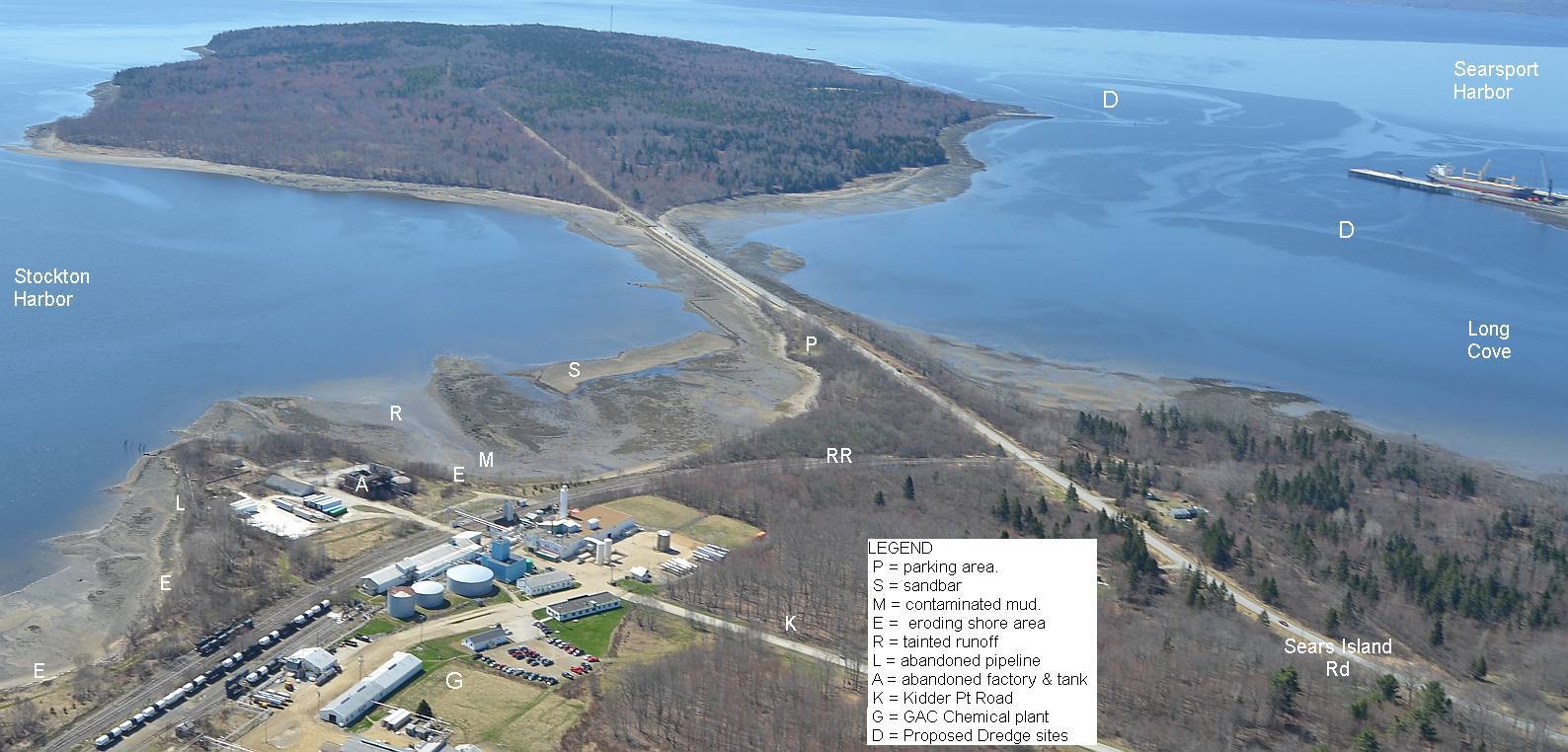
We held our press conference and public briefing at point (P) on this map. Once the final media showed up, we went down onto the beach and followed the curve of the cove around to the industrialized far side of it. There, the tainted flats and eroding shore wastes, their dispersal into the mud so easily visible from the air also evident from the ground.

We praised GAC Chemical Corp for its present compliance with state and federal environmental laws regarding their their outfall emissions, and for their important contribution to the local and state economy. 

But at the same time we urged David Colter, the now-CEO of the company, who has run the Searsport operation so well, to seize the time and deal with mitigating the legacy goop and funk dumped there the last 90 years, as fertilizer and chemical operations rose and fell, each leaving its layer of waste 'down the hill' on the shore! 

FOPB  is offering GAC a choice: 1. the Carrot of Community Cooperation or 2. the Stick of Agency Enforcement or 3. the Sword of Litigation.

We of  course want them to  take Door# 1 and  work with  the people whose parents and grandparents fished, clammed, dug worms and otherwise once made $$ in that harbor. They will  join GAC in healing the past injuries GAC's predecessors have made to the shore and intertidal area there. 
For the history of the industrial age from the late 1800s to the present day can be seen there. The bluff above the shore is layered like a cake with different colors , along the shore of Stockton harbor from the that built atop each other leaking out of their land into Stockton Harbor. 

Worse, the harbor that GAC is leaking into is the very first in a chain of little sub-estuaries of upper Penobscot Bay that the Penobscot River mixes into. Folks used to send their kids to college by digging worms and clams there, there were so many. 

Then Governor McKernan's causeway turned Sears Island into the fat end of a mile-long skinny peninsula jutting out from the mainland. Cutting off the circulation between Stockton Harbor and its neighbor sub-estuary Searsport, except by going around the island, into the river flowing past into the bay and into the other harbor. Now the GAC funk doesn't dilute out into the bay with the circulation.

Instead it has concentrated in the inward portion of the intertidal flats right alongside the eroding shore instead of dispersing out into the bay. At least it will be easier to clean up since its in a sort of contained areasection of that cove. Thus removable!

Jul 29, 2013

Waterfront waste dump tour of GAC Chemical Corp's shorefront NOON on TUESDAY

On Tuesday July 30th at 12 noon, advocacy group Friends of Penobscot Bay will host a press conference and tour of the contaminated Stockton Harbor shoreline beneath GAC Chemical Corporation

All are welcome! Wear footwear that can get a bit muddy. 

Take the Sears Island Road, from Route 1 Searsport to the parking area on the left near the mainland end of the Sears Island causeway.
See image of where to park and where to go (sandbar in this aerial photo)

The Friends of Penobscot Bay hope to bring journalists and the interested public across a small cove via a sandbar, to where they can see, close up, the company's polluted muds, its debris-filled waterfront, including eroding  shoreline waste dumps, and tainted clamflats, a tottering abandoned pipeline, a crumbling abandoned pumphouse  and ceramic waste littering a beach


The Friends of Penobscot Bay group wants GAC to trim back and revegetate shorelines that are eroding mid 20th century wastes into the harbor, or are on the verge of doing so. (DMRrecommended this in 1998It is also asking the company to demolish and remove a long-abandoned factory and chemical tank perched above the shore of Stockton harbor and clean up the soils underneath them.

Aerial photos taken recently by Friends of Penobscot Bay strongly suggest that wastes are leaking underground from the derelict facility, into the intertidal mud and moving through the harbor's intertidal flats. 

GAC manufactures a variety of chemicals, including ammonium sulfate used in pharmaceuticals and foods to alum, sodium aluminate, aqua ammonia and sodium hypochlorite.  Additionally, GAC Chemical distributes "sulfuric acid, specialty flocculants and coagulants", and creates "custom blends of various fertilizer chemicals."

"The current operator of GAC Chemical is doing a great job keeping their present operationswell within their discharge license limits," said Friends of Penobscot Bay executive director Ron Huber. "They are an example of responsible industrial manufacturing, and deserve their slogan "Maine's Chemical Company".

"But because earlier companies on the the site in the twentieth century thoughtlessly dumped 100s of tons of industrial wastes on the shore, GAC Chemical's property is  today eroding and leaking these wastes into Penobscot Bay. "
This has got to stop." Huber said.

The bay conservation group says the company's mile long shore received sustantial deposits of acidic bauxite ore, sulfur, carbon and other waste materials as a succession of fertilizer and chemical companies came and went on the Kidder Point site in the middle and  late 20th Century.  See a 1998 letter and a chart by former GAC plant operator Alex Horth  to Maine DEP, describing shoreline waste depositions  from 1939 to 1970.

"This stuff is from businesses that proceeded GAC Chemical on Kidder Point," said Harlan McLaughlin, president of the Friends group.   "Plant operator David Colter doesn't allow wastes to be dumped on the shore.  But the company knew the wastes were there when it bought the property from Delta Chemical," he said.  "GAC owns the eroding waste dumps and abandoned buildings that right now are polluting Stockton Harbor."

"We think that Mr. Colter is up to the challenge," said Huber.  He's shown a willingness to listen to our concerns and hire an environmental consultant, but a year of multiple missed deadlines has passed since he first promised to fix GAC's eroding shores. Nothing has happened." 

We are calling on him to honor his agreement and put an end to the polluting of Stockton Harbor by legacy wastes on his company's property.  We know he's a busy man, but Penobscot Bay needs a clean estuary to grow the fish & shellfish that should be filling it.   Putting an end of waste erosion  here will make a difference."

Huber said he hopes that GAC Chemical's David Colter will come out and speak with the people and media at the noon  press conference on Tuesday. 

Jul 19, 2013

GAC Chemical Corp moves closer to waterfront waste removal.

Searsport. Advocacy group Friends of Penobscot Bay asked Searsport's Planning Board's help getting local company GACChemical to halt the erosion of industrial wastes dumped by past tenants of the company's Kidder Point property, that are washing into Stockton Harbor. 

The group also called for GAC to remove an abandoned factory and tank onsite that aerial photos suggest are also leaking wastes into the harbor. After the meeting, company chief David Colter hinted that remediation could start by early August. Details, link to audio, below.
GAC's abandoned factory and tank. Stockton Harbor past treeline.
Noting the Planning Board's recent decision to reject DCP Midstream's giant tank plan has given the board a moral force for protecting their community, Friends of Penobscot Bay executive director Ron Huber said, We would like you to use whatever force you have available to get GAC to commit to dealing with the legacy industrial waste dumps along its shoreline." 
GAC Chemical's abandoned factory on right; operating facilities on left. MMA Railroad separates the two
He said this is especially important here, as Penobscot Bay is "America's Lobsterbasket" and a worldclass scenic destination. The bottom line is, he told the planning board, "a healthy, ecologically productive and naturally beautiful bay is a profitable bay." 
Huber to Planning Board: Help GAC clean up its shore.
Listen Here to Huber's presentation and questions from the Searsport planning board. (15 min mp3)

Huber praised GAC Chief David Colter for keeping the company's  present operations well in compliance with its EPA permits.  Mr. Colter runs a tight ship at GAC,“ Huber said.

But unlike its present operations, Huber said, GAC Chemical has a disappointing record on cleaning up industrial wastes that previous businesses have left behind on the company's mile long shore since the the start of the 20th century.
Old factory & tank, center right.Tainted flats, left.
“As we speak," Huber said,"a variety of wastes left on the shore half a century ago are still eroding and leaking into Stockton Harbor."
"These include bauxite tailings and other wastes dumped along the shore in the middle of the last century  that have contaminated the intertidal flats, and unknown  materials leaking from an abandoned factory, chemical tank & pipeline on their waterfront.” 

Huber gave the planning board copies of a photograph of the site showing the eroding wastes, contaminated mud and abandoned buildings and said GAC is the responsible party
GAC's abandoned tank above eroding bluff and alum tainted mud


FOPB: "GAC can do this by committing to creating and implementing a shoreline remediation plan and an intertidal flat remediation plan."

Huber said the Friends of Penobscot Bay incorporated only last fall.

"However, the members of our board have each spent decades or even lifetimes responsibly exploiting the bay or protecting it. We fish the bay for lobsters, sea urchins, sandworms and bloodworms, clams and mussels, we run tourism businesses dependent on the bay's scenic assets, we use advocacy and litigation to defend the bay from pollution inappropriate development. 
GAC Chemical's Stockton Harbor shoreline: Ceramic waste.
Noting that a year had passed since the company struck an informal agreement with the Friends of Penobscot Bay to start ending waste erosion, Huber urged the company to move forward on its own initiative. 

When Searsport Planning Board Chair Bruce Probert suggested going to the enforcement branch of the Maine Department of Environmental Protection. Huber responded that his group would prefer not to go the  enforcement route. He urged GAC to do proactively what's right for the health of the bay, not because a government agency makes them do it.

 "GAC can do this by committing to creating and implementing a shoreline remediation plan", he said, "and an intertidal flat remediation plan."

Following Huber's  presentation, GAC Chemical's CEO David Colter came before the planning board seeking permission to install housing for a gas regulator, as part of their plan to switch fuels from oil to natural gas. 
GAC's Colter: to Board: No Tank. Yes gas tankers.

Instead of one big gas tank onsite, GAC would connect a succession of tanker trucks that would pump gas into the facility as needed.

A minor kerfluffle ensued when Colter halted his testimony to object to FOPB's placement of an audio recorder on a table close to him. At the planning board chairman's request, Huber,who had been recording the meeting from its beginning, moved the recorder to a location out of Colter's sight.

But persistence may have paid off. After the meeting Huber met with Colter and apologized for distracting him. But he also repeated that the conservation group was “getting a little exasperated” with GAC's year-long series of delays in its promised startup of fixing their waste erosion problem.

Huber said that when he pressed Colter to come up with a timeline for starting the cleanup, the GAC chief indicated that he would have a shore erosion plan ready in two weeks.

Jul 11, 2013

Searsport Harbor Dredging Plan: What's at Issue?

Have you heard about  the Army Corps' proposed mercury-liberating "dredge of dreams" plan to "spoil" Penobscot Bay?  

AT ISSUE: If Army Corps of Engineers has its way, then Prock Marine or another company's dredge gear will double the dredged area next to the existing Mack Point piers, carry out scheduled maintenance dredging. and take an 800,000 cubic yard bite out of the shoal between Sears Island and the rest of Searsport Harbor. 

Read the Army Corps of Engineers' Feasibility Study, the Appendices and the Sediment testing results for their "Searsport Harbor Enhancement" project

While the maintenance dredging is needed to maintain access for the freighters and tankers that use Mack Point port, the doubling of the area near the pier will involve unearthing a great deal of petroleum tainted waste and other muck  ("..coal, slag and petroleum odor were encountered..." said the sediment testers.) This waste should NOT bne dumped into any Penobscot Bay's disposal site. Instead upland toxic waste landfilling will be necessary

Sears Island Shoal. Dredging here has no purpose other than to create a ghost harbor for the Sears Island ghost port, stillborn in 1995 and unable to attract a would-be port builder (Note "existing dredge area" that the new dredging would provide access to.
Some things don't change.

WHAT'S THE PROBLEM?  Petroleum and mercury contamination
The Army Corps study describes the  harbor sediments that would be dredged thusly:
(1) An upper layer of Searsport Harbor sediments is a 2 to 5 feet thick layer of "very soft black organic silt"  with "a strong organic odor". In addition,  "..coal, slag and petroleum odor were encountered" in the proposed dredge area closest to the existing piers

2. Below that black organic matter, the Corps found a layer of  brown silt that is also contaminated - though to a lesser degree, the report says. 

3. Then comes gray marine clay, up to twentyone feet thick, the upper part mixed with sand and gravel, with "lenses of rust colored sand."

The corp claims that all this material may be dug up and dumped in the deeper area of the bay, But lobstermen and others in the know from perevious dredging projects in the bay  hold that if dredging proceeds, the black organic matter and the brown silt must be dumped upland, along with the contents of the "lenses of rust colored sand" which could be old rusted out waste barrels from the 19th or 20th century.

Worse than oily waste is the findings of extensive mercury deposition 

The Maine Department off Marine Resources, US Army Corps and other agencies prevail, then, tainted  silt plumes dislodged by the dredgers' jaws will  rise off Wassumkeag and spread throughout Searsport Harbor, and to Belfast Bay, leaving a patina of the deadly metal dusting the seaweed, clams, the lobsterbait in trap, the lobsters - and  lobster eaters.

Meanwhile, mercurious spoils dumped onto the Rockland Disposal Site will, under the sway of  prevailing deep bay currents, be sent streaming back north along both sides of Islesboro, back to Belfast, to Searsport, to Castine; coming together in the shallows of the upper bay.  

So say those who fish the upper bay and know it well.   Should the Corps get approval and then dump into the site between Islesboro and Belfast instead... - the mind boggles.

Nor will  only our waterbreathing cousins imbibe this neurotoxin.   New research shows that marine methylmercury that reaches shallow waters  transfers quickly and efficiently into the microdroplets of spring and summer bay fogs. 

There it can transfer to seabirds' lungs - and yours. As well as every leaf in  our foggy coastal forests and island homes and gardens.


Keep the Army Corps of Engineers from loosing this deadly menace  upon Penobscot Bay.  Already methyl mercury levels of some upper bay lobster claws and tails  have risen above state and federal food safety notification  levels,  

One ring that could sink the hard gained marine sustainability certification of Maine lobster, by requiring mercury warning labels on live and processed lobsters from frozen tails to lobster rolls and stew.

One ring that, science shows, would bring methylmercury  to all airbreathers of the upper bay.

The Army Corps of Engineers hopes to get the okay this summer.

The people are rising against this needless dangerous plan.  

Got creative? Express your self -  at the ghost port

Jul 5, 2013

Help requested for Maine green crab survey

Clammers in Casco Bay have reported seeing very few sublegal clams this spring and summer. They are also witnessing what appears to be an explosion in populations of green crabs.  


Maine Clammers Association is trying to extend the observations made in the Freeport area to other areas along the Maine coast to see if a similar reduction in clams and increase in green crab infestations are happening elsewhere.  

If you have seen pockmarking on flats, if you have seen green crabs in channels or on mudflats, if you have seen green crabs causing erosion in shoreland areas, please contact:

Chad Coffin – Maine Clammer’s Association: friendsoftheclammers@comcast.net    or Brian Beal – University of Maine at Machias/Downeast Institute: bbeal@maine.edu

Listen to Chad Coffin testify before the Maine Legislature's Marine Resources Committee earlier this year, on the devastation wrought by green crabs. And to the questions the legislators responded with.

Jun 26, 2013

Maine Legislature finishes work on windpower reform bills

Here's a summary of the windpower reform  related bills that the Maine legislature considered during the just ending 2012/2013 session
Source  Friends of Maine Mountains

The 126th Legislature cleared away the last of bills that proposed to make changes to Maine's wind power siting law. We're in our sixth year of a law that has been problematic ever since it was enacted, but the Legislature has once again refused to make any meaningful changes to it. Following are a few notes on the results of each of these bills.

LD 616An Act To Amend the Expedited Permitting Area for Wind Energy Development under the Jurisdiction of the Maine Land Use Planning Commission.
STATUS: Committed back to the Joint Standing Committee on Energy, Utilities and Technology.
LD 616 would reform to the 2008 Wind Energy Act. It received a bipartisan majority report from the EUT Committee and passed the House of Representatives with relative ease. However,  the Maine Senate mkajority leadership voted to send it back to the Energy and Untilities Committee, instead of lettering rather than allowing the Senate to vote on the bill, the majority leadership moved to send it back to the EUT Committee. The motion passed on a largely partisan vote with only one Democratic legislator voting to address the issue in this session.

It was a purely strategic move to avoid any chance of making a change to current wind power siting law. Energy Office Director, Patrick Woodcock, said, "It was another tactic to retain the status quo."

When the legislature reconvenes for the second session, it's probable that there will be pressure to kill the bill's provisions or at least make them more wind industry-friendly.

Click here to see breakdowns for the House and Senate votes. Also, please consider thanking those legislators who cast votes in favor of LD 616.

"Rural citizens lose battle to have a say in wind tower rezoning" - Maine Center for Public Interest Reporting

LD 247An Act To Amend the Law Governing Appeals of Final Agency Action on Applications Concerning Wind Energy Development.
STATUS: Dead. Unanimous Ought Not To Pass in EUT Committee.


LD 385An Act To Improve Wind Energy Development Permitting.
STATUS: Passed to be enacted. Not yet signed by the governor as of 6/24/13.

From a practical standpoint, the original version of this bill proposed few changes that would have been noticeable under current patterns of development. The version that passed was amended under the guidance of wind industry representatives and does even less than the original. LD 385 originated with groups advocating wind development including the Natural Resources Council of Maine and Maine Audubon. These groups were among those that crafted the current law that has been so troublesome.

LD 1061An Act To Regulate Meteorological Data-gathering Towers in Maine.
STATUS: Dead. Unanimous 
Ought Not To Pass in EUT Committee.

LD 1147An Act To Protect Maine's Scenic Character.
STATUS: Referred to Joint Standing Committee on Energy, Utilities and Technology.
In an unusual move, the Environment and Natural Resources Committee voted to refer this bill to the EUT Committee after the public hearing had already taken place. This means the EUT Committee never heard the testimony given by supporters of the bill. Several ENR Committee members objected to the Committee majority's action on the grounds that it was unfair to the supporters of the citizens who brought the bill to the Legislature. The bill will be passed into the next session.

LD 1323An Act Regarding Wind Power Siting in the Unorganized Territory.
STATUS: Referred to Joint Standing Committee on Energy, Utilities and Technology.
This bill followed the same path as LD 1147 above.

LD 1325Resolve, To Place a Temporary Suspension on Permitting of Certain Expedited Grid-scale Wind Energy Developments.
STATUS: Dead. Divided report from EUT Committee. Killed by Senate and House votes.

LD 1375An Act To Enhance Maine's Economy and Environment.
STATUS: Dead. Unanimous 
Ought Not To Pass in EUT Committee.

LD 1434An Act To Clarify the Laws Governing Noise from Wind Turbines
STATUS: Carried over to next session.

The parties involved in this bill will be attempting to work out a solution before the next session in order to eliminate the need for the bill.

LD 1471An Act Authorizing the Board of Environmental Protection To Modify a License for a Wind Energy Development.
STATUS: Dead. Unanimous 
Ought Not To Pass in EUT Committee.

 
Thank you.

Jun 15, 2013

CLF got GAC to Drop Acid back in 2002

The Coastal Waters Project and the Conservation Law Foundation both took on General Alum  when evidence of at least three serious pollution problems emerged.  Only one was resolved. The failure to resolve the other two warrants an effort to make state and federal permits for GAC's industrial expansion plan contingent on  dealing with them, by GAC creating and implementing a shoreline remediation plan and an intertidal flat remediation plan to end those two pollution sources.

Background  the GAC Chemical plant on Kidder Point (photo) in Stockton Harbor has badly polluted shoreline conditions. Read history of industry on Kidder Point 

The GAC Chemical facility  is only the latest in a series of chemical & fertilizer companies that have operated there since the early 20th century. See 1998 GAC letter to DEP Bangor and its attached chart of results of aerial reconnaisance of site 1937 to 1990


CLF's 2001-2002  sues GAC Chemical. In 2001, CLF's then-attorney Roger Fleming reviewed the outfall records of GAC Chemical and discovered persistent ongoing violations of the company's discharge permit, specifically unlawfully low pH of outfall effluent
See a 3/27/98 Notice of Violation  sent to GAC by DEP, and the company's 4/20/98 Response to DEP

. On October 3, 2001 CLF filed a Notice of Intent to Sue under the Clean Water Act. On February 11, 2002, CLF filed this complaint.  Eight months later, on October 9, 2002a settlement was reached.   See: CLF Reports:Stopping General Alum & Chemical Corporation's pollution of Stockton Harbor   

PRESENT SITUATION
The photograph in the above linked Stopping General Alum & Chemical page illustrates graphically three of the ongoing pollution problems on the GAC Chemical shore  The silvery mud in the foreground is acidic bauxite tailings that have eroded into the intertidal flat from a predecessor company's shorefront dump since at least 1957. Midground: see an eroding shoreline waste dump whence the bauxite came. The abandoned tank in the background has supplied its own multicolored wastes into another part of the same cove's beach and intertidal flat.  

Photos from March 2013 site visit (unless otherwise noted)
Shoreline # 1  Eroding sites March 2013.  Here and here  and hereDumped ceramic grinding parts (1) Here (May 2012)
Shoreline # 2  Shorefront landfills March 2013.  Here and Here and Here  Dumped ceramic stirring parts (2) Here

Abandoned structures 
Old import pipeline from offshore dock to now demolished plant Here and here
Abandoned pumphouse with two outfalls inside. Here and  here (closeup) *** 1998 Aerial of dischargefrom"abandoned" pumphouse
Abandoned closed outfall catch basin Here  ** April 8,1998 BDN story on waste buildup in basin that we ID'd and forced cleanup of.
Abandoned building w/ abandoned tank Here
Tainted flats below abandoned building & tank  From land *** from land (2) *** From air  from air (2) *** from air (3)

Agency Actions to date
On  April 16, 2004  two DEP marine ecologists sampled the mud.  Low levels of biodiversity was found. Ending erosion  of wastes by trimming bluff back and sodding it over was suggested but not carried out.  Report by John Sowles *** Report by Lee Doggett

Meeting with the Company
Last year  we took Colter and his CES environmental consultant on two walka along the worst part of his company's shores.  There, exposed strata of acidic  alum production wastes dumped along the shore in the 1960s and 70s  have eroded into the harbor, adding a silvery color to the mud in the clamflats, Nearby, red and black leacheate rises up through the gravelly beach and into the mud, with the apparently culpable derelict building & tank rising above it

We urged Colter to start by removing or cutting back and resodding the waste piles that are leaking onto the harbor's shores and adjacent clamflats. Then, we suggested, at least an acre of contaminated mudflat should be dredged up or dug up and landfilled, possibly onsite in the company's existing landfill.

Mr. Colter was enthusiastic at first: He wrote after GAC's enviro consultant CES gave him an update:
"I recently received options from CES for improvements to the shoreline to address erosion concerns.  We are working through the cost options to decide what will be best.  From a budgetary perspective, this will have to be a 2013 project.  I am pleased with what CES has proposed.  Once we have the cost pieces pulled together we will approach the DEP to determine the steps to move forward.   I will keep you posted." 
That was 7 months ago. No postings from Colter yet.

PROPOSED ACTION  Leverage mitigation as quid pro quo for company expansion plan.
Last September GAC  applied to the Searsport Planning Board to add an additional chemical plant to their property. The new facility would create "plastic pigments"  and would be a joint venture with Mexican chemical firm Dalegip America. See media coverage  here and here

We would like the new facility's state  or federal permits to be conditional on GAC creating and implementing a shoreline remediation plan and an intertidal flat remediation plan.  The eroding shore bluff, bauxited clam flat, and leacheate-drenched beach areas are all unlicensed discharge violations of the Clean Water Act.

Whether or not cleaup is tied to their expansion plans, if CLF did a site walk along the intertidal shore first without, then with, GAC's David Colter, you may be able to  convince him that remediating his site's historic shore waste problems -as responsible party- needs to be a top priority.

Colter has run a tight ship.  MDEP records show that the GAC Chemical facility has greatly improved its pollution controls since the 1990s. The company is locally well liked; it has a large local payroll and contributes to civic betterment projects.  Thus it is a disappointment that Colter seems to have a problem keeping his promise to deal with the facility's shoreline waste dumps.  CLF could help nudge the company along in the right direction