Search

Mar 31, 2009

Port Plan Flameout as Huber pulls MDOT's plug.

MDOT misses all four critical deadlines. Huber Wins by Default?

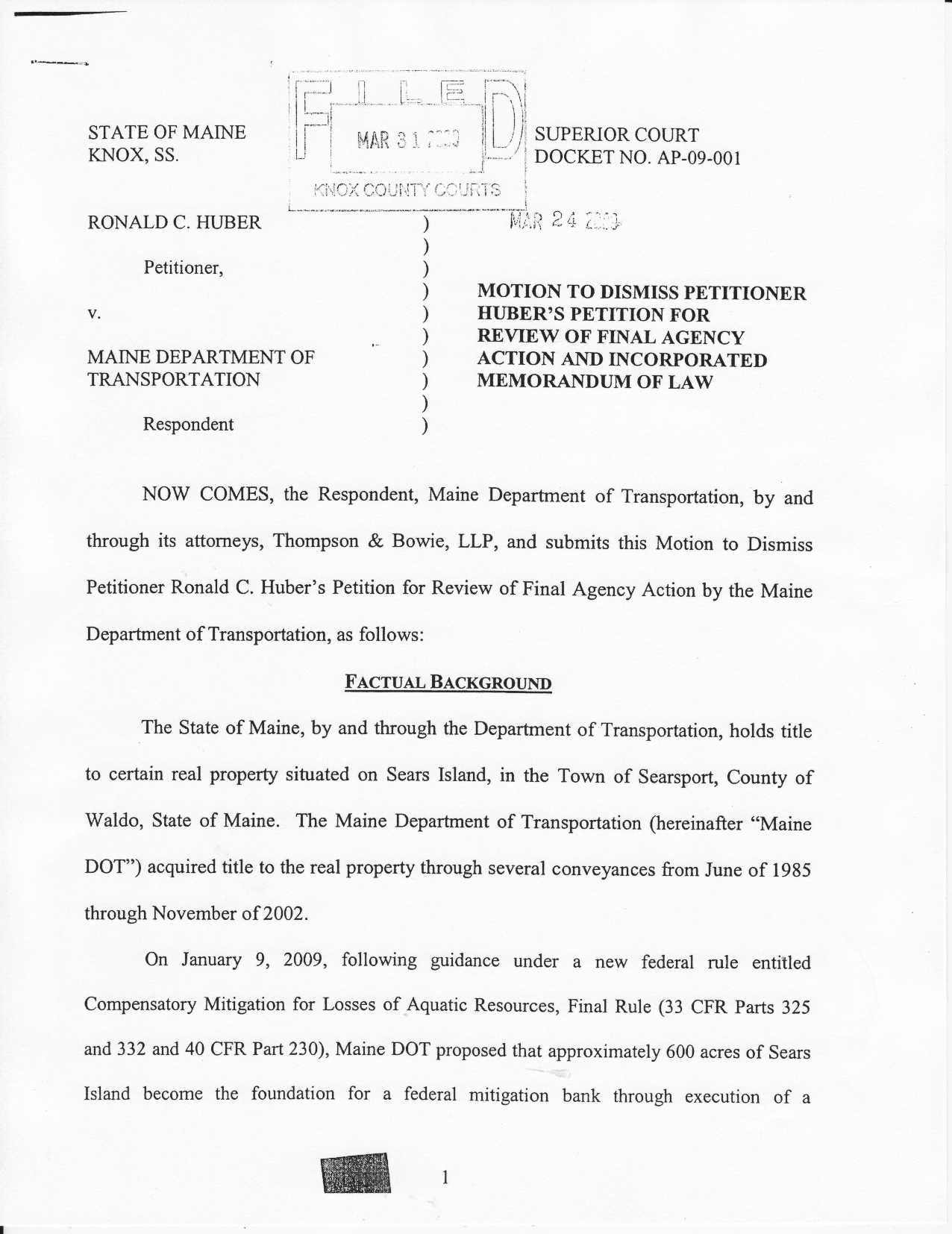
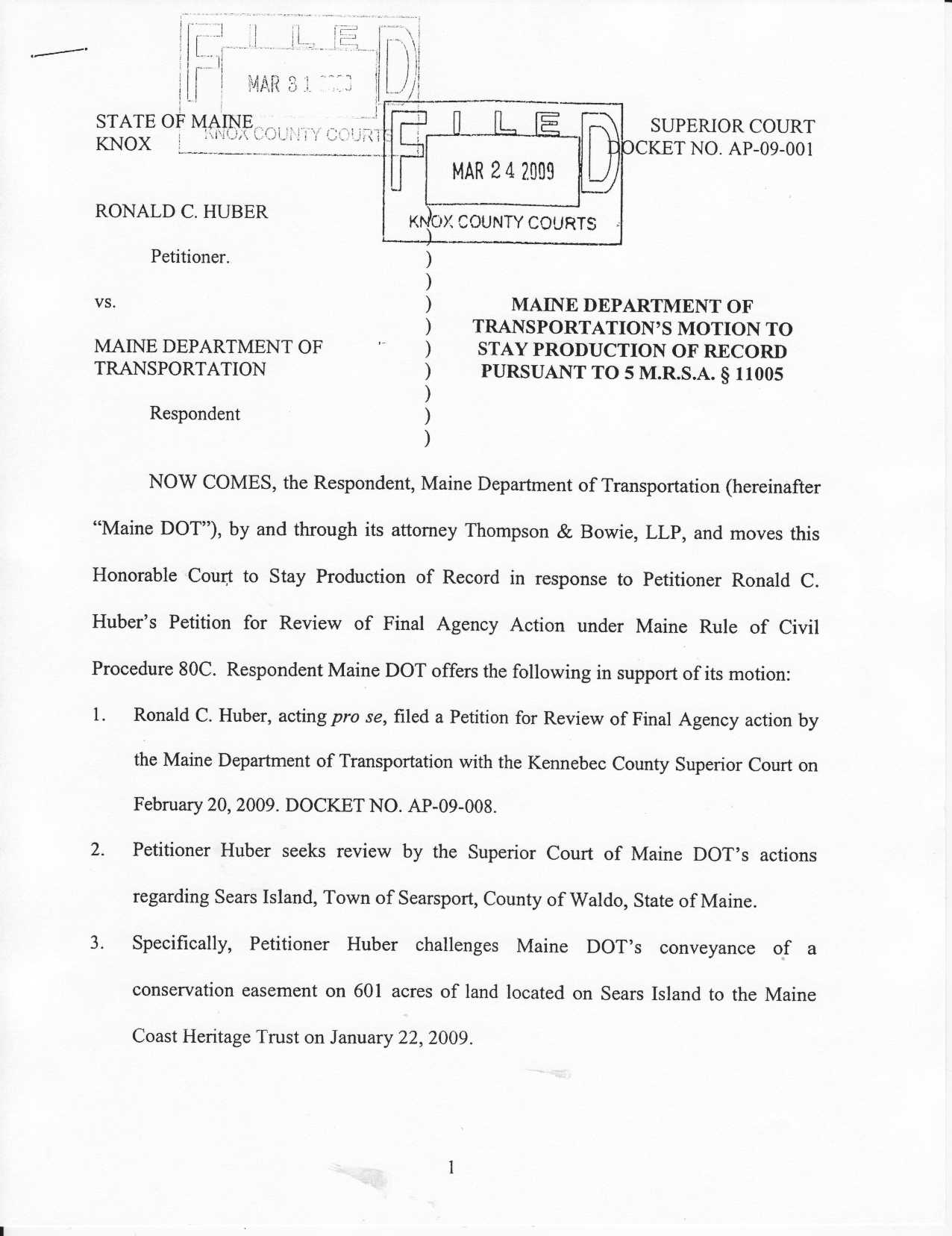
ROCKLAND. The Sears Island partition plan may be history, depending on how a Superior Court judge rules on a motion filed March 31, 2009 by environmental activist Ron Huber in response to efforts by private attorneys hired by Maine Department of Transportation. Huber's motion:

"...moves this Honorable Court to find that MDOT failed to file both its Motion to Stay Production of Record and its Motion to Dismiss in a timely manner, and to exclude these motions from consideration in the Court's review of Huber's Petition for Review of Agency Action."

See all motions filed in the case by all five sides

"I have faith that Judge Hjelm will agree with my motion, rule MDOT to be loser-by-default,'' said Ron Huber "and send the agency off to carry out the environmental impact reviews under state law required for such a gigantic project as the world class containerport the agency wants."

WHAT HAPPENED. Not only did MDOT's hired guns miss EVERY deadline set by the court, they tried to obscure the fact by altering their and Huber's filing dates in the motions they filed with Knox County Superior Court.

Said Huber, "for a prestigious Maine law firm's perhaps most prestigious attorney - former state bar association president, a list of commendations long as a windmill's arm, known to revel in being called "superlawyer" - for this officer of the court to miss her every response deadline regarding the Huber vs Maine DOT case before Knox County Superior court is ...well...fine with me."

For indeed, not a thing sent in to Knox County Superior Court for the Huber vs MDOT docket by Superlawyer Rebecca H. Farnham and her barely-out-of-law-school sidekick Jason Donovan, Esq, arrived before the deadline was long past

Not MDOT's Motion to Dismiss. Not MDOT's Motion to Stay Production of the Record. MDOT's Motion to Consolidate not only missed the deadline, it never even reached Knox County Courthouse.

As anyone who practices law on either side of the bench, or gets law practiced for or against them knows, deadlines in legal proceedings are near-immutable forces of nature, no more capable of being tweaked this way or that by a tardily responding lawyer than an iceberg is by a penguin. Of course there are exceptions - but only for those who 'fess up to the Court before that deadline smacks them, and receive the Judge's blessing to try try again.

But that didn't happen. Huber's Motion states:

"In their motions to this Court, MDOT erroneously asserts that Huber filed his Petition for Review of Agency Action on February 20, 2009. MDOT further erroneously asserts that it filed its responses to Huber's Petition on March 23, 2004. A review of the date stamps on Huber's petition and on MDOT's response motions in the Knox County Superior Court's docket files reveals that Huber actually filed his petition on February 19, 2009, while MDOT actually filed its two response motions on March 24th, 2009."

Huber goes on to observe that:

"Whether these errors are attributable to carelessness or to an attempt by the Defendant to appear to have filed its response in a timely manner is unknown. The fact remains that the Defendant has failed to respond in a timely fashion as required by 5 MRSA §11005 Responsive Pleading; filing of the record, which says in pertinent part:

"The agency shall file in the reviewing court within 30 days after the petition for review is filed, or, within such shorter or longer time as the court may allow on motion, the original or a certified copy of the complete record of the proceedings under review." A review of the docket reveals that no such motion requesting a "longer time" was filed was filed with the Knox County Superior Court within the 30 day period set by MRSA 5 § 11005."

"Courts have got to be merciless with deadlines;" Huber said. "Else they face docket gridlock. Superior Court Judges are busy enough endlessly untying or slashing the Gordian Knots of Law brought before them. Extensions stop up the process."

Huber's February 19, 2009 Petition for Review of Final Agency Action asks the Maine Superior Court:

"to rescind the Jan. 22, 2009 conservation easement until the MDOT has fully complied with the requirements of the Maine Sensible Transportation Policy Act and the Maine Site Location of Development Law."

"These are important laws that protect Maine's most important natural and wild places for their irreplaceable scenic, recreational and ecological resources." Huber said. "Sears Island is a wild Noah's Ark holding representatives of most of the coastal plant and animal species that Almighty God blessed Maine's coast with. Its not right for MDOT to just barge in and start clearcutting, bulldozing and dredging this precious remnant."


# # #

For more information:
Ron Huber
e: coastwatch@gmail.com
tel: 207-691-7485


Mar 27, 2009

Sears Island Smackdown! Chief Justice won't accept MDOTs motions: wrong court!

It is as though MDOT's hired guns, attorneys Rebecca Farnum and her sidekick Jason Donovan of Thompson and Bowie LLP, had purposely set out to insult the Maine Superior Court Judges of three counties.

"So what
if the rules say requests to consolidate 80C cases must be made to the judges of the courts where the petitions were filed? We're MaineDOT's attorneys! We don't need to follow the rules!"

That or something similar must have been rolling through the noggins of T&B's dynamic duo when they decided to go over those judges' heads and ask the Chief Justice of Maine Superior Court to rule on the motion instead.

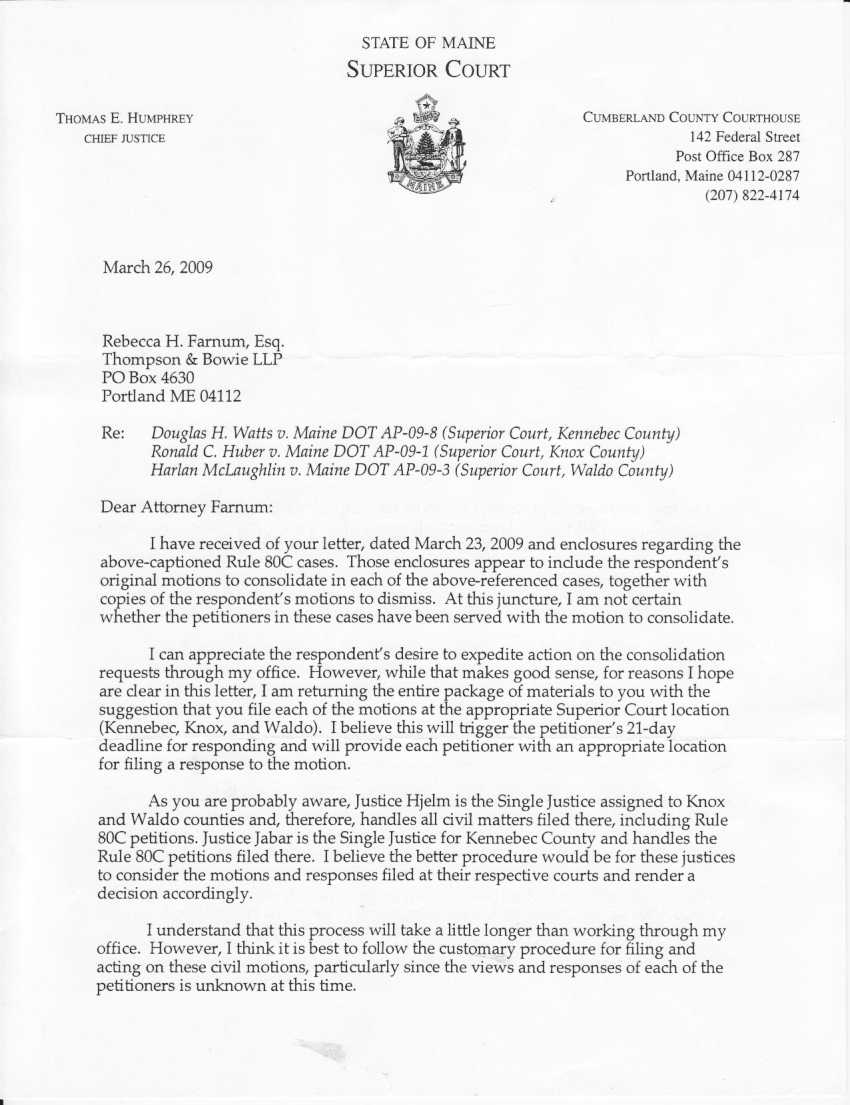
Chief Justice Thomas Humphrey politely but firmly declined to accept their motion for consolidation on March 26th.  With admirable restraint, Justice Humphrey identified for them the Superior Court judges of Knox, Waldo and Kennebec counties, explained to Farnum and Donovan that  "...it is best to follow the customary procedure for filing and acting on these civil motions",   returned their motions unread and bade them go practice their craft on the two judges at the courts where the plaintiffs filed.

In the interest of moving this case along, Ms. Farnum and Mr. Donovan are respectfully offered a link to Rule 80C of the Maine Rules of Civil Procedure. Updated to January 2009.

An excellent resource for those lawyers who find themselves still baffled by the mysteries of civil procedure!

Mar 26, 2009

Sears Island litigant calls MDOT's response to suit "encouraging".

Legal actions continue in Maine Superior Court over State's Sears Island Partition Plan.

Rockland. A man suing the Maine Department of Transportation's over its January partitioning of Sears Island into port and conservation easement zones today called the response filed by MDOT's hired private lawyers on March 23rd "encouraging."

"MaineDOT violated the Maine Sensible Transportation Act (STPA) by planning an enormous and enormously destructive container port project, said plaintiff Ron Huber of Rockland, "without taking a single look at the ecological and health consequences of doing so." Huber sued MaineDOT in February (pdf)

"I find their argument - essentially that a containerport is not officially a transportation facility, and thus the Sensible Transportation Act doesn't apply, to be encouraging in its lameness, as it shows the agency has no real defense to the charges I have brought against it."

The state has filed a motion to dismiss Huber's lawsuit, a motion to consolidate his suit with two similar lawsuits and a motion to avoid having to divulge state documents related to the easement.

It is not surprising, Huber said, that MDOT's response to the lawsuit spends so little time defending its actions and so much on challenging his legal standing. "They've got no excuses. Along with the STPA, Commissioner Cole violated Maine's Site Location of Development Act and the Maine Constitution. All he can hope for is that somehow the judge won't allow the case to be heard. But my case and my legal standing to bring it are rock solid, so that's not going to happen."

Huber also said it is very significant that Maine's Attorney General has declined to represent MDOT in the lawsuit.

"MDOT has been hung out to dry," Huber said. "When former MDEP Commissioner Dawn Gallagher got caught having illegal dealings with a polluting company, she too was forced to seek outside counsel for herself and her agency. The blatancy of the lawbreaking here by Maine DOT Commissioner Cole must have been too much for Attorney General Mills to stomach."

"Let's put it this way: the AG's office isn't even on the court's cc list about this case. This is completely unheard of when an agency is in court over violations of state laws and the Maine Constitution."

Huber said he will file his responses to MDOT's filings over the next three weeks..

END

Mar 20, 2009

Is it your mudflat, my mudflat or our mudflat?

LD 852 An Act To Clarify the Public Ownership of Marine Organisms within the Intertidal Zone

Be it enacted by the People of the State of Maine as follows:

Sec. 1. 1 MRSA §3-A is enacted to read:

§ 3-A. Ownership of marine organisms in the intertidal zone

In addition to the living resources of the seas owned and controlled by the State under section 2, subsection 2-A, the State declares that it owns and controls the harvesting of seaweed, shellfish and other marine organisms on or under lands within the intertidal zone.

summary

This bill declares that the State owns and controls the harvesting of seaweed, shellfish and other marine organisms on or under lands within the intertidal zone.


Exiled Pen Bay Area inmates - bring 'em home - Meeting at Belfast UU Sat Noon

On Saturday, noon to 4pm the Maine Prisoner Advocacy Coalition, or MPAC, is hosting a gathering and potluck at the Unitarian Universalist church in Belfast.

Topics include bringing exiled inmates back to Maine. Lynne Williams about her gubernatorial corrections positions, Volunteers for Hancock Jail Residents (split sentencing bill), Black Bird Legal Collective ( anti-torture legislation) Naughty North Collective ( queer prisoner correspondence project and support for the NJ4) Maine Native Prison Project, Dewey Fagerburg ( NAACP's reentry program).

Organized by the Blackbird Legal Collective, from Portland. Y'all come.

Mar 15, 2009

First Nations' name for Sears Island goes from bright to dark.

Just as the European colonists and their descendants have given the island at the top of Penobscot Bay a variety of names, so to have the aboriginal peoples of the Penobscot Bay Area and their descendants named and renamed the island. Penobscots, Passamaquoddies and members of other First Nations visited, lived and loved on Sears Island for the ten millenia they lived here in what we call the Midcoast Maine region - before the European occupation.

Going back in time, Sears Island was Brigadier's Island, was Wasumkeag, was Wasa-umkeag, was Awassawamkeak.

Wasumkeag (variant Wassumkeag) has been translated by some as ‘bright sand beach island’ or "Island of the shining shore."

However, an official of the Penobscot Indian Nation recently notified Maine's Natural Areas Program that the Island's name Wasumkeag , in present Penobscot Indian language, now means "Darkly covered island".

Referenced in Maine Natural Areas Program Sears Island report of 2007 (pdf) HTML version

Mar 13, 2009

MDOT may use stimulus money to destroy Searsport's Long Cove Ledge and Sears Island fish nursery to help container ships,

The date was fitting. On Friday the 13th of March, the Legislature's Transportation Committee was given a plan by MDOT Commissioner Cole to use 10.5 million dollars of federal stimulus money to (1) destroy a third of the Wasumkeag Fish Nursery's juvenile cod habitat with dredging, and (2) use explosives to destroy a nearby ledge used by salmon and other fish during their brackish transitions between river and bay.

Here's a 7 minute excerpt Cole and Damon are going back and forth about using a chunk of MDOT $timulus money for dredging near Sears island (mp3 file) And about giving money to Montreal Maine Atlantic railroad, and about blowing up the Long Cove Ledge for easier shipping.

The attack on the estuary would come in two waves: dredging out the the northern most sheltered third of the Nursery shoal, and using explosives to destroy Long Cove Ledge - a shoaling ledge only 1 foot deep near its southern end, used by wild salmon during their Switchover from salt to fresh and vice versa.

Click here for the complete 20 minute recording of Cole and staff talking to the transportation committee about stimulus money for many projects, on March 13, 2009.

Sears Island plaintiffs may subpoena Maine JUPC members

Members of the Joint Use Planning Committee may soon find themselves ordered to appear in Maine Superior Court, after preliminary motions for the cases opposing the partition of Sears Island brought by Harlan Mclaughlin of Searsport, Ron Huber of Rockland, and Doug Watts of Augusta, are resolved.

Sears Island Joint Use Planning Committee members that may be subpoenaed include Coastal Mountain's Land Trust official Scott Dickerson, Maine Sierra Club leader Joan Saxe, Islesboro Island Trust head Stephen Miller, Friends of Sears Island president Jimmy Freeman and Penobscot Bay Alliance chief Becky Bartovics.

It is believed that information will be elicited as to how these environmentalists arrived at a deal with state officials to dismember New England's biggest unprotected wild island into port zone and conservation easement zone without following state laws that require planning for the inevitable environmental damagesuch a project would cause.

"It will be a messy case," Huber said, "but like sausagemaking, what comes out at the end will be worth it."

Mar 8, 2009

Ocean Energy. Maine Fishermens Forum Panel Audio online.

At the 2009 Maine Fishermen's Forum, ocean wind and water energy proponent John Ferland of Ocean Energy Renewable Power Co of Maine held forth on the positives of ocean energy development, followed by a more cautious talk by Maine Marine Resources Commissioner George Lapointe. Both speakers generated many questions.
Listen to the talks and discussions (MP3s ) **** Media Coverage of the session

Mar 2, 2009

Shipping Pollution - can upper Penobscot bay handle all the carbon?

Commercial ships spew half as much particulate pollution as world's cars . Upper Penobscot Bay could become an asthma cluster area if Sears Island is turned into a containerport. The diesel fumes from ships, tugboats, trucks railroad enginees and derricks will create a stinking choking cloud over the upper Bay.

Here's a recent study of the issue of shipping air pollution:

Daniel Lack, a researcher at the National Oceanic and Atmospheric Administration (NOAA)'s Earth System Research Laboratory has just published results of a government study finding that that globally, commercial ships emit almost half as much particulate pollution into the air as the total amount released by cars, according to a new study. Ship pollutants affect both the Earth's climate and the health of people living along coastlines.

"Since more than 70 percent of shipping traffic takes place within 250 miles of the coastline, this is a significant health concern for coastal communities," says lead author Daniel Lack. He and his colleagues reported their findings on 25 February 2009 in the Journal of Geophysical Research – Atmospheres, a publication of the American Geophysical Union (AGU). Read article here

Feb 25, 2009

Eelgrass researchers, regulators of NW Atlantic meeting.

The workshop Status, Trends, and Conservation of Eelgrass in Atlantic Canada and the Northeastern United States,was a two day event, February 24-25, at the Regency Hotel in Portland, Maine. Valet parking simplified the Portland parking challenge
Listen here to recordings of the day speakers

* Hilary Neckles of the Augusta, Maine office of Patuxent Wildlife Research Center started the workshop, going over the agenda and setting the issues facing eelgrass out in brief.

* Dr. Fred Short of the University of New Hampshire, held forth on "Eelgrass: the Big Picture", Lots of interesting facts emerged as Fred took us on a visit to eelgrass around our globe - it is there in the northern temperate zone - and declining around the world, too.

* Seth Barker, Maine DMR's GIS and habitat mapping expert, described Maine's eelgrass situation

Clink on the link for recordings of all of the day's speakers

From the discussions:

*Eelgrass is a flowering plant that aeons ago migrated from fresh to saltwater. In the Gulf of Maine it grows down to eleven meters deep.

*It can grow well in anoxic sediments, bringing oxygen down into its roots and discharging it into the mud, creating an oxygen-rich biological zone around the roots, called a "rhizosphere". Mats of roots can form, creating large rhizospheres.

* We have overused our coastal zone. Back in the good old days, nearshore eelgrass hosted flounder, lobster and cod in plenty. Sadly, very few cod nowadays are found in eelgrass. I.e. in shallow waters

Eelgrass wasting disease, the scourge of this plant in the early twentieth century, is now known to be attacks by the colonial slime amoeba Labyrinthula zosterae

The more nutrients in the shallow water, the more epiphytes or fouling organisms clutter the eelgrass' fronds, blocking sunlight from photosynthetic cells But at the same time the epiphytes provide food and shelter for myriads of other tiny organisms.

*Snowshoes are good for walking on eelgrass flats and mudflats without crushing the rhizospheres and without sinking deeply into them..

The Eelgrass Workshop Steering Committee - which has done a splendid job- consists of, Al Hanson of Environment Canada's Canadian Wildilfe Service, Phil Colarusso of U.S. EPA, and Robert Buchsbaum of Mass Audubon. Good work, people!


Feb 23, 2009

Sears Island: Second Lawsuit filed against MaineDOT easement

For Immediate Release Feb 23, 2009

Sears Island Conservation Easement seen increasingly in doubt .

AUGUSTA – An Augusta man has filed a petition in Maine Superior Court asking for MaineDOT's Sears Island Conservation Easement to be set aside. The move follows Thursday's filing of a similar petition (pdf) in Knox County Courthouse by a Rockland, Maine man.

Douglas Watts filed his Petition for Review of Final Agency Action on Friday afternoon in the Kennebec County Superior Court. Read Douglas Watts' Petition Here (pdf).

Watts describes himself in his petition as "an avid user of the Penobscot River and its tributaries near Sears Island since
1982."
and wrote to the court that the conservation easement signed by MDOt and Maine Coast Heritage Trust "will irrevocably harm his ability to continue using and enjoying the Penobscot River and these tributaries as he has done since 1982."

He is asking the Court to "rescind the Jan. 22, 2009 conservation easement until the MDOT has fully complied with the requirements of the Maine Sensible Transportation Policy Act and the Maine Site Location of Development Law."

Watts played an important role in development and passage of the Maine Sensible Transportation Policy Act In the late 80s and early 90's.

For more information contact Doug Watts at (207) 622-1003 or by email at info@dougwatts.com

###


Feb 20, 2009

Sears Island activist takes MDOT & State Legislature to court

FOR IMMEDIATE RELEASE FEBRUARY 20, 2009
Contact Ron Huber 207-691-7485 or coastwatch@gmail.com

Legal action filed in Maine Superior Court against state's
Sears Island Partition Plan.


On Thursday February 19, 2009, Ron Huber, an opponent of the Maine Department of Transportation's January 22nd partitioning of Sears Island into port zone and conservation easement zone, filed a "Petition for Review of Final Agency Action by the Maine Department of Transportation" with Maine Superior Court in Rockland, Maine.

The petition (pdf file) charges that the Maine Department of Transportation (MDOT) and the Maine Legislature's Joint Committee on Transportation violated state law and the Maine Constitution when planning and approving the partitioning of Sears Island in upper Penobscot Bay into industrial and conservation zones.
The petition calls for the Superior Court to protect the irreplaceable Wasumkeag Estuarine Complex made up of Stockton Harbor, Long Cove and Searsport Harbor, (see illustration) from irresponsible MDOT port development.
Huber has asked the Court to order the the state's 600 acre conservation easement to Maine Coast Heritage Trust to be rescinded until a careful look is taken at the environmental implications that a container port on the other 340 acres of Sears Island could have for upper Penobscot Bay/lower Penobscot River water quality and the River's and Bay's fish and shellfish

It also calls for the Superior Court to declare a 2005 law unconstitutional that gives the Legislature's Transportation Committee approval power over activities on Sears Island,by violating the Maine Constitution's separation of powers.

Plaintiff Ronald Huber of Rockland, Maine, has asked the court to:

1. Find that Public Law Chapter 277 "An Act Regarding the Management and Use of Sears Island" violates the Maine Constitution's Article III Distribution of Powers. The 2005 law improperly grants Executive Branch decision-making power to the Maine Legislature's Joint Committee on Transportation.

"Get the Legislature's Joint Committee on Transportation out of the Executive Branch's turf." Huber said. "Sears Island decisionmaking needs to be free of backroom politics of the sort demonstrated by the Senator Dennis Damon in his co-chairmanship of the Transportation Committee over the past year."

2. Find that MDOT and its Joint Use Planning Committee failed to comply with the planning requirements of the Maine Sensible Transportation Policy Act and the Maine Site Location of Development Law.

"Those two state laws have hugely important environmental impact review standards that the Baldacci administration with, incredibly, the active collaboration of the Maine Chapter of the Sierra Club and other "conservation' members of the Joint Use Planning Committee like Friends of Sears Island and Penobscot Bay Alliance, have tried to work their way around." Huber said. "Maine uses them to protect her places of natural biological productivity, her irreplaceable scenery, her historic and archaeological sites, from the long term effects of poorly-planned large scale developments like a container port."

Huber also criticized Senator Dennis Damon for unconstitutionally using Public Law 277 to lead the Transportation Committee into on November 18, 2008 , imposing binding conditions on MDOT's before the agency could execute the conservation easement, and then then, on January 13, 2009, pressuring his Committee into completely reversing its earlier unanimous vote, and vote to waive the restriction they'd earlier imposed.

"What was the quid pro quo?" Huber said."What did Senator Damon ask for and receive during those private meetings with the governor he admits to having after the November 18th vote?"

"What was enough to make him switch not only his vote, but also to press the members of the Legislature's latest transportation committee into switching theirs?"

"I am asking the Court to relieve the Transportation Committee of the burden of implementing PL 277" Huber said. "I trust the judge will declare it in violation of the Maine Constitution's Article III Distribution of Powers.

"I am proud as well to have a religious and spiritual relationship with Sears Island and its surrounding estuarine complex, protected under Article 1 Section 3 of the Maine Constitution." Huber said.

"This is a place that Almighty God has created to nourish, shelter and transition the salmon that morph there - freshwater to saltwater, salt to fresh, back and forth between Penobscot River and Penobscot Bay, have done so for at least 8,000 years, and will continue to do so, if I can help it. Not to mention the river herring, the sturgeon and the other fishes and water-dependent wildlife that use these sheltered fertile waters."

For more information contact Ron Huber at (207) 691-7485 or by email at coastwatch@gmail.com


Feb 18, 2009

Gulf of Maine funding sponges threaten to uselessly absorb Obama Bucks

Is it a case of : "If at first you don't succeed, try, try again."?
Or is it:
"The definition of insanity is trying the same thing over and over again and expecting different results."?

In the case of the Gulf of Maine Restoration Collaborative, one hopes the former, but fears the latter.

For decades, Maine has had a small community of on-the-government-payroll coastal marine advocates, who revolve themselves through the doors of the Maine Coastal Program, the Department of Marine Resources, Maine SeaGrant and the Maine Cooperative Extension marine team . Shifting, as the years and decades pass, from organization to agency and back again as the funding shifts. Attending fishing industry regulatory meetings, taking part in research panels and keeping a harem of private consultants on call upon whom to shower grant monies that pass through their disbursing hands.

With the combined talents and energies of this merry band, and the greater Gulf of Maine Council on the Marine Environment, one would think that every ill that afflicts the Maine coast and its coastal waters: pollution, habitat loss, coastal sprawl, inappropriate fishing tech, mal-regulated aquaculture - every one of these challenges would have been met long ago.

Guess again.

These folks have met and spent much time (decades) and treasure on "task forces" designed to take on "bay management, aquaculture reform and more.
Those task forces have steamed furiously about the Gulf of Maine, holding meetings, dispensing coffee, catered lunches, grants and goodwill. But these task forces - run by the very same people who (see below) now want $500,000 dollars of stimulus money to outfit another intellectual armada - have always returned empty-handed.

The Maine Bay Management Study and the Maine Aquaculture Task Force (pdf) illuminate this nicely. Both well funded initiatives, they brought together the above usual suspects and a few chosen hangers-on, held copious meetings with 'stakeholders' over the course of a year or more, teleconferenced mightily, and then at their close brought out lavishly illustrated reports that were completely barren of innovation.

Neither task force, however, proposed any changes to state law or state regulation to better manage Maine's bays, or to improve aquaculture operations. Nada. The reports do conclude, with a smirk, that more cash is desperately needed to finance further adventures of the task force voyageurs.

In fact, in a sort of mea culpa, David Keeley, former head of the Maine Coastal Program and now employed somewhere within the bi-national bureaucracy of the GOMCME, confesses the failure of he and his fellow taskforcers to protect natural Maine:

"The Gulf of Maine watershed—its streams, lakes, bays, and beaches—are damaged by untreated sewage, toxic pollution, invasive species, loss of wildlife habitat, abandoned fishing gear and other human-caused impacts," Keely writes, warning that "The problems are serious and many of them, have reached or are reaching crisis proportions."

So Mr Keeley, under whose guidance and direction that crisis has taken shape, now wants $500,000 to develop "a comprehensive ecosystem restoration strategy for the Gulf of Maine".

Notice that this money would not be used to plant eelgrass, or to remove ghost traps from the water, or to in any way restore any habitat or fish stock or anything tangible.

No, it would be used to develop a "strategy". In other words, it would be spent for the creation of -what else- a task force, in which he and his revolving door friends once more tootle about the Gulf of Maine region, lamenting the lack of research, genuflecting to the wisdom of the fishing industry that has nearly destroyed the Gulf of Maine's fishes, noshing on catered luncheons and producing a report heavy on graphics but once again light on ideas.

Beyond -burp- demanding more money for more catered conferences.

Feb 17, 2009

Sears island Mitigation Bank Meeting 2/23/09 - TIME CHANGE - day to evening

Army Corps's Ruth Ladd wrote Bay Blog announcing that the February 23rd mitigation meeting at Union Hall in Searsport is going to delayed from day until evening, i.e. from 2pm to 7 pm. This change is in response to several requests that the meeting be done at night to allow more of the public to attend

Ladd will still be at Union Hall at 2 pm (as will Deane Van Dusen with MaineDOT) to chat with anyone who shows up at the original 2 pm time. FMI: Ruth M. Ladd (978) 318-8818
Chief, Policy Analysis and Technical Support Branch, Regulatory Division
New England District Corps of Engineers ,696 Virginia Road Concord, MA 01742-2751

Feb 16, 2009

End your optimism, you Climate Change Pollyannas!

In his below review of Global Warming For Dummies by Canadian Green Party leaders Elizabeth May and Zoë Caron, Green Web organizer David Orton of Nova Scotia takes issue with the espousal of what is false optimism by May and other leaders in the mainstream and green conservation communities, who fail to grasp the thistle; they won't promote and lead the actual drastic  global actions necessary to survive the coming ecological crash in some semblance of civilization, focusing instead on what is essentially Titanic deckchair rearranging. Read Mr. Orton's thoughtful essay, below:

Climate Change Pollyannas by David Orton GreenWeb, Nova Scotia, Canada

The Pollyanna title for this review -- meaning a false optimism or attitude of looking for the good side of any situation -- is misleading, given the situation we face. The basic working position permeating this book is not that we are facing a civilizational and ecocide crisis of hard to grasp proportions -- which require seismic cultural and institutional changes and lifestyle change which are difficult to comprehend -- with the outcome very much in doubt. But it is the promotion of the view that good things are being done around climate change and global warming, that we are moving in the right direction, and only need to accelerate our efforts. I believe this to be a false, harmful, and very misleading Pollyanna-type message.


Full article Here

Feb 6, 2009

Sierra Club calls Sears Island sell-out a historic........what?

Was it historic, this Sears Island legislative self-abuse, its attendant gubernatorial executive ordering, those hymns to holy compromise rising from the Bangor Daily News and other outlets, all primed by the Governor's public affairs crew and his tame enviros, that just went down over the last 90 days?

The Sierra Club Maine Chapter would say so. That is, its tiny politburo, in its omniscience, would say so. They can speak - or they claim to - for thousand upon thousands of Maine Sierra Clubbers - without ever contacting them. Such outreach is unnecessary, expensive, time consuming, intrusive - a litany of negative adjectives flows freely from the all-knowing Ex Comm's keyboards when inquiry is made. !

For they are the EX-COM and as such know what is best for you and I, for Sears Island, the bay, for Maine, for the Universe!

"It has long been the Sierra Club’s position" the Cabal intones, "that the island should be limited to compatibly managed marine transportation, education, recreation, and conservation."

How long is "long", one is compelled to ask.

To those who persist in raising a pother about Club democracy, the gauntlet is thrown: fight your way into our Cabal, and rule the Four Thousand along with us! Or to perdition with ye.

Jan 28, 2009

Mitigation Bankers to meet soon in Searsport - last step before divvying up Sears Island


Ah yes. That poignant little phrase of the Sierra Clubbers: 'Don't worry, they'll never build on Sears Island,' is about to enter the history books alongside the "Dewey defeats Truman " headlines of yore.

Why, Because MDOT has now resubmitted its umbrella mitigation bank prospectus to the Army Corps of Engineers for approval. (link is to the notice from June 2008 that was cancelled in November (pdf)) The Corps' mitigation bank officer Ruth Ladd wrote in response to a recent inquiry:

"Yes, there will be a new Public Notice on the resubmitted prospectus and there will be a public meeting in Searsport. I anticipate sending out the Public Notice on February 3."

THAT'S RIGHT. This direct result of the signing of the final order on Sears island, makes it now possible for MDOT to 'bank' the value of the "conserved" portion of Sears island for its first 'deposit' in its spanking new mitigation bank.

Why? So MDOT can then 'spend' that value compensating for the savagery it is about to inflict upon the salmon, sturgeon and baby cod who rely on the shallow brackish shoals that must be dredged to make Sears Island safe for container ships.

This time, thanks to the credulous JUPCians - Sierra Club in particular, Sears Island has been transformed into a 600 acre wad of mitigation cash - called by some a 'conservation easement', a 300 acre transportation parcel, upon which that wad will be dropped, and the great unspoken 500 acres of nursery shoal that will be wrecked. ('Not our issue,' intones JUPC, 'we're upland-focused. The Bay be d__ed')

So things should go just splendidly for MDOT and the island depredator it has waiting in the wings. The Army Corps of Engineers and Maine DOT will come to Searsport this spring, bearing mitigation bankers on their shoulders. Becky and Steve of Penobscot Bay Alliance and Islesboro Islands Trust respectively will proclaim their discomfort with the bank using their 600 acre playground as credit to despoil the rest of the island and its fish nurseries. Then they will exude sternly worded letters in a futile attempt at CYA.

Sierra Club too may register its displeasure, though not too likely; its headline story on Sears Island in the new edition of the Maine Sierran neglects to mention the umbrella mitigation plan even once.

If they do show, Sierra Club's Ken Cline - Joan'll be busy - will frown severely at the MDOT and Corps officials lined up at the front table and deliver a lengthy but meaningless lecture, aimed mostly at garnishing a few mea culpa soundbites. Commissioner Kenneth Cole will cough to hide his grin.

Crocodile tears shall flow in such quantities from the JUPC-ites as to threaten the very brackishness of the upper bay estuary, which is lapping quietly at the shore across Route One from the meeting.

But that's okay. Maine Coast Heritage Trust will again attempt to reassure the other sellouts that the environmental quality of Sears Island ain't so great anyway, so why give a ****?   "We do not have a wild island"  Scott intones. "We have an island that owned by the state of Maine that's been occupied for two hundred years by different levels of intensive use."

(Earth to Dickerson - It's had intensive use for over eight thousand years, Scotty.  Just not the 20th century, which non-exploitation being  why it IS a wild island.  But we forget: the immense archaeological and prehistoric assets of the island that would be paved over are not your Baldaccian charge, so they don't matter.) 

Finally the Army Corps andf Maine DOT will put an end to the farce, thank the assembled for their input, and then go on their merry way to the office of the port applicant, where a toast will be drunk to the Sierra Club and its little hangers-on in FOSI and PBA, for making mitigation to build a port possible.

Jan 22, 2009

Baldacci, Cole okay dismembering Sears Island; activists vow to contest final rule.

Opponents of a Maine DOT-devised plan to partition Penobscot Bay's Sears Island into a port zone and a protected zone said that they will contest today's approval of a controversial conservation easement by the Baldacci Administration.

Because the easement is a Final Agency Rule, those seeking to overturn the rule have thirty days to bring suit before state or federal court.

"Sears Island will not be dismembered," said Ron Huber, executive director of Penobscot Bay Watch. "The final rule is based on false and misleading information, purposely fed to both MDOT's Sears Island Joint Use Planning Committee, and to the members of the Legislature's Transportation Committee*. Garbage in/garbage out. It won't hold up to judicial scrutiny."

* Under Public Law 277 the Maine Legislature's Joint Committee on Transportation has authority to review all Sears Island development proposals. After the committee reviewed the Joint Use Plan on November 18, 2008 and in December, Transportation Committee co-chair Dennis Damon who had promised on June 26, '08 to bring the Sears Island issue before the legislature's Marine Resources Committee, declined to do so.
Instead, brushing aside concerns from new legislators on the Transportation Committee, and refusing to allow Sears Island fishery concerns to be brought up before the Marine Resources Committee on January 14th (the Senator co-chairs that committee, too) , Damon shoved approval of the Joint Use Plan (15 minute mp3) through on January 15, 2009: in the process dealing a tremendous slap in the face to Midcoast groundfishermen struggling to keep their industry alive in the current ecomoic climate.
Huber said his group and others have worked with many others to restore Penobscot Bay's finfisheries and shellfisheries.

"The chronic pollution and permanent destruction of groundfish nursery habitat and salmon habitat in the upper bay that a container port on Sears Island would make it far less likely that the bay's cod, haddock and flounder will make a comback in our lifetime.

In addition, 'smolts', young Atlantic salmon transitioning from freshwater to saltwater life, gather in the shallow brackish protected waters near Sears Island while they morph from being fresh to saltwater breathing. These too will find their essential nearshore habitat destroyed or fouled with ballast water, bilge and other tainted runoff from a functioning container port. The same holds true for Penobscot River's sturgeon

The groups will ask that the MDOT's Final Order partitioning the island into conservation zone and port zone be set aside, and that Maine DOT be made to carry out and pass an environmental review as required under federal and state law before moving ahead with any partition plan

Penobscot Bay Watch is part of a larger regional coalition, Fair Play for Sears Island, which will take part in the expected litigation. "This is not the first time we've fought off a Sears Island proposal, said Harlan McLaughlan, director of Fair Play for Sears Island, "but we hope it will be the last."

At issue is whether Maine DOT and its Joint Use Planning Committee (JUPC) erred when they declined during their two years of deliberations to consider the environmental damage a container port might have on the island's and bay's natural marine resources. The agency claimed its JUPC group, which operated as a state rulemaking consensus process could voluntarily exempt itself from having to consider the potential environmental impacts of their evolving plan.

Critics say this contravenes the Sensible Transportation Policy Act (STPA), Maine's key transportation law. STPA warns that MDOT's decisions on transportation plans (like Sears Island) can: "have profound, long-lasting and sometimes detrimental impacts on the natural resources of the State, including its air quality, land and water."

Becuase of that concern, in its rules, STPA "requires that MaineDOT identify and develop strategies that are context sensitive and minimize adverse affects to environmental quality."

"Evidently Commissioner Cole forgot to look at his rulebook," Huber said. "Now we'll have to have a judge 'throw the book at him'.

Baldacci/Cole plan goes against Legal Precedent. The January 22 2009 decisions also run MDOT afoul of established federal Sears Island legal precedent. Consider the 1989 federal court case Sierra Club v. Marsh (pdf), 1989 US App (1st) 75 - a critical Sears island precedent case.

In his decision, then-1st Circuit Chief Judge Breyer wrote thusly about the folly of MDOT's planning process playing down the likely harm a port on Sears Island could have:
"..... the harm consists of the added risk to the environment that takes place when governmental decisionmakers make up their minds without having before them an analysis (with prior public comment) of the likely effects of their decision upon the environment."
Breyer held that decisions about Sears Island need to be made in
"...a process whereby administrators make important decisions with an informed awareness of how the decision might significantly affect the environment."

But Maine DOT and its Joint Use Planning Committee have done just the opposite. Wouldn't Judge Breyer - now a US Supreme Court justice - be disappointed to learn of Maine DOT's repeat of its 1980s blunder?

Huber said he is not surprised by the Baldacci Administration's machinations. "When it comes to Sears Island, Maine's government has a sad history of ignoring economic and ecological reality, and of skirting or outright ignoring the law." he said.

In 1995, facing certain denial of his cargo port plan for environmental reasons, Governor Angus King and members of the Maine congressional delegation infamously pressured EPA's regional administrator into agreeing to transfer the EPA's staff reviewing Sears Island off the Sears Island port plan review.

When he learned of King's plot, Huber notified legal advocacy organization Public Employees for Environmental Responsibility, which filed a lawsuit that forced the EPA administrator to reverse his decision and keep the staff on the job. Once the EPA official backed down, PEER withdrew its suit, the staffer returned to work and, based on her recommendations, the US Army Corp of Engineers set stiff requirements for mitigating the damage the port would cause to island and bay. Unable to foot the bill, Angus King withdrew his Sears Island port plan in early 1996. (short mp3)

Huber said he was not surprised that Maine DOT didn't seek a review of their plan by the Maine Department of Marine Resources. "DMR kowtowed completely to the port proponents under King" he said.

In October 1995, then-DMR Commissioner Robin Alden submitted a controversial letter to the Army Corps of Engineers and FHWA that pooh-poohed the value of Sears Island's shoals and eelgrass meadows as fish habitat, earning her a rebuke from federal officials as well as New England's marine science community - including one of the scientists she quoted in her letter.

Steve Miller of the Islesboro Islands Trust wrote in a letter to Commissioner Alden that his "initial reaction ranged from disbelief to horror.. .your letter seemed more like a defense of the cargo port than a discussion of natural resources and their preservation."

Ironically, Miller is now himself committed to port development on Sears Island, as a consensing member of the Joint Use Planning Committee, a decision that has put him at odds with many former allies.

""We likewise reacted with disbelief and horror, when we learned that Steve Miller had joined the dark side", McLaughlan said. "Go figure."

Perhaps mindful of Alden's debacle, present day Marine Resources Commissioner George Lapointe has kept mum.

"Hopefully something will finally penetrate MDOT's leaders' thick skulls", said Mclaughlan. "Their brains always turn to mush when Sears Island gets put on their to-do list."


Below: Governor Baldacci's January 2 press release (includes full text of governor's executive order)

-----------------------------------------------------------------------------

January 22, 2009

An Order Implementing the Recommendations of the Sears Island Planning Initiative's Joint Use Planning Committee

WHEREAS, the State of Maine is dedicated to preserving its historic coastline while providing economic opportunities to its citizens that its proximity to navigable waters offer; and

WHEREAS, the State of Maine owns Sears Island in the Town of Searsport, County of Waldo, where both of these goals can be compatibly and responsibly pursued; and

WHEREAS, Sears Island lies centrally on Maine's largest bay, Penobscot Bay, which has seaports, manufacturing centers, farms, rocky headlands and well over 100 islands on its waters and shores. The Bay, which serves as the economic domain of a thousand or more working fishing and lobster boats, includes a major shipping channel, and is a recreational and ecological location of world class standing; and

WHEREAS, Sears Island located in the harbor of Searsport is uniquely suited, through its deep water ship access and its rail connection allowing double stacked rail cars to travel unabated from Searsport to Chicago, to be the location of a future freight container port; and

WHEREAS, Maine's future economy will be strengthened by the inclusion of Sears Island in the global freight transportation routes; and

WHEREAS, the parties to the Consensus Agreement, that created the Joint Use Planning Committee, shared a good faith belief that opportunities to pursue a port and conservation uses were compatible and should be given equal weight and attention and should all be vigorously pursued ; and

WHEREAS, the Sears Island Planning Initiative Consensus Agreement established that the appropriate uses for Sears Island are compatibly managed marine transportation, recreation, education, and conservation, therefore, the joint use planning process defined two significant land use parcels on the Island, a 601-acre conservation parcel known as the "Protected Property" and a 330-acre "Transportation Parcel", for the benefit of the Town of Searsport, County of Waldo and the State of Maine; and

WHEREAS, Sears Island Planning Initiative Consensus Agreement established that the Maine Department of Transportation (MaineDOT) will actively market, solicit proposals and create partnerships for a cargo/container port on Mack Point and/or Sears Island on the Transportation Parcel; and

WHEREAS, Sears Island Planning Initiative Consensus Agreement established that the MaineDOT, with the Town of Searsport and appropriate others will provide for light recreation, education and conservation facilities on the Protected Property by conveyance of an easement covering that area; and

WHEREAS, the Final Report and Recommendations for Implementation of the Sears Island Planning Initiative Joint Use Planning Committee, prepared pursuant to the Sears Island Planning Initiative Steering Committee Consensus Agreement has been presented to and approved by the Joint Standing Committee on Transportation of the Maine Legislature in accordance with Maine Public Law 2005, Chapter 277;

NOW, THEREFORE, I, John E. Baldacci, Governor of the State of Maine, do hereby order and direct as follows:

The Maine Department of Transportation will in all respects implement the recommendations of the Sears Island Planning Initiative's Joint Use Planning Committee.

o MaineDOT, as Grantor, will grant a Conservation Easement on a 601-acre conservation parcel known as the Protected Property on Sears Island to the Maine Coast Heritage Trust, the Holder, with the Maine Department of Environmental Protection as the Third Party Enforcer.

o MaineDOT will fix the boundaries of the Transportation Parcel and the Protected Property as determined by the Joint Use Planning Committee and defined in the Conservation Easement.

o The Transportation Parcel is reserved by MaineDOT for future transportation use, allowing for joint or concurrent development of a marine transportation facility, compliant with 23 CFR 774.

o MaineDOT will create a "Sears Island Conservation Area Advisory Group" to provide public input on future land use and guidance to MaineDOT with respect to the management of the Protected Property.

o MaineDOT, upon execution of the Conservation Easement, will actively and aggressively work with the Maine Port Authority and other interested parties to initiate the process of marketing and development of a cargo/container port on Mack Point and Sears Island in accordance with the Agreement including initiating a request for proposals for a cargo/container port facility which will utilize environmentally-responsible technologies to minimize impact to natural resources, cultural values and existing marine activities while creating significant economic opportunity for the citizens of the State of Maine.


Effective Date:

The effective date of this Executive Order is January 22, 2009.

------------------------------------------

END

------------------------------------

Jan 16, 2009

Sears Island : Transportation Committee reverses 11/18/08 decision

Listen to the Maine Legislature's Transportation Committee get lied into voting to dismember Sears Island, privatizing 2/3 of it to a private land trust, and privatizing 1/3 of it to an industrial port operator. Click Here to hear the final debate and vote. (15 minute mp3)