Search

Oct 20, 2012

Sinking global warming - will it be a unicellular solution?

links unedited


Marine biofilms constitute a bank of hidden microbial diversity and functional potential 2019


Signaling-mediated cross-talk modulates swarming and biofilm formation in a coral pathogen Serratia marcescens


Planktonic Marine Archaea


Biofilm plasmids with a rhamnose operon are widely distributed determinants of the ‘swim-or-stick’ lifestyle in roseobacters


Possible influence of bacterial quorum sensing on the hydrolysis of sinking particulate organic carbon in marine environments  

FROM: Environmental Microbiology Reports (2011) 3(6), 682–688

Possible influence of bacterial quorum sensing on the hydrolysis of sinking particulate organic carbon in marine environments

Laura R. Hmelo,† Tracy J. Mincer and Benjamin A. S. Van Mooy*
Department of Marine Chemistry and Geochemistry,
Woods Hole Oceanographic Institution, MS #4, Woods Hole, MA 02543, USA
.

Summary
A central component of the ocean’s biological carbon pump is the export of sinking, photosynthetically derived, particulate organic carbon (POC). Bacteria colonize these particles and produce enzymes that hydrolyse sinking POC thereby acting as one of the major controls on the biological pump.

Here we provide evidence that a bacterial cell–cell communication mechanism, quorum sensing (QS), may influence the activity of hydrolytic enzymes on sinking particles.
(Continued below image.)
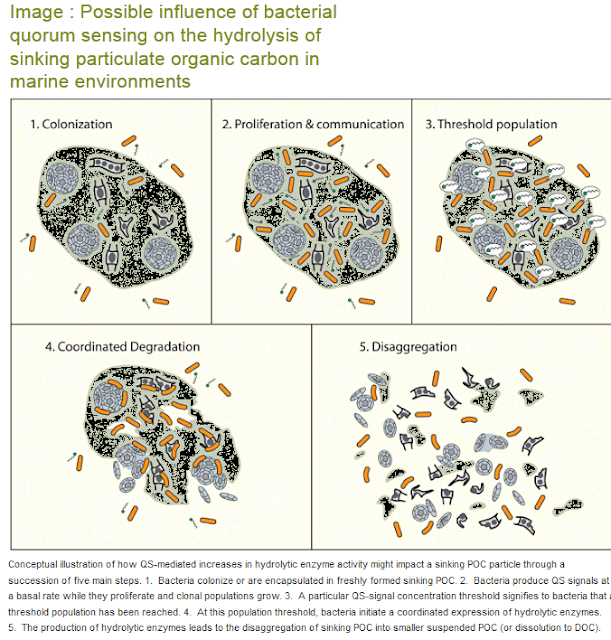
 We collected sinking POC from a site off Vancouver Island, Canada and found that it contained acylated homoserine lactones (AHLs), a suite of well known bacterial communication molecules. Furthermore, we observed that the addition of exogenous
AHLs to incubations containing sinking POC affected the activity of key hydrolytic enzymes involved in POC degradation in some cases.

Our results suggest that AHL-based QS could play an important role in regulating the degradation of sinking POC and that variability in AHL-triggered POC hydrolysis is a heretofore unrecognized process that impacts the marine biological carbon pump.
Introduction
Carbon fixed by photosynthesis is transferred to the deep ocean via sinking particulate organic carbon (POC) where it is removed from the atmosphere for hundreds to thousands of years. Sinking POC flux declines significantly in the upper few hundred meters of the ocean (Martin et al., 1987; Buesseler et al., 2008), but there is significant
spatial and temporal variability in this attenuation (Buesseler et al., 2007). 

It is generally accepted that POC - attached bacteria contribute significantly to organic
carbon degradation during sinking (Steinberg et al., 2008), but parameterizing their contribution remains a major obstacle to the development of accurate carbon cycle models. Currently, flux attenuation is represented by empirical (Martin et al., 1987) or chemical models (Armstrong et al., 2001), which do not explicitly incorporate the
activities of particle-attached bacteria.

Many bacteria use a cell-density dependent signalling system, ‘quorum sensing’ (QS) to coordinate the expression of genes encoding behaviours that benefit cells at high population density (e.g. extracellular hydrolytic enzyme production, luminescence, biofilm formation).

Extracellular hydrolytic enzymes are used by particle attached bacteria in the conversion of sinking POC to suspended POC or dissolved organic carbon (DOC) in the environment (e.g. Smith et al., 1992). Bacteria that produce the particular class of QS signal molecules, acylated homoserine lactones (AHLs), are readily isolated
from marine environments where bacterial population densities are high (Gram et al., 2002; Wagner-Dobler
et al., 2005).

At this time there are only a limited number of cultivation-independent reports of AHLs from natural marine environments (e.g. Decho et al., 2009).

Although micromolar concentrations of AHLs have been reported in bacterial cultures (Boettcher and Ruby, 1995; e.g. Puskas et al., 1997), many bacteria can respond to concentrations in the nanomolar range (Kaplan and Greenberg, 1985; Boettcher and Ruby, 1995; Burton et al., 2005).

In the marine environment, AHLs are most likely to accumulate in microenvironments where bacterial densities are high (Hmelo and Van Mooy, 2009), such as within sinking POC.

Direct measurements of AHLs in environmental samples require extremely sensitive and selective analytical tools, which are only now becoming available to the oceanographic community.

Although bacterial cultivars from marine particles have ben shown to possess the capacity for Quorum Sensing (Gram et al., 2002), in situ QS activity has yet to be demonstrated in sinking POC

Oct 18, 2012

Toxic Release Inventory of Penobscot Bay companies with industrial outfalls or stacks

West Penobscot Bay companies with licensed and historic  toxic releases. Click on Facility Report, then scroll down below facility map, for details on company's waste discharges. 

 SEARSPORT

GAC CHEMICAL  Facility Report 34 Kidder Point Rd, Searsport ME 04974-3111
EPA Registry Id: 110000581549

IRVING OIL TERMINALS INC Facility Report
52  Station Acvve Searsport, ME 04974-3389
EPA Registry Id: 110025246847

SPRAGUE ENERGY-SEARSPORT TERMINAL Facility Report
70 Trundy Road, Searsport, ME 04974
EPA Registry Id: 110028276513

SUNRISE MATERIALS Facility Report
Dump Road, Searsport, ME 04974
EPA Registry Id: 110007273510

US DEFENSE LOGISTICS FUEL SUPPORT POINT Facility Report
58 Trundy Road, Searsport, ME 04974
EPA Registry Id: 110008459916


BELFAST

STINSON SEAFOOD (2000) INC. Facility Report
101 Front Street, Belfast ME 04915
EPA Registry Id: 110008053541 


CAMDEN

CAMDEN TANNING CO  Facility Report
116 Washington Street, Camden ME 04843-1529
EPA Registry Id: 110015329928 


ROCKLAND

FISHER ENGINEERING
  Facility Report
12 Water Street Rockland ME 04841-3523
EPA Registry Id: 110000314696

FISHER ENGINEERING  Facility Report
50 Gordon Drive, Rockland, ME 04841-2139
EPA Registry Id: 110002088507

FMC BIOPOLYMER FOOD INGREDIENTS  Facility Report
1 Crocketts Point Rd. Rockland  ME 04841-3444
EPA Registry Id: 110000581512

NORTH END COMPOSITES Facility Report
23 Merrill Drive, Rockland , ME 04841
EPA Registry Id: 110031001190

NORTH END COMPOSITES  Facility Report
28 Gordon Drive, Rockland, ME 04841
EPA Registry Id: 110000314703

JOURNEY S END MARINA (O'Hara)  Facility Report
120 Tillson Avenue, ROckland, ME 04841-3450
EPA Registry Id: 110022438441

SEAPRO INCORPORATED  Facility Report
779 Maine Street, Rockland, ME 04841
EPA Registry Id: 110001839146


GAC Chemical's annual licensed discharges into Penobscot Bay, 1987-2011.

GAC Chemical's licensed discharges of Ammonia, Chlorine and Sulfuric Acid  through an outfall into Stockton Harbor of Penobscot Bay. Average annual discharge 1987 to 2011. Click on  the chem names for EPA info about each pollutant. Source: MDEP and GAC.


Chemical Name Year Unit Of Measure Release Amount Stream Or Body of Water
AMMONIA
(TRI Chemical ID: 007664417)
2011 Pounds 493.53 PENOBSCOT BAY
AMMONIA
(TRI Chemical ID: 007664417)
2010 Pounds 445.51 PENOBSCOT BAY
AMMONIA
(TRI Chemical ID: 007664417)
2009 Pounds 555.73 PENOBSCOT BAY
AMMONIA
(TRI Chemical ID: 007664417)
2008 Pounds 788.7 PENOBSCOT BAY
AMMONIA
(TRI Chemical ID: 007664417)
2007 Pounds 498.03 PENOBSCOT BAY
AMMONIA
(TRI Chemical ID: 007664417)
2006 Pounds 713.14 PENOBSCOT BAY
AMMONIA
(TRI Chemical ID: 007664417)
2005 Pounds 1312.14 PENOBSCOT BAY
AMMONIA
(TRI Chemical ID: 007664417)
2004 Pounds 622 PENOBSCOT BAY
AMMONIA
(TRI Chemical ID: 007664417)
2003 Pounds 694 PENOBSCOT BAY
AMMONIA
(TRI Chemical ID: 007664417)
2002 Pounds 534 PENOBSCOT BAY
AMMONIA
(TRI Chemical ID: 007664417)
2001 Pounds 578 PENOBSCOT BAY
AMMONIA
(TRI Chemical ID: 007664417)
2000 Pounds 301 PENOBSCOT BAY
AMMONIA
(TRI Chemical ID: 007664417)
1999 Pounds 619 PENOBSCOT BAY
AMMONIA
(TRI Chemical ID: 007664417)
1998 Pounds 57 PENOBSCOT BAY
AMMONIA
(TRI Chemical ID: 007664417)
1997 Pounds 633 PENOBSCOT BAY
AMMONIA
(TRI Chemical ID: 007664417)
1996 Pounds 39 PENOBSCOT BAY
AMMONIA
(TRI Chemical ID: 007664417)
1995 Pounds 39 PENOBSCOT BAY
AMMONIA
(TRI Chemical ID: 007664417)
1994 Pounds 39 PENOBSCOT BAY
AMMONIUM SULFATE (SOLUTION)
(TRI Chemical ID: 007783202)
1990 Pounds 5200 PENOBSCOT BAY
AMMONIUM SULFATE (SOLUTION)
(TRI Chemical ID: 007783202)
1993 Pounds 3000 PENOBSCOT BAY
AMMONIUM SULFATE (SOLUTION)
(TRI Chemical ID: 007783202)
1992 Pounds 5200 PENOBSCOT BAY
AMMONIUM SULFATE (SOLUTION)
(TRI Chemical ID: 007783202)
1991 Pounds 5200 PENOBSCOT BAY
AMMONIUM SULFATE (SOLUTION)
(TRI Chemical ID: 007783202)
1989 Pounds 5200 PENOBSCOT BAY
AMMONIUM SULFATE (SOLUTION)
(TRI Chemical ID: 007783202)
1988 Pounds 5200 PENOBSCOT BAY
AMMONIUM SULFATE (SOLUTION)
(TRI Chemical ID: 007783202)
1987 Pounds 2000 PENOBSCOT BAY
CHLORINE
(TRI Chemical ID: 007782505)
2004 Pounds 1 PENOBSCOT BAY
CHLORINE
(TRI Chemical ID: 007782505)
2003 Pounds 3 PENOBSCOT BAY
CHLORINE
(TRI Chemical ID: 007782505)
2002 Pounds 2 PENOBSCOT BAY
SULFURIC ACID (1994 AND AFTER "ACID AEROSOLS" ONLY)
(TRI Chemical ID: 007664939)
1989 Pounds 1350 PENOBSCOT BAY
SULFURIC ACID (1994 AND AFTER "ACID AEROSOLS" ONLY)
(TRI Chemical ID: 007664939)
1988 Pounds 16000 PENOBSCOT BAY

Oct 14, 2012

From Waldo Village Soup  A friendly approachLocals who rely on Penobscot Bay forge partnership. By Tanya Mitchell | Oct 12, 2012

SEARSPORT — On a chilly and overcast afternoon Thursday, Oct. 4, residents and businesspeople of the Penobscot Bay region met on the Sears Island causeway to introduce a newly formed alliance aimed at cleaning up the local waterway.
Ron Huber, executive director of Penobscot Baywatch, joined forces with people like Sheila Dassatt of Belfast, who heads the Downeast Lobstermen's Association and fishes on the bay with her husband, Mike, and Searsport Shores Campground co-owners Astrig Tanguay to form the fledgling Friends of Penobscot Bay.
"There are thing happening here that affect the other end of the bay, and vice versa," said Huber during the press conference. 
Photo:  Sheila Dassatt of Belfast, second from left, head of the Downeast Lobstermen's Association, speaks during a press conference at the Sears Island causeway Thursday, Oct. 4 Photo by Tanya Mitchell
Huber said the idea behind forming FOPB was to unify individuals and businesses who all depend on the bay to thrive so those parties may act collectively toward working with area businesses and industry to improve the health of the bay.
In a prepared statement provided to the media Thursday, Tanguay said her campground depends on the tourism industry, which she said is directly linked to the bay.
"Anecdotally, I know that our guests come to Searsport and the region because of the bay — a chance to kayak, hike, sail, pick mussels and eat lobster," she stated. "The state's research backs this up with numbers: The primary purpose of overnight leisure trips is outdoor recreation."
Tanguay went on to say the top four trip activities among Maine visitors are enjoying ocean views, resting and relaxing, outdoor activities (including fishing, sailing, kayaking and hiking) and shopping.
"When those of us who [live] here rely on the bay for sustenance, we must ask why our wild mussel beds and fin fish are at historically low levels," she said. "If we accept that we are all dependent on clean water, let's deal with the petroleum spills, waste dumps and tainted sediments in and around Pen Bay while they may still be manageable."
Dassatt, whose family has deep lobster-fishing roots in the region, said she and other lobster fishermen are working with the University of Maine in an effort to learn more about the shell disease that she said now appears in about one out of every 10 lobsters caught here. The study, said Dassatt, is aimed at learning whether the meat of those affected lobsters is safe to eat, and also to see if water pollution may be adversely impacting the bait used to capture Maine's best-known shellfish.
"Even for the fishermen who are handling the water, we're seeing things that we haven't seen before this year," she said. "Fishermen with open cuts come up with things that aren't healthy."
Specifically, she said, fishermen are developing blistering rashes and skin infections after being exposed to the bay water.
Huber said he hopes that by forming FOPB, all involved will have more resources to accomplish their bay-related goals, and in the end, all Maine residents will be better off.
"We want clean water so that people keep coming here," said Huber. "Someone has to speak for the bay, not just one town or another town."

Oct 9, 2012

Northern Shrimp Science! meeting Oct 17th, Portland


On October 17th, 10am to 3pm, the Atlantic States Marine Fisheries Commission (ASMFC) is holding a workshop on the Northern Shrimp, Pandalus Borealis. at the Gulf of Maine Research Institute offices in Portland. 

Workshop will include an overview of the lives of northern shrimp, how the ASMFC measures the # of shrimp out there in the Gulf of Maine, and how they decide and divvy up the total allowable catch.

GOMRI is at 350 Commercial Street, Portland, Maine. All are welcome to attend.

FMI: Mike Waine, Fishery Management Plan Coordinator, at mwaine@asmfc.org or 703.842.0740

Oct 5, 2012

Penobscot Bay gets 'Friended'

A new environmental organization has risen to steward Penobscot Bay's water quality, fish and shellfish habitat and scenic resources. It held its first press conference October 4th 2012 on the Sears Island causeway. See TV coverage.

Why a new NGO? Aren't there enough already? Not..exactly.

For too long, Maine's biggest bay has suffered from a scattershot approach to protection of its natural resources from oil spills and other pollution sources and from inappropriate development.

Maine's newest marine conservation group, the Friends of Penobscot Bay, which held a media rollout of the organization on Thursday October 4, 2012 on the Sears Island causeway will bring expertise from around the bay and among the bay's fishery and tourism sectors to bear on these many local concerns.

Communities and citizens in the trenches defending their piece of Penobscot Bay
 from sprawl or pollution rarely have an opportunity to assist the bay's other defenders up and down her coast. Yet the problems raised by developers and waste dischargers around the bay are often very similar, often involving the same officials of the same agencies. The companies are represented by the same environmental consultants, law firms and public relations teams

The Friends of Penobscot Bay has come into being to respond to the need to coordinate such information. With a baywide organization run by fishermen and others whose living is dependent on their Bay having clean water and healthy marine and shoreline habitats, abundant prey and forage species, and high quality natural scenic beauty, the Friends are able to respond to any kind of issue, anywhere around the bay.

The vast majority of the bay's hatchling  fish and shellfish do not survive their first year before falling to predation, starvation or poor water quality. 


Unique among environmental groups the makeup of the Friends of Penobscot Bay's Board of Directors reflects its small business/ natural resource protection orientation: Sheila Dassatt of the Downeast Lobstermen's Association; Thomas Atherton of Bucksport, a commercial wormdigger and biologist; scalloper Michael Keating of Owls Head, workboat operator and diver Robert Izerbyt of Rockport, oyster farmer Jesse Stuart of Penobscot, recreational clammer and coastal camp operator Astrig Tanguay of Searsport, environmentalist Harlan McLaughlin, also of Searsport, and conservationist Ron Huber of Rockland
 
The Friends of Penobscot Bay  will inventory the knowledge and talents of the bay's many natural resource-reliant commercial businesses, from fishermen to wormdiggers to coastal campground operators and apply it  to each bay impacting development proposal, be it a summer home builder seeking to riprap an eroding shoreline or an energy giant.

Combining the local close-in citizens are critical for protection and improvement of our natural environment, bit by irreplaceable bit. However, the Friends of Penobscot Bay seek to boost the likelihood of bay-friendly outcomes in those efforts, by bringing  the combined  talents, knowledge, skills and assets of  the bay's fishermen, eco-defenders, and other bay users and enjoyers to bear on each local issue.

The bay is suffering from a thousand local cuts, inflicted over the last three hundred years. The combined effect is such that even small new development projects and waste sites can combine with dreadful effect on our bay's entire ecology.

An unhappy result of those 'thousand cuts' is that Penobscot Bay's finfish, mussels, scallops, seaworms, urchins and more are at historic low levels. Meanwhile many of the bay's irreplaceable scenic  and sonic viewsheds and other natural assets have been degraded by inappropriate coastal development, and many more are threatened. Lobstermen have reported a new  and stubborn skin disease infecting from even the minor cuts and abrasions that occur on the job.

While overfishing and inappropriate fishing tech are part of the poor fish stocks picture, has a rise in larval mortality of many bay fish and shellfish species added another stress to these animals?  

The vast majority of the bay's hatchling  fish and shellfish do not survive their first year before falling to predators, sometimes, as in the case of the cod, even their own species

BAY POLLUTION Under the guidance of that board,  the Friends of Penobscot Bay will take up the task of reducing water pollution and cleaning up the 100s of legacy toxic and petroleum waste dumps and spills that were created in the 19th and 20th centuries. They will also keep an eye on the bay's many operating outfalls, each of which has strict limitations on the discharges they are allowed to make into Penobscot Bay. 

BAY REPLENISHMENT The Friends of Penobscot Bay will attempt to redevelop and replenish the diversified fisheries and scenic wonders that, once overwhelmingly bountiful, have declined in many reaches of Penobscot Bay over the last 300 years.

Let's hope the Friends of Penobscot Bay accomplish what they are setting out to do! 
 

Sep 14, 2012

Penobscot Bay's Fishes & Shellfishes, circa 1994

In the early 1990s NOAA carried out a survey of estuary fishes along the United States' North Atlantic Coast, charting abundance and distribution in bays along the North Atlantic Coast. The survey Distribution and abundance of fishes and invertebrates in North Atlantic estuaries included Penobscot Bay.  Below are the fish and shellfish  that were detected in Penobscot Bay in that 1994 survey.

ELMR North Atlantic Species in Penobscot Bay, surveyed by NOAA, 1994

Blue mussel Mytilus edulis Mytilidea
Sea scallop Placopeclen magellanicus  Pectinidae
American oyster Crassostrea virginica Ostreidae   USFC
Northern quahog Mercenaria mercinaria  Veneridae
Softshell clam  Mya arenaria   Myidae

Green sea urchin Strongylocentrotus droebachiensis Strongylocentrotidae

Daggerblade grass shrimp Pelaemonetes pugio Palaemonidae
Northern shrimp Pandalus borealis Pandalidae
Sevenspine bay shrimp Crangon septemspinosa Crangonidae
American lobster Homarus americanus  Nephropidae
Jonah crab Cancer borealis Canceridae
Atlantic rock crab Cancer irroratus Canceridae
Green crab Cancer Maenas Portunidae

Blueback herring Alosa aestivalis Clupeidae
Alewife Alosa pseudoharengus Clupeidae
American shad Alosa sapidissima Clupeidae
Atlantic menhaden Brevoortia tyrannus Clupeidae
Atlantic herring Clupea harengus Clupeidae
Flainbow smelt Osmerus mordax Osmeridae

Atlantic salmon Salmo salar  Salmonidae

Atlantic cod Gadus morhua Gadidae
Haddock  Melanogrammus aeglefinus  Gadidae
Silver hake Merlucccius bilinearis Gadidae
Atlantic tomcod  Microgadus tomcod Gadidae
Pollock Pollachius virens Gadidae
Red hake Urophycis chuss Gadidae
White hake Urophycis tenuis  Gadidae

White perch Morone americana Percichthyidae
Striped bass Morone saxatilis Percichthyidae
Bluefish Pomatomus saltatrix Pomatomidae

Scup  Stenotomus chrysops Sparidae
Tautog Tautoga onitis Labridae
Cunner Tautogolabrus adspersus Labridae
Ocean pout  Macrozoarces americansus Zoarcldae
Rock gunnel Pholis gunnellus Pholidae
American sand lance Ammodytes americanus Ammodytidae

Atlantic mackerel Scomber scombrus Scombridae
Butterfish Peprilus triacanthus Stromateidae

Windowpane flounder Scophthalmus aquosus Bothidae
American plaice Hippoglossoides platessoides Pleuronectidae
Winter flounder Pleuronectes americansus  Pleuronectidae
Yellowtail flounder Pleurontectes ferrugineus Pleuronectidae
Smooth flounder Pleuronectes putnami Pleuronectidae

Mummichogs Fundulus heteroclitus Cyprinodontidae
Silversides Menidia species Atherinidae
Fourspine stickleback Apeltes quadracus Gasterosteidae
Threespine sticklebeck Gasterosteus aculeatus Gasterostaidae
Ninespine stickleback  Pungitius pungitius  Gasterosteidae

Spiny dogfish Squalus acanthias Squalidae
Skates Raja species Rajidae
Shortnose sturgeon Aclnenser brevirostrum Acipenseridae
Atlantic sturgeon Acioenser oxyrhynchus Acipenseridae
American eel Anguilla rostrata  Anguillidae

Northern pipefish Syngnathus fuscus,Syngnathidae
Northern searobin Prionotus carolinus Triglidae
Grubby Myoxocephalus aenaeus Cottidae
Longhorn sculpin Myoxocephalus octodecemspinosus Cottidae
Shorthorn sculpin Myoxocephalus scorpius Coltidae

Penobscot Bay Report Audio recordings 2008 to 2012

Penobscot Bay Report Audio 2008 to 2012
Listen to a  selection of the public meeting recordings I've made  since 2008, starting with 2012 Listen to them and learn about Penobscot Bay, the Gulf of Maine and those that work and play upon these waters. Or plan to.
Ron

2012

July 2, 2012 Rockland city council takes testimony on letter to Searsport about DCP http://penobscotbay.blogspot.com/2012/07/rockland-drafting-letter-to-searsport.html


Jun 21, 2012 Statoil Speaks: six Interviews at public info meeting in Rockland Six Interviews at public info meeting June 21, 2012 in Rockland ...Earlier Statoil Hywind events audio ... 3/12/12 Statoil at 2012 Maine Fishermens Forum. Posted by Ron Huber at 6/28/2012 08:12:00 AM ...

6/11/12  DCP midstream - my sampled song "Shut us down" sampled from Searport planning board meeting http://penbay.org/dcp/audio/shutdown.mp3

May 23, 2012 Penobscot Bay Blog: Feds/Maine ocean energy task force e-meets, holds public teleconference  Feds/Maine ocean energy task force e-meets on next 2 steps reviewing Statoil's 4-turbine floating windpark plan, then holds public teleconference. AUDIO and TRANSCRIPT of public teleconference.

May 17, 2012 The Waldo County Local Emergency Planning Committee held a meeting and hosted an open house at their Waldo County Emergency Management Agency  facility in Belfast. Listen to Podcast  & listen to an mp3 recording of the hour long question and answer period in two formats:

Mar 13 and 14, 2012
  Open pit metal mining bill. Open pit metal mining: Maine legislature grapples with last minute bill. AUDIO of hearing and worksession.  

April 9, 2012 April 9th  Senator Douglas Thomas made the case before the appropriations committee (5min mp3) to get Sears Island dredge money on the transportation bond.

March 29, 2012  Casella  "surprise" resolution to  the Environment and Natural Resources Committee. Listen to the committee chair describe it around 2:40pm today

March 13 & 14 2012 the Maine legislature's Environment and Natural Resources Committee heard and received testimony and emails for or against  LD 1853 "An Act To Improve Environmental Oversight and Streamline Permitting for Mining in Maine"

Mar 04, 2012 Windpower seminar at 2012 Maine Fishermen's Forum. Overwhelming static forced editing out of parts of several speakers including Glenn Libby and Pete Jumars.

Mar 02, 2012  Fishermens Forum: Maine Groundfish Permit Bank Seminar:: Maine Groundfish Permit Bank Seminar: "Maine Permit Bank Program:Full Speed Ahead."

Mar 01, 2012  Penobscot Bay Blog: Maine Legislature considers elver fishery and shrimp dealers.. On March 1st the Maine Legislature's Marine Resources Committee, Led by Committee chair Lois Snow-Mello, with DMR Commissioner Pat Keliher, held a worksession on LD 1765 An Act To Sustain the Elver Fishery,

Feb 28, 2012 Penobscot Bay Blog: LURC reform legislation LD 1798 has  Maine Legislature's February 28, 2012 worksession on LD 1798 "An Act To Reform Land Use Planning in the Unorganized Territory". NOTE to listen to the February 16th public hearing ...

Feb 24, 2012 Sears Island Container port bill gets skeptical reception. 

Industrial port-huggers and two determined Penobscot Bay defenders Paul McCarrier and Will Neils, at the Maine statehouse, challenging the "LD 420 An Act To Authorize a General Fund Bond Issue To Fund Building a Container Port on Sears Island" that came before the Maine Legislature's Appropriations Committee 

Feb 21, 2012 Belfast City Council hears TBNT on LPG, votes to write to ACOE Belfast City Council hears TBNT on LPG, votes to write to ACOE 

Feb 16, 2012 Penobscot Bay Blog: Legislature & citizens ponder bill LD 1798 to reform LURC...  On February 16, 2012, the Maine legislature took testimony on LD 1798 ,"An Act To Reform Land Use Planning in the Unorganized Territory" 

Feb 14, 2012: East West Highway bill hearing   February 14, 2012, the People came out to speak against LD 1671 An Act To Provide Funding to the Department of Transportation for a Feasibility Study of an East-west Highway Click on a name for the link to an MP3 audio ...

2011

... to explain their bits of the puzzle. But without the Norwegian company's officials present, the meeting was strangely unfulfilling, like.

Audio. At the November 15, 2011 Belfast City Council Meeting, three Belfast residents spoke out with their concerns about the proposed LPG super tank in nearby Searsport. And the City Councilors listened and replied. Listen ...

Thanks But No Tank! Belfast public presentation AUDIO. Belfast Library, November third. The library's meeting room filled quickly and a two hour presentation and discussion ensued, exploring what is known about the plan for ...


 recordings. The meeting was organized by Island Institute. Speakers included Heather Deese, Ph.D., II Director of Marine Programs, Amanda LaBelle, II Marine ...

2010


October 19, 2010  Audio recordings of DeepCwind official Habib Dagher. * Habib Dagher speaks at 1st annual Maine Deepwater Offshore Wind Conference (one hour). * 

Sept 14, 2010  BOEMRE meeting Belfast Maine

 March 6, 2010  Maine Fishermens' Forum panel and discussion on windpower


March 11, 2010  Fishermen at Maine's State Legislature on LD 1810, An Act To Implement the Recommendations of the Governor's Ocean Energy Task Force.  ...

Jan 1, 2010 Fox Island Wind, polluting the soundscape .Wonder what the windmills on Vinalhaven sound like ? Click here for an hour long unedited recording of these windmills' endless warbling howl, as if jets are constantly flying past in the middle distance.

2009

Oct 28, 2009 ME Coastal Waters Conference  Maine Coastal Waters Conference October 28, 2009. Audio mp3s. See state website of the conference. The event had 10 sessions. Paul Anderson, Maine SeaGrant Welcoming remarks. George Lapointe. Angus King speaks.

June 2009 Shirley Oliver  on  historic Sears Island on a rainy day on the causeway back in June.  11 minutes long http://www.searsisland.org/audio/si_shirleyoliver_june09.mp3
Critics including members of their own group locally, Atlantic Canada Sierra Club members, and as far away as California (mp3 audio of Tom Politeo, interviewed by Ron Huber, Penobscot Bay Report, WRFR COmmunity ...

These are a selection of recordings listen to them and learn about Penobscot Bay, the Gulf of Maine and that that work and play upon them.

Feds put 60 day ban on gillnetting to protect porpoises


No reprieve on fall gillnet closures
By Richard Gaines, Gloucester Times, September 12, 2012

NOAA's regional office has affirmed the agency's decision to impose a two-month closure on gillnet fishing in the Gulf of Maine beginning Oct. 1 due to what officials say are unacceptable levels of harbor porpoise bycatch that, to the government, showed lack of compliance with a requirement that nets be equipped with functioning "pingers."

The closed area encompasses about 2,130 square miles of prime fishing grounds north, west and south of Gloucester. Pingers, which are placed in fishermen's nets, send an audible signal designed to scare away the porpoises.

The decision to stick with the closure announced last spring came in the form of a rejection of an alternative proposal.

Presented last summer by the Gloucester-based Northeast Seafood Coalition, the region's largest industry group, the alternative would have reduced the length of the closure and the size of the area being closed; it also would have shifted the closure from October and November to the second half of March and April.

The decision to stand by the closures marks the first major science- and law-based action by John Bullard, who just weeks ago took over as Northeast regional administrator. Since his appointment in mid-summer, Bullard, a former mayor of New Bedford, has been on an introductory and opinion-and-fact-gathering tour of the states from Maine through North Carolina, whose federal waters are governed by the National Oceanic and Atmospheric Administration's Northeast offices in Gloucester's Blackburn Industrial Park.

In a letter last Thursday to Jackie Odell, the seafood coalition's executive director, Bullard wrote that he had asked the acting administrator of fisheries, Sam Rauth, to have the harbor porpoise protection problem delegated to him; since then, Bullard said, he directed his staff to see if there was a way to protect harbor seals that "could justify" modifying the "consequence" closing.

Bullard rejected the proposed alternative proposed by the coalition, writing that switching to the coalition alternative offered fishermen or the harbor porpoises little to gain.

Moreover, he warned in his letter to Odell, a recent harbor porpoise stock assessment showed the "population has declined," implying that more radical actions than the "consequence" closure would be expected.

The term derives from the harbor seal management plan and indicates a carrot-stick approach to protecting harbor porpoises as required in the U.S. Marine Mammal Protection Act.

"The consequence closure area strategy gave gillnetters control of their own fate," Bullard wrote to Odell. "Fishermen on the (harbor porpoise take reduction team) accepted this as a challenge they could meet.

"Environmentalists on the team accepted it instead of an immediate closure of a smaller area. Unfortunately, during the past two years, fishermen in the Gulf of Maine did not fully respond to the compliance challenge," Bullard wrote.

Richard Burgess, who owns a multi-boat gillinetting business, disputed the assertion that the Gloucester-based gillnetters failed to utilize the pingers, while Paul "Sasquatch" Cohan, another Gloucester-based gillnetter, said losing the inshore grounds in October and November cannot be obviated by fishing in open months, due to the dearth of equally valued fish.

Cohan said he found insulting the suggestion by Bullard that, if they chose not to fish, gillnetters could lease out their quota. Such a business decision would produce a small fraction of the revenue of fishing one's own quota, he said.

"The analysis provided in the environmental assessment supporting the 2010 amendment to the (Take Reduction Plan) shows that if fishermen use the appropriate number of fully functional pinger the harbor porpoise takes would stay below total allowable catch equivalent for porpoises," said David Gouveia, a member of the take reduction team.

"If takes continue to occur at this high rate," Gouveia added, "the 'consequence' closure will likely be the back story as more measures to reduce harbor porpoise bycatch will likely take the front page."

That will likely be the focal point, he said of a take reduction team meeting in October.

In the initial announcement\of the Gulf of Maine closure, NOAA's Protected Resource Division said, "We have determined that the bycatch rate for the Coastal Gulf of Maine Consequence Closure Area has exceeded the target rate" for harbor porpoise mortality of one per 71,117 pounds of fish.

Richard Gaines can be reached at 978-283-7000, x3464, or at rgaines@gloucestertimes.com.

But the "bycatch rate was so high (in the first year of monitoring) that the two-year average cannot be reduced below the target bycatch rate for this area, even if no harbor porpoises are observed being caught (in year two)," the NOAA statement said.

The two-year bycatch rate for porpoises in the Coastal Gulf of Maine Consequence Area was set at 0.031 porpoises per metric ton of fish landed, and in the first year the bycatch rate was reported to be 0.078.

In contrast, gillnet boats working in the east and south of Cape Cod did no exceed the limits: Pinger compliance was 65 percent, and the one-year by catch rate was 0.012 porpoises per metric ton of fish. The target rate for the Cape Cod region was 0.023 porpoises per metric ton of fish.

A Harbor Porpoise Take Reduction Team made up of industry, environmental group representatives, the New England and Mid-Atlantic Regional Fishery Management Councils, gear researchers and state and regional management organizations wrote the plan, required by the Marine Mammal Protection Act, to drive down losses to a statistical zero.

Before management began in 1998, there were about 1,500 porpoise deaths a year from fishing gear, but the number fell to near zero for the first five years of regulation, before fatalities began trending upward again in 2005, which was when pinger compliance efforts were increased, said NOAA spokeswoman Maggie Mooney-Seus.

Government officials said they saw a cause and effect relationship between pingers and porpoise bycatch levels.

ShareThis Facebook Tweet