Search

Feb 22, 2019

Maine legislature hears testimony of bill to restrict teachers' speech in classrooms. Audio mp3s!

LD 589  came before the Maine legislature's Education and Cultural Affairs Committee today. \
(Listen to testimony below) The bill calls for
  "prohibiting teachers in public schools from engaging in political, religious or ideological advocacy in the classroom or from introducing any controversial subject matter that is not germane to the topic of the course being taught,..."\
This is LD 589.Resolve, Directing the State Board of Education To Adopt Rules Prohibiting Teachers in Public Schools from Engaging in Political, Ideological or Religious Advocacy in the Classroom

AUDIO OF TESTIMONY
SPONSOR
Larry Lockman introduces  LD 589  9min

SPONSOR READS LETTER
Lockman reads letter from Karen Gerrish 5min26sec
Lockman questioned 72sec

SUPPORTERS OF LD 589
James Mosier 4min14sec
Kathy Nichols 4min 2sec

OPPONENTS  
Isabelle Weil 7min
Rachel Nadeau 6min
Unidentified  woman 5min
Rep Alison Hepler
Oamshri Amarasingham  MCLUFiona Hopper 6min30sec
Grace Leavitt  pres me edu assn. 7min
Crystal Ward 7min
Genovan Dell 6min
Solomon Haifetz 4min
Timothy P. Wilson teacher since 1966  12min
Steve Bailey Maine School Mgmt Assoc 5min


Panel discussion held on Nordic Aquafarms in Camden 2/21/19. Audio of the event

Complete Feb 21, 2019 panel discussions & Q&A on land based aquaculture, at the Camden Public Library.  MP3s

On Feb 21, 2019 a panel discussion on land based aquaculture and the health of  Penobscot  Bay was held in the Camden Public Library.

Hosted by Kathy Cartwright  Midcoast Audubon, the panel included, Retired EPA regulator Andrew Stevenson, Kathleen Thornton of Darling Center for Marine Science, and Belfast city councilor Eric Sanders. Moderated by John Morrison, WWF 


END

Issues raised at the Feb 21, 2019 panel discussion in Camden on land based aquaculture

On Feb 21, 2019 a panel discussion on land based aquaculture & the health of  Penobscot  Bay was held in the Camden Public Library.  Panelists: Andrew Stevenson of Upstream Watch, Kathleen Thornton of Darling Center for Marine Sciences, and Belfast city councilor Eric Sanders. Link to audios of full meeting.

Below we have separated out from that meeting  the  statement and answers of  panelist Andrew Stevenson, a retired EPA regulator and member of NGO Upstream Watch.  If you've only time to listen to one, listen to Stevenson's response to Question 3

.
Opening Statement 3min

Q1. What are the benefits of the Nordic project 3min24sec.mp3

Q2. What are the problems with the Nordic Aqua Farms project? 4min21sec

Q3. What issues have not had enough attention? 8min22sec

Q&A session of all three panelists 15 minutes

Feb 19, 2019

Maine Board of Pesticide Control Public Hearing March 8, 2019

Twentyfive amendments to Maine Pesticides Rules under consideration


PUBLIC HEARING: Friday, March 8, 2019, 9:00 a.m., Room 118, Marquardt Building, 32 Blossom Lane, Augusta .
COMMENT DEADLINE: 8:00 a.m., Monday, March 25, 2019
Contact  Megan Patterson, DACF, 28 State House Station, Augusta, ME 04333. Telephone: (207) 287-2731. Email: Megan.L.Patterson@Maine.gov

List of changes

Chapter 26 Standards for Indoor Application of Pesticides: One amendment is proposed [PDF of rule with proposed amendments]
Chapter 27 Standards for Pesticide Applications and Public Notification in Schools: Three amendments are proposed [PDF of rule with proposed amendments
Chapter 28 Notification Provisions for Outdoor Pesticide Applications: One amendment is proposed [PDF of rule with proposed amendments]
Chapter 31 Certification and Licensing Provisions / Commercial Applicators: Eleven amendments are proposed [PDF of rule with proposed amendments]
Chapter 32 Certification and Licensing Provisions for Private Applicators: Six amendments are proposed [PDF of rule with proposed amendments]
Chapter 50 Reporting Requirements for Applicators and Dealers: One amendment is proposed [PDF of rule with proposed amendments]
Chapter 36 Certification and Licensing Provisions for Monitors and Spotters for Forest Insect Aerial Spray Program [PDF of rule with proposed amendments]
Repeal of Ch. 36 is proposed. Associated requirements were previously repealed because they are no longer necessary with the current technology used in aircraft.

Summary of each proposed change.
Chapter 10 Definitions and Terms: Two amendments are proposed [PDF of rule with proposed amendments]
  1. Amend the definition of “Aerial Applicator” to allow certification as a private applicator. Currently the rule requires applicators to hold a commercial license which prevents an individual from making applications on their own property. This is required by the new EPA C&T rules, and is in anticipation of potential applications by unmanned aircraft systems.
Chapter 26 Standards for Indoor Application of Pesticides: One amendment is proposed [PDF of rule with proposed amendments]
  1. Clarify the definition of “occupied buildings” to mean fully enclosed indoor spaces inside buildings and that roofed structures which are otherwise not enclosed are not buildings for the purpose of the rule.
Chapter 27 Standards for Pesticide Applications and Public Notification in Schools: Three amendments are proposed [PDF of rule with proposed amendments]
  1. Change wording to clarify that all pesticide applications, inside and outside, must be included in the pest management activity log.
    Change wording to clarify that applications made to the exterior of buildings are included in the rule.
    Add personal insect repellents to the list of products which do not require licensure.
Chapter 28 Notification Provisions for Outdoor Pesticide Applications: One amendment is proposed [PDF of rule with proposed amendments]
  1. Clarify that the telephone number required on signs must be a working number.
Chapter 31 Certification and Licensing Provisions / Commercial Applicators: Eleven amendments are proposed [PDF of rule with proposed amendments]
  1. Add requirement for a government-issued photo id for all exams (required by EPA C&T).
  2. Establish annual training requirements for noncertified applicators of restricted use pesticides (required by EPA C&T).
  3. Establish minimum age for individuals certified as commercial or private applicators (required by EPA C&T).
  4. Describe the credentials which will be issued to each applicator verifying certification (required by EPA C&T).
  5. Remove section on transitioning to revised licensing and certification requirements since the time frame has passed.
  6. Update the names of certain categories to align with current exams.
  7. Remove requirement to collect social security number.
  8. Change cost of master exams from $50 for both to $10 for Master Regulations exam and $40 for Master Oral exam.
  9. Remove exemption for those certifying in the Post Harvest Treatment category from having to take the core exam.
  10. Remove requirements for applicators to receive continuing education credits in specific categories as the Board doesn’t categorize courses this way.
  11. Remove fee for replacement and upgraded licenses as the Board no longer charges for these due to improved software.
Chapter 32 Certification and Licensing Provisions for Private Applicators: Six amendments are proposed [PDF of rule with proposed amendments]
  1. Amend competency standards to include those required by EPA C&T: label comprehension; responsibilities for supervisors of noncertified applicators; stewardship; ability to read and understand pesticide labeling.
  2. Remove option to provide oral exam as EPA C&T no longer allows non-reader accommodations.
  3. Add supplemental private categories which can be obtained in addition to certification for private licensure: aerial application; soil fumigation; non-soil fumigation (required by EPA C&T).
  4. Set minimum age for individuals certified as commercial or private applicators (required by EPA C&T).
  5. Describe tcredentials which will be issued to each applicator verifying certification (required by EPA C&T).
  6. Add requirement for a government-issued photo id for all exams (required by EPA C&T amendments).
Chapter 50 Reporting Requirements for Applicators and Dealers: One amendment is proposed [PDF of rule with proposed amendments]
  1. Add requirements to dealer records of sales (required by EPA C&T amendments):
    • customer address 
    • issuing authority, certification expiration date, and categories of certification in addition to the applicator’s certification number
Chapter 36 Certification and Licensing Provisions for Monitors and Spotters for Forest Insect Aerial Spray Program [PDF of rule with proposed amendments]

Repeal of Ch. 36 is proposed. Associated requirements were previously repealed because they are no longer necessary with the current technology used in aircraft.

Feb 18, 2019

Hot Topics at the 2019 Maine Fishermen's Forum

Maine Fisherman's Forum  Feb 28, March 1st & 2nd Samoset Resort Rockport Three days of full immersion in Maine's fishing culture and industry, and its scientific and management cutting edges. Workshops galore! Free and open to the public

Thursday February 28, 2019
(9:00‐10:30 am)  Applied Shellfish Science Block, DMR & DownEast Institute  (DEI) clam seed projects (9:00‐10:00 am) DEI mussel seed presentation (10:00‐10:30 am)

1:00pm  Scallops Public Scoping Hearing: Amendment 21 to the Atlantic Sea Scallop Fishery Management Plan.  The New England Fishery Mgmt Council NEFMC wants to  safely develop "a growing directed scallop fishery in federal waters in the Northern Gulf of Maine" but must prevent a "derby" fishery of unrestrained dredging.

1:00 pm Monhegan Room Environmental Monitors on Lobster Traps and Large Trawlers (eMOLT)Real Time Bottom Temperatures. Host Sheila Dassatt, Downeast Lobstermen’s Assn.
The Gulf of Maine itself is experiencing significant environmental change and as temperature is an essential parameter in the movement of commercially important species, it is a critical piece of knowledge for fishermen. The Environmental Monitors on Lobster Trap (and Large Trawlers) Program (eMOLT, see www.gomlf.org/emolt/) has been collecting bottom temperature data for nearly two decades, and now observations are reporting in real-time. Staff from the Gulf of Maine Lobster Foundation will show how to access the data both on and off the water, and offer opportunities to get involved. We will also share other ways of accessing real-time ocean information and forecasts through NERACOOS, and discuss with participants plans for future information products.\

Friday March 1, 2019
9:00 am Rockland Room Fishery-Dependent Data: What's in it for You? 
Although a lot of "data" gets collected from fishing vessels and seafood dealers, it isn't always clear how these data are used in  decisionmaking  This seminar is on how fishery dependent data is used, why it is important, and how it can help fishermen, scientists, and managers to make informed management decisions.

9am 9:00 am Rockport Room Maine Lobstermen’s Association 65th Annual Meeting  MLA's President, Kristan Porter, will offer his reflections.

10:30 am Rockland Room  Students in the Eastern  Maine Skipper's Program pose the question "How Do We Use Technology in Any Form to Contribute to Sustainable, Safe and Thriving Local Fisheries' Futures? "

10:30 am Rockport Room Update on Right Whale Status. Topics: Research and Potential Regulations , population and entanglement updates, an overview of where things stand with potential management actions and pending court cases, an update on the results from the ongoing DMR vertical line research project, and a demonstration of a new prototype for the Time Tension Line Cutter.

1:00 pm Rockland Room Quota Leasing Costs in New England's Groundfishery . In 2010, the majority of the New England groundfishing fleet switched from the Days At Sea management system, which controlled fishing catch by limiting days fished, to the Sector system, which limits catch using annual allocations of hard quotas.  This seminar will  be on the cost of leasing annual catch entitlements in this fishery.

1:00 pm Rockport Room DMR Lobster Science and Management Update In this double session, the results of DMR's lobster monitoring programs and new research projects will be presented and discussed.

2:45 pm Rockland Room Open Forum with NOAA Fisheries Leadership 

Saturday March 2, 2019
8:00 am Samoset Pool Water Survival Training: Water Safety and Emergency Egress Training
9:00 am Golf Club Maine Elver Fishermen’s Association - Annual Meeting

9:00 am Rockland Room Maine Lobster Boat Races 2019 Pre-Season Meeting The Maine Lobster Boat Racing Association (MLBRA) will hold its annual meeting to discuss the upcoming 2019 race season.

9:00 am Rockport Room  Youth and Maine's Fisheries& Aquaculture,  Maine Ocean School, a public magnet school in Searsport that offers an ocean themed high school education and transferable skills ocean-related career skills hosts a Leadership Forum" and  Aquaculture Workforce mtg". 

9:00 am Camden Room Preserving Maine's Working Waterfronts: How are We Doing, What's It Going to Take?  Maine still has a working waterfront, but these waterfronts are under increasing development pressure. As property values and taxes rise and residential or tourism based uses increase how will Maine hold on to its working waterfronts?

10:30am  Rockland Room The Food Guys  Think you know chowder? Think again.  Come try some interesting new dishes that COULD be called chowder.

10:30 am Rockport Room  Maine Lobster Marketing Collaborative  Annual Presentation. Learn what the marketing teams  have been up to, promoting Maine lobster worldwide.

10:30 am Camden Room Technical Strategies for Anchoring Floating Aquaculture Systems

1:00 pm Rockland Room You & Your Money - Planning for the Retirement You Want

1:00 pm Rockport Room Commercial Fisheries Research Foundation  Warming Waters, Emerging Species and Market Changes: Lessons Learned from Southern New England’s Black Sea Bass and Jonah Crab fisheries

1:00 pm Camden Room Scallop Farming in Maine 

2:45 pm Rockland Room Show Me the Money: Options for Funding My Business’s Growth,

2:45 pm Rockport Room Developing Viable Fisheries and Markets for Green Crabs: Current and Future Opportunities and Challenges The invasive E

2:45 pm Camden Room Space-age Data and Shellfish Farming: How Data from Buoys to Satellites can Improve Site Selection

End


Feb 14, 2019

Biochemistry of Atlantic Salmon skin emissions,

SALMON EMISSIONS
The papers below , dating from 2018 to  2005, describe the peptides and other signal molecules Atlantic Salmon   naturally emit , and their effect when released into the water column

All Salmonids continually emit a mixture of peptides and other biochemicals.  These  are breakdown products of the salmon's outer skin cells as they wear & their proteins dissolve.

These "peptides" (protein fragments) get  emitted  between the fishes' scales, then pass into their slime coats  for release into  the water  column.  Call it "dandruff with a purpose"
That skin hosts  a lively and healthy natural marine microbe community, too.


ABOUT SALMON SKIN

The Skin-Mucus Microbial Community of Farmed Atlantic Salmon (Salmo salar) October 2017  Frontiers in Microbiology 8:2043 FULL


PEPTIDES ATTRACT SEALICE
Antimicrobial peptides from Salmo salar skin induce frontal filament development and olfactory/cuticle-related genes in the sea louse Caligus rogercresseyi.  ABSTRACT

The Atlantic salmon (Salmo salar) antimicrobial peptide cathelicidin-2 is a molecular host associated cue for the salmon louse (Lepeophtheirus salmonis) 2018  Source . 2018; 8: 13738.    Published  2018 Sep 13


* A new finding of ACE inhibitory activity peptide sequences from salmon skin.  2011
Summary► Two ACE inhibitory peptides are identified from salmon skin collagen hydrolysate.
Source  Food Research International  Volume 44, Issue 5, June 2011, Pages 1536-1540

ESTROGEN POLLUTION DISRUPTS SMOLTING
Endocrine disruption of parr-smolt transformation and seawater tolerance of Atlantic salmon by 4-nonylphenol and 17 -estradiol  .
EXCERPT The results indicate that the parr-smolt transformation and salinity tolerance can be compromised by exposure to estrogenic compounds. Suppression of plasma IGF-I levels is a likely endocrine pathway for the eVects of estrogenic compounds on hypo-osmoregulatory capacity, and the detrimental effects of E2 and NP on thyroid hormone levels are also likely to compromise the normal parr-smolt transformation of Atlantic salmon.

* Enzyme inhibitory activity of low-molecular-weight peptides from Atlantic salmon  skin (Salmo salar.) Excerpt    (SSCP ="Salmon Skin Collagen Peptides )

A Total of eleven peptide sequences were identified, and two dipeptides, Ala-Pro and Val-Arg, were selected for further ACE inhibitory activity analysis. The ACE inhibitory activities of Ala-Pro (IC50 = 0.060 ± 0.001 mg/ml) and Val-Arg (IC50 = 0.332 ± 0.005 mg/ml) were found to be approximately 20- and 4-fold higher than that of SSCP (1.165 ± 0.087 mg/ml), respectively.

The Atlantic salmon (Salmo salar) antimicrobial peptide cathelicidin-2 is a molecular host-associated cue for the salmon louse (Lepeophtheirus salmonis)   2018 Source: Scientific Reports volume 8, Article number: 13738 (2018)

Drinking rate in juvenile Atlantic salmon, Salmo salar L fry in response to anitric oxide donor, sodium nitroprusside and an inhibitor of angiotensin-converting enzyme, enalapril.

Dynamics of Naþ,Kþ,2Cl Cotransporter and Naþ,Kþ-ATPase Expression in the Branchial Epithelium of Brown Trout (Salmo trutta) and Atlantic Salmon (Salmo salar) Journal of Experimental Zoology. 293:106–118 (2002)  The study demonstrates the coordinated regulation of NKCC and NKA proteins in the gill during salinity shifts and parr-smolt transformation of salmonids. J. Exp. Zool. 293:106–118, 2002. r 2002 Wiley-Liss, Inc


Additional Studies
https://www.sciencedirect.com/topics/agricultural-and-biological-sciences/smoltification

https://www.ncbi.nlm.nih.gov/pmc/articles/PMC3460234/

https://www.sciencedirect.com/science/article/abs/pii/S0044848616303271

https://pdfs.semanticscholar.org/e458/42a23519b0e41b103d6304e98c11e620b730.pdf

https://www.researchgate.net/publication/238025934_Parr-smolt_transformation_of_a_nonanadromous_population_of_Atlantic_salmon_Salmo_salar_in_Norway


Feb 12, 2019

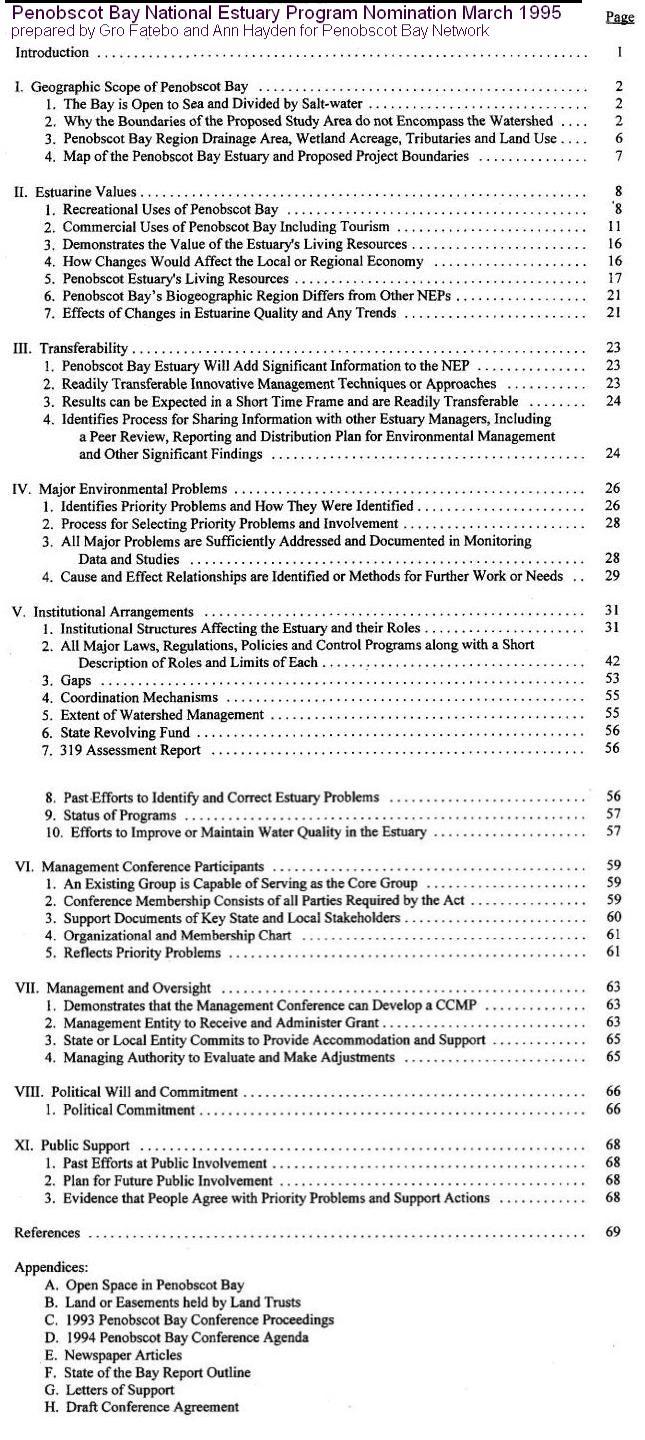
Angus King's failed 1995 nomination of Penobscot Bay for the National Estuary Program. Plus our failed 2019 renomination.

In 1995 Maine Governor Angus King nominated Penobscot Bay for EPA's National Estuary Program. Read it below.  In 2019 an attempt to renominate the Bay for the  NEP was blocked by certain interests who pressured the legislature into withdrawing the bill before hearing. ONTP'd

Feb 6, 2019

Summary of Penobscot Bay historic data & primary sources.


Summary of Penobscot Bay historic data & primary sources.


EPA's  ECHO program  https://echo.epa.gov/

EPA's Facility Registry Service https://www.epa.gov/frs Searchable by zipcode

* Distribution and abundance of fishes and invertebrates in North Atlantic estuaries NOAA 1994   


***FOPB-Retrieved recent and  historic  Data (including gray literature)
20th century
* Sears Island cargoport plan Environmental documents . Federal, state and NGO docs re the 1995 and 2003 island port plans.

 * Upper Penobscot Bay Clam Survey, 1967.  https://www.penbay.org/bm/pbclams1967.html

*  Conference in the Matter of Pollution of the Navigable Waters of the Penobscot River and Upper Penobscot Bay...April 20, 1967

*****  Fishing Grounds of the Gulf of Maine 1929 US Bureau of Fisheries  fishery map with links to data  http://www.penbay.org/wrich/fginnergom2.html
*
19th century
* The Salmon Fishery of Penobscot Bay and River 1895-1896, US Fish Commission http://www.penbay.org/usfc/usfc1897_salmon.html* 

* The Lobster Fishery of Maine,  US Fish Commission 1899  http://penbay.org/usfc/lfm/usfc1899_lobsterfisheryme.html

HISTORIC WATER QUALITY DATA 
* Historic & realtime Penobscot Bay weather buoy data. Source *****NERACOOS  https://www.neracoos.org

* Ducktrap River realtime and historic  flows http://waterdata.usgs.gov/nwis/nwismap/?site_no=01037380&agency_cd=USGS

* Archived citizen water quality monitoring data of Penobscot Bay  Source Pen Bay Stewards https://www.belfastbaywatershed.org/

HISTORIC AERIAL PHOTOGRAPHY  source: USGS https://earthexplorer.usgs.gov/ 

Stockton Harbor. Kidder Point 1940 and 1940-2011 comparisons http://penobscotbay.blogspot.com/2014/11/kidder-point-high-altitude-aerial.html

 AERIAL VIDEOGRAPHY courtesy Lighthawk http://www.lighthawk.org/
* Belfast south side of Passagassawakeag River.  Head of tide to Little River,      May 1, 2013 https://www.youtube.com/watch?v=ACtReh14yC8

* GAC Chemical Corp western Stockton Harbor flyby  https://www.youtube.com/watch?v=7s-MPd2bFN8

* Penobscot Marine Museum https://penobscotmarinemuseum.org

* Rockport Harbor Aerial Photo 1977

* Bathymetric chart of Rockport Harbor 2013 lg jpg http://penbay.org/rockport/rockport_harbor_chart_lg.jpg

UNDERWATER VIDEOGRAPHY & STILL PHOTOS 

Rockport Harbor
* Rockport Harbor  Photos  of Habitat Area of Particular Concern for juvenile Atlantic Cod from FOPB's 10/19/12  underwater towed vidcam run 

*Rockport Harbor floor video, Porterfield Ledge, 2013.  
Penobscot Bay Watch  4 minutes 

Rockland Harbor Video (DMR)
* 16 minute video of Rockland Harbor  HAPC https://www.youtube.com/watch?v=pXYK7rlxPBU (Maine department of Marine Resources

Searsport Harbor
Diver video footage off northwest shore of Sears Island  (ghostport site) 2009   369mb mov file


 Wayback Machine-accessed earlier Maine environmental data - See http://web.archive.org/web/http://state.me.us/dep  &   earlier Maine DEP website(1998-2014 archive and the present MDEP URL's archive (2002-2015) http://web.archive.org/web/20141228134600/http://www.maine.gov/dep/ Some of the subpages are archived down to the data level