Search

Dec 16, 2007

Invasive species solution - a look outside the box.

In addition to organisms stowing away in ballast water, ships transport aquatic and marine life on their submerged hulls. The environment created by such organisms as barnacles, sea squirts other 'fouling' organisms, serves as protective habitat for even more species.

When the vessel's hull is cleaned, the biofouling community is scraped off and may well find its way into the harbor, bringing a host of species native to elsewhere.

A SOLUTION? 'Paint' the hulls of vessels with a preselected mix of fouling organisms , of a sort that is non-invasive in nature, that is already globally ubiquitous, that nonetheless makes short shrift of any other species that tries to com aboard the hull to pull an aquatic hitchhike across the seas by fouling to the ship or to the boat.

"Go away! There's no room at the inn", the invader wannabe is told.

Thats the idea, anyway. Let's explore it further at a later time and date.

Dec 6, 2007

Right Whales visiting Penobscot Bay!

A pod of nearly two dozen northern right whales is visiting the mouth of Penobscot Bay.

As a precaution, the National Marine Fisheries Service (NMFS) has imposed lobster gear restrictions on nearly 2,000 square miles of ocean south of Rockland through December 19th.

Photo shows 600 feet of lobsterline unwrapped from a humpback whale.

The Dynamic Area Management (DAM) zone is likely to have varying impacts Maine fishermen. December is a big month in the offshore lobster fishery. Monhegan opens in January.

Some of the largest boats that fish offshore can land as much as 20,000 pounds of lobster, earning thousands of dollars for their crew on a single December trip. While the rewards can be high, so can the risk.

Its a hard pill to swallow, but until lobstering technology moves into the 21st century, we humans must make way for our majestic predecessors, who have lived in these waters since before the bronze age, for the trap lines WILL snarl a rightie if he or she blunders into it the wrong way.

Dec 4, 2007

As goes Moosehead Lake, so goes Maine - right, Governor?

Shall Moosehead Lake be crucified on the cross of corporatocracy?

Tourism and respectful exploitation of wild and natural northern Maine, or corporate profit driven growth centers sprawling over the wild landscape?

The question comes up repeatedly, even daily for Mainers: How shall our local economy be? Atomized into a robust democracy of small businesses, or congeal into superstores for the many and gated estates for the few.

Even Governor Baldacci, no enemy to big business, admits the plans of Plum Creek for the Moosehead Lake region are defined by the "S" word. And unfavorably so.)

Keep the faith, Governor. Don't equivocate. Better to leave a legacy of wild nature than be known as the hangman of Moosehead Lake.

Nov 30, 2007

IMO punts on ballast water


The International Maritime Organization (IMO) has decided to delay enforcement of a 2009 requirement for new ships to have ballast water treatment equipment,arguing that the 2004 Ballast Water Management Convention has not yet entered into force, and, moreover that there is a lack of type-approved equipment.

Shipping Industry group ICS has been complaining that cost-effective ballast water treating equipment continues to fail to be available since the 2004 IMO Conference which adopted 2009 for its mandatory use by certain ships constructed after this date. IMO agreed.

Maine court whacks ocean polluter

Its $525,000 and two years probation for the owners of the M/V Kent Navigator, which was inspected when it entered the port of Portland by the US Coast Guard after receiving an anonymous tip. The inspectors found oily residue in piping that led to overboard discharge valves and inoperable oil pollution control equipment., and were able to prove to the court that the ship's crew circumvented the ship's oil water separator and discharged waste oil tanks and bilge tanks directly overboard.

Good job Coasties! Read the full story:

Vessel Operator Sentenced to Pay $525000 for Environmental Crime
WASHINGTON, Nov. 28 /PRNewswire-USNewswire/ — A federal district court in Maine sentenced Petraia Maritime Ltd., late yesterday, to pay a fine of $525,000 and serve two years probation for violating the Act to Prevent Pollution From Ships (APPS), the Justice Department announced.

Petraia had been convicted following a jury trial in May 2007 of failing to maintain a record of its overboard discharges of oily bilge waste, which it made without using required pollution control equipment, from the Kent Navigator a vessel that it owned and operated. Two chief engineers serving aboard the M/V Kent Navigator had previously pleaded guilty to making false statements to the Coast Guard for their role in the attempted cover-up of Petraia Maritime’s discharges of oily waste.

"This sentence should make clear that the shipping industry will continue to pay penalties if they fail to abide by laws protecting the environment when they choose to enter any United States port," said Ronald J. Tenpas, Acting Assistant Attorney General for the Justice Department’s Environment and Natural Resources Division.

"This case sends a clear message to vessel operators and mariners that dumping waste at sea and covering up pollution are serious crimes that will be prosecuted. We take our stewardship of our oceans very seriously and will continue to pursue cases like this," said Rear Admiral Timothy S. Sullivan, Commander of the First Coast Guard District.

"My Office will continue to aggressively pursue those vessel operators and mariners whose actions threaten Maine waters and violate the integrity of their recordkeeping obligations," said Paula D. Silsby, U.S. Attorney for the District of Maine.

The government's investigation began in August 2004, when the U.S. Coast Guard received an anonymous tip that a vessel bound for Portland, Maine, was illegally discharging its waste oil and bilge while at sea. MARPOL, a treaty signed by more than 135 countries representing approximately 97.5 % of the world's commercial tonnage and implemented into U.S. law by the APPS, limits the oil content of discharges from ships to no more than 15 parts per million. Oil pollution control equipment, called an oil water separator, is equipment required by these laws that, when operated correctly, will prevent discharges of oil in excess of 15 parts per million.

The Coast Guard inspected the Kent Navigator when it entered the port of Portland and found oily residue in piping that led to overboard discharge valves and inoperable oil pollution control equipment. The Coast Guard's investigation revealed that while the vessel was at sea, the ship's crew discharged waste oil tanks and bilge tanks directly overboard and also discharged the bilges in a way that circumvented the ship's oil water separator. These discharges, which numbered 13 over eight months, were usually in excess of 5,000 gallons each and resulted in the discharge of significant quantities of oil. In addition to entering port in Portland in August 2004, the investigation revealed that the Kent Navigator had entered the Portland port on numerous prior occasions.

To conceal this illegal discharge activity, Petraia's employees falsified records in the ship's oil record book, making it appear as if the discharges were made using the required pollution control equipment when in fact they were not.

The investigation was conducted by Special Agent Daniel Bradford, of the U.S. Coast Guard Investigative Service, with assistance from the Coast Guard Sector Northern New England, the Coast Guard First District Legal Office, and the Coast Guard Headquarters Office of Investigation and Analysis. The case was prosecuted by Wayne Hettenbach and Kevin Cassidy of the Environmental Crimes Section of the Department of Justice and the U.S. Attorney's Office for the District of Maine.

Source: U.S. Department of Justice

Nov 16, 2007

Right whale whackers must be stopped

Sounds like a bad idea. The U.S. Navy wants to put a training range for lethal mid-frequency
sonar off the coast of Cape Hatteras, North Carolina smack in a key migratory route for menhaden, bluefish, striped bass, right whales, humpbacks, swordfish, eels, ...you name it, and if it travels the north/south route along the US Atlantic coast that is used by so much marine nature, it could be in deep trouble if the proposed sonar range gets set up in those waters.

The Navy's new Atlantic Undersea Warfare Training Range would create a 500-square-mile hub of sonar activity. While they could likely be forced to refrain from sonar testing during whale thru-migration times, many other species travel on their own schedules, and the survival of such species is every bit as important as that of the marine mammals.


We'll keep an eye on this...Stay tuned.

Oct 31, 2007

Sears Island Joint Use Committee met, sets 341 acres aside for future port.

By Tanya Mitchell VillageSoup/Waldo County Citizen Reporter

SEARSPORT (Oct 31): The Sears Island Joint Use Planning Committee learned the basics of creating a document that would spell out how the island will be used in the future at its meeting Friday, Oct. 26.

As a result of the April 12 consensus agreement that came out of the Sears Island Planning Initiative Steering Committee meetings, 341 acres will be set aside for development of a future port, while 600 acres are earmarked for recreation/conservation purposes.

Along with fixing the boundary line to reflect that land division between the state Department of Transportation and those interested in keeping the island open for conservation, the JUPC is charged with drafting a conservation easement to make the land-share arrangement work for both parties.

The next JUPC meeting is slated for Thursday, Nov. 15. Read full story

Oct 26, 2007

Wiscassett coal degasification plant would create 770 tons of toxics-rich slag per day.

The coal degasification plant proposed for the shore of in Wiscassett would produce about 770 tons of boron-rich slag per day. I understand by looking at the literature. Where's that going to go?

Boron is a significant component of that slag. Aquatic toxicity of Boron in the leacheate from this type of slag. is described below (can you explain what the findings to this paper mean? (it is also toxic to waterfowl at some concentration.

The scientfic literature is equivocal. We need some science on the topics of boron toxicity. There are concerns about impacts to fresh and waters zooplankton and importantly to Wiscassett's fisheries, to eelgrass.

Inshore GOM herring fishery closed till January 1, '08

From the Federal Register: October 25, 2007
Fisheries of the Northeastern United States:

ACTION: Closure of Atlantic herring fishery for Management Area 1A.

SUMMARY: NMFS announces that effective 0001 hours, October 25, 2007, federally permitted vessels may not fish for, catch, possess, transferor land more than 2,000 lb (907.2 kg) of Atlantic herring in or from Management Area 1A (Area 1A) per trip or calendar day until January 1,2008, when the 2008 TAC becomes available, except for transiting purposes as described in this notice.
This action is based on the determination that 95 percent of the Atlantic herring total allowable catch (TAC) allocated to Area 1A for 2007 is projected to be harvestedby October 25, 2007.

Regulations governing the Atlantic herring fishery require publication of this notification to advise vessel and dealer permit holders that no TAC is available for the directed fishery for Atlantic herring harvested from Area 1A.
DATES: Effective 0001 hrs local time, October 25, 2007, through 2400hrs local time, December 31, 2007.


FOR FURTHER INFORMATION CONTACT: Don Frei, Fishery ManagementSpecialist, at (978) 281-9221.

Getting lost between Matinicus and Rockland

It's the sort of minor tale of the sea that that "the Humble Farmer' might memorialize on his weekly radio show:

Lobster boat leaves Matinicus Island and becomes lost on en route to Rockland.

Was it storming? Did deep fogs fill the mouth of the bay? Was the crew desperately ill, or worse? Apparently not. Skies were clear. It was a little after 3 in the morning, and their chart plotter was broken and it was blowing about 15 knots out of the southwest, with a 4 foot swell. But still...

Coast Guard Station Rockland's public releases on the hapless lobster boat's two October 23rd incidents follow:

23 October
At 2:55am, Station Rockland received a report of a 40 foot lobster boat with two people on board that was disabled near Matinicus Island. When no commercial providers responded to the Marine Assistance Request Broadcast, Station Rockland responded with its 47' Motor Life Boat and Boatswain's Mate 1st Class Scott Self as the Coxswain.

Two and one half hours later:

At 5:39am, the MLB arrived on scene, took the boat in tow and proceeded to Matinicus Island. At 6:37am, just outside Matinicus Harbor, the boat was able to regain propulsion and the tow was dropped. The disable boat went into the harbor and the MLB returned to Rockland. Case Closed.

Four Hours Later

23 October
At 9:50am, Station Rockland received a report from the same boat they had just towed, that they were underway enroute Rockland when their chart plotter had broken and they didn't have any local charts. They did have GPS, but no way to tell where they were. Another commercial fishing vessel over heard the radio traffic, was near their position and offered to help. The commercial fishing vessel was able to locate the lobster boat and escort them back to Rockland. Case Closed.


CWO3 Curtis Barthel
Commanding Officer
CG Station Rockland


Matinicus is about 18 miles from Rockland. Its hard to think of any lobsterman who couldn't navigate this pretty straightforward route

The answer? They were delivering the lobsterboat from Away.

The Coasties didn't reveal whether they were downeasters bringing a lobster boat from Jonesport, or up from Portland, or even Canadians.

Oct 17, 2007

Mack Point's security analyzed

Maine port officials say facilities secure
By BDN Staff
Wednesday, October 17, 2007 - Bangor Daily News

By Rebekah Metzler
Boston University Washington News Service

WASHINGTON — The small size, remote locations and relatively low-value cargo of Maine’s ports in Searsport and Eastport make them easier to manage and to secure, according to security agents from the two ports. Full story

Oct 3, 2007

Bay saved from toxic river dredge spoils

Construction firm Cianbro, poised to redevelop the abandoned Eastern Fine Paper site on the Brewer shore of Penobscot River, has bowed to bay fishermen and other citizens' concerns, and abandoned plans to dump dredge spoils from its site into Penobscot Bay. 

 he company will instead spread spoils dredged from its waterfront onto its land and use them as part of the redevelopment. The company had planned to dump its spoils at the Rockland Disposal Site, but pressure from Penobscot Bay Alliance, Maine Lobstermen's Association and others moved them to abandon the plan in favor of land-deposition.

Sep 28, 2007

Boat fuel spill fouls Saint George River

According to a report in Village Soup:

"About 600 gallons of number two diesel fuel have leaked into the St. George River Friday morning from a boat [Arcadia] docked at Lyman Morse Boat Builders near the Wadsworth Street Bridge and "has spread down to the St. George/South Thomaston line and flowed up to Warren, according to officials on the scene."

The spoill occurred when the boat owner failed to pay attention to the fueling process.

Responders include Maine DEP, DMR the Thomaston and Warren Fire Departments

While optimistic officials have told the press the cleanup will take only " several days", this remains to be seen. Stay Tuned...

Bad ballast water bill pulled from consideration!

Pressed by environmental activists, the US Senate Commerce Committee has pulled a foul amendment from consideration as part of S 1578: the "Ballast Water Management Act of 2007". The industry supported "Nelson Amendment" would have stripped states of the right under the federal clean water act to prevent invader species from being discharged into their lakes, rivers and coastal waters in ballast water. Recreational boating industry was a major part of the impetus to weaken state powers.

According to a Snowe staffer in Washington, the Nelson Amendment was withdrawn by its sponsor, after Sen Barbara Boxer introduced, then withdrew, her own amendment restoring the primacy of the Clean Water Act. So the bill never came up before the Senate Commerce Committee Thursday and will be worked on into the future. See a recent (August 07) news article detailing the POVs of S 1578's critics and supporters.

Nina Bell of Northwest Environmental Advocates organized marine activists around the nation's coasts into signing a joint letter to Commerce Committee members opposing the bill, and organized a call-in campaign to legislators. Maine's Olympia Snowe "laid low", according to one observer familiar with the hearing, and was neither in support or opposition. Other Senators on the Commerce Committee were concerned enough by the issues raising in the letter and calls to pressure its withdrawal from consideration.

Sep 26, 2007

Bill strips Maine of power to fend off marine invader species.

Dear Friends,

In the cause of environmental justice, please urge Senator Olympia Snowe to vote against a bill -- S 1578--the so-called "Ballast Water Management Act of 2007" The bill is coming up before the Senate Commerce Committee tomorrow.

Please call the capital switchboard (202) 224-3121) ask for Olympia Snowe. NOTE THE COMMITTEE VOTE IS TOMORROW. Snowe's staffers are totting up how much interest there is, so please call!

Under the Clean Water Act, Maine Department of Environmental Protection can impose strict conditions on ballast water discharges into state waters and even bar it entirely.

This water, required to be pumped out of the ballast holds of oceangoing cargo ships to accomodate the weight of onloaded cargo and to pass through shallow areas, is typically found to be rich with exotic marine life, pathogens and pollutants from distant waters and ports around the globe.

With actual andf attempted increases in cargo and tanker ships and barges picking up and delivering cargo at ports in Casco, Penobscot and Passamaquoddy Bays, the state needs to retain its powers to protect its vital lobster industry and other coastal fisheries from ecological disasters from marine invader species introduction --granted it under the Clean Water Act-- more than ever.

The new bill S 1578--the "Ballast Water Management Act of 2007" would declare the Coast Guard to be "the sole Federal authority" to limit species' introduction by vessels. This would invalidate Maine and other states' ability to use the powers given to states under the Clean Water Act to restrict such discharges.

Pushing this mandate of marine biological management onto an ill-equipped and already-overburdened US Coast Guard takes the agency into a regulatory area it lacks both expertise and time to perform successfully.

Even worse, under the bill the Coast Guard could postpone indefinitely the date at which whatever standards it finally comes up with are enacted. In the politicized morass of the present administration that can mean "never".

As a letter sent to the Commerce Committee today by fortyfour environmental and conservation groups notes:

"Individually and in combination, the proposed provisions precluding States from taking their own actions, exempting ballast water discharges from the Clean Water Act, and curtailing the federal agencies’ actions, result in a bill that we fear will perpetuate the economic and environmental harm of invasive species for many years to come."

Senator Snowe needs to know that this bill is bad news for Maine's lobsters and lobster industry. Maine is much better positioned to identify and prevent discharges of marine invader species into its waters that could put its fisheries and public health at risk.

Please call Snowe's office and urge her vote against this a fast-moving industry bill. With increases in cargo and tanker ships and barges picking up and delivering cargo at ports in Casco, Penobscot and Passamaquoddy Bays, the state needs its powers to prevent ecological disasters from marine invader species --granted it under the Clean Water Act-- more than ever.

Call Senator Snow via the capital switchboard (202) 224-3121, and let her know you care about marine Maine.

Ron Huber
Penobscot BayWatch


Sep 12, 2007

Public criticises Cianbro plan to dump Brewer dredge spoils into Penobscot Bay

Dredge 'n dump meeting at Rockland Middle School thronged; industry reps present, lobstermen glare, agencies filibuster, environmentalists fume.

At a meeting sponsored by the Maine Department of Marine Resources
lobstermen and environmentalists challenged the proposal by Cianbro and an unnamed corporate partner to dredge mud and woody debris from Penobscot River bottom adjacent to the defunct Eastern Fine Paper site in Brewer , as part of setting up and operating an industrial module producing plan on the site. News coverage... more media coverage___even more media coverage

The Cianbro Company is partnered with unnamed investors to build and operate an industrial module assembly facility that would import parts from other states and nations, assemble them, then shipping out the completed "industrial modules" to be put together onsite . "Like erector sets" the company rep said.

Cianbro and its partners say they want to move quickly and be assembling these modules 12 months from now.

Fishermen and conservationists at the meeting lobbied hard for a total upland disposal option be substituted for bay dumping at the Rockland Disposal Site.

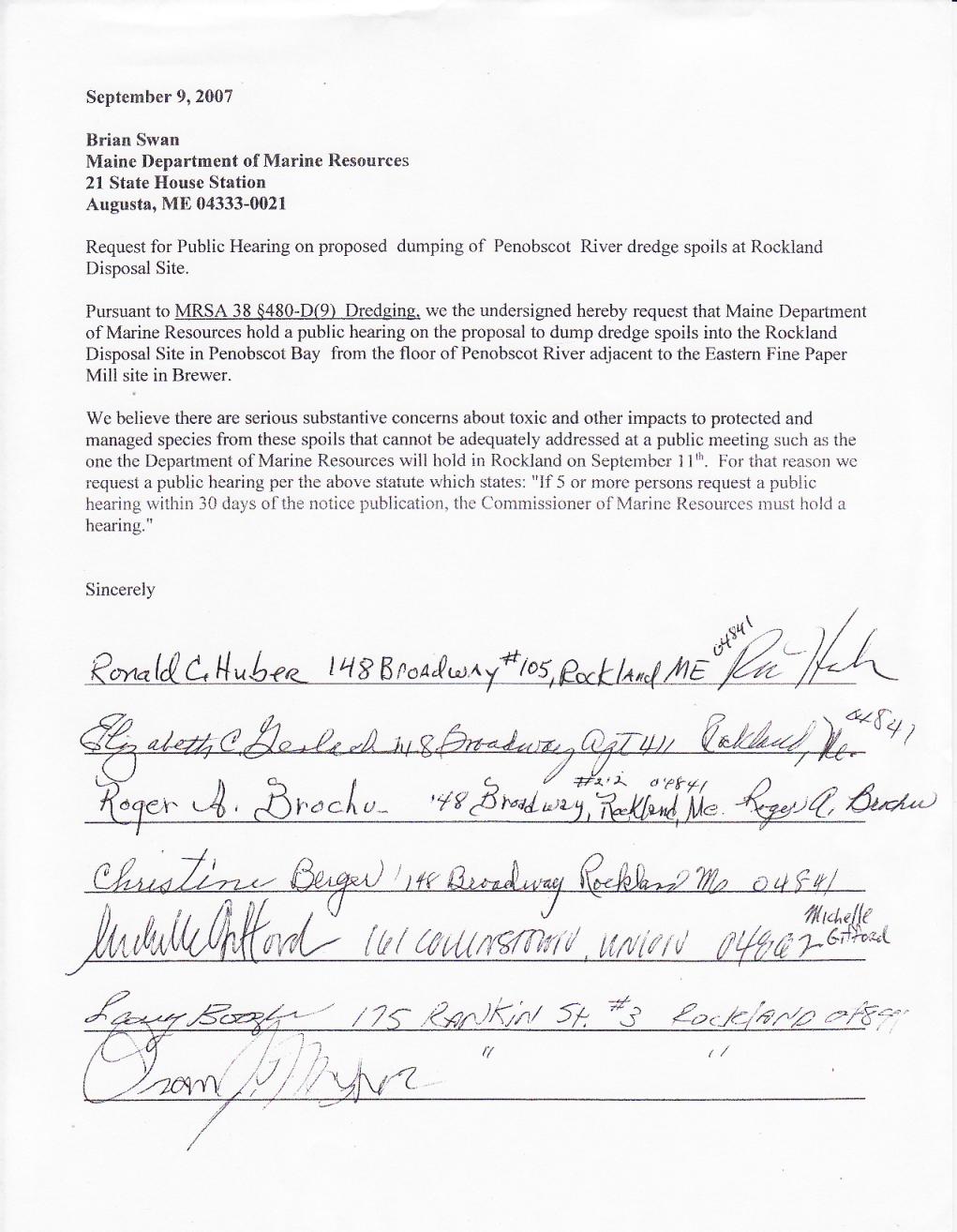
Two petitions were sent or given to DMR, one calling for a public hearing and one expressing the concern of dozens of bay area citizens who would be affected. DMR claimed that the public information meeting being held, was adequate ; I objected, citing the plain language of MRSA 38 480-D(9) Dredging. (scroll down to (9) the statutory chapter and verse.

The meeting was about 1 & 1/2 hours long. At the head tables, (speaking mostly in that annoying sotte voce used by midlevel officials at such interagency public meetings) were two DEPers: the permit reviewer and the DEP marine ecologist; in the middle: DMR's Brian Swan. On the other side sat the Cianbro representatives including Parker Hadlock, with experience in port building and renovation in Portland, who will be the project manager for the project, which will build by-request modular machines for global big industry. Army Corps of Engineers' Shawn Mahaney sat in the back of the audience, occasionally fielding RFI's from the state and industry reps up front.

An enviro/chem consultant for Cianbro sat quietly in the front row, saying little, and that little with awesomely developed pass-the-buck skill.

Maine Lobstermens' Association President Dave Cousens was in the second row with several lieutenants and a row or two of Vinalhaven lobstermen with families. Lobstermen pushed for schedule change to minimize interference iwth autumn fishery, questioned the toxicity information and opposed damaging their industry to better another one; Sierra Club's Vivian Newman questioned the jobs projections, (she came in about 45 minutes in.) The Lobster Conservancy voiced concerns over toxicity and the smothering of lobsters, the Lower Penobscot Watershed Association advised, the Island Institute rep spoke; Hannah Pingree gave a lengthy statement recapping the fishermens' concerns.

Posters on easels: an 1880s architect's drawing of a chlorine-using paper mill filling the same local footprint. It showed two docks operating back then: one for shipping materials and paper, one labeled "coal dock" (gotta be a lot of coal down there). A nav chart of Penobscot Bay with the east and west l shipping lanes highlighted, a chart tabulating of toxics findings of sediment cores.

The Pitch
Cianbrorep was enthused about re-using this old riverside industrial site in Brewer , providing good paying jobs non-polluting industy since it is only assembly of parts coming in, completed industrial modules going out. If approved, the facility's first project, that they have already been awarded the contract to build, will be sent to some facility near or in the Gulf of Mexico in October 2008. Although they wouldn't identify even potential clients, in general the operation will custom build large complete modular industrial plants of all types. These will then be barged to distant seaports whence they are taken to whatever Mordor-ian industrial facility awaits the instant industrial plant.

Confronted on the non-transparency of their process to date, agency faces were red. Clearly they would rather not have a further public hearing. Maine DEP's permit reviewer announced that the public comment period was over, but finally bent to some pressure to accept public comment to the end of the month.

Fishermen have been trying for years to have the bay dump site permanently closed.
A lobsterman said it was known to be a terrible location for a dump due to the vigorous currents that have sent the spoils spreading across the bay. Fifty years of dumping there and the bottom is still flat, he noted.

First dredging act will be removal of 'windrows of wood' on the river floor. Divers have examined it. Then about 1/2 of the total amount of mud and sand spoils that they would be licensed to discharge they are allowed to.
They may or may not use the train (RR tracks run past the site.)

Many more details, soon.

Sep 3, 2007

Paper company dredge spoils could end up off Rockland. Pub Mtg 9/11


Public Meeting on Plan to Dump Paper Mill Dredge Spoils off Rockland. September 11th,

On Tuesday, September 11, 2007, 6:30 - 8:00 p.m. Maine Department of Marine Resources will host a public meeting/listening session at the Rockland Middle School, to take comments on a proposal to dump dredge spoils from Penobscot River off the former Eastern Fine Paper mill site in Brewer Maine, into the Rockland Disposal Site. The meeting will take place in the cafeteria of the Rockland Middle School 30 Broadway, Rockland.

AT ISSUE: Eastern Fine Paper Mill discharged significant quantities of dioxin and other wastes into Penobscot River. The material being dredged for the benefit of a riverfront developer i contaminated. However, the US Army Corps of Engineers decides whether the level of contamination is low enough to permit dumping at the Rockland Disposal Site Army Corps of Engineers most recent review of the dumpsite (large pdf), which is located between North Haven and Rockland, 3 and 1/2 miles from the Rockland Breakwater Lighhouse

The meeting that Maine Department of Marine Resources is hosting IS NOT A PUBLIC HEARING. Rather officials from DMR and other agencies will sit silently at a table before the public, members of which will be invited to make statements. The officials will not answer any questions. See excerpt from public notice, below

However, MRSA 38 §480-D(9) Maine state law concerning dredging (scroll down to 9. Dredging) states:
"If 5 or more persons request a public hearing within 30 days of the notice publication, the Commissioner of Marine Resources must hold a hearing."

According to the DMR's Public Notice:

The purpose of the meeting is to gather information and comments from the public on a proposal by Penobscot River Holdings, LLC and Cianbro Construction, LLC of Pittsfield to dredge approximately 33,000 cubic yards of intertidal and subtidal sediments from the Penobscot River along the shore of the former Eastern Fine Paper Mill in Brewer.

Dredged materials suitable for open water disposal would be transported by barge for disposal at the Rockland Ocean Disposal Site located approximately 3.33 nautical miles east northeasterly of the Rockland Breakwater light. Dredged materials not suitable for open water disposal would be disposed of in an upland location.
For further information contact Brian Swan, DMR at 624-6573.

Jul 26, 2007

GOM Right Whale Protection Stymied by Bush Admin

July 24, 2007. The White House is currently delaying enactment of a final rule intended to protect the critically endangered North Atlantic Right Whale.

What's going on here? According to NOAA, the chief cause of accidental deaths of North Atlantic right whales is "ship strikes" i.e. being run over by oil tankers and other big vessels while drowsing away on the surface. Not lobster pot-warp entanglements, not fishing of any kind. The US and Canadian fishing fleets already have a brace of strictures on their operations to protect our cetacean relatives sharing the Gulf of Maine.

But big global trade vessels have big money, big lawfirms and big lobbyists to keep themselves as free of profit-threatening regulations as possible. These are the chief culprits. A little known administration bureaucracy, the "White House Office of Information and Regulatory Affairs" (OIRA) is holding things up. Under Executive Order 12866, issues by Clinton, all federal agencies have to run their new regulations past OIRA before it can go on the books and be enforced. OIRA looks at the regulation's costs and benefits. It is supposed to make its decisions swiftly
But in this case....Not! Read the details here as assembled by public interest watchdog group OMB Watch

Jul 21, 2007

Seal Island: ACOE, USFWS and other stakers recommend "Remedial Investigation & Feasibility Study


The latest communication from Army Corps of Engineers is promising:

"An RI/FS was recommended at this site due to past discovery of MEC and the MC risk associated with the COPECS"

Huh? Translated into plainer English below, but first the news:
the Seal Island Site Inspection Report has been finalized "with concurrence of all stakeholders and regulators who participated with us in the process."


Okay. So what did they decide? In plainer English:
"A Remedial Investigation & Feasibility Study was recommended at this site due to past discovery of munitions and explosives of concern and the munitions constituents risk associated with chemicals of potential ecological concern" (see acronyms list, coming soon)

This is bad and good news:
Bad News: An initial quick& dirty onceover of the bombing range has revealed enough UXO to warrant developing a remediation plan. So yes, this outer Penobscot Bay gunnery range of an island is indeed contaminated.

The MK 15: most common UXO at Seal Island


Good news: The agencies and stakeholders have concurred that a plan should now be drawn up; a detailed plan for seeking out and removing or neutralizing UXO or MEC therefrom this former bombing range, which is identified on nautical charts as federal Danger Area 334.10.

The scuttle at a recent brownbagger in Army Corps of Engineers in Baltimore is that Army and DoD were talking last year about extending the scope of the area of concern to the waters the ranges out to the 125 contour (safe diving depth) eligible for cleanup; instead of the area within 100 yards of shore, (the present accepted limit.) This will be followed up on...

Now the heat is on the conservation/environmental community to act on behalf of Marine Maine down there, i.e. ensure the dangerous polluting munitions on the seafloor off Seal Island, steadily leaking into state waters and also washing ashore on nearby islands as the Gulf of Maine's currents tumble the underwater cache of UXO about is looked at, and appropriate remediation taken.

What's needed: Regional NGOs must step up to the plate.

Penobscot Bay is well-freighted with conservation and environmental non government organizations of all stripes. Commercial fisherfolk groups, coastal and island land trusts, regional environmental outfits. A shifting mosaic of grassroots groups in Maine coastal towns and cities rising and falling as they take on their particular NIMBY Nightmares.

It is historically been dififcult to impossible to draw Natural Resources Council of Maine down below the low tide line; those vast natural areas that make up Maine's state territorial sea must do without Brownie Carson's bands of merry men and women that fight the green fight so well on Maine's land and in Maine's freshwater rivers and lakes. Lukewarm interest so far. from Toxics Action Center.

So far. Time will tell. Get updated Seal Island info

Jul 11, 2007

Sears Island Joint Use Committee takes first steps. updated

Sears Island's Joint Use Planning Committee met July 11th.

See media coverage. The purpose of the two hour meeting, according to the agenda sent out by email, was to introduce JUPC members to each other, agree on ground rules for future JUPC meetings, and examine a draft “Scope of Work” paper from Maine DOT. The meeting was held at the Searsport town office from 10 am to noon.

According to a reliable source at the meeting, it went as follows:

Searsport town official Dianne Smith opened the meeting, praising the the attendees for their perserverance. “We've come farther than I ever thought we'd get,” she said.

Maine DOT commissioner David Cole spoke up “we're making history” he said. He said the Sears Island Committee was “one of the best I've ever worked with.”

James Gillway, Searsport town mgr, said that people have spoken to him and want the question settled.

Sierra Club representative Joan Saxe's cell phone loudly went off, annoyingly going through 8 or 9 rings before she could dig it out of her bag.

Senator Damon spoke up, noting that he had entered into the process late, but said he'd written to Governor Baldacci recently, praising “the tremendous amount of work” regarding “a tremendous asset and a tremendous natural resource.” He said he believed the two could be combined. “Every bit of our natural resources is important, and a port too.” he said.

The meeting participants ( see list below) agreed to adopt the groundrules of their predecessor group Sears Island Planning Initiative Steering Committee.

Then Duane Scott of Maine Department of Transportation presented his “Scope of Work” proposal. Calling it “a foundation” to work from he identified the following work priorities

(1) finalizing the buffer easement language
(2) fixing boundaries between the industrial zone and the natural zone
(3) Creating a new legal “Easement Deed”
(4) Deciding on Public Access Issues
(5) Develop a plan to provide revenue for the island for Searsport
(6) Mitigation options

Discussion followed.
Robert Grindrod,representing Montreal Maine railroad (formerly called Bangor and Aroostook Railroad) said setting out and fixing the boundaries must be done first. “
Grindrod says fix boundaries first. “Can't do anything without that.” he said.

DOT Commissioner Cole says with the 341 acres allocated to port usage “we have a core area to work with.”

Senator Damon said that the boundaries “shouldn't unduly constrain the permitting process”


Maine DOT's Duane Scott then talked about a state “mitigation bank”.
He said there were ten or eleven sites with “excess compensation credits”
Working with the feds as well ACOE, but he believed that the state could potentially have acquired
credit by agreeing not to develop the 600 acres of the island now to be kept free of industry.

Cole then read from a letter to the group from Aroostock County legislator and former paper industry official Rose Peletier, asking that SIJUPC members submit a thumbnail biography. “We can all learn from each other” Pelletier wrote.

Cole also noted that JUPC member Anne Crimaudo of Protect Sears Island is a former business executive who once helped save up trade agreements with China.

The question arose of committee transparency to the public.

“The DOT” Cole said, was being "as open as we can." Dianne Smith asked what do as a JUPC member if contacted by the media. Cole said “You speak for the committee.”

Bangor Daily News Journalist Tom Groening asked, “So who do I go to?”
Go to the state Sears Island website , Cole said. And to Duane Scott of Maine DOT.

Diane Smith wondered if sections of the meeting should be open to public participation?

Sandy Blitz said this sort of meeting should have a public session first then the meeting be limited to committee members for the rest of the meeting.

Grindrod expressed concern that if the public is let into the process “We'll be starting over.” he said. It would be “extremely unwise.”