In a posting last summer, the Bay Watch asserted that in the 1940s and 50s
"... several generations of student bomber-trainees frequently missed the slender W-shaped[Seal] island during their practice bombing runs....To this day, scores of bay-area fishermen can recount encounters with sunken ordnance during their careers.
NOT SO FAST THERE, CHIEF. The Watch has heard from than two Bay fishermen with extensive knowledge of the waters around Seal Island, who state that, apart from a few metal fragments, there have been no unexploded shells or rockets washed up, towed up or snarled up from the waters around Seal Island in at minimum decades.
S.R. wrote:
Never in the last 15-20 have I heard of a fisherman snarling back an
unexploded bomb; they get pieces of metal every now and then, but no
unexploded bombs. Your web site, however, says that scores of fishermen
have repeatedly snarled back bombs; that is false. Scores would mean at
least 40 - there happen to hardly be 40 fishermen who fish around Seal
Island. Where did you get that data?
JD wrote:
During the last twenty years I have never seen nor heard a report of a bomb washing ashore. Where did you get reports of bombs washing ashore? I've not heard of fishermen snarling bombs down there recently either, where did those reports come from?
So where did the report of 'scores' of fishermen encountering WW2 bombs and rockets, of dud munitions washing ashore around this island in the outer Penobscot Bay, come from?
Checking.... Stay tuned.


Jan 9, 2008
Sears Island - at risk of LNG again?
Someone asked me recently
In 2004, LNG was kiboshed at Sears Island, after PBW's 2003-2004 FOAs of Governor Baldacci on the topic revealed his covert support for the proposal; outraged upper bay residents pressured him into agreeing to abide by a Searsport plebiscite, which rejected LNG at Sears Island.
The LNG issue then moved downeast, was swiftly thumbs-downed in Winter Harbor, but took root with the Passamaquoddy Nation and with another group of investors, only to run into the opposition of the Canadian government, which may well doom the two proposals there by barring LNG vessels entry into Passamaquoddy Bay by the only route that is even
remotely safe for large vessels.
Now? Over the last year and a half, the Maine Department of Transportation, state planning office and others, have managed to browbeat, outnegotiate and otherwise wear down most Sears Island protectors/opponents of the LNG proposal into signing off on an agreement to allow port development on 1/3 of Sears Island. In exchange for....a no-development easement on the rest of the island, and permission to build a visitors center.
What kind of port? That wasn't agreed upon. Could it be LNG once more? Possibly. Now that the LNG proposals on the shore of Passamaquoddy Bay are showing signs of defeat, Sears Island is the only logical site left in Maine.
And this time, most of the area environmental community, having signed off on that Sears-Island-port-is-okay agreement**, will have no legs to stand opposed on, for the agreement they signed pledged them not to oppose any port proposal for the island, as long as the port wannabes follow the regulatory process.
Oh...Governor Baldacci's promise still stands, but something like an 'energy emergency' or other plausible claim could well get him to backtrack on THAT.
** The agreement reached by the now-defunct stakeholders group stated specifically that
" 1) Inappropriate Uses for Sears Island: The Steering Committee acknowledges the position of Governor Baldacci that no LNG facility will be sited over the objection of local residents, and acknowledges that the majority of Searsport residents have clearly objected to siting such a facility within their community. The Steering Committee therefore agrees that no LNG facility of any kind would be an appropriate use for Sears Island."
As aforementioned, this Steering Committee no longer exists...but one hopes its agreements linger on.
The effect of other kinds of industrial ports on Penobscot Bay marine ecology would be similar to that of an LNG terminal - if not worse: (ballast water-mediated invasives, loss of eelgrass meadows important for groundfish larvae, among other impacts.
Arguably the most important thing to be done for Penobscot Bay right now is ensuring that the new federal regulation is finalized that designates Gulf of Maine coastal shallows, including those of Penobscot Bay, as Habitat Area of Particular Concern for juvenile Atlantic cod. See http://www.penbay.org/bm/hapcme.html
Once this process passes through its regulatory reviews, developers that want to impinge on the coast will have to demonstrate that their runoffs and discharges will not harm the prey of juvenile cod, let alone the juvenile cod themselves. The prey for freshly hatched cod -
amoebas and other soft protozoans -- are very susceptible to pesticides, and oil-tainted runoff. The timeline for that regulation is sometime late this year or early next.
Is the LNG issue still at large?
He was referring to Penobscot Bay, after reading an undated penbay.org webpage from 2004, on the then-proposal to build an LNG port on Sears Island; for all he knew, it was recent news.
My answer to Is the LNG issue still at large?
Yes and no. (But the yes has been increasing recently) Let's take a look back:He was referring to Penobscot Bay, after reading an undated penbay.org webpage from 2004, on the then-proposal to build an LNG port on Sears Island; for all he knew, it was recent news.
My answer to Is the LNG issue still at large?
In 2004, LNG was kiboshed at Sears Island, after PBW's 2003-2004 FOAs of Governor Baldacci on the topic revealed his covert support for the proposal; outraged upper bay residents pressured him into agreeing to abide by a Searsport plebiscite, which rejected LNG at Sears Island.
The LNG issue then moved downeast, was swiftly thumbs-downed in Winter Harbor, but took root with the Passamaquoddy Nation and with another group of investors, only to run into the opposition of the Canadian government, which may well doom the two proposals there by barring LNG vessels entry into Passamaquoddy Bay by the only route that is even
remotely safe for large vessels.
Now? Over the last year and a half, the Maine Department of Transportation, state planning office and others, have managed to browbeat, outnegotiate and otherwise wear down most Sears Island protectors/opponents of the LNG proposal into signing off on an agreement to allow port development on 1/3 of Sears Island. In exchange for....a no-development easement on the rest of the island, and permission to build a visitors center.
What kind of port? That wasn't agreed upon. Could it be LNG once more? Possibly. Now that the LNG proposals on the shore of Passamaquoddy Bay are showing signs of defeat, Sears Island is the only logical site left in Maine.
And this time, most of the area environmental community, having signed off on that Sears-Island-port-is-okay agreement**, will have no legs to stand opposed on, for the agreement they signed pledged them not to oppose any port proposal for the island, as long as the port wannabes follow the regulatory process.
Oh...Governor Baldacci's promise still stands, but something like an 'energy emergency' or other plausible claim could well get him to backtrack on THAT.
** The agreement reached by the now-defunct stakeholders group stated specifically that
" 1) Inappropriate Uses for Sears Island: The Steering Committee acknowledges the position of Governor Baldacci that no LNG facility will be sited over the objection of local residents, and acknowledges that the majority of Searsport residents have clearly objected to siting such a facility within their community. The Steering Committee therefore agrees that no LNG facility of any kind would be an appropriate use for Sears Island."
As aforementioned, this Steering Committee no longer exists...but one hopes its agreements linger on.
The effect of other kinds of industrial ports on Penobscot Bay marine ecology would be similar to that of an LNG terminal - if not worse: (ballast water-mediated invasives, loss of eelgrass meadows important for groundfish larvae, among other impacts.
Arguably the most important thing to be done for Penobscot Bay right now is ensuring that the new federal regulation is finalized that designates Gulf of Maine coastal shallows, including those of Penobscot Bay, as Habitat Area of Particular Concern for juvenile Atlantic cod. See http://www.penbay.org/bm
Once this process passes through its regulatory reviews, developers that want to impinge on the coast will have to demonstrate that their runoffs and discharges will not harm the prey of juvenile cod, let alone the juvenile cod themselves. The prey for freshly hatched cod -
amoebas and other soft protozoans -- are very susceptible to pesticides, and oil-tainted runoff. The timeline for that regulation is sometime late this year or early next.
Jan 4, 2008
Maine/NH Port Safety Forum January 30th: LNG; icebreaking, port security, Penobscot Bay & much more
Penobscot Bay maritime issues, LNG, icebreaking and more will be among the many topics discussed January 31st at the 80th meeting of the Maine/New Hampshire Port Safety Forum in Portsmouth, New Hampshire. The event will take place 10:00 AM at the NH Dept. of Environmental Services, in Portsmouth, NH. Members of the public are welcome to attend as observers.
The meeting agenda includes updates & presentations on:
Right whale sightings, by Kristen Koyama, NMFS; Maritime Incident Resources & Training for Piscataqua & Merrimack River Region (Val Pamboukes, Portsmouth FD, Ret.); LNG Update-Al Moore, USCG; results of the Frontier Sentinel port security exercise, a mock attack against a navy supply ship. (Lt Cdr Mike Sams, USCG); the raising of the 40 foot Seahawke, a 40 ft boat that sank in Great Bay, NH, (Rick Berry, NHDES); the new Transportation Worker ID Card (Al Moore, USCG); and the Homeport Program (LTJG Beacher, USCG).
Participants will also discuss a Small Passenger Vessel Seminar (call for topics) (LT Green, USCG) and get a report on the Ice Breaking season to date, CWO Chase, USCG)
Under New Business, John Henshaw of the Maine Port Authority will lead a discussion of Penobscot Bay maritime issues. (what are these issues? I'll have to ask him); other new biz includes a proposed Waterway Round-Table Discussion of "port access thresholds" LTJG Miller; the America's Waterway Watch & Sea Partner Program (LT Green) and interpretation of the CBP Passenger Vessel Services Act (John Henshaw, Maine Port Authority).
The event will take place 10:00 AM at the NH Dept. of Environmental Services, in Portsmouth, New Hampshire. Members of the public are welcome to attend as
observers.
The meeting agenda includes updates & presentations on:
Right whale sightings, by Kristen Koyama, NMFS; Maritime Incident Resources & Training for Piscataqua & Merrimack River Region (Val Pamboukes, Portsmouth FD, Ret.); LNG Update-Al Moore, USCG; results of the Frontier Sentinel port security exercise, a mock attack against a navy supply ship. (Lt Cdr Mike Sams, USCG); the raising of the 40 foot Seahawke, a 40 ft boat that sank in Great Bay, NH, (Rick Berry, NHDES); the new Transportation Worker ID Card (Al Moore, USCG); and the Homeport Program (LTJG Beacher, USCG).
Participants will also discuss a Small Passenger Vessel Seminar (call for topics) (LT Green, USCG) and get a report on the Ice Breaking season to date, CWO Chase, USCG)
Under New Business, John Henshaw of the Maine Port Authority will lead a discussion of Penobscot Bay maritime issues. (what are these issues? I'll have to ask him); other new biz includes a proposed Waterway Round-Table Discussion of "port access thresholds" LTJG Miller; the America's Waterway Watch & Sea Partner Program (LT Green) and interpretation of the CBP Passenger Vessel Services Act (John Henshaw, Maine Port Authority).
The event will take place 10:00 AM at the NH Dept. of Environmental Services, in Portsmouth, New Hampshire. Members of the public are welcome to attend as
observers.
Dec 16, 2007
Invasive species solution - a look outside the box.
 In addition to organisms stowing away in ballast water, ships transport aquatic and marine life on their submerged hulls. The environment created by such organisms as barnacles, sea squirts other 'fouling' organisms, serves as protective habitat for even more species.
When the vessel's hull is cleaned, the biofouling community is scraped off and may well find its way into the harbor, bringing a host of species native to elsewhere.
A SOLUTION? 'Paint' the hulls of vessels with a preselected mix of fouling organisms , of a sort that is non-invasive in nature, that is already globally ubiquitous, that nonetheless makes short shrift of any other species that tries to com aboard the hull to pull an aquatic hitchhike across the seas by fouling to the ship or to the boat.
"Go away! There's no room at the inn", the invader wannabe is told.
Thats the idea, anyway. Let's explore it further at a later time and date.
Dec 6, 2007
Right Whales visiting Penobscot Bay!
 A pod of nearly two dozen northern right whales is visiting the mouth of Penobscot Bay.
As a precaution, the National Marine Fisheries Service (NMFS) has imposed lobster gear restrictions on nearly 2,000 square miles of ocean south of Rockland through December 19th.
Photo shows 600 feet of lobsterline unwrapped from a humpback whale.
The Dynamic Area Management (DAM) zone is likely to have varying impacts Maine fishermen. December is a big month in the offshore lobster fishery. Monhegan opens in January.
Some of the largest boats that fish offshore can land as much as 20,000 pounds of lobster, earning thousands of dollars for their crew on a single December trip. While the rewards can be high, so can the risk.
Its a hard pill to swallow, but until lobstering technology moves into the 21st century, we humans must make way for our majestic predecessors, who have lived in these waters since before the bronze age, for the trap lines WILL snarl a rightie if he or she blunders into it the wrong way.
Dec 4, 2007
As goes Moosehead Lake, so goes Maine - right, Governor?
 Shall Moosehead Lake be crucified on the cross of corporatocracy?
Tourism and respectful exploitation of wild and natural northern Maine, or corporate profit driven growth centers sprawling over the wild landscape?
The question comes up repeatedly, even daily for Mainers: How shall our local economy be? Atomized into a robust democracy of small businesses, or congeal into superstores for the many and gated estates for the few.
Even Governor Baldacci, no enemy to big business, admits the plans of Plum Creek for the Moosehead Lake region are defined by the "S" word. And unfavorably so.)
Keep the faith, Governor. Don't equivocate. Better to leave a legacy of wild nature than be known as the hangman of Moosehead Lake.
Nov 30, 2007
IMO punts on ballast water

The International Maritime Organization (IMO) has decided to delay enforcement of a 2009 requirement for new ships to have ballast water treatment equipment,arguing that the 2004 Ballast Water Management Convention has not yet entered into force, and, moreover that there is a lack of type-approved equipment.
Shipping Industry group ICS has been complaining that cost-effective ballast water treating equipment continues to fail to be available since the 2004 IMO Conference which adopted 2009 for its mandatory use by certain ships constructed after this date. IMO agreed.
Maine court whacks ocean polluter
Its $525,000 and two years probation for the owners of the M/V Kent Navigator, which was inspected when it entered the port of Portland by the US Coast Guard after receiving an anonymous tip. The inspectors found oily residue in piping that led to overboard discharge valves and inoperable oil pollution control equipment., and were able to prove to the court that the ship's crew circumvented the ship's oil water separator and discharged waste oil tanks and bilge tanks directly overboard.
Good job Coasties! Read the full story:
Vessel Operator Sentenced to Pay $525000 for Environmental Crime
WASHINGTON, Nov. 28 /PRNewswire-USNewswire/ — A federal district court in Maine sentenced Petraia Maritime Ltd., late yesterday, to pay a fine of $525,000 and serve two years probation for violating the Act to Prevent Pollution From Ships (APPS), the Justice Department announced.
Petraia had been convicted following a jury trial in May 2007 of failing to maintain a record of its overboard discharges of oily bilge waste, which it made without using required pollution control equipment, from the Kent Navigator a vessel that it owned and operated. Two chief engineers serving aboard the M/V Kent Navigator had previously pleaded guilty to making false statements to the Coast Guard for their role in the attempted cover-up of Petraia Maritime’s discharges of oily waste.
"This sentence should make clear that the shipping industry will continue to pay penalties if they fail to abide by laws protecting the environment when they choose to enter any United States port," said Ronald J. Tenpas, Acting Assistant Attorney General for the Justice Department’s Environment and Natural Resources Division.
"This case sends a clear message to vessel operators and mariners that dumping waste at sea and covering up pollution are serious crimes that will be prosecuted. We take our stewardship of our oceans very seriously and will continue to pursue cases like this," said Rear Admiral Timothy S. Sullivan, Commander of the First Coast Guard District.
"My Office will continue to aggressively pursue those vessel operators and mariners whose actions threaten Maine waters and violate the integrity of their recordkeeping obligations," said Paula D. Silsby, U.S. Attorney for the District of Maine.
The government's investigation began in August 2004, when the U.S. Coast Guard received an anonymous tip that a vessel bound for Portland, Maine, was illegally discharging its waste oil and bilge while at sea. MARPOL, a treaty signed by more than 135 countries representing approximately 97.5 % of the world's commercial tonnage and implemented into U.S. law by the APPS, limits the oil content of discharges from ships to no more than 15 parts per million. Oil pollution control equipment, called an oil water separator, is equipment required by these laws that, when operated correctly, will prevent discharges of oil in excess of 15 parts per million.
The Coast Guard inspected the Kent Navigator when it entered the port of Portland and found oily residue in piping that led to overboard discharge valves and inoperable oil pollution control equipment. The Coast Guard's investigation revealed that while the vessel was at sea, the ship's crew discharged waste oil tanks and bilge tanks directly overboard and also discharged the bilges in a way that circumvented the ship's oil water separator. These discharges, which numbered 13 over eight months, were usually in excess of 5,000 gallons each and resulted in the discharge of significant quantities of oil. In addition to entering port in Portland in August 2004, the investigation revealed that the Kent Navigator had entered the Portland port on numerous prior occasions.
To conceal this illegal discharge activity, Petraia's employees falsified records in the ship's oil record book, making it appear as if the discharges were made using the required pollution control equipment when in fact they were not.
The investigation was conducted by Special Agent Daniel Bradford, of the U.S. Coast Guard Investigative Service, with assistance from the Coast Guard Sector Northern New England, the Coast Guard First District Legal Office, and the Coast Guard Headquarters Office of Investigation and Analysis. The case was prosecuted by Wayne Hettenbach and Kevin Cassidy of the Environmental Crimes Section of the Department of Justice and the U.S. Attorney's Office for the District of Maine.
Source: U.S. Department of Justice
Good job Coasties! Read the full story:
Vessel Operator Sentenced to Pay $525000 for Environmental Crime
WASHINGTON, Nov. 28 /PRNewswire-USNewswire/ — A federal district court in Maine sentenced Petraia Maritime Ltd., late yesterday, to pay a fine of $525,000 and serve two years probation for violating the Act to Prevent Pollution From Ships (APPS), the Justice Department announced.
Petraia had been convicted following a jury trial in May 2007 of failing to maintain a record of its overboard discharges of oily bilge waste, which it made without using required pollution control equipment, from the Kent Navigator a vessel that it owned and operated. Two chief engineers serving aboard the M/V Kent Navigator had previously pleaded guilty to making false statements to the Coast Guard for their role in the attempted cover-up of Petraia Maritime’s discharges of oily waste.
"This sentence should make clear that the shipping industry will continue to pay penalties if they fail to abide by laws protecting the environment when they choose to enter any United States port," said Ronald J. Tenpas, Acting Assistant Attorney General for the Justice Department’s Environment and Natural Resources Division.
"This case sends a clear message to vessel operators and mariners that dumping waste at sea and covering up pollution are serious crimes that will be prosecuted. We take our stewardship of our oceans very seriously and will continue to pursue cases like this," said Rear Admiral Timothy S. Sullivan, Commander of the First Coast Guard District.
"My Office will continue to aggressively pursue those vessel operators and mariners whose actions threaten Maine waters and violate the integrity of their recordkeeping obligations," said Paula D. Silsby, U.S. Attorney for the District of Maine.
The government's investigation began in August 2004, when the U.S. Coast Guard received an anonymous tip that a vessel bound for Portland, Maine, was illegally discharging its waste oil and bilge while at sea. MARPOL, a treaty signed by more than 135 countries representing approximately 97.5 % of the world's commercial tonnage and implemented into U.S. law by the APPS, limits the oil content of discharges from ships to no more than 15 parts per million. Oil pollution control equipment, called an oil water separator, is equipment required by these laws that, when operated correctly, will prevent discharges of oil in excess of 15 parts per million.
The Coast Guard inspected the Kent Navigator when it entered the port of Portland and found oily residue in piping that led to overboard discharge valves and inoperable oil pollution control equipment. The Coast Guard's investigation revealed that while the vessel was at sea, the ship's crew discharged waste oil tanks and bilge tanks directly overboard and also discharged the bilges in a way that circumvented the ship's oil water separator. These discharges, which numbered 13 over eight months, were usually in excess of 5,000 gallons each and resulted in the discharge of significant quantities of oil. In addition to entering port in Portland in August 2004, the investigation revealed that the Kent Navigator had entered the Portland port on numerous prior occasions.
To conceal this illegal discharge activity, Petraia's employees falsified records in the ship's oil record book, making it appear as if the discharges were made using the required pollution control equipment when in fact they were not.
The investigation was conducted by Special Agent Daniel Bradford, of the U.S. Coast Guard Investigative Service, with assistance from the Coast Guard Sector Northern New England, the Coast Guard First District Legal Office, and the Coast Guard Headquarters Office of Investigation and Analysis. The case was prosecuted by Wayne Hettenbach and Kevin Cassidy of the Environmental Crimes Section of the Department of Justice and the U.S. Attorney's Office for the District of Maine.
Source: U.S. Department of Justice
Nov 16, 2007
Right whale whackers must be stopped
Sounds like a bad idea. The U.S. Navy wants to put a training range for lethal mid-frequency
sonar off the coast of Cape Hatteras, North Carolina smack in a key migratory route for menhaden, bluefish, striped bass, right whales, humpbacks, swordfish, eels, ...you name it, and if it travels the north/south route along the US Atlantic coast that is used by so much marine nature, it could be in deep trouble if the proposed sonar range gets set up in those waters.
The Navy's new Atlantic Undersea Warfare Training Range would create a 500-square-mile hub of sonar activity. While they could likely be forced to refrain from sonar testing during whale thru-migration times, many other species travel on their own schedules, and the survival of such species is every bit as important as that of the marine mammals.
We'll keep an eye on this...Stay tuned.
sonar off the coast of Cape Hatteras, North Carolina smack in a key migratory route for menhaden, bluefish, striped bass, right whales, humpbacks, swordfish, eels, ...you name it, and if it travels the north/south route along the US Atlantic coast that is used by so much marine nature, it could be in deep trouble if the proposed sonar range gets set up in those waters.
The Navy's new Atlantic Undersea Warfare Training Range would create a 500-square-mile hub of sonar activity. While they could likely be forced to refrain from sonar testing during whale thru-migration times, many other species travel on their own schedules, and the survival of such species is every bit as important as that of the marine mammals.
We'll keep an eye on this...Stay tuned.
Oct 31, 2007
Sears Island Joint Use Committee met, sets 341 acres aside for future port.
By Tanya Mitchell VillageSoup/Waldo County Citizen Reporter
SEARSPORT (Oct 31): The Sears Island Joint Use Planning Committee learned the basics of creating a document that would spell out how the island will be used in the future at its meeting Friday, Oct. 26.
As a result of the April 12 consensus agreement that came out of the Sears Island Planning Initiative Steering Committee meetings, 341 acres will be set aside for development of a future port, while 600 acres are earmarked for recreation/conservation purposes.
Along with fixing the boundary line to reflect that land division between the state Department of Transportation and those interested in keeping the island open for conservation, the JUPC is charged with drafting a conservation easement to make the land-share arrangement work for both parties.
The next JUPC meeting is slated for Thursday, Nov. 15. Read full story
Oct 26, 2007
Wiscassett coal degasification plant would create 770 tons of toxics-rich slag per day.
The coal degasification plant proposed for the shore of in Wiscassett would produce about 770 tons of boron-rich slag per day. I understand by looking at the literature. Where's that going to go?
Boron is a significant component of that slag. Aquatic toxicity of Boron in the leacheate from this type of slag. is described below (can you explain what the findings to this paper mean? (it is also toxic to waterfowl at some concentration.
The scientfic literature is equivocal. We need some science on the topics of boron toxicity. There are concerns about impacts to fresh and waters zooplankton and importantly to Wiscassett's fisheries, to eelgrass.
Boron is a significant component of that slag. Aquatic toxicity of Boron in the leacheate from this type of slag. is described below (can you explain what the findings to this paper mean? (it is also toxic to waterfowl at some concentration.
The scientfic literature is equivocal. We need some science on the topics of boron toxicity. There are concerns about impacts to fresh and waters zooplankton and importantly to Wiscassett's fisheries, to eelgrass.
Inshore GOM herring fishery closed till January 1, '08
 From the Federal Register: October 25, 2007
Fisheries of the Northeastern United States:
ACTION: Closure of Atlantic herring fishery for Management Area 1A.
SUMMARY: NMFS announces that effective 0001 hours, October 25, 2007, federally permitted vessels may not fish for, catch, possess, transferor land more than 2,000 lb (907.2 kg) of Atlantic herring in or from Management Area 1A (Area 1A) per trip or calendar day until January 1,2008, when the 2008 TAC becomes available, except for transiting purposes as described in this notice.
This action is based on the determination that 95 percent of the Atlantic herring total allowable catch (TAC) allocated to Area 1A for 2007 is projected to be harvestedby October 25, 2007.
Regulations governing the Atlantic herring fishery require publication of this notification to advise vessel and dealer permit holders that no TAC is available for the directed fishery for Atlantic herring harvested from Area 1A.
DATES: Effective 0001 hrs local time, October 25, 2007, through 2400hrs local time, December 31, 2007.
FOR FURTHER INFORMATION CONTACT: Don Frei, Fishery ManagementSpecialist, at (978) 281-9221.
Getting lost between Matinicus and Rockland
It's the sort of minor tale of the sea that that "the Humble Farmer' might memorialize on his weekly radio show:
Lobster boat leaves Matinicus Island and becomes lost on en route to Rockland.
Was it storming? Did deep fogs fill the mouth of the bay? Was the crew desperately ill, or worse? Apparently not. Skies were clear. It was a little after 3 in the morning, and their chart plotter was broken and it was blowing about 15 knots out of the southwest, with a 4 foot swell. But still...
Coast Guard Station Rockland's public releases on the hapless lobster boat's two October 23rd incidents follow:
23 October
At 2:55am, Station Rockland received a report of a 40 foot lobster boat with two people on board that was disabled near Matinicus Island. When no commercial providers responded to the Marine Assistance Request Broadcast, Station Rockland responded with its 47' Motor Life Boat and Boatswain's Mate 1st Class Scott Self as the Coxswain.
Two and one half hours later:
At 5:39am, the MLB arrived on scene, took the boat in tow and proceeded to Matinicus Island. At 6:37am, just outside Matinicus Harbor, the boat was able to regain propulsion and the tow was dropped. The disable boat went into the harbor and the MLB returned to Rockland. Case Closed.
Four Hours Later
23 October
At 9:50am, Station Rockland received a report from the same boat they had just towed, that they were underway enroute Rockland when their chart plotter had broken and they didn't have any local charts. They did have GPS, but no way to tell where they were. Another commercial fishing vessel over heard the radio traffic, was near their position and offered to help. The commercial fishing vessel was able to locate the lobster boat and escort them back to Rockland. Case Closed.
CWO3 Curtis Barthel
Commanding Officer
CG Station Rockland
Matinicus is about 18 miles from Rockland. Its hard to think of any lobsterman who couldn't navigate this pretty straightforward route
The answer? They were delivering the lobsterboat from Away.
The Coasties didn't reveal whether they were downeasters bringing a lobster boat from Jonesport, or up from Portland, or even Canadians.
Lobster boat leaves Matinicus Island and becomes lost on en route to Rockland.

Was it storming? Did deep fogs fill the mouth of the bay? Was the crew desperately ill, or worse? Apparently not. Skies were clear. It was a little after 3 in the morning, and their chart plotter was broken and it was blowing about 15 knots out of the southwest, with a 4 foot swell. But still...
Coast Guard Station Rockland's public releases on the hapless lobster boat's two October 23rd incidents follow:
23 October
At 2:55am, Station Rockland received a report of a 40 foot lobster boat with two people on board that was disabled near Matinicus Island. When no commercial providers responded to the Marine Assistance Request Broadcast, Station Rockland responded with its 47' Motor Life Boat and Boatswain's Mate 1st Class Scott Self as the Coxswain.

Two and one half hours later:
At 5:39am, the MLB arrived on scene, took the boat in tow and proceeded to Matinicus Island. At 6:37am, just outside Matinicus Harbor, the boat was able to regain propulsion and the tow was dropped. The disable boat went into the harbor and the MLB returned to Rockland. Case Closed.
Four Hours Later
23 October
At 9:50am, Station Rockland received a report from the same boat they had just towed, that they were underway enroute Rockland when their chart plotter had broken and they didn't have any local charts. They did have GPS, but no way to tell where they were. Another commercial fishing vessel over heard the radio traffic, was near their position and offered to help. The commercial fishing vessel was able to locate the lobster boat and escort them back to Rockland. Case Closed.
CWO3 Curtis Barthel
Commanding Officer
CG Station Rockland
Matinicus is about 18 miles from Rockland. Its hard to think of any lobsterman who couldn't navigate this pretty straightforward route
The answer? They were delivering the lobsterboat from Away.
The Coasties didn't reveal whether they were downeasters bringing a lobster boat from Jonesport, or up from Portland, or even Canadians.
Oct 17, 2007
Mack Point's security analyzed
Maine port officials say facilities secure
By BDN Staff
Wednesday, October 17, 2007 - Bangor Daily News
By Rebekah Metzler
Boston University Washington News Service
WASHINGTON — The small size, remote locations and relatively low-value cargo of Maine’s ports in Searsport and Eastport make them easier to manage and to secure, according to security agents from the two ports. Full story
By BDN Staff
Wednesday, October 17, 2007 - Bangor Daily News
By Rebekah Metzler
Boston University Washington News Service
WASHINGTON — The small size, remote locations and relatively low-value cargo of Maine’s ports in Searsport and Eastport make them easier to manage and to secure, according to security agents from the two ports. Full story
Oct 3, 2007
Bay saved from toxic river dredge spoils
Construction firm Cianbro, poised to redevelop the abandoned Eastern Fine Paper site on the Brewer shore of Penobscot River, has bowed to bay fishermen and other citizens' concerns, and abandoned plans to dump dredge spoils from its site into Penobscot Bay.
he company will instead spread spoils dredged from its waterfront onto its land and use them as part of the redevelopment.
The company had planned to dump its spoils at the Rockland Disposal Site, but pressure from Penobscot Bay Alliance, Maine Lobstermen's Association and others moved them to abandon the plan in favor of land-deposition.
Sep 28, 2007
Boat fuel spill fouls Saint George River
According to a report in Village Soup:
"About 600 gallons of number two diesel fuel have leaked into the St. George River Friday morning from a boat [Arcadia] docked at Lyman Morse Boat Builders near the Wadsworth Street Bridge and "has spread down to the St. George/South Thomaston line and flowed up to Warren, according to officials on the scene."
The spoill occurred when the boat owner failed to pay attention to the fueling process.
"About 600 gallons of number two diesel fuel have leaked into the St. George River Friday morning from a boat [Arcadia] docked at Lyman Morse Boat Builders near the Wadsworth Street Bridge and "has spread down to the St. George/South Thomaston line and flowed up to Warren, according to officials on the scene."
The spoill occurred when the boat owner failed to pay attention to the fueling process.
Responders include Maine DEP, DMR the Thomaston and Warren Fire Departments
While optimistic officials have told the press the cleanup will take only " several days", this remains to be seen. Stay Tuned...
Bad ballast water bill pulled from consideration!
 Pressed by environmental activists, the US Senate Commerce Committee has pulled a foul amendment from consideration as part of S 1578: the "Ballast Water Management Act of 2007". The industry supported "Nelson Amendment" would have stripped states of the right under the federal clean water act to prevent invader species from being discharged into their lakes, rivers and coastal waters in ballast water. Recreational boating industry was a major part of the impetus to weaken state powers.
According to a Snowe staffer in Washington, the Nelson Amendment was withdrawn by its sponsor, after Sen Barbara Boxer introduced, then withdrew, her own amendment restoring the primacy of the Clean Water Act. So the bill never came up before the Senate Commerce Committee Thursday and will be worked on into the future. See a recent (August 07) news article detailing the POVs of S 1578's critics and supporters.
Nina Bell of Northwest Environmental Advocates organized marine activists around the nation's coasts into signing a joint letter to Commerce Committee members opposing the bill, and organized a call-in campaign to legislators. Maine's Olympia Snowe "laid low", according to one observer familiar with the hearing, and was neither in support or opposition. Other Senators on the Commerce Committee were concerned enough by the issues raising in the letter and calls to pressure its withdrawal from consideration.
Sep 26, 2007
Bill strips Maine of power to fend off marine invader species.
Dear Friends,
In the cause of environmental justice, please urge Senator Olympia Snowe to vote against a bill -- S 1578--the so-called "Ballast Water Management Act of 2007" The bill is coming up before the Senate Commerce Committee tomorrow.
Please call the capital switchboard (202) 224-3121) ask for Olympia Snowe. NOTE THE COMMITTEE VOTE IS TOMORROW. Snowe's staffers are totting up how much interest there is, so please call!
Under the Clean Water Act, Maine Department of Environmental Protection can impose strict conditions on ballast water discharges into state waters and even bar it entirely.
This water, required to be pumped out of the ballast holds of oceangoing cargo ships to accomodate the weight of onloaded cargo and to pass through shallow areas, is typically found to be rich with exotic marine life, pathogens and pollutants from distant waters and ports around the globe.
With actual andf attempted increases in cargo and tanker ships and barges picking up and delivering cargo at ports in Casco, Penobscot and Passamaquoddy Bays, the state needs to retain its powers to protect its vital lobster industry and other coastal fisheries from ecological disasters from marine invader species introduction --granted it under the Clean Water Act-- more than ever.
The new bill S 1578--the "Ballast Water Management Act of 2007" would declare the Coast Guard to be "the sole Federal authority" to limit species' introduction by vessels. This would invalidate Maine and other states' ability to use the powers given to states under the Clean Water Act to restrict such discharges.
Pushing this mandate of marine biological management onto an ill-equipped and already-overburdened US Coast Guard takes the agency into a regulatory area it lacks both expertise and time to perform successfully.
Even worse, under the bill the Coast Guard could postpone indefinitely the date at which whatever standards it finally comes up with are enacted. In the politicized morass of the present administration that can mean "never".
As a letter sent to the Commerce Committee today by fortyfour environmental and conservation groups notes:
"Individually and in combination, the proposed provisions precluding States from taking their own actions, exempting ballast water discharges from the Clean Water Act, and curtailing the federal agencies’ actions, result in a bill that we fear will perpetuate the economic and environmental harm of invasive species for many years to come."
Senator Snowe needs to know that this bill is bad news for Maine's lobsters and lobster industry. Maine is much better positioned to identify and prevent discharges of marine invader species into its waters that could put its fisheries and public health at risk.
Please call Snowe's office and urge her vote against this a fast-moving industry bill. With increases in cargo and tanker ships and barges picking up and delivering cargo at ports in Casco, Penobscot and Passamaquoddy Bays, the state needs its powers to prevent ecological disasters from marine invader species --granted it under the Clean Water Act-- more than ever.
Call Senator Snow via the capital switchboard (202) 224-3121, and let her know you care about marine Maine.
Ron Huber
Penobscot BayWatch
In the cause of environmental justice, please urge Senator Olympia Snowe to vote against a bill -- S 1578--the so-called "Ballast Water Management Act of 2007" The bill is coming up before the Senate Commerce Committee tomorrow.
Please call the capital switchboard (202) 224-3121) ask for Olympia Snowe. NOTE THE COMMITTEE VOTE IS TOMORROW. Snowe's staffers are totting up how much interest there is, so please call!
Under the Clean Water Act, Maine Department of Environmental Protection can impose strict conditions on ballast water discharges into state waters and even bar it entirely.
This water, required to be pumped out of the ballast holds of oceangoing cargo ships to accomodate the weight of onloaded cargo and to pass through shallow areas, is typically found to be rich with exotic marine life, pathogens and pollutants from distant waters and ports around the globe.
With actual andf attempted increases in cargo and tanker ships and barges picking up and delivering cargo at ports in Casco, Penobscot and Passamaquoddy Bays, the state needs to retain its powers to protect its vital lobster industry and other coastal fisheries from ecological disasters from marine invader species introduction --granted it under the Clean Water Act-- more than ever.
The new bill S 1578--the "Ballast Water Management Act of 2007" would declare the Coast Guard to be "the sole Federal authority" to limit species' introduction by vessels. This would invalidate Maine and other states' ability to use the powers given to states under the Clean Water Act to restrict such discharges.
Pushing this mandate of marine biological management onto an ill-equipped and already-overburdened US Coast Guard takes the agency into a regulatory area it lacks both expertise and time to perform successfully.
Even worse, under the bill the Coast Guard could postpone indefinitely the date at which whatever standards it finally comes up with are enacted. In the politicized morass of the present administration that can mean "never".
As a letter sent to the Commerce Committee today by fortyfour environmental and conservation groups notes:
"Individually and in combination, the proposed provisions precluding States from taking their own actions, exempting ballast water discharges from the Clean Water Act, and curtailing the federal agencies’ actions, result in a bill that we fear will perpetuate the economic and environmental harm of invasive species for many years to come."
Senator Snowe needs to know that this bill is bad news for Maine's lobsters and lobster industry. Maine is much better positioned to identify and prevent discharges of marine invader species into its waters that could put its fisheries and public health at risk.
Please call Snowe's office and urge her vote against this a fast-moving industry bill. With increases in cargo and tanker ships and barges picking up and delivering cargo at ports in Casco, Penobscot and Passamaquoddy Bays, the state needs its powers to prevent ecological disasters from marine invader species --granted it under the Clean Water Act-- more than ever.
Call Senator Snow via the capital switchboard (202) 224-3121, and let her know you care about marine Maine.
Ron Huber
Penobscot BayWatch
Sep 12, 2007
Public criticises Cianbro plan to dump Brewer dredge spoils into Penobscot Bay
Dredge 'n dump meeting at Rockland Middle School thronged; industry reps present, lobstermen glare, agencies filibuster, environmentalists fume.
At a meeting sponsored by the Maine Department of Marine Resources
lobstermen and environmentalists challenged the proposal by Cianbro and an unnamed corporate partner to dredge mud and woody debris from Penobscot River bottom adjacent to the defunct Eastern Fine Paper site in Brewer , as part of setting up and operating an industrial module producing plan on the site. News coverage... more media coverage___even more media coverage
The Cianbro Company is partnered with unnamed investors to build and operate an industrial module assembly facility that would import parts from other states and nations, assemble them, then shipping out the completed "industrial modules" to be put together onsite . "Like erector sets" the company rep said.
Cianbro and its partners say they want to move quickly and be assembling these modules 12 months from now.
Fishermen and conservationists at the meeting lobbied hard for a total upland disposal option be substituted for bay dumping at the Rockland Disposal Site.
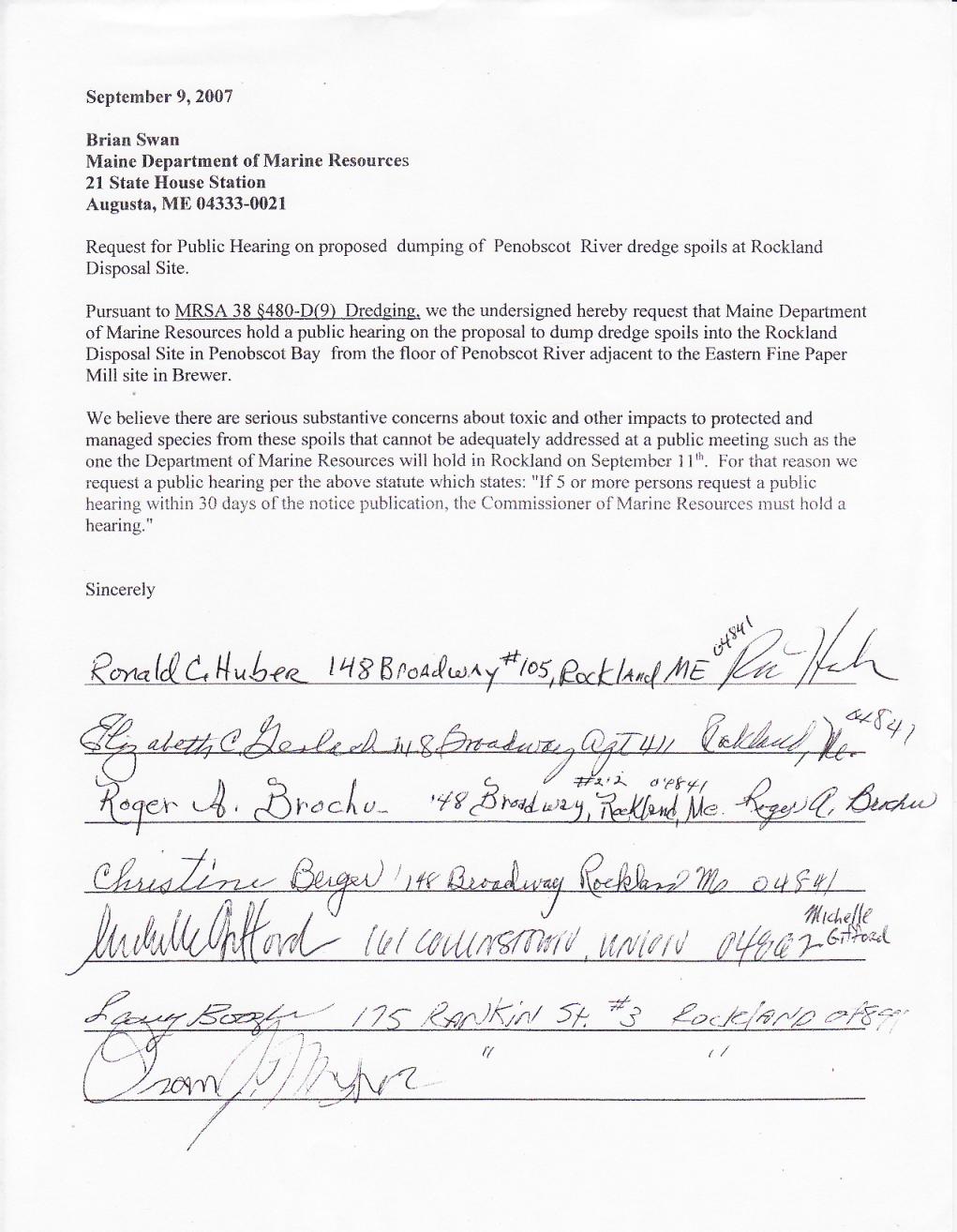
Two petitions were sent or given to DMR, one calling for a public hearing and one expressing the concern of dozens of bay area citizens who would be affected. DMR claimed that the public information meeting being held, was adequate ; I objected, citing the plain language of MRSA 38 480-D(9) Dredging. (scroll down to (9) the statutory chapter and verse.
The meeting was about 1 & 1/2 hours long. At the head tables, (speaking mostly in that annoying sotte voce used by midlevel officials at such interagency public meetings) were two DEPers: the permit reviewer and the DEP marine ecologist; in the middle: DMR's Brian Swan. On the other side sat the Cianbro representatives including Parker Hadlock, with experience in port building and renovation in Portland, who will be the project manager for the project, which will build by-request modular machines for global big industry. Army Corps of Engineers' Shawn Mahaney sat in the back of the audience, occasionally fielding RFI's from the state and industry reps up front.
An enviro/chem consultant for Cianbro sat quietly in the front row, saying little, and that little with awesomely developed pass-the-buck skill.
Maine Lobstermens' Association President Dave Cousens was in the second row with several lieutenants and a row or two of Vinalhaven lobstermen with families. Lobstermen pushed for schedule change to minimize interference iwth autumn fishery, questioned the toxicity information and opposed damaging their industry to better another one; Sierra Club's Vivian Newman questioned the jobs projections, (she came in about 45 minutes in.) The Lobster Conservancy voiced concerns over toxicity and the smothering of lobsters, the Lower Penobscot Watershed Association advised, the Island Institute rep spoke; Hannah Pingree gave a lengthy statement recapping the fishermens' concerns.
Posters on easels: an 1880s architect's drawing of a chlorine-using paper mill filling the same local footprint. It showed two docks operating back then: one for shipping materials and paper, one labeled "coal dock" (gotta be a lot of coal down there). A nav chart of Penobscot Bay with the east and west l shipping lanes highlighted, a chart tabulating of toxics findings of sediment cores.
The Pitch
Cianbrorep was enthused about re-using this old riverside industrial site in Brewer , providing good paying jobs non-polluting industy since it is only assembly of parts coming in, completed industrial modules going out. If approved, the facility's first project, that they have already been awarded the contract to build, will be sent to some facility near or in the Gulf of Mexico in October 2008. Although they wouldn't identify even potential clients, in general the operation will custom build large complete modular industrial plants of all types. These will then be barged to distant seaports whence they are taken to whatever Mordor-ian industrial facility awaits the instant industrial plant.
Confronted on the non-transparency of their process to date, agency faces were red. Clearly they would rather not have a further public hearing. Maine DEP's permit reviewer announced that the public comment period was over, but finally bent to some pressure to accept public comment to the end of the month.
Fishermen have been trying for years to have the bay dump site permanently closed.
A lobsterman said it was known to be a terrible location for a dump due to the vigorous currents that have sent the spoils spreading across the bay. Fifty years of dumping there and the bottom is still flat, he noted.
First dredging act will be removal of 'windrows of wood' on the river floor. Divers have examined it. Then about 1/2 of the total amount of mud and sand spoils that they would be licensed to discharge they are allowed to.
They may or may not use the train (RR tracks run past the site.)
Many more details, soon.
At a meeting sponsored by the Maine Department of Marine Resources
lobstermen and environmentalists challenged the proposal by Cianbro and an unnamed corporate partner to dredge mud and woody debris from Penobscot River bottom adjacent to the defunct Eastern Fine Paper site in Brewer , as part of setting up and operating an industrial module producing plan on the site. News coverage... more media coverage___even more media coverage
The Cianbro Company is partnered with unnamed investors to build and operate an industrial module assembly facility that would import parts from other states and nations, assemble them, then shipping out the completed "industrial modules" to be put together onsite . "Like erector sets" the company rep said.
Cianbro and its partners say they want to move quickly and be assembling these modules 12 months from now.
Fishermen and conservationists at the meeting lobbied hard for a total upland disposal option be substituted for bay dumping at the Rockland Disposal Site.
Two petitions were sent or given to DMR, one calling for a public hearing and one expressing the concern of dozens of bay area citizens who would be affected. DMR claimed that the public information meeting being held, was adequate ; I objected, citing the plain language of MRSA 38 480-D(9) Dredging. (scroll down to (9) the statutory chapter and verse.
The meeting was about 1 & 1/2 hours long. At the head tables, (speaking mostly in that annoying sotte voce used by midlevel officials at such interagency public meetings) were two DEPers: the permit reviewer and the DEP marine ecologist; in the middle: DMR's Brian Swan. On the other side sat the Cianbro representatives including Parker Hadlock, with experience in port building and renovation in Portland, who will be the project manager for the project, which will build by-request modular machines for global big industry. Army Corps of Engineers' Shawn Mahaney sat in the back of the audience, occasionally fielding RFI's from the state and industry reps up front.
An enviro/chem consultant for Cianbro sat quietly in the front row, saying little, and that little with awesomely developed pass-the-buck skill.
Maine Lobstermens' Association President Dave Cousens was in the second row with several lieutenants and a row or two of Vinalhaven lobstermen with families. Lobstermen pushed for schedule change to minimize interference iwth autumn fishery, questioned the toxicity information and opposed damaging their industry to better another one; Sierra Club's Vivian Newman questioned the jobs projections, (she came in about 45 minutes in.) The Lobster Conservancy voiced concerns over toxicity and the smothering of lobsters, the Lower Penobscot Watershed Association advised, the Island Institute rep spoke; Hannah Pingree gave a lengthy statement recapping the fishermens' concerns.
Posters on easels: an 1880s architect's drawing of a chlorine-using paper mill filling the same local footprint. It showed two docks operating back then: one for shipping materials and paper, one labeled "coal dock" (gotta be a lot of coal down there). A nav chart of Penobscot Bay with the east and west l shipping lanes highlighted, a chart tabulating of toxics findings of sediment cores.
The Pitch
Cianbrorep was enthused about re-using this old riverside industrial site in Brewer , providing good paying jobs non-polluting industy since it is only assembly of parts coming in, completed industrial modules going out. If approved, the facility's first project, that they have already been awarded the contract to build, will be sent to some facility near or in the Gulf of Mexico in October 2008. Although they wouldn't identify even potential clients, in general the operation will custom build large complete modular industrial plants of all types. These will then be barged to distant seaports whence they are taken to whatever Mordor-ian industrial facility awaits the instant industrial plant.
Confronted on the non-transparency of their process to date, agency faces were red. Clearly they would rather not have a further public hearing. Maine DEP's permit reviewer announced that the public comment period was over, but finally bent to some pressure to accept public comment to the end of the month.
Fishermen have been trying for years to have the bay dump site permanently closed.
A lobsterman said it was known to be a terrible location for a dump due to the vigorous currents that have sent the spoils spreading across the bay. Fifty years of dumping there and the bottom is still flat, he noted.
First dredging act will be removal of 'windrows of wood' on the river floor. Divers have examined it. Then about 1/2 of the total amount of mud and sand spoils that they would be licensed to discharge they are allowed to.
They may or may not use the train (RR tracks run past the site.)
Many more details, soon.
Sep 3, 2007
Paper company dredge spoils could end up off Rockland. Pub Mtg 9/11

Public Meeting on Plan to Dump Paper Mill Dredge Spoils off Rockland. September 11th,
On Tuesday, September 11, 2007, 6:30 - 8:00 p.m. Maine Department of Marine Resources will host a public meeting/listening session at the Rockland Middle School, to take comments on a proposal to dump dredge spoils from Penobscot River off the former Eastern Fine Paper mill site in Brewer Maine, into the Rockland Disposal Site. The meeting will take place in the cafeteria of the Rockland Middle School 30 Broadway, Rockland.
AT ISSUE: Eastern Fine Paper Mill discharged significant quantities of dioxin and other wastes into Penobscot River. The material being dredged for the benefit of a riverfront developer i contaminated. However, the US Army Corps of Engineers decides whether the level of contamination is low enough to permit dumping at the Rockland Disposal Site Army Corps of Engineers most recent review of the dumpsite (large pdf), which is located between North Haven and Rockland, 3 and 1/2 miles from the Rockland Breakwater Lighhouse
The meeting that Maine Department of Marine Resources is hosting IS NOT A PUBLIC HEARING. Rather officials from DMR and other agencies will sit silently at a table before the public, members of which will be invited to make statements. The officials will not answer any questions. See excerpt from public notice, below
However, MRSA 38 §480-D(9) Maine state law concerning dredging (scroll down to 9. Dredging) states:
"If 5 or more persons request a public hearing within 30 days of the notice publication, the Commissioner of Marine Resources must hold a hearing."
According to the DMR's Public Notice:
The purpose of the meeting is to gather information and comments from the public on a proposal by Penobscot River Holdings, LLC and Cianbro Construction, LLC of Pittsfield to dredge approximately 33,000 cubic yards of intertidal and subtidal sediments from the Penobscot River along the shore of the former Eastern Fine Paper Mill in Brewer.
Dredged materials suitable for open water disposal would be transported by barge for disposal at the Rockland Ocean Disposal Site located approximately 3.33 nautical miles east northeasterly of the Rockland Breakwater light. Dredged materials not suitable for open water disposal would be disposed of in an upland location.
For further information contact Brian Swan, DMR at 624-6573.
Subscribe to:
Posts (Atom)